
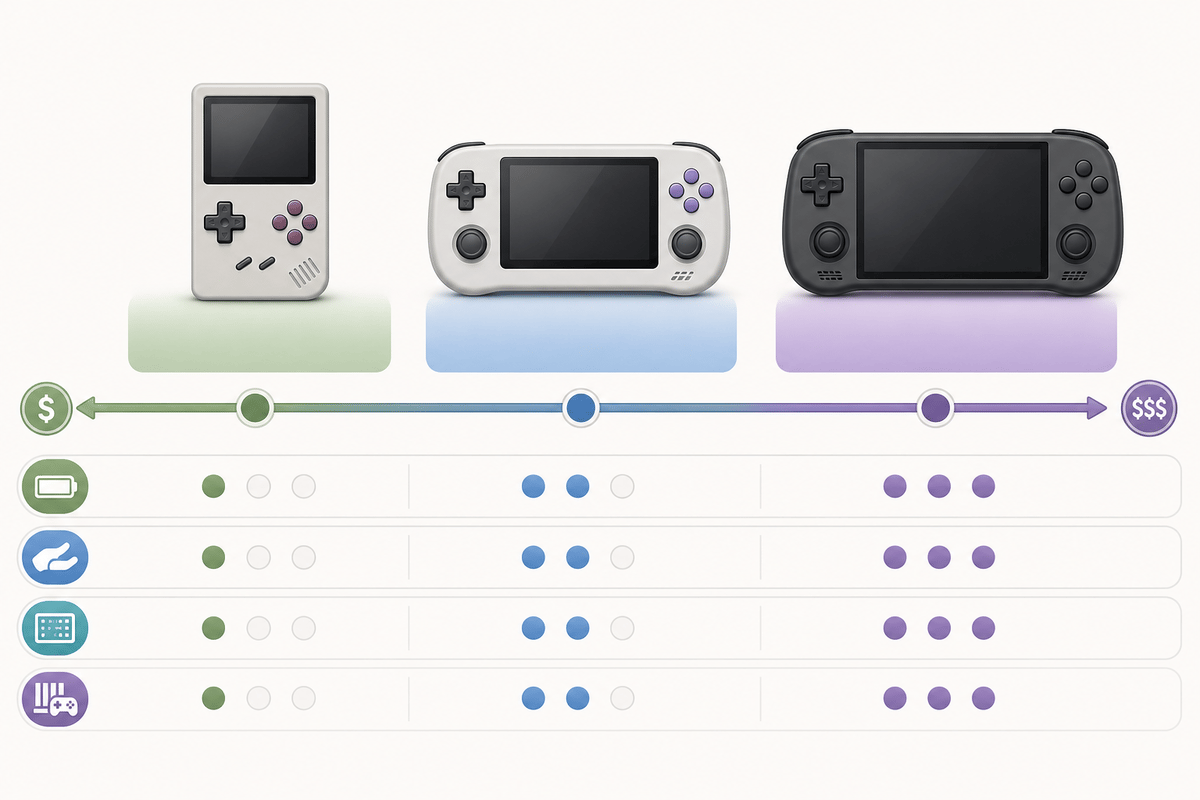
The best retro handhelds in 2026 divide cleanly by budget. Buy the Anbernic RG 35 below $50, the Anbernic RG SP around $100, the Anbernic RG556 around $200, and the Retroid Pocket 6 when performance matters more than keeping the budget tidy. Everything else on this list has a narrower reason to exist: a dual-screen layout, a particular screen shape, or stronger Android hardware.
This ranking values the things that matter after the unboxing glow wears off: a screen that suits older games, controls that fit the systems you want to emulate, battery capacity, software flexibility, and a price that makes sense for the chip inside. It also avoids the usual fantasy promise that every handheld runs every game from every console. Cheap Linux machines are excellent Game Boy, 8-bit, 16-bit, arcade, and PlayStation companions. Android hardware earns its higher asking price with heavier 3D libraries, widescreen options, and more demanding frontends.
For more hardware coverage, including current portable gaming news and buying guides, visit FinalBoss’s handhelds hub.
| Handheld | SoC | Screen | Battery | Price and date | Practical emulation target |
|---|---|---|---|---|---|
| Anbernic RG 35 | Rockchip RK3326 | 3.5-inch 640×480 IPS | 3,200mAh | $37.99, September 2, 2026 | 8-bit, 16-bit, arcade, PlayStation-era libraries |
| Anbernic RG SP | Allwinner H700 | 3.4-inch 720×480 IPS | 3,300mAh, up to 6 hours | $64.99, August 3, 2026 | Classic systems through PlayStation; selective low-end 3D |
| Anbernic RG556 | Unisoc T820 | 5.48-inch 1080×1920 AMOLED | 5,500mAh, up to 8 hours | $184.99, March 10, 2026 | Android retro through PlayStation 2 and GameCube-class use |
| Retroid Pocket 6 | Snapdragon 8 Gen 2 | 5.5-inch 1080p AMOLED | 6,000mAh | $244, June 12, 2026 | High-end Android emulation beyond PS2 and GameCube, game-dependent |
| Anbernic RG DS Plus | Rockchip RK3568 | Dual 4.3-inch 1024×768 IPS | Not specified | $85-$95, September 13, 2026 | Dual-screen-focused retro use; exact ceiling not specified |
| Anbernic RG 55G1 | Snapdragon G1 Gen 2 | 5.5-inch 1080p | Not specified | $139.99 sale price, August 31, 2026 | Midrange Android retro; exact ceiling not specified |
| Retroid Pocket Nova | Not specified | 4:3 display | Not specified | $274, June 25, 2026 | PS2-class target |
| Retroid Pocket Duo Lite | Not specified | Not specified | Not specified | $150, 2026 | Exact ceiling not specified |
| Retroid Pocket Duo | Qualcomm Dragonwing Q-7790 | Not specified | Not specified | $270, 2026 | Android 16 hardware; exact ceiling not specified |
| AYN Thor Base | Snapdragon 8 Gen 2 | Not specified | Not specified | $329, 2026 | High-end Android emulation; exact ceiling not specified |
Table of Contents (10)
1. Retroid Pocket 6
Buy this one for the performance-first budget. The Retroid Pocket 6 is the strongest all-purpose recommendation once the goal shifts from “play old games cheaply” to “stop negotiating with demanding emulators.” Its Snapdragon 8 Gen 2, 8GB of LPDDR5x RAM, active cooling, 5.5-inch 1080p AMOLED display, and 6,000mAh battery put it in a tier far above budget Linux handhelds.
The $244 price recorded on June 12, 2026 makes the “$300-plus” category more useful than it sounds: this is the device to buy when the budget allows for premium Android power, even if the listed price lands below $300. It has room for upscaled rendering, more ambitious Android games, and the heavier end of retro libraries. Compatibility still comes down to the emulator and the individual game, so avoid treating any Android handheld as a universal sixth-generation guarantee.
Its real advantage is longevity. A fast chip and active cooling give the Pocket 6 more breathing room than a cheaper handheld that is already operating at its limit.
2. Anbernic RG556
Buy this one around $200. At $184.99 on March 10, 2026, the RG556 is the sensible midrange answer for players who want Android flexibility without spending Pocket 6 money. The 5.48-inch 1080×1920 AMOLED screen is the headline feature: dark frontends look properly black, pixel art carries more contrast, and larger 3D games have enough space to breathe.
Under the shell sits a Unisoc T820, 8GB of LPDDR4X RAM, 128GB of UFS 2.2 storage, Android 13, and a 5,500mAh battery rated for up to eight hours. That spec sheet makes a practical case for PlayStation 2 and GameCube-class emulation, alongside the older systems that every machine here handles. The RG556 is not the device for buyers who only want Game Boy and Super Nintendo; its price makes little sense for that job. It is for players building one Android library across generations.
3. Anbernic RG SP
Buy this one under $100. The RG SP earns this placement because a good clamshell is more useful than another generic slab. Its folding shape protects the 3.4-inch 720×480 IPS screen in a bag, recalls the Game Boy Advance SP without becoming cosplay hardware, and makes the machine easy to keep around for short sessions.
The August 3, 2026 price was $64.99 for the base model, with a $57.99 early-buyer price during the first three days after its August 5 launch. Higher bundles reached $79.99 and $94.99 depending on the included microSD card. The Allwinner H700, 1GB of RAM, dual microSD slots, dual-band Wi-Fi, Bluetooth 4.2, and 3,300mAh battery give it a stronger feature set than its price implies. Anbernic rates battery life at up to six hours.
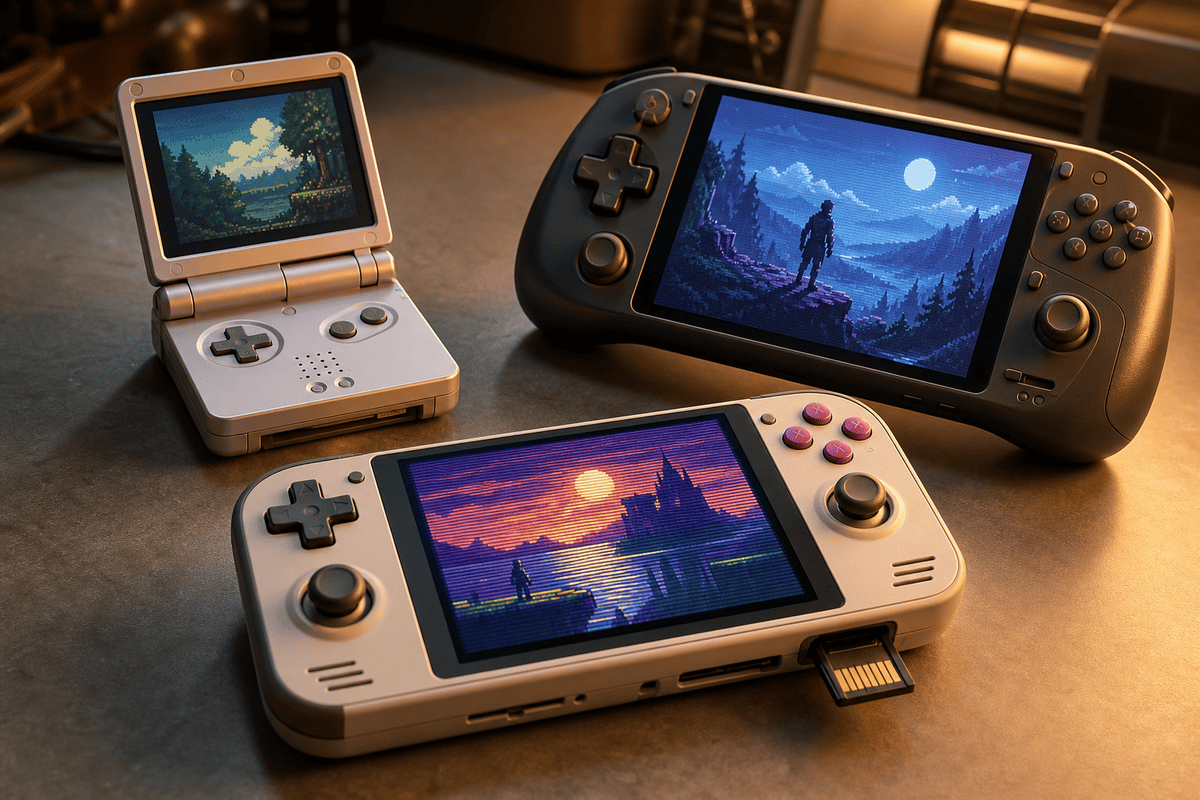
Keep its mission focused on classic libraries, PlayStation, and lighter 3D work. The RG SP’s appeal is portable comfort and a protected screen, not brute force.
4. Anbernic RG 35
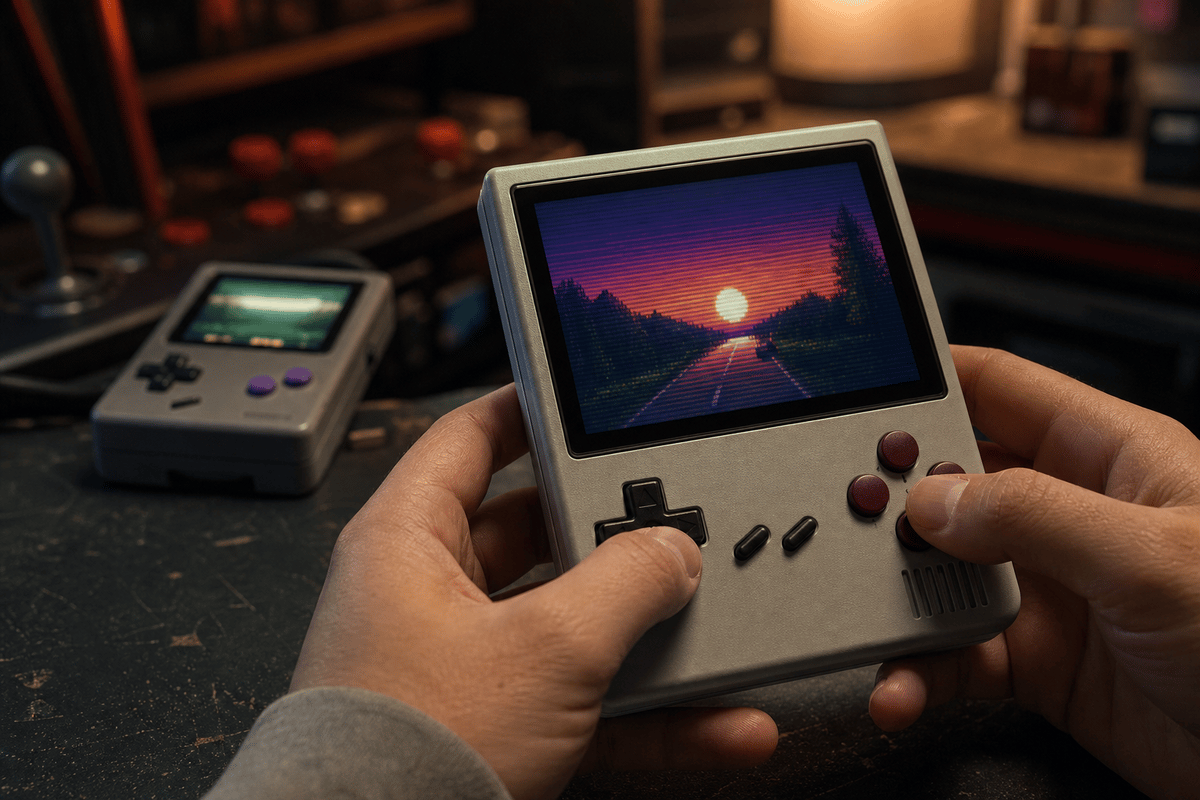
Buy this one below $50. The RG 35 costs $37.99 as of September 2, 2026, and that number changes the standards for an entry-level retro handheld. It has a 3.5-inch 640×480 IPS display, a Rockchip RK3326, 1GB of RAM, two microSD slots, a 3,200mAh battery, and dual analog sticks. At this price, those sticks are a welcome inclusion rather than a throwaway bullet point.
The 640×480 panel is also the correct kind of inexpensive screen. It matches the aspect ratios and visual language of Game Boy, Game Boy Color, Game Boy Advance, 8-bit, 16-bit, arcade, and PlayStation-era games far better than a stretched widescreen panel would. This is a small machine for an old-school library, not an underpowered substitute for a modern handheld PC.
Buy the RG 35 with realistic expectations, add a reliable microSD card, and use it as a dedicated classic-games machine. That is a cleaner recommendation than paying extra for power you will never use.
5. Anbernic RG DS Plus
The RG DS Plus is the most interesting specialist handheld in the lower-price half of this list. It launched in the $85-$95 range during September 2026, placing it close enough to the RG SP that choosing between them comes down to form factor rather than raw bargain hunting.
Its defining hardware is the pair of 4.3-inch 1024×768 IPS displays. That is a much more deliberate proposition than simply bolting a second screen onto a cheap device: dual displays matter for Nintendo DS-style play and any setup where menus, maps, or touch-oriented layouts benefit from staying visible. The Rockchip RK3568 and dual microSD slots, each supporting up to 2TB, make it a flexible storage platform as well.
Buy it for the two-screen experience. A conventional single-screen handheld remains the better fit for players whose library is mostly Game Boy, arcade, and PlayStation.
6. Anbernic RG 55G1
The RG 55G1 is Anbernic’s direct challenge to the notion that the RG556 owns the entire midrange. Its Snapdragon G1 Gen 2 processor, Android 14, Hall-effect controls, and 5.5-inch 1080p screen create a credible $150-class Android package. The 8GB RAM and 128GB storage model was priced at $164.99, while the range began at $139.99 and received a $139.99 sale price beginning August 31, 2026.
There is a meaningful choice here. The RG556 costs more, but its AMOLED screen, 5,500mAh battery, and established 8GB/128GB configuration make it the safer $200 recommendation. The RG 55G1 is for someone who specifically wants a lower entry price, Android 14, Hall controls, and a horizontal format closer to a compact modern portable.
Do not buy it solely because “Snapdragon” sounds decisive. Compare the exact configuration and sale price against the RG556 before checking out.
7. Retroid Pocket Nova
The Retroid Pocket Nova occupies the awkward but valuable space between affordable Android handhelds and premium performance models. A 12GB RAM and 128GB storage configuration was priced at $274 on June 25, 2026. That is expensive beside the RG556 and close enough to the Pocket 6 that it needs a more specific appeal.
That appeal is its 4:3 display. The older console libraries that dominate retro collections were largely built around squarer screens, and a 4:3 panel avoids the black-bar compromise or image stretching that comes with widescreen hardware. For PlayStation 2-era games and earlier libraries, screen shape can matter as much as headline resolution.
The Nova is the pick for players who care about a faithful 4:3 presentation and want premium memory capacity. Buyers chasing the most demanding Android performance should still step up to the Pocket 6.
8. Retroid Pocket Duo Lite
The Pocket Duo Lite costs $150 and exists for buyers who want the Duo concept without paying flagship money. Its major compromise is clear: it has half the RAM and storage of the $270 flagship Pocket Duo, which carries 8GB of RAM and 128GB of storage.
That makes the Lite a value proposition only when its specific layout is the priority. It sits directly in the crowded $150 range, where the RG 55G1 also competes with Android 14, Hall controls, and a 5.5-inch 1080p display. The cheaper Duo needs to win on how you intend to use it, not on an assumption that a lower price automatically means a better buy.
Choose the Lite when its dual-screen design is essential. Choose a conventional Android handheld when a single large display is the whole point.
9. Retroid Pocket Duo
The full Retroid Pocket Duo is the more substantial version of the dual-screen idea. It uses Qualcomm’s Dragonwing Q-7790 processor, runs Android 16, includes 8GB of RAM and 128GB of storage, and costs $270 before a $20 pre-order coupon. That places its effective launch price close to $250.
Android 16 gives it a more current software base than the Android 13 RG556 and Pocket 6. Still, its value depends on whether two screens solve a real problem in your library. For DS-focused play, multitasking layouts, and users who value the extra display as a functional part of the interface, the Duo has a distinct identity. For standard retro systems, the second panel adds cost and complexity that a good AMOLED slab avoids.
The Pocket Duo is a deliberate enthusiast purchase. It should never be the default recommendation for someone who simply wants the fastest handheld for the money.
10. AYN Thor Base
The AYN Thor Base is the high-end alternative for buyers willing to pay $329 for elevated dual-screen hardware. Its Snapdragon 8 Gen 2 puts it in the same processor class as the Retroid Pocket 6, while its price asks you to pay for the specialized format rather than for extra raw power.
There is also an AYN Thor Lite at $259, making the family relevant to shoppers cross-shopping the Retroid Pocket Duo and Anbernic RG DS Plus. The hierarchy is straightforward: the RG DS Plus is the lower-cost entry to dual-screen retro play, the Pocket Duo targets Android 16 at a lower flagship price, and the Thor Base is the premium option with Snapdragon 8 Gen 2 hardware.
For most people, the Pocket 6 remains the stronger high-performance buy because it costs less at $244. The Thor Base earns its spot only for players who place dual displays above simple value. Keep an eye on FinalBoss’s handhelds hub for future AYN, Retroid, Miyoo, Powkiddy, and TrimUI hardware updates.
FinalBoss // Gear
Level up your setup
01Retro consoleson Amazon→028BitDo controllerson Amazon→03Capture cards (Elgato & more)on Amazon→04Discounted game keyson Kinguin→Affiliate links · As an Amazon Associate, FinalBoss earns from qualifying purchases.
Want to Level Up Your Gaming?
Get access to exclusive strategies, hidden tips, and pro-level insights that we don't share publicly.
Ultimate Top Strategy Guide + Weekly Pro Tips