
Warhammer 40k and detective fiction shouldn’t work together as well as they do. The setting’s famous for chainswords, bolters, and shouting about heresy, not quietly combing a crime scene for clues. Yet that’s exactly where Warhammer 40k: Dark Heresy’s alpha build feels most confident: in letting an Inquisitor actually be a methodical investigator instead of just a glorified executioner.
This early slice of Owlcat Games’ next CRPG is only available if you’ve pre-ordered the pricey Developer Digital Pack or absurdly lavish Collector’s Edition, so most people won’t see it for a while. It covers roughly one extended early-game case, which shakes out to around eight hours of content if you’re thorough and curious, a bit less if you mainline objectives. It’s clearly labeled alpha, and it feels like one-but it’s also already doing enough interesting things that it’s hard not to start theorycrafting builds and daydreaming about the full game.
The short version: the investigation systems and writing already feel dangerously moreish, the Inquisitorial Journal is a killer idea straight out of the Disco Elysium school of design, and one Kroot mercenary in particular threatens to steal the entire show. The turn-based combat, though? Right now it’s the one thing keeping this from instant “shut up and take my Thrones” territory.
Table of Contents (6)
An Inquisitor Who Actually Has to Think
Dark Heresy is technically a spin-off from a miniatures game that’s about as subtle as an orbital bombardment. On the tabletop, it was all skirmishes and firefights. In this CRPG incarnation, the job of an Inquisitor finally leans into the “secret police detective” fantasy: your remit is to identify, understand, and then eradicate heresy, in that order.
The alpha drops you into one of the opening investigations, with a pre-set cast and a choice between two “world states” that slightly reframe the context of events. You’re still on rails as far as the big plot beats go, but the moment-to-moment flow already has that flexible, “I could have handled this three different ways” energy. You move around fairly contained environments-streets, interiors, industrial spaces-talking to witnesses, interrogating suspects, examining background details, and slowly building an understanding of what’s actually going on.
Dialogue is where Dark Heresy starts showing its teeth. There’s that Owlcat familiarity if you’ve played Rogue Trader: lots of stats, lots of skill checks, lots of different ways to bully, persuade, or outthink people. But here the stakes feel less like “pick the right DC or miss some loot” and more like “if you phrase this wrong, this whole situation will explode into a firefight you didn’t want.” The alpha already contains several branches where a successful check lets you walk away without drawing a weapon at all, which feels refreshing in a genre that usually treats talking as foreplay before the shooting starts.
That emphasis on pre-combat problem solving fits the fiction. An Inquisitor who just kicks in every door is a blunt instrument; this build pushes you to act more like the Emperor’s very nosy, very dangerous accountant: check the ledgers, find the discrepancies, then decide who gets vaporized. When an interrogation goes well and a tense standoff fizzles into information instead of violence, it feels more satisfying than any lucky crit.
The Inquisitorial Journal: Disco Elysium in a Rosarius Field
The most obvious—and honestly, most exciting—connection to Disco Elysium is the new text flow. Instead of the usual CRPG log tucked away in a horizontal bar at the bottom of the screen, Dark Heresy shifts the action text and dialogue feed to a vertical pane along the right-hand side. That might sound like a tiny UI tweak, but it dramatically changes how you read the game.
Conversations and observations stack up into a running column you can scroll back through, so even if you click through a line too quickly or get distracted mid-dialogue, it’s easy to reconstruct exactly what was said and what checks succeeded or failed. While the writing doesn’t go for quite the same baroque, drunken-poet style as ZA/UM’s masterpiece, there’s still a deliberate rhythm to the way key details pop in that pane. Ambient lines, suspicious mutterings, the sharp crack of a successful skill check—they all live in that vertical feed, and it keeps your brain in “read and connect clues” mode.
Those clues all feed into the Inquisitorial Journal, which is the star of the alpha. Mechanically, it’s a living case file: every scrap of relevant information, from throwaway comments to physical evidence, is collated into a tidy set of entries you can reference at any time. It’s not just a lore codex; it’s a practical tool. When you’re about to confront a suspect, cracking the Journal open to remind yourself exactly what that dockworker said an hour ago can meaningfully change which dialogue options make sense.
This creates a nice feedback loop. You poke around the environment because you know almost everything has a chance of ending up as a Journal entry. The Journal then reframes how you think about later scenes, which in turn nudges you to look harder for inconsistencies and contradictions, which generates more Journal entries. It’s the same basic detective high that Disco Elysium weaponized, just filtered through the Inquisition’s paranoid bureaucracy.
Importantly, the game isn’t constantly slapping a giant quest marker on “the right” clue. You’re often choosing what to push on, what to ignore, and how aggressively to interpret the data you’ve collected. That room for interpretation is where Dark Heresy feels most like it’s onto something special.
Ra’ahkti the Kroot: Dark Heresy’s Answer to Kim Kitsuragi
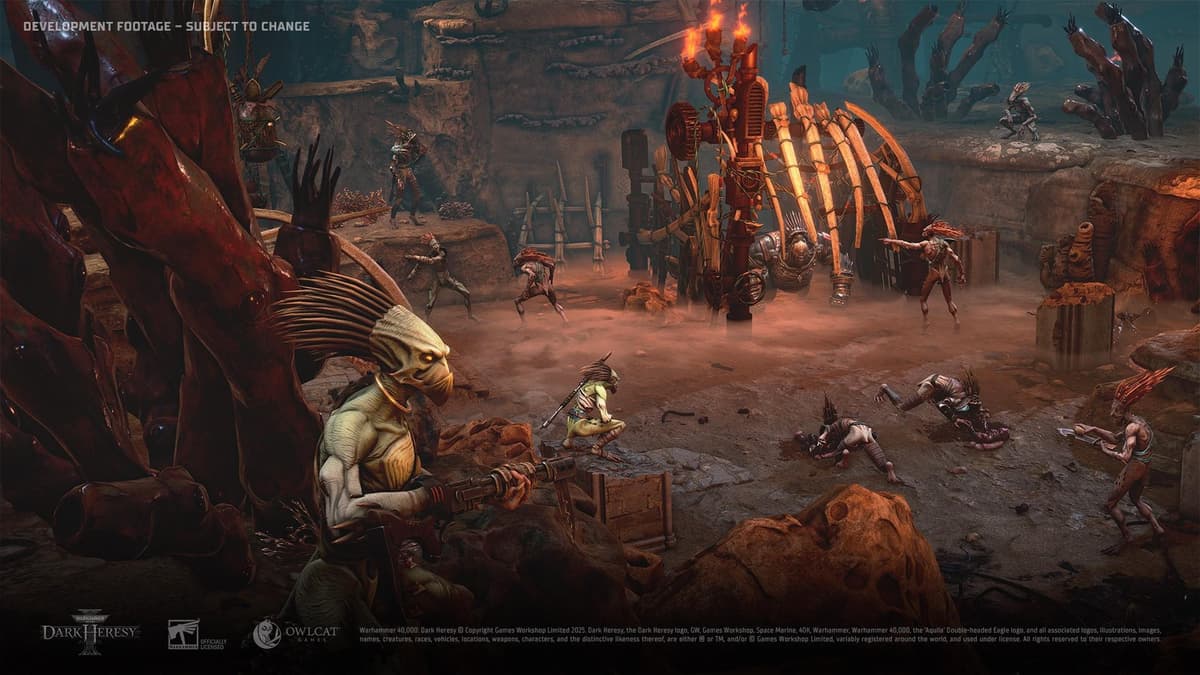
Companions were one of the highlights of Rogue Trader, so it’s no shock that the alpha already hints at another strong cast. The standout, without question, is Ra’ahkti, a Kroot companion who’s basically a living rebuttal to anyone who says 40k can’t do nuance.
On paper, she’s a mercenary xenos with a very casual relationship to cannibalistic evolution and Imperial law. In practice, she’s written with a mix of dry practicality, alien worldview, and surprisingly grounded warmth that makes her feel like the closest thing Dark Heresy has to a moral anchor. Not because she’s a paragon of virtue—she absolutely is not—but because she actually thinks about consequences past “purge it with fire.”
The comparison that keeps coming up is Kim Kitsuragi from Disco Elysium, and it fits. Ra’ahkti doesn’t mirror Kim’s cop-on-the-edge-of-resignation energy, but she fills a similar role: the steady presence at your side, quietly judging your choices, occasionally stepping in with a brutally efficient solution when you’re about to fly off the handle. When she cuts through the pompous rhetoric of some puffed-up Imperial functionary with one calm, precisely barbed comment, it lands with the same kind of “thank the God-Emperor someone here is an adult” relief.
The rest of the party in this slice is solid but not as instantly memorable, in part because the alpha doesn’t spend much time letting you dig into their backstories yet. Ra’ahkti, by contrast, already feels like she has layers—cultural pride, professional curiosity about human hypocrisy, and a hint of personal vulnerability under all that sinew and predatory bravado. With Owlcat openly teasing “kinky stuff” in marketing, it’s hard not to assume she’ll be romancable, which is either extremely heretical or exactly what Slaanesh would want, depending on your theology.
If the rest of the companion roster in the full game can hit even half this level of personality, Dark Heresy’s party banter is going to be dangerous for people who already spent way too long exhausting every dialogue option in Rogue Trader.
Combat: The One System That Still Feels Heretical (In a Bad Way)
All of that investigative goodness makes it sting harder that the part of Dark Heresy that feels the rustiest right now is the one thing most 40k games hang their hat on: combat. Owlcat is clearly tinkering with its established formula rather than ripping it up entirely, but the current incarnation in this alpha doesn’t quite come together.
Fights are still turn-based, squad-focused affairs. You have action points, cover, a range of weapon types, and abilities tied to your build and companions. The big mechanical shift is how armor works. Instead of being a simple flat reduction or a minor extra stat to track, armor behaves almost like a second health bar, very reminiscent of how Divinity: Original Sin 2 handled physical and magical armor. In theory, this should add an extra tactical layer: strip armor first, then go for the kill.
In practice, at least in the alpha, it mostly makes enemies feel spongy. You chew through the armor bar, then chew through the health bar, and since many attacks don’t have the kind of punchy feedback you’d expect from bolters and power weapons, there’s a slight “hitting cardboard cutouts” vibe. On top of that, line-of-sight and cover sometimes behave in unintuitive ways. Shots that look like they should be clear get flagged as blocked, while half-obscured angles somehow count as 80% to hit.
None of this is unfixable—it’s exactly the sort of jank an alpha is supposed to expose—but it does mean that every time an investigation tips into open fighting, the pacing stutters. The arenas themselves often feel just a hair too cramped or oddly laid out, magnifying the sense that you’re wrestling the rules rather than outsmarting the enemy. When a carefully set up engagement gets derailed because an ability can’t be used from what looks like perfectly valid cover, it’s less “XCOM heartbreak” and more “early access bug report.”
The saving grace is that the game doesn’t force you into combat as often as you might expect. With solid dialogue skills and a bit of foresight, a lot of potential firefights can be defused or redirected. That’s a fascinating inversion for 40k: instead of being rewarded for optimizing your DPS per turn, you’re rewarded for doing your job as an Inquisitor so well that you never have to draw your gun in the first place.
Of course, this is still the 41st millennium, and there are Night Lords lurking somewhere in the wings. It’s extremely unlikely the full game will allow a true “zero kills” pacifist run; some horrors have to be purged the old-fashioned way. But if Owlcat can bring the combat up to the same standard as the investigations, Dark Heresy has a real shot at being something special rather than just “Rogue Trader, but moodier.”
Grimdark Vibes, Solid Tech, and a Very Busy Owlcat
Owlcat is stretching itself right now. The studio’s still supporting Rogue Trader with DLC, has announced a Mass Effect-style RPG based on The Expanse, and has spun up its own publishing arm that’s putting out mystery titles like Rue Valley (with Disco Elysium’s Robert Kurvitz involved). Dark Heresy could easily have felt like a side project, a cheap excuse to reuse art assets and core systems from Rogue Trader.
The alpha doesn’t give that impression. It absolutely shares some DNA—UI stylings, certain animations, a general “Owlcat CRPG” look—but the overall presentation leans harder into detective thriller than swashbuckling void opera. Environments are properly oppressive: heavy gothic silhouettes, sickly lighting, shrines and skulls everywhere. It’s not the most technically dazzling 40k game out there, but it sells atmosphere in a way that suits the premise. You’re not a Rogue Trader flexing wealth out among the stars; you’re the thing people pray never shows up on their planet.
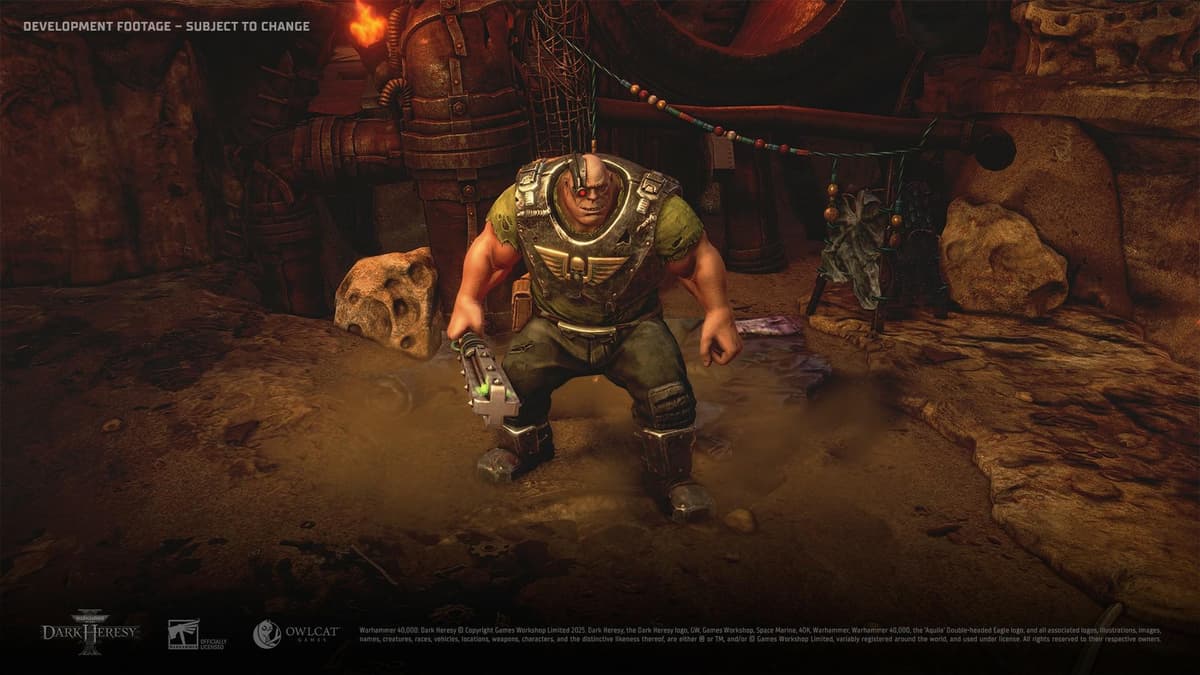
On the technical side, the alpha is surprisingly stable. Visual bugs and rough edges are there if you go hunting for them, but the core experience isn’t drowning in crashes or obviously broken quest logic. Performance feels in line with Rogue Trader’s more recent patches: not cutting edge, but very playable, with only occasional hitches when loading into new areas or kicking off a major scene. The one notable UX change—the text pane shifting to the right—takes about ten minutes to get used to and then feels so natural that going back to the old style in other RPGs is going to be weird.
Should You Buy Into the Alpha Now?
Here’s the awkward part: to get access to this alpha right now, you need to put down serious money. The Developer Digital Pack clocks in around $79 / ~£59, and the Collector’s Edition—with that admittedly gorgeous Kroot statue that will absolutely tempt a certain type of fan—is a wallet-annihilating $289 / ~£217. This isn’t a “throw $30 at early access and see how it grows” situation.
The alpha itself, while promising, is still clearly a work in progress. If what you want is a polished, complete CRPG to sink 100 hours into, this isn’t that yet. The combat needs tuning, balance is in flux, and there are bound to be systems and narrative branches not represented at all in this initial slice.
On the other hand, if you’re the kind of player who adored Rogue Trader, misses the heady days of living inside Disco Elysium’s detective brain, and gets excited about being in the weeds with a game as it’s still finding itself, Dark Heresy’s alpha is already rich enough to justify curiosity—if not necessarily that collector’s-tier buy-in. It’s less a demo and more a statement of intent: “Yes, we really are making a 40k game where talking, thinking, and note-taking matter as much as firing a bolter.”
FinalBoss // Gear
Level up your setup
01Top-rated gaming headsetson Amazon→02High-refresh gaming monitorson Amazon→03Gaming chairson Amazon→04Discounted game keyson Kinguin→Affiliate links · As an Amazon Associate, FinalBoss earns from qualifying purchases.
Want to Level Up Your Gaming?
Get access to exclusive strategies, hidden tips, and pro-level insights that we don't share publicly.
Ultimate Reviews Strategy Guide + Weekly Pro Tips