

12 Best Mobile Detective and Mystery Games for Android and iOS
The best mobile detective games split cleanly by what you want to solve. Android has strong story-first cases, including MazM’s Jekyll & Hyde, while iOS covers everything from a real-time train murder to social deduction. These 12 picks prioritise a distinct investigation hook over generic crime-scene tapping: letters, testimony, audio, hidden objects, courtroom contradictions, and suspicious friends.
Entries 1-6 are Android picks; entries 7-12 are iOS picks. The order weighs how well each game turns its particular mystery format into something worth carrying in your pocket.
1. Jekyll & Hyde | Mystery Story
Android — Best for gothic, story-first detective work. MazM’s Jekyll & Hyde | Mystery Story is the pick for players who would rather read a troubling letter and chase its implications through London than burn through a stack of matching puzzles. It frames its investigation as a gothic visual novel, built around following clues and piecing together a literary mystery.
The game’s Android listing was updated on 14 August 2026 and shows more than 10 million downloads, alongside a 4.0 rating from 67.9K reviews. It carries a Teen rating for violence and blood, plus digital purchases. Go in for atmosphere and narrative investigation; this is a drama with detective elements, not a hard-nosed procedural.
2. Evidence 111
Android — Best for headphones-on investigation. Evidence 111 understands that a voice can be more suspicious than a fingerprint. Its cursed-hotel case leans heavily on audio, asking players to listen closely as blackmail, threats, and the shape of the wider conspiracy emerge.
That makes it the best change of pace from tap-heavy mobile mysteries. There is no room for half-listening while a podcast plays in the background: the performance and sound design are the evidence. Save this one for a commute or a dark room, ideally with decent headphones.
3. The Vigil Files: Case 1

Android — Best for a case that follows you beyond the app. The Vigil Files: Case 1 sends players to real websites for clues, a smart trick that makes the investigation feel less contained than a typical dialogue tree. Its characters also respond at different real-time intervals, including during the night.
That live-case structure will either be catnip or a scheduling nuisance, depending on how much patience you have for waiting. For players who enjoy the fiction of checking in on an active investigation rather than clearing a chapter in one sitting, it is the most immersive option here.
4. Detective Story: Jack’s Case

Android — Best for a traditional private-eye setup. A strange package arriving at the detective agency is exactly the kind of old-school hook that Detective Story: Jack’s Case needs. From there, the game builds its mystery around the aftermath of that delivery rather than wasting time on a long origin story.
This is the pick for players who want the familiar rhythm of an agency case: an unsettling object, a reason to investigate, and a thread that keeps unspooling. It has a more direct crime-story flavour than Jekyll & Hyde’s literary gloom.
5. Detective Games: Criminal Case
Android — Best for hidden-object crime scenes. Detective Games: Criminal Case turns detective work into visual scavenging, including the undignified but necessary task of searching through trash for clues. That is very much the point: every scene is a crowded puzzle box where the tiniest object can advance the case.
The caveat is the energy wall. Scenes consume energy, and the supply replenishes each day, so this is designed for shorter sessions rather than an all-night investigation binge. Players who find that structure irritating should skip it; hidden-object fans who like a daily case routine will get more mileage from it.
6. CLUEDO

Android — Best for deduction with a clear rulebook. CLUEDO remains satisfying because its murder mystery has a properly defined finish line: identify the weapon, the modus operandi, and the location. Moving through the mansion is more than board-game ceremony; each room can narrow the field.
It is a cleaner, more competitive form of detective play than a sprawling visual novel. The fun comes from making a deduction before somebody else reaches the same conclusion, then realising one overlooked detail has wrecked the whole theory.
FinalBoss // Gear
Level up your setup
01Mobile gaming controllerson Amazon→02Top-rated gaming headsetson Amazon→038BitDo controllerson Amazon→Affiliate links · As an Amazon Associate, FinalBoss earns from qualifying purchases.
Want to Level Up Your Gaming?
Get access to exclusive strategies, hidden tips, and pro-level insights that we don't share publicly.
Ultimate Top Strategy Guide + Weekly Pro Tips
7. Cognition: Episode One
iOS — Best for supernatural point-and-click cases. Cognition: Episode One earns its place through its supernatural-case premise and classic point-and-click structure. It gives investigation a stranger edge than the usual police procedural, with the mystery carrying as much weight as the item interaction.
This is the iOS recommendation for players who miss adventure games that let a case breathe. Expect an investigative story with eerie pressure rather than a brisk sequence of score-chasing mini-games.
8. The Last Express

iOS — Best for one of mobile gaming’s great train murders. Created by the mind behind Prince of Persia, The Last Express places a murder mystery aboard an Edwardian train and lets its passengers move, talk, and react in real time. The case does not wait politely for the player to inspect every compartment.
That real-time structure is why it still feels special. Miss a conversation, choose the wrong moment to intervene, or follow the wrong lead and the train keeps rolling. It is demanding, occasionally merciless, and far more alive than most mobile mysteries.
9. Layton Brothers: Mystery Room

iOS — Best for logic-led case solving. Layton Brothers: Mystery Room puts deduction at the centre of its cases. The appeal is less about rummaging through every pixel of a crime scene and more about working through evidence, contradictions, and the logic connecting them.
Its pacing suits short mobile sessions particularly well: examine the facts, advance a line of reasoning, then put the device down before the next revelation. Players who want puzzles with a proper detective wrapper should start here.
10. Among Us

iOS — Best for accusing friends with flimsy evidence. Among Us turns every round into a social investigation. Impostors try to eliminate Crewmates without being exposed; everyone else watches movement, behaviour, timing, and each other’s increasingly desperate explanations before voting.
There is no authored culprit to outsmart here. The mystery is the people in the match, and the best evidence often comes from spotting a story that does not line up with where somebody was 20 seconds earlier. It is detective work at its loudest and least dignified.
11. Mystery Manor

iOS — Best for players who enjoy hunting every last object. Mystery Manor is the hidden-object specialist in this selection. Its investigations are built around searching dense scenes, catching visual details under pressure, and gradually opening up the next piece of the manor’s larger mystery.
It works best for players who find relaxation in methodical scanning rather than deduction trees. The mystery provides the excuse; the real pleasure is locating the absurdly well-hidden item that was sitting in plain sight the entire time.
12. Apollo Justice: Ace Attorney
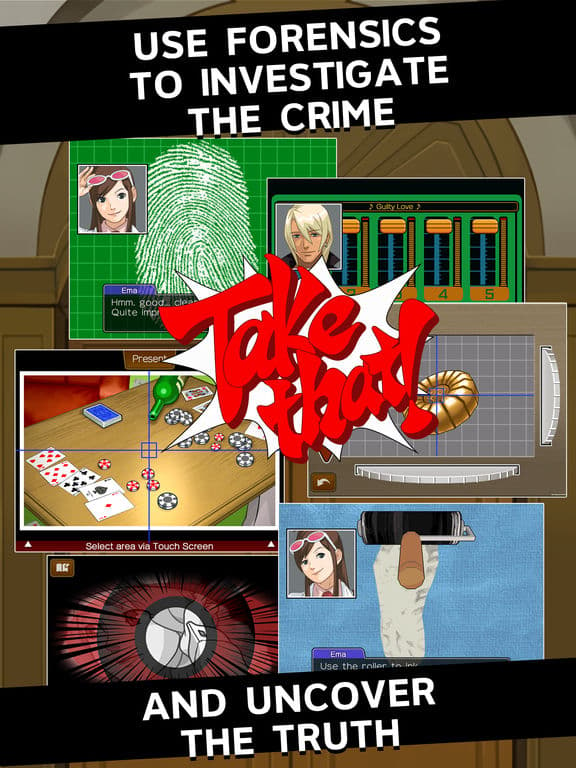
iOS — Best for players who want to prosecute the mystery. Apollo Justice: Ace Attorney combines investigation with courtroom argument, so every clue has to survive more than a simple inventory check. Finding evidence is only half the battle; the other half is exposing testimony that collapses under scrutiny.
That split gives it a sharper sense of payoff than many case-file games. A strange detail discovered during investigation can become the exact tool that corners a witness later, making each contradiction feel earned instead of handed over by the script.