
Table of Contents (12)
From “this isn’t for me” to “one more raid”: my first days with Marathon
When Bungie announced Marathon as an extraction shooter, I mentally filed it under “cool trailer, not my thing.” I loved Halo, I poured far too many hours into Destiny, but I’ve always bounced off hardcore extraction stuff like Escape from Tarkov. Losing your gear on death? Full PvP focus? My stress levels said no, thanks.
Then Marathon finally landed on March 5th for PS5, Xbox Series X|S and PC, and curiosity (and the Bungie logo) got the better of me. Thirty-something hours later, I’ve died more times than I care to count, lost gear that took me nights to assemble… and I keep queuing up for “just one more run.”
This is a review in progress, because Bungie is about to drop a new endgame map called Cryo Archive in mid-March, and that could seriously shake up the late game. But even without that, there’s already enough here to see what kind of beast Marathon is: a vicious, stylish, intoxicating loop that lives and dies on Bungie’s unmatched gunfeel.
What Marathon actually is (and why the lore quietly rules)
Marathon takes place 99 years after the events of the original 90s games. You’re a “Runner,” someone who has ditched their human body to project their consciousness into biosynthetic shells called Frames. Corporations basically own your immortality. If that sounds a bit cyberpunk and a bit depressing, that’s because it is.
Every raid drops you onto Tau Ceti IV, the planet where humanity’s flagship colony ship – the Marathon – vanished. Your job is to dive into hostile zones, vacuum up data and resources, complete contracts for powerful factions, and then extract alive. Die on the way out and everything you’re carrying in your inventory is gone. Not “damaged,” not “taxed.” Gone.
The story doesn’t get in your face. There’s no traditional campaign, no cutscene parade. It’s mostly delivered through faction contacts talking to you between raids, environmental details, and lore entries you unlock for doing specific things – finishing a contract line, using a certain Frame, reaching deeper areas of the maps. It’s very Bungie in that way: if you want to ignore it and just min-max your build, you absolutely can… but if you like picking at the edges of a universe, there’s a surprisingly rich, melancholic sci-fi setting here.
I went in expecting barebones narrative scaffolding and ended up reading flavor text between runs and googling the old Marathon trilogy. That’s not easy to pull off in a PvP-first extraction game.
How a run works: 25 minutes of tension, greed and improvisation
At its core, Marathon is a loop you’ll either click with or bounce off hard. Every match (or “dive”) gives you a 25-minute window on a large, multi-layered map. You can spawn solo, with a premade squad, or with random teammates. Once you’re down there, a few things are always true:
- You’re hunting for loot: weapons, armor, resources, implants, quest items.
- You’re trying to complete contracts for factions, which ask you to visit specific points, interact with terminals or secure particular items.
- You need to reach an extraction point and survive the evac sequence to bank everything you’re carrying.
What surprised me is how sharply the tone swings inside a single match. I had runs where the first 10 minutes were eerily quiet – just me and my squad creeping through abandoned corridors, opening lockers, nervously joking on voice chat – and then everything exploded because another team decided to third-party our contract objective.
The risk-reward balance is deliciously cruel. You can extract early with mediocre loot and play it safe, or you can push deeper, hit more contracts, and become walking piñatas full of ultra-valuable gear that everyone on the map wants to crack open. More than once I’ve gotten greedy, decided “one more building,” and watched the whole raid collapse in thirty seconds of total chaos.
That’s where the roguelike energy kicks in. Even after a brutal wipe where I lost my favorite rifle and a near-finished contract objective, my brain immediately flipped to, “Okay, next run, we drop on the other side of the map and try a different route.” The loss stings, but it doesn’t feel pointless – it actually made the next extraction succeed feel like a mini-raid victory.
Frames: Bungie’s answer to “classes” (and why Rook gave me horror-game anxiety)
Instead of traditional classes, Marathon gives you seven Frames, each with its own stats and abilities: some favor raw aggression, others speed and scouting, others information control or stealth. Swapping Frames really does change the rhythm of a run.
As someone who’s decent at aim but terrible at ego-challenging every fight, I gravitated early towards supportive play. The Triaje Frame – essentially the medic archetype – became my comfort pick: stabilizing teammates, keeping us topped up, and making risky revives that turn hopeless fights around. It’s that same high you get from dropping a clutch Well of Radiance in Destiny, just with way more on the line if you fail.
Then there’s Rook, the solo-oriented Frame, and that thing changes the entire flavor of the game. When you queue as Rook, you’re locked into going alone. No teammates to watch your angles, no one to pick you up. Bungie cranks the atmosphere: every footstep echoes just a bit louder, every creak in the distance could be another Runner or an UESC patrol.
One Rook run in particular is burned into my memory. I’d finally scraped together a decent kit after a rough night – solid mid-range rifle, good armor, some rare consumables. I decided to try a quiet infil, hugging the edges of the map. Fifteen minutes of pure tension later, I was one room away from extraction, heart absolutely pounding, when I heard faint metallic footsteps above me. I froze. UESC robot? Another solo Runner? A trio?
I killed my flashlight, crept into a dark corner and just listened. The sound got closer, then stopped. For a full thirty seconds, nothing. I finally peeked, saw nothing… and got instantly deleted by a bot I hadn’t spotted on the catwalk. Watching that entire kit vaporize was like a jump scare. Marathon is not a horror game, but Rook comes close.
The key point: no Frame feels useless. Whether you like flanking and diving fights, sitting back and scouting, playing bait, or being the team’s lifeline, there’s a shell that supports that fantasy. More importantly, they seem genuinely well balanced right now. I’ve never loaded into a lobby and thought, “Oh great, we’re all playing the same busted Frame.”
Maps that force different playstyles – and a looming endgame dungeon
At launch, Marathon has three main maps, with a fourth – Cryo Archive – teased for mid-March as a sort of endgame destination. On paper that doesn’t sound like a lot, but the existing trio are dense, multi-route spaces that have taken me dozens of raids to really learn.
The Perimeter is the classic starting ground: sprawling industrial sprawl, vertical sightlines everywhere, a mix of open yards and cramped interiors. It’s where I learned the hard way to stop sprinting blindly around corners. Every building here feels like it hides at least three flanking routes, which makes it fantastic for squads who know how to pinch and collapse on gunfire.
The Swamp (the name everyone uses, even if your menu calls it something fancier) is sniper heaven and shotgun hell. Open bogs, pockets of mist, long causeways between structures. Crossing open ground feels like playing roulette: you scan every ridge, every window, convinced a scoped Frame is tracking your skull. I both hate and love this map; it’s where I had my first proper long-range duel, a two-minute exchange of suppressed shots and repositioning that felt like tactical chess.
Then there’s the Outpost, which is just pure chaos in the best way. Environmental hazards periodically force everyone to hunker down inside, turning certain buildings into pressure cookers. I’ve had some of my nastiest close-quarters fights here, clearing room by room, listening for muffled footsteps above the storm outside. It’s exhausting… and incredibly replayable.
Cryo Archive is being positioned as a higher-stakes, endgame-style activity. Bungie has been coy on specifics, but everything about the marketing whispers “raid-like” – deeper objectives, maybe a boss encounter, certainly higher-value loot. That’s a big part of why I’m holding back a final score: if Cryo Archive lands, it could transform Marathon from “great core loop” to “I live here now.” If it whiffs, the late game might feel thinner than it should.
Contracts, factions and the meta-game grind
Outside individual raids, your long-term goals revolve around factions, contracts and your growing stash. There are six factions vying for control, each with its own flavor, rewards and contract lines. You pick who to work for, complete priority contracts to unlock new lore chunks, Frames options, guns, implants, and cosmetic bits.
The contracts themselves are rarely exciting on paper: go here, interact with this terminal, collect X of item Y, extract with it. What’s clever is how they’re used as player magnets. Those glowing objective icons basically scream to every Runner: “hotspot here.” So even a boring-sounding “download some data” contract often turns into a three-way shootout, or a tense standoff where you can hear another squad working the same objective in the next room.

Meta progression has two sides. On one hand, it’s satisfying to slowly expand your secure stash, unlock stronger gear, and specialize your loadouts with implants that subtly tweak your playstyle. On the other, the game doesn’t hold your hand at all. The menus are dense, the terminology is new, and Marathon expects you to spend real time reading tooltips and poking around submenus to fully understand what you’re slotting where.
Early on, it honestly felt like information overload. Between the stash, inventory, deposit, crafting components and faction currencies, I spent as long in menus as I did on the ground. After a dozen hours it clicked – the UI is actually more logical than it first appears – but I’d be lying if I said the learning curve isn’t steep, especially for players new to extraction games.
Early on, it honestly felt like information overload. Between the stash, inventory, deposit, crafting components and faction currencies, I spent as long in menus as I did on the ground. After a dozen hours it clicked – the UI is actually more logical than it first appears – but I’d be lying if I said the learning curve isn’t steep, especially for players new to extraction games.
🎮 Get This Game at the Best Price
Compare prices instantly and save up to 80% on Steam keys with Kinguin — trusted by 15+ million gamers worldwide.
*Affiliate link — supports our independent coverage at no extra cost to you
For the record, microtransactions are here, but so far they’ve been purely cosmetic. Think Frames skins, paint jobs, that sort of thing. I never felt pressured to spend, and the actual power progression is strongly tied to playing well and extracting, not swiping a card. That could always change with future seasons, but right now, it’s tolerable.
Difficulty: Marathon wants you dead, repeatedly
Let’s be blunt: Marathon is brutally hard, especially in the first 10–15 hours. You will die. A lot. Sometimes to other Runners who seem to have god-tier aim and map knowledge. Sometimes to UESC robots with AI smart enough that I’ve genuinely mistaken them for human players. And sometimes to dumb stuff like overextending, fall damage, or not noticing the angry turret in the corner.
The bots deserve special mention. They flank, they suppress, they coordinate in ways that feel alarmingly human. I’ve watched them use cover intelligently and slowly box my squad into a crossfire. At first I assumed we’d been ambushed by another team; only on the death screen did I realise it was “just” robots. Whatever dark magic Bungie is using for their AI here, it works.
There are no difficulty sliders, no PvE-only safe mode. The only way Marathon gets “easier” is:
- you learn the maps,
- you learn sound cues and sightlines,
- you build better gear,
- you find regular teammates you sync with, or
- the matchmaking gifts you two demigods with controllers.
Losing your loot on death never stops hurting, but it does start feeling fairer as your knowledge grows. The first night, I genuinely wondered if the game was for me; a string of wipeouts where we didn’t even make it halfway to extraction had me alt-tabbing to watch streams and see what I was missing. By hour 20, those same situations turned into “okay, we over-peeked that angle, next time we rotate through the lower level.”
The best compliment I can give the difficulty is this: it creates stories. You remember the raids where everything went wrong, where you extracted with 10 seconds on the clock, where your medic crawled through fire to res you, where you survived on 5 HP against a full squad. The punishment fuels the high. If you hate that dynamic on principle, you’ll hate Marathon. If you secretly crave it, this game will get its hooks into you.
That Bungie gunfeel still hits different
All of this would fall apart if the shooting wasn’t exceptional. Thankfully, this is Bungie. The gunplay is the reason Marathon works at all.
Weapons kick and snap in a way that’s instantly readable. Headshots feel crisp. Recoil patterns are learnable without being laser-straight. There’s weight to the movement – a bit less floaty than Destiny, more grounded and lethal. Time-to-kill in PvP is short enough that positioning and first shots matter, but not so instant that you never get a chance to react or trade.
Every gun type I’ve tried so far has a clear identity: aggressive SMGs that encourage face-checking corners, patient DMRs that reward pixel peeking, shotguns that turn tight hallways into no-go zones. Layer in tactical grenades, Frame abilities and vertical map design, and the best fights in Marathon feel like tiny, self-contained Crucible matches – except someone’s life savings of loot are on the line.
Sound design does a ton of heavy lifting here too. Footsteps are distinct across surfaces, bullets have serious presence, and you can usually tell weapon archetypes just from the audio. More than once I’ve heard the distant crack of a particular rifle and immediately changed routes because I knew that squad would delete us in open ground.
Style for days: audiovisual design that feels genuinely fresh
Visually, Marathon is not going for gritty realism. It’s a colorful, almost plastic sci-fi, with clean lines and bold shapes that somehow still feel oppressive and alien. It leans away from the overdesigned “neon vomit” that a lot of cyberpunk games fall into and instead sells the idea of mass-produced immortality and corporate control through its shapes and surfaces.
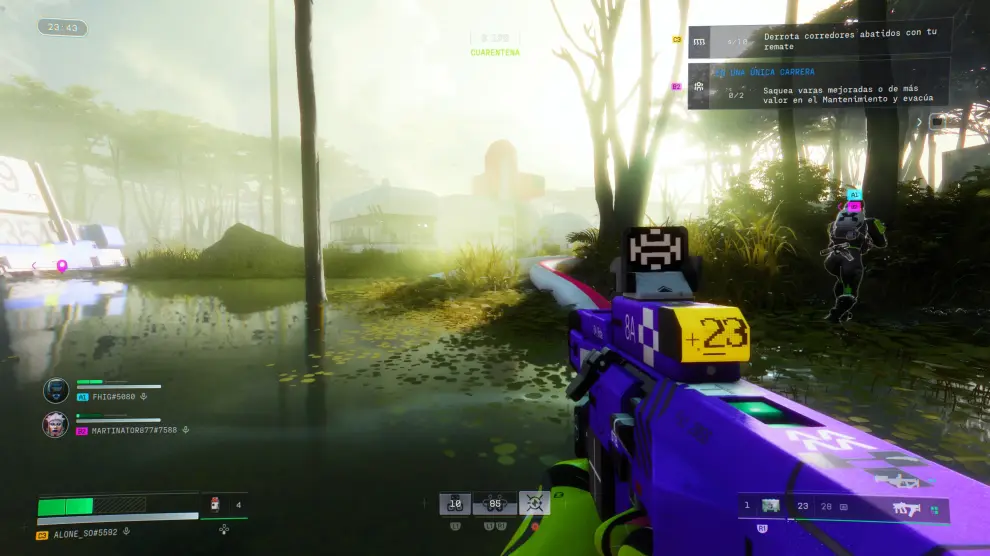
The Frames themselves look fantastic – intricate but readable silhouettes, each with a personality that matches its role. Faction NPCs are pure Bungie weirdness in the best way, with some sly nods to the studio’s history if you know where to look. Even the UI, once you push past the initial overload, has a strong visual identity that fits the whole “cold, efficient future OS” aesthetic.
The soundtrack is the other star here. It’s full of glitchy, futuristic electronic tracks that hum under your raids and then absolutely shine when you listen to them on their own. During matches, the music is often just a pulse under the constant tension, but outside the game I’ve caught myself looping certain tracks while writing or working. It’s that kind of score – not just good background noise, but something you want to revisit.
Technical performance and polish (PS5 impressions)
I’ve been playing primarily on PS5, and from a technical standpoint Marathon has been solid. Framerate feels like a steady 60 most of the time, even in busy firefights. I’ve seen the occasional hitch when a lot of effects kick off at once, but nothing that cost me a fight or made me want to quit out.
Load times between orbit, menus and drops are short enough that wipes don’t feel like they waste your whole night. Netcode has been mostly reliable in my sessions: hit registration feels fair, and when I died, I almost always knew exactly why. I’ve had a couple of weird desync moments (a robot snapping position from one side of cover to another), but they were the exception, not the rule.
On the bug front, I’ve run into a few minor issues – UI elements flickering, a contract tracker not updating until after extraction – but nothing game-breaking. For a live-service launch this ambitious, “a bit of jank in the menus” is frankly acceptable.
Who Marathon is (and isn’t) for
If you’re wondering whether to jump in, here’s the honest breakdown.
You’ll probably love Marathon if:
- You already enjoy extraction shooters and want one with best-in-class gunplay.
- You like high-stakes PvP where losing actually matters.
- You’re a Bungie fan who cares more about tight combat and atmosphere than a traditional campaign.
- You’re willing to push through a rough first few hours and learn systems, maps and sound cues.
You’ll probably bounce off it if:
- You want a story-driven, single-player Halo/Destiny-style campaign. That doesn’t exist here.
- You hate losing gear and feeling like a bad run “wasted” your time.
- You prefer casual, low-stress shooters where you can switch your brain off.
- You detest dense UIs and steep learning curves.
I went in firmly in the second camp. Extraction shooters never clicked with me. But Bungie’s execution – the gunplay, the soundscape, the map design, the way every extraction feels like a tiny heist movie – managed to win me over. It’s absolutely not for everyone, but if anything about this loop sounds intriguing, Marathon is worth giving a real chance, not just two casual matches.
FinalBoss // Gear
Level up your setup
01Top-rated gaming headsetson Amazon→02High-refresh gaming monitorson Amazon→03Gaming chairson Amazon→04Discounted game keyson Kinguin→
Affiliate links · As an Amazon Associate, FinalBoss earns from qualifying purchases.
Want to Level Up Your Gaming?
Get access to exclusive strategies, hidden tips, and pro-level insights that we don't share publicly.
Ultimate Reviews Strategy Guide + Weekly Pro Tips