
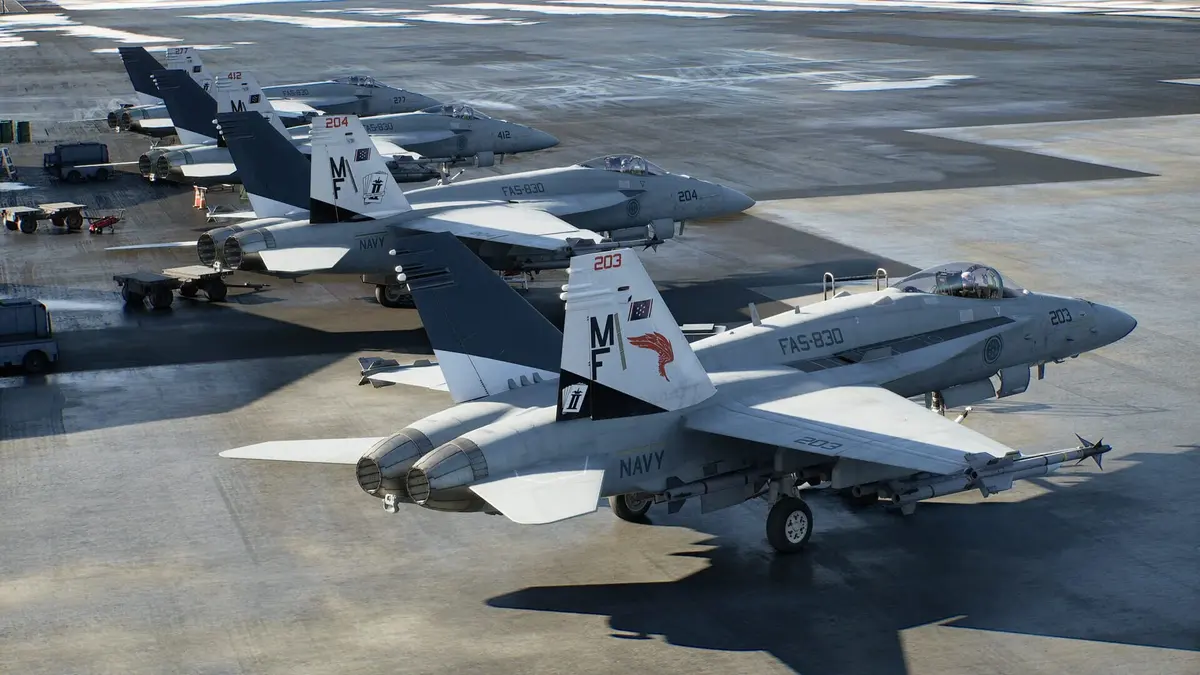
This is not a score roundup, and it should not pretend to be one. The buying decision around Ace Combat 8 is still defined by the questions that matter most in this series: how good the aircraft feel over a full campaign, how well the missions sustain their rhythm across 30 sorties, and whether ACE COMBAT ONLINE launches with enough depth and stability to be more than a promising extra mode.
That creates an awkward but necessary conclusion. I am interested in what Bandai Namco Aces Inc. is building, especially because the campaign premise gives Ace Combat 8 more dramatic weight than a standard “save the world from the cockpit” setup. There is also more concrete structure here than the usual marketing fog: a 30-mission campaign, distinct control schemes, carrier landings, aircraft upgrades, and an online hub built to hold up to 100 players. Still, those details do not automatically become a recommendation. The right call is to let the finished game prove its dogfights, pacing, and online value before treating Wings of Theve as a day-one essential.
- Ace Combat 8: Wings of Theve launches October 2, 2026 for PlayStation 5, Xbox Series X|S, and PC via Steam, with Deluxe Edition early access beginning September 29.
- The campaign is set in July 2029, after the Republic of Sotoa invades the Federation of Central Usea, and it begins aboard the aging carrier Endurance.
- The story hands the player the fabricated “Wings of Theve” ace identity after Jan “Rex” Cope is killed, then places that legend inside Joker Flight.
- The single-player campaign runs 30 missions and includes Standard and Expert control schemes, carrier landings, and a progression loop that lets players buy aircraft, weapons, and parts with mission-earned currency.
- ACE COMBAT ONLINE has separate progression and save data from the campaign, while its Air Base hub can host up to 100 players, but the full long-term multiplayer feature set still needs real-world testing.
A strong premise is waiting for a finished game
Bandai Namco labels Ace Combat 8 a “flight shooting” game, and this time that label comes wrapped in a sharper political frame than usual. The campaign takes place in July 2029, after the Republic of Sotoa invades the Federation of Central Usea. The FCU military has collapsed, refugees are fleeing, and the player is rescued at sea by the Endurance, an aging aircraft carrier that functions as shelter, staging ground, and symbol of a country trying not to disappear.
The opening also does something more specific than “you are the chosen ace.” The player first rides behind Jan “Rex” Cope as a weapons systems officer, then inherits Cope’s mantle after he is killed. That mantle is the title itself: Wings of Theve, a legendary ace identity tied to the FCU capital. The official premise makes a point of saying the legend was fabricated to maintain morale. That matters. It shifts the story from heroic wish fulfillment toward something more uneasy: propaganda, symbols, nationalism, and the way war turns people into myths because myths are easier to deploy than truth.
That is exactly the kind of idea Ace Combat can do well when it is locked in. The series has always thrived when its radio chatter, squadron rivalries, and absurdly earnest geopolitics all click into the same fevered register. Wings of Theve seems built for that tone. The Shadows are an elite squadron that announces itself by singing over an open channel on comms, which is such a wonderfully committed bit of Ace Combat nonsense that it instantly feels at home. A Sotoan ace called Shadow 22 gives the story a more personal threat. The campaign backdrop is not subtle, and it should not be. This series is usually at its best when it commits hard and trusts the cockpit to carry the melodrama.
Joker Flight gives the player a human center for all of this. Ellington “Professor” Baxter fills the mentor lane on comms. William “Noise” Coster brings a more reckless, rock-and-roll energy. Tasha Severskaya rounds out the core group. Between deck scenes, briefing-room moments, and the Endurance serving as a recurring home base, the structure is clearly trying to make the squadron feel like more than a radio filter between you and the next target marker.
The campaign is also substantial on paper. Thirty missions is not a throwaway single-player offering, and that matters in a genre where spectacle can cover for short campaigns if nobody is careful. There is room here for escalation, quieter setup missions, multi-phase battles, and the sort of late-game sorties that make Ace Combat players replay the same mission until dawn because they are convinced the perfect run is one missile away. But a long campaign is not automatically a well-paced one. A cutscene-forward structure can either build a convincing anti-war arc or drag the mission flow into the ground. That is exactly why the premise is promising, not proven.