
Table of Contents (8)
From 100-hour RPGs to a two-hour magnet fever dream
Most of my gaming time disappears into enormous RPGs and bloated open worlds. If there isn’t a skill tree and a map full of side quests, I usually bounce. So during the latest Steam Next Fest, I decided to do the exact opposite: pick something small, focused, and weird.
That’s how I ended up in Distant Shore: Bretagne, spending roughly two hours in a first-person parkour demo about a guy with magnetic gloves trying not to die in electrified seawater off the coast of a ruined Brittany. The pitch sounds like a fever dream, but the moment I fired a metal crate across a tide pool to build a makeshift bridge, it clicked: this is one of those physics-driven games that really lives or dies on how good it feels in the hands.
The verdict after my time with the demo: the story is still just a skeleton, but the movement, puzzles, and atmosphere already feel sharp enough that I’m absolutely coming back for the full release.
A ruined Brittany that feels lonely, wet, and very metal
You play as Aaron in the year 2080, sent by a biotech company called BIO2 into the so‑called West Zone of Brittany. Officially you’re there to recover lost data. Unofficially, you’re looking for your missing brother Thomas. Hanging over everything is “The Cloud” – a strange, almost sentient weather phenomenon that seems to watch your every move like a moody storm god.
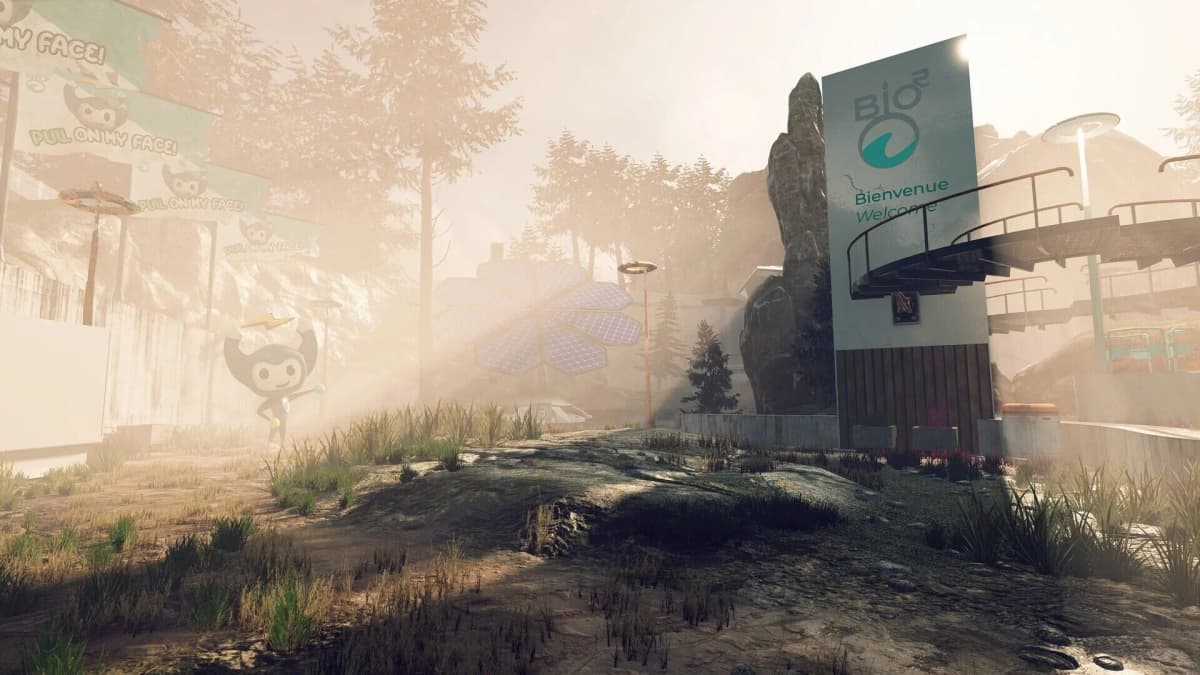
The demo opens on a beach at the edge of the peninsula. Sand crunches underfoot, the sky is this heavy, oppressive grey, and everywhere you look something metallic sticks out of the landscape: corroded pylons, half-sunk platforms, rusting pipes. The whole place feels like a massive scrapyard that used to be a coastline. It’s not flashy, but it’s cohesive, and it sells the idea that this region has been chewed up and spat out by experiments gone wrong.
Water is the big villain here. Your fancy gloves don’t play nicely with it, and the game wastes no time teaching that lesson. Step into the sea, or slip off a wet metal platform, and you’re fried in seconds. The first time I misjudged a jump and dropped into a shallow pool, there was this horrible split second of sizzling and whiteout before the checkpoint reload. It instantly changed how I read the environment: in this world, “blue” means “basically lava.”
What really sold the setting for me, though, were the video and audio logs scattered around the early area. When you find certain devices, they erupt into floating points of light that shape themselves into rough human silhouettes while a voice plays – workers from old research stations talking about their routines, mishaps, or fears. It feels a bit like stumbling over holo-logs in Horizon Zero Dawn, except here you’re standing right inside the projection, watching these shimmering ghosts reenact their memories.
One of the standout moments in the whole demo happens pretty early: I found an audio message containing a song written by Thomas, called “Sleeping Boats”. As it played, I was scrambling across precarious metal platforms toward a distant research station, with the game’s title logo hazy on the horizon. The mix of melancholy vocals, gusting wind, and creaking metal gave me full-on goosebumps. That sequence did more to sell Aaron’s bond with his brother than any bit of exposition.
Learning to think in magnets
At the heart of Distant Shore: Bretagne is a simple but surprisingly flexible idea: you have two magnetic gauntlets, each capable of emitting an impulse. With them, you can attract, repel, or connect metal objects in the world and yank yourself around like a human grappling hook.
The first few minutes ease you in gently. I started by dragging a metal crate a few meters to use as a step, or pulling a floating chunk of scrap closer so I could hop on it. Within minutes, though, you’re doing more interesting things, like linking two loose objects together to form a makeshift bridge over water, then reconfiguring that same metal chain into a staircase on the far side. The game rarely tells you what to do explicitly; it just places a bunch of magnetic “toys” in your vicinity and trusts that you’ll mess with them until the solution appears.

The real magic kicks in when the parkour segments and the physics puzzles merge. You can aim each glove separately, connecting a dangling pipe to a nearby support beam, then instantly shift targets and pull yourself toward the pipe before gravity reasserts itself. I had runs where I’d chain two or three of these moves in quick succession – magnetize a bar, leap, pull, land on a swinging ladder, detach, then latch onto a platform before dropping into the drink. When it works, there’s this wonderful flow that reminded me of threading a perfect line in Mirror’s Edge, but with the added brainload of actively re-routing the architecture mid‑run.
In the demo, the gloves feel powerful but not godlike. Objects have weight. If you try to yank a massive structure from too far away, it won’t just snap to you – it might swing dangerously or not move enough, forcing you to reposition. More than once I pulled a long pipe toward a support column and watched in horror as it pivoted the wrong way, turning my planned bridge into a useless metal pendulum. That constant push and pull between “I control this” and “nope, physics controls you” gives the traversal a great tension.
Parkour at dizzying heights, with checkpoints that don’t always save you
About fifteen minutes into the demo, the game stops flirting and throws you into full-blown parkour gauntlets. This is where my hands started sweating and my fingers began to cramp.
You climb enormous vertical structures made of suspended pipes, walkways, ladders and hanging platforms. Much of it is attached by a single cable or hinge, so as soon as you connect something with your magnet or land on it, it swings or tilts. You’re rarely just jumping; you’re constantly reconfiguring the scaffolding while perched on it, trying not to look down at the deadly water far below.
There’s a particular chain of jumps early on that crystallized my relationship with the game. I had to connect two dangling rods to form a crude V-shaped bridge, pull it into position, sprint across before it drifted away, then hook my glove to a ladder above and yank myself up. I messed it up at least six times. Once I overshot and sailed clean over the ladder into the abyss. Another time my bridge swung away mid-run and dumped me straight into the sea. Each failure sent me back to a checkpoint a little further down the structure, which meant I had to redo a chunk of climbing before getting another try.
The checkpoint spacing is mostly fair, but there are moments where the game clearly wants you to feel that “oh no, not again” sting. I didn’t mind it; the frustration fed into the satisfaction when I finally nailed the sequence in one smooth, panicky sprint. But if you’re the type of player who hates redoing tricky platforming sections, consider this fair warning: Distant Shore: Bretagne is not a chilled-out coastal walk. It’s a magnetised assault course.
One thing I appreciated is how the game supports different kinds of players within those constraints. The level design obviously hints at a “golden path” of clean, flowing jumps, but the physics system is open enough that you can improvise ugly but effective routes. At one point I basically built a floating pile of junk by linking several small metal planks together, then used it as a slow, wobbly elevator to cheese my way up to a catwalk. It looked ridiculous, but the game let it work.
Puzzles that actually got under my skin
What surprised me most was how quickly the puzzles ramped up in complexity without becoming unfair. Many demos treat their first hour like a glorified tutorial, but here I was already getting stuck, staring at clusters of scrap and trying to map out all the ways they could connect.
One recurring pattern involves figuring out which pieces of metal you should “sacrifice” to form a bridge or chain, knowing you might need them later as anchor points for climbing. I had a section where I happily spent several minutes building a perfect series of stepping stones over water, only to realise I had nothing left nearby to attach a crucial hanging ladder for the next section. I had to dismantle half of my beautiful setup and rethink the whole thing from scratch.
Because the system is physics-driven, the game often doesn’t judge you on whether you used the “intended” solution; it cares whether you made something that works at all. That can lead to some scrappy, emergent problem-solving. I love this style of design because it invites creativity and chaos. At the same time, it can occasionally make you wonder if you’re approaching a room correctly or just brute forcing it with janky magnet spam. A reset or “rebuild default layout” option for certain clusters of objects wouldn’t hurt, especially once the full game expands beyond this demo slice.
Either way, the key point is this: I rarely feel genuine puzzle-induced stubbornness in a short demo, but Distant Shore: Bretagne had me muttering at my monitor and refusing to quit until I cracked a route. There’s a satisfying mental burn here that matches the physical one in your fingers.
Story and characters: intriguing setup, thin in the demo
Narratively, the demo mostly gives you fragments. You know Aaron is working for BIO2 and that he’s secretly hunting for Thomas. You learn that The Cloud is something between an anomaly and a hostile deity, a storm system with a mind. You hear workers’ voices in the logs and get small hints about corporate pressure, failed experiments, and day-to-day life in these isolated stations.
What you don’t get yet is much in the way of character depth or big plot turns. Aaron himself is mainly a pair of hands and a voice in text, and beyond that musical moment with “Sleeping Boats”, Thomas is more of a concept than a person. The world feels coherent, but it still lacks that narrative hook that would keep me here purely for the story.
To be clear, this is a criticism with an asterisk. I’ve only spent a couple of hours with a vertical slice, and it absolutely feels like the prologue to a larger mystery. The tone and the slow drip of information remind me a bit of the opening hours of games like INSIDE or Somerville: you know something went horribly wrong here, but the demo won’t fully unpack it yet. I just hope the full game capitalises on the potential of The Cloud and the BIO2 angle, rather than leaving them as cool background dressing.
Look, sound, and feel on PC
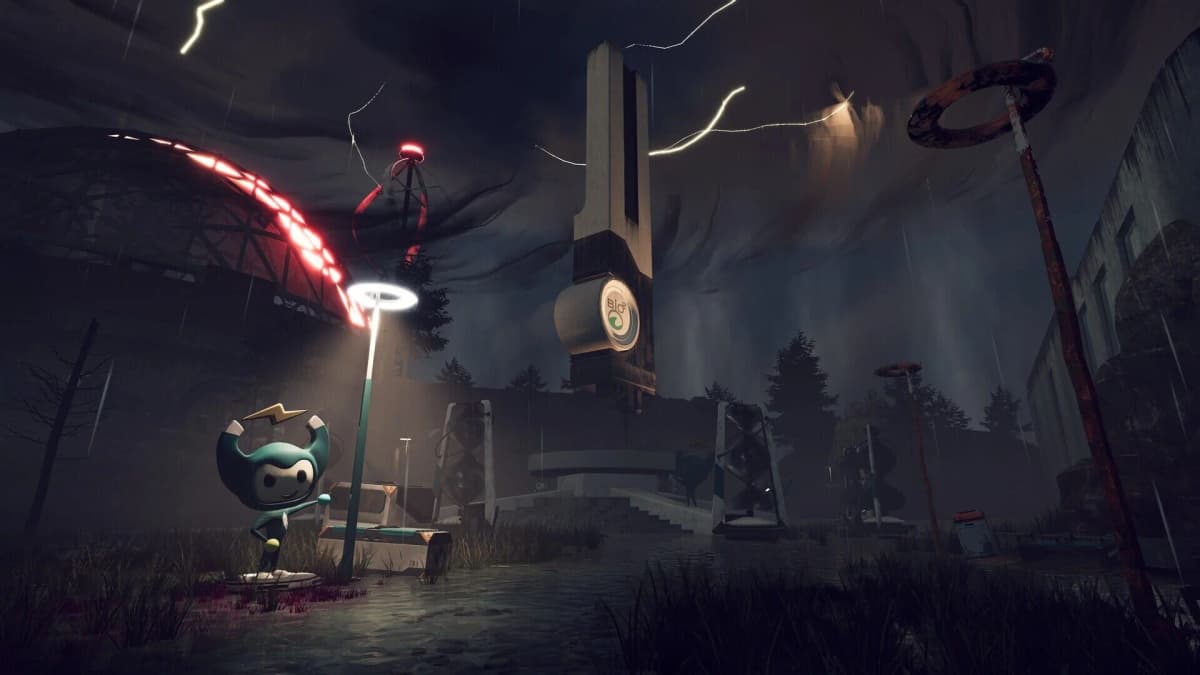
Visually, Distant Shore: Bretagne aims more for mood than technical shock and awe. The colour palette leans into muted blues, greens and rusted browns, which fits the drowned, corroded setting. The water looks appropriately hostile rather than inviting, and the hulking metal shapes rising from it have a sharp, industrial silhouette that makes them easy to read at a glance.
On my PC, the demo ran smoothly. I played with mouse and keyboard, which felt like the natural fit for the fast, precise aiming the magnets demand. The default sensitivity needed a small tweak, but after that I rarely fought the controls. The only awkward moments came in very tight spaces, where my view would sometimes snag on geometry as I tried to line up a shot with the gloves.
The audio work adds a lot. Environmental sounds — clanking metal, wind whipping through open frames, distant thunder from The Cloud — make the spaces feel exposed and dangerous. The voice acting in the logs is quietly effective; it doesn’t try too hard, which makes the workers feel like regular people rather than exposition machines. And that “Sleeping Boats” track is genuinely lovely, setting a melancholic tone that stuck with me well after I closed the demo.
Who this demo is really for
After a couple of hours, a few patterns emerged about the kind of player Distant Shore: Bretagne seems to be courting.
- If you enjoy first-person parkour games like Mirror’s Edge or the movement puzzles in Portal, this scratches a similar itch but adds a strong physics twist.
- If you like being challenged — both in reflexes and in spatial reasoning — the demo already has real teeth. This isn’t a casual, low-stakes platformer.
- If you primarily play for dense storytelling or combat, you may find the current slice a bit sparse. There’s no fighting in the demo, only movement and puzzles, and the plot is still in setup mode.
- If you’re prone to motion sickness in first-person platformers, approach with caution. Fast vertical movement and abrupt camera swings are part of the package here.
I went in wanting a quick break from sprawling RPGs and came out with a new itch: I now want to see just how wild the later areas get once the game stops pretending to be gentle.
FinalBoss // Gear
Level up your setup
01Top-rated gaming headsetson Amazon→02High-refresh gaming monitorson Amazon→03Gaming chairson Amazon→04Discounted game keyson Kinguin→Affiliate links · As an Amazon Associate, FinalBoss earns from qualifying purchases.
Want to Level Up Your Gaming?
Get access to exclusive strategies, hidden tips, and pro-level insights that we don't share publicly.
Ultimate Reviews Strategy Guide + Weekly Pro Tips