
Table of Contents (13)
Two Very Different Flexes: Living With Switch 2’s Big Launch Pair
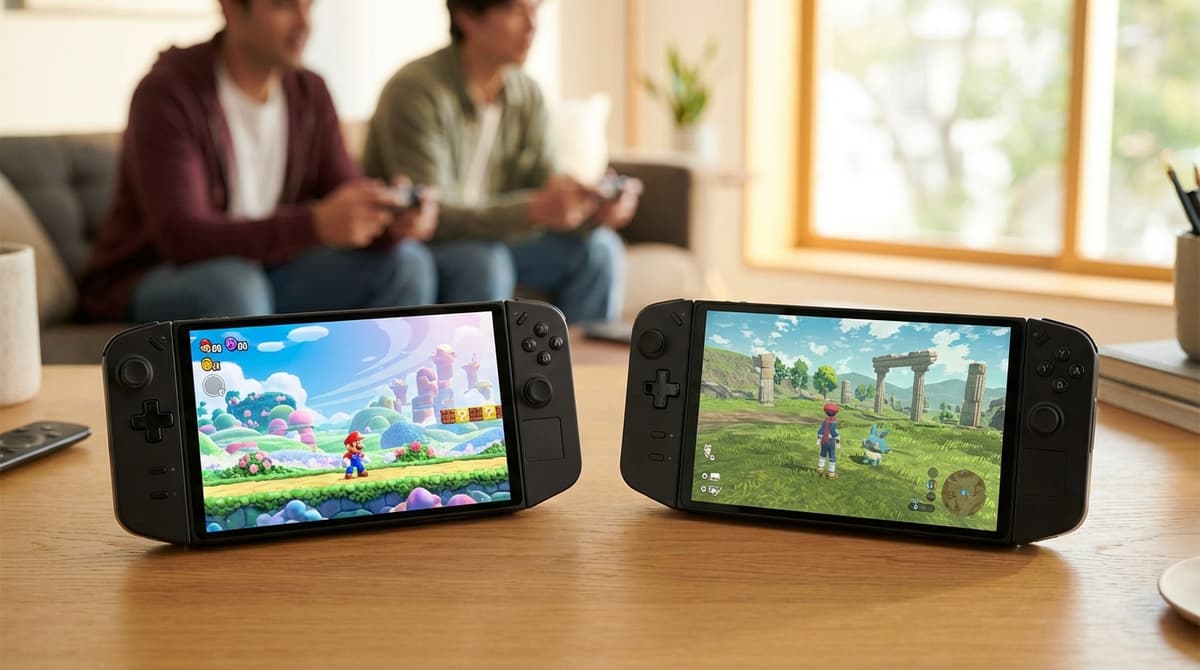
The first weekend with my Switch 2 was basically a pendulum swing between chaos and quiet. On one side of the home screen: Super Mario Bros. Wonder: Nintendo Switch 2 Edition, all sugar-rush color and bouncy music. On the other: Pokémon Pokopia, a slower, melancholy take on a post-cataclysm Kanto where you play as a Ditto doing habitat restoration instead of picking fights.
I bounced between them for roughly 30 hours – about 18 in Wonder 2 Edition (including a full clear of the main campaign plus a big chunk of new content) and 12 in Pokopia (finishing the main restoration “arc” and dabbling in late-game cleanup). That back-and-forth ended up being a great accidental stress test for the Switch 2’s launch software: two first-party-style flagships, totally different genres, both designed to show off the new hardware in their own way.
This isn’t a technical teardown with oscilloscope traces and frame-time graphs. It’s the “what it actually feels like to live with these games” version of a Switch 2 launch games review: Mario Wonder Edition vs Pokémon Pokopia performance – the kind of thing I’d tell a friend who’s trying to decide which $70 to drop first.
Why These Two Matter for Switch 2
On paper, they exist at opposite ends of the spectrum:
- Super Mario Bros. Wonder: Switch 2 Edition is a deluxe re-release of one of the best 2D platformers in years, now with new content and native 4K/60fps support docked (and native 1080p/60 in handheld, according to Digital Foundry’s breakdown).
- Pokémon Pokopia is a fully new spin on the Pokémon formula, built as a chill, combat-free, environment-focused sim where performance has to handle big streaming outdoor spaces, lots of foliage, and slower but more systemic gameplay.
In other words, Wonder 2 Edition is the “precision showcase”: tight inputs, rock-solid frame rate, painterly 2D art blown up to 4K without a hitch. Pokopia is the “world showcase”: streaming, density, day-night shifts, and how far Nintendo’s ecosystem can push big open-ish spaces without the Switch 1’s telltale hitches and blurry resolution dips.
After a week, a pattern emerged: when I wanted to feel the hardware’s raw crispness and response, I booted Mario. When I wanted to feel the system quietly flex its streaming and simulation muscles, I went back to tending broken Kanto in Pokopia.
Super Mario Bros. Wonder: Switch 2 Edition – Still Magic, Just Sharper and Denser
I already loved Wonder on the original Switch. It was one of those games where you could feel Nintendo’s designers finally shaking off a decade of “New Super Mario Bros.” safe choices, going weird again with talking flowers, morphing levels, and enemy animations that feel straight out of a feature film.
Booting the Switch 2 Edition, my first thought was honestly just: “Ah, so this is what they wanted it to look like all along.” On a 4K TV, the native 4K/60 presentation is immediately obvious. Lines are razor clean, no shimmering around text or UI, and those watercolor backdrops that already looked good on Switch 1 finally have the clarity to match the art style.
Performance-wise, it’s boring in the best way: in about 10 hours of docked play, I never saw or felt a single meaningful stutter. Even in four-player chaos with badges that spam visual effects and wild Wonder Seed transformations, it stayed locked. You forget you’re “testing” a launch game at all; it just feels done.
New Content: Bella(bel) Park, Flower Mario, and the Little Stuff That Matters
The Switch 2 Edition isn’t just a resolution bump and call it a day. There’s new content layered in that actually changes how you chip away at the game.
- Bellabel Park / Bella Park hub (Nintendo and IGN both call it the new multiplayer-focused area) became my go-to when friends were over. It strings together little co-op-oriented mini-challenges and bite-sized obstacle courses – perfect “we’ve got 20 minutes before dinner” fodder. The fact you can jump in and out without touching your main save flow is a small but crucial quality-of-life win.
- The Toad Brigade training camp is where I ended up burning an embarrassing amount of time solo. It’s basically a 70+ challenge gauntlet that turns the game’s mechanics into mini “labs”: precision wall jumps, badge-specific puzzles, more demanding take on enemy layouts. On Switch 2, the instant reloads when you fail make this much more addictive than on the original hardware.
- The new Flower Mario power-up sounds almost redundant at first (Wonder already has so much floral theming), but the way it lets you temporarily “paint” platforms and interact with certain background elements is more interesting than I expected. A couple of new single-player stages are clearly designed to show it off, and they hit that Nintendo sweet spot of “simple idea, surprisingly deep execution.”
None of this blows up the original game’s structure. If you finished Wonder on Switch 1, you’re not getting a whole new campaign. What you are getting is a version that feels definitive – like a “Game of the Year” cut that respects your time instead of padding it out.
Co-op and Badges: The Switch 2 Quality-of-Life Glow-Up
Where the Switch 2 Edition quietly justifies itself is in the small co-op usability tweaks that stack up over an evening.
- Camera options are more flexible. In local co-op, I felt way fewer “whoops, I dragged you into the pit because I went too far right” moments. Being able to toggle how aggressively the camera tracks the leader versus trying to keep everyone in frame gives families different comfort settings.
- Warp flags / entry options make jumping into already-cleared areas less of a chore. When we were hunting for missed Wonder Seeds, we spent less time replaying the boring first half of levels and more time experimenting where it actually mattered.
- Dual badge loadouts (something IGN calls out as a new Switch 2 perk) are a godsend. On my original Wonder run I constantly swapped between mobility and utility badges depending on level gimmicks; now, having a “default” and “secondary” setup means you’re less stuck in menus. It sounds small, but over a multi-hour session it makes the game feel snappier.
All of this rides on that rock-solid 60fps. As someone who grew up obsessing over tight-feeling platformers, I can say bluntly: this is the version of Wonder I wish we’d had day one. Playing it on Switch 2 handheld at native 1080p feels great too – the extra sharpness over the old system is obvious when you see UI text and tiny background details.
There’s no HDR or 120fps mode here, and I never felt their absence. Wonder’s art direction was built for bright SDR displays; it pops just fine. I’d rather have this “nailed” 4K/60 target than a half-baked attempt at higher refresh that adds inconsistency.
Pokémon Pokopia – A Quiet Technical Flex Disguised as a Cozy Game
Where Wonder screams “look at me” with neon colors and instant input response, Pokémon Pokopia takes the opposite tack. It’s slow, meditative, and structurally closer to a management sim or chill sandbox than a traditional Pokémon adventure. You play as a Ditto working with researchers and wild Pokémon to restore shattered habitats in a post-cataclysm Kanto, nudging ecosystems back into balance instead of grinding battles.
From a performance perspective, that slower pace is a bit of a Trojan horse. It’s very easy to take what Pokopia’s doing for granted because it doesn’t shove spectacle in your face every ten seconds. But after a few hours of gliding from one ruined biome to another, watching flocks migrate and weather systems roll in, you start to realize how much work the engine is quietly doing.
Streaming and Stability: The “No Drama” Launch Showcase
The biggest technical compliment I can give Pokopia is that I kept waiting for a moment where it buckled – and it never really did.
- Moving from the edge of a flooded Viridian Forest analogue into the bones of a collapsed city, there’s no obvious loading pause or nasty hitch. The world just keeps going.
- Heavy foliage, swarms of small Pokémon, and weather overlays (rain that actually accumulates in puddles, dust storms in the wastelands) all pile up without tanking responsiveness.
- Camera swings – especially when you’re using Ditto’s glide form or riding certain Pokémon for traversal – stay smooth. I never hit that telltale “oh, the streaming system is catching up” micro-stutter that plagued bigger Switch 1 open-worlds.
I can’t tell you exactly what resolution it’s running at in every scenario – that’s for the DF crowd – but from a player perspective, image quality is pleasantly clean in both docked and handheld. If there’s dynamic resolution scaling under the hood, it’s subtle enough that I didn’t notice big swings even when I deliberately tried to stress the game by spinning the camera in busy areas.
Frame rate-wise, it feels like a solid 60 most of the time, with the occasional slight softness when there’s an absurd amount of particle effects and critters on screen. Crucially, nothing ever dropped enough to affect inputs or break immersion. Compared to the performance compromises we tolerated on prior-gen Pokémon titles, Pokopia feels like the “we finally have overhead again” moment.
Art Style and Atmosphere: Selling the Post-Cataclysm Kanto
Pokopia isn’t chasing realism. Visually, it sits somewhere between Legends: Arceus and the anime films, but with a stronger sense of lighting and texture work. Cracked highway overpasses with ivy reclaiming concrete, Pokémon nests built into the ribs of old ships, slow fog banks rolling through ghost-town suburbs – it all benefits from the extra resolution and cleaner anti-aliasing the Switch 2 can push.
Where it really landed for me was in the small, persistent details the game keeps track of:
- Areas you’ve partially restored stay that way as you pan the camera from one corner of a biome to the other. Grass regrowth, cleared debris, and returning Pokémon populations aren’t just toggled on/off; they phase in over time and distance without obvious pop-in.
- Day/night cycles matter for atmosphere. Coming back to a once-toxic marsh you’ve slowly cleaned up and seeing moonlight hit clear water for the first time is weirdly emotional, and the lighting shift is handled gracefully.
- Particle-heavy events, like a storm of spores when you overfeed a fungal ecosystem, never turned into slideshow territory. I went out of my way to spam these moments just to see if I could crack the framerate, and the system held.
It’s not the instant “wow” of Mario’s razor-sharp 2D art, but after a few hours, the consistency of Pokopia’s presentation becomes its own silent flex. This feels like the kind of game that would’ve been a mess on the original Switch without major compromises. Here, it just hums along.
Head-to-Head: Which Game Shows Off Switch 2 Better?
So, taken together, what do these two actually say about the Switch 2 as a platform – and which is the better “tech flex” if you’re choosing a launch game to judge the system by?
Raw Responsiveness and Clarity: Mario Wonder 2 Edition Wins
If you care about how fast and clean a game feels the instant you press a button, Wonder is the showcase.
- Native 4K/60 docked gives you that “new console” snap when you first see it in motion, especially coming from the slightly softer Switch 1 output.
- Handheld native 1080p/60 makes it feel like you’re playing a high-end animated short on a portable screen. It’s actually hard to go back to the original version after a few hours of this.
- The new content and co-op QoL tweaks directly leverage that responsiveness. Mini-games in Bellabel Park and Toad Brigade trials rely on instant feedback; if performance wobbled, they’d feel annoying instead of addictive.
From a “show this to a friend to impress them in 30 seconds” perspective, Wonder 2 Edition is the obvious candidate. It’s bright, fast, immediately readable, and you can hand someone a controller and let them feel the improvement instantly, especially if they ever touched the original.
World Streaming and Systems: Pokopia Quietly Shows the Ceiling
Pokopia, on the other hand, is the long game flex. It’s the one that makes you think, “Okay, so this is what we can expect from open, systemic games on this hardware if studios really lean in.”
- Its near-seamless traversal across fairly big, detailed spaces suggests the days of every outdoor area being a stitched-together corridor might finally be behind us for Nintendo handheld hybrids.
- The way it tracks environmental changes over time and space without hitching implies a decent amount of CPU and memory headroom versus what we’re used to from the original Switch era.
- Weather and particle effects run often enough that if the engine were fragile, you’d see it. You just don’t. That consistency is arguably more impressive than one-off set pieces.
Pokopia isn’t as flashy on a showroom floor, but if you’re interested in what future Pokémon, Monster Hunter, or Xenoblade-style games might feel like on Switch 2, it’s the more telling hint.
Moment-to-Moment: How They Actually Feel to Play
Beyond charts and resolutions, this is what my actual nights with these games looked like.
- With Wonder 2 Edition, I’d tell myself I had time for “one more level” and then lose 90 minutes clearing a world, replaying a Toad Brigade challenge until I shaved a second off my time, and messing around in Bellabel Park with a friend. It’s pure kinetic joy – and the fact that performance never intruded meant that every death felt like my fault, not the hardware’s.
- With Pokopia, I’d put on headphones, curl up in handheld mode, and fall into the rhythm of restoration. Survey a ruined coastal route, plan a few actions, watch how the ecosystem responds, adjust. The 60fps target and smooth camera make this soothing instead of sluggish. I never felt like I was fighting the engine to do something simple.
One surprise: load times. Both games benefit from the Switch 2’s faster storage, but you feel it more in Wonder because of how often you die, restart, jump between mini-modes, and pop in and out of side content. Instant respawns and quick world map transitions keep the momentum going. Pokopia’s fewer, slightly longer loads are easy to ignore because the gameplay is less start-stop by nature.
So Which Should You Buy First?
Honestly, the choice says more about you than about the games. Both are strong, both run well, and both make a solid case for the Switch 2 as a worthy upgrade. But if you’re forcing me to draw a line:
- If you want the cleanest, most immediately impressive “new system” feeling and have any love for platformers at all, Super Mario Bros. Wonder: Switch 2 Edition is the move. Native 4K/60, flawless input response, smart new content, and QoL tweaks that make it the definitive way to play. As a performance showcase, it’s a 9/10 for me.
- If you’re burned out on noisy games and care more about what open, systemic titles can do on this hardware, Pokémon Pokopia is quietly excellent. It doesn’t chase spectacle, but the way it streams, simulates, and stabilizes a recovering Kanto makes it the most technically confident Pokémon-adjacent launch we’ve had. Slight pacing lulls and the occasional soft frame moment keep it just shy of perfect, but it’s still an 8.5/10 in my book.
If you’re the kind of player who loved something like Animal Crossing: New Horizons or Stardew Valley and always wished Pokémon would commit to that slower life-sim vibe, Pokopia is the better fit. If you miss the days when a new Nintendo console meant a new gold-standard Mario, Wonder 2 Edition is that energy.
FinalBoss // Gear
Level up your setup
01Best-selling Switch 2 gameson Amazon→02Switch 2 accessorieson Amazon→038BitDo controllerson Amazon→04Discounted game keyson Kinguin→Affiliate links · As an Amazon Associate, FinalBoss earns from qualifying purchases.
Want to Level Up Your Gaming?
Get access to exclusive strategies, hidden tips, and pro-level insights that we don't share publicly.
Ultimate Reviews Strategy Guide + Weekly Pro Tips