
This caught my attention because Valve has spent years smoothing Steam Deck supply issues – and now the problem looks external, driven by an industry-wide scramble for DDR5 and high‑capacity SSDs. That’s a supply shock Valve can’t control, and it carries real risk for the Steam Machine launch window and price stability.
Table of Contents (6)
Steam Deck OLED shortages are ripples from the AI hardware boom – what it means for Steam Machine timing and price
- Key Takeaway 1: Valve warns Steam Deck OLED may be intermittently out of stock worldwide due to memory (DDR5) and SSD shortages tied to AI data‑center demand.
- Key Takeaway 2: DDR5 prices have spiked dramatically recently, and SSD supply is strained – the same pressure hitting GPUs — which could complicate Valve’s planned Steam Machine release in H1 2026.
- Key Takeaway 3: Valve hasn’t raised Steam Deck prices yet, softening the consumer impact for now, but extended shortages make a higher price or delayed Steam Machine launch increasingly plausible.
- Key Takeaway 4: Stock availability is regional (US sold out; UK still has variants; Germany limited to 1TB OLED), showing intermittent, unpredictable supply rather than uniform global scarcity.
{{INFO_TABLE_START}}
Publisher|pcgamesn-com
Release Date|2026-02-17T11:46:58
Category|hardware supply
Platform|website, social, email newsletter, mobile app
{{INFO_TABLE_END}}
What Valve announced — and why it matters
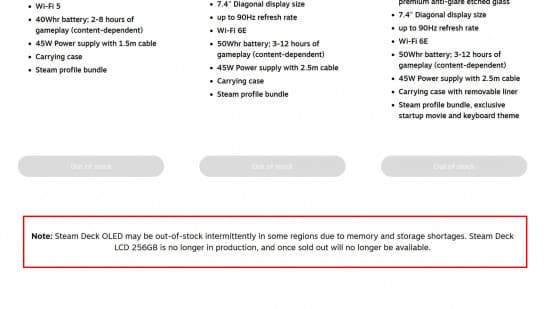
Valve quietly added a notice to its Steam Deck store pages saying the Steam Deck OLED “may be out-of-stock intermittently in some regions due to memory and storage shortages.” That’s blunt and short, but the context is the important bit: AI operators are buying huge volumes of DDR5 RAM and NVMe storage to scale training and inference clusters, tightening supply for consumer devices.
Historically, Deck shortages were demand-driven (Valve built a popular handheld), but this moment is different: the bottleneck is component availability, not just Valve’s production cadence. DDR5 pricing reportedly surged — with dramatic increases in a short window — and SSD supply is similarly strained. Those component markets are now competing directly with Valve’s BOM (bill of materials).

Why this could complicate the Steam Machine launch
Valve still lists the Steam Machine for “the first half of 2026” after earlier talk of “early 2026,” and AMD has publicly suggested the timeline is intact. But the reality of component pricing matters. A handheld like the Deck uses high-bandwidth DDR5 and NVMe storage at cost levels that matter to a sub-$X00 product. If DDR5 stays expensive or SSD supply remains constrained, Valve faces two unappealing choices: raise the Steam Machine’s price or delay to secure parts without inflating margins.
Given Valve’s positioning — building enthusiast-friendly hardware at accessible price points — a meaningful price hike would be notable. For now, Valve has resisted raising Deck prices despite the squeeze, which is a good sign for consumers but may not be sustainable if component headwinds persist.
Regional availability and what buyers should expect
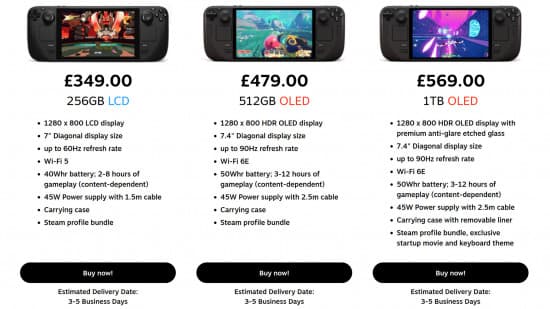
The outages are intermittent and region-specific: the US is reportedly sold out of all Steam Decks, the UK still shows inventory across variants, and Germany has only the 1TB OLED. That pattern is typical of constrained supply chains — components get allocated differently by region and factory runs — and means prospective buyers will have to monitor stock rather than expect steady availability.
Practically speaking, if you need a Deck now and see one in your region, it’s reasonable to buy rather than betting on future restocks or lower prices. If you can wait, watch RAM and SSD price trends and Valve’s statements about the Steam Machine — both will be key signals for whether the ecosystem can absorb a new console without cost creep.
Industry context — AI demand is reshaping consumer hardware availability
This is part of a broader pattern: AI compute demand is reshuffling parts markets. GPUs were first, then memory and storage. For consumer hardware makers that rely on the same DDR5 and NVMe supply chains, the new competition from cloud and AI-scale buyers increases volatility. Companies with deep pockets or long-term contracts (hyperscalers) will take priority, leaving smaller hardware makers to adapt — and consumers to feel the pinch.
TL;DR — The short verdict
AI data‑center buying is spilling into the consumer space: Steam Deck OLED stock will be intermittently scarce as DDR5 and SSD supply tighten. Valve hasn’t raised Deck prices yet, but the same component crunch could force a delayed or costlier Steam Machine if market pressure continues. For enthusiasts: buy if you need one now; otherwise monitor component-price trends and Valve’s updates before assuming the Steam Machine will land at the originally implied price or timeline.
FinalBoss // Gear
Level up your setup
01Graphics cardson Amazon→02Gaming laptopson Amazon→03High-refresh gaming monitorson Amazon→04Discounted game keyson Kinguin→Affiliate links · As an Amazon Associate, FinalBoss earns from qualifying purchases.