
The last time a game’s credits made me mad, it wasn’t because of some missing composer or a buried QA team. It was because I saw a tiny line tucked away in a “Special Thanks” section that boiled my blood: “AI tools used for asset generation.” No mention of the dozens of concept artists who used to be on that studio’s previous projects. I’d literally just read their layoff announcements a month before.
Booting the game, it was obvious where the “magic” happened. NPC portraits with that same sleepy, mushy, AI-glaze in the eyes. Background paintings that looked like someone fed ArtStation into a blender. Lore books full of oddly repetitive prose and characters whose names changed spelling between pages. This wasn’t support tooling. This was slop. And it felt like it had replaced actual people I’d been following on ArtStation for years.
Here’s where it gets messy: a week later I was raving to friends about a tiny experimental tactics game made by basically one person, where the dev openly said they’d used AI to auto-generate placeholder UI layouts and code snippets so they could focus on tuning mechanics. That game ruled. Tight design, strong art direction, nothing felt machine-smeared. Same technology, completely different ethics and outcome.
That’s the headspace I’m in with AI in game development right now: furious, impressed, scared for my friends’ jobs, and grudgingly fascinated by what’s possible if we don’t completely screw this up.
Table of Contents (6)
The split reality of AI in game dev: everyone uses it, almost everyone hates it
By 2026, AI in game development isn’t some future hypothetical. It’s the water everyone’s already swimming in. Roughly half of studios have adopted AI in their pipelines. Around 97% of developers use some kind of AI-assisted tool. About 74% use ChatGPT-style tools for research, boilerplate code, prototyping. That’s basically “if you’re not using it, you’re the weirdo.”
And yet the mood has absolutely cratered. Survey data around GDC 2026 shows only about 7% of respondents see AI’s impact on games as positive. More than half of professionals – 52% – now say generative AI is a net negative, up from around 30% the year before. Go deeper and it gets even uglier: artists are the most hostile, with roughly 64% opposed; designers sit around 63%.
There’s a clear split: executives and some technical leads talk about “efficiency” and “scaling content,” while the people who actually make the stuff we care about – art, levels, narrative, audio – are watching their crafts get treated like a line item. It’s not abstract; it’s happening during one of the worst waves of industry layoffs we’ve seen in years.
To be completely fair, nobody can turn around and say, “This job loss, right here, was caused by AI.” The causal lines are muddy as hell: bloated budgets, bad management, chasing live-service fads, interest rates, you name it. Even the more serious analyses admit we don’t have clean numbers proving “X% of layoffs were because of generative tools.”
But when a studio guts an art team, starts quietly shipping AI-generated textures and concept art, then calls AI “just another tool,” I’m sorry – that’s not a coincidence, that’s a strategy. And it sure as hell has ethical consequences even if it’s technically “legal” right now.
“It’s just a tool” is doing a lot of dishonest heavy lifting
I keep hearing the same line from defenders: “AI is just a tool. Photoshop didn’t kill artists. Synths didn’t kill musicians.” I’ve been around this medium long enough – from Dreamcast days obsessing over Shenmue’s hand-placed props to modern live-service patch cycles – to know that’s half-true at best.
Yes, any tech can be “just a tool.” The problem is what happens in an industry that’s already addicted to cutting costs and burning people out. Right now, AI isn’t landing in a utopian co-creation workshop. It’s landing in boardrooms where someone’s job is literally to ask: “How few humans can we get away with?”
Talk to working devs – especially contract artists and narrative designers – and the anxiety is visceral. One friend of mine who’s shipped multiple AA RPGs went from a stable gig to scrambling for freelance after their studio pivoted to “AI-assisted concept exploration.” Their role wasn’t renamed, it was erased. Another friend in tools engineering is slammed because their studio wants them to bolt generative models into the pipeline next to build servers, while also pretending nothing fundamental is changing.
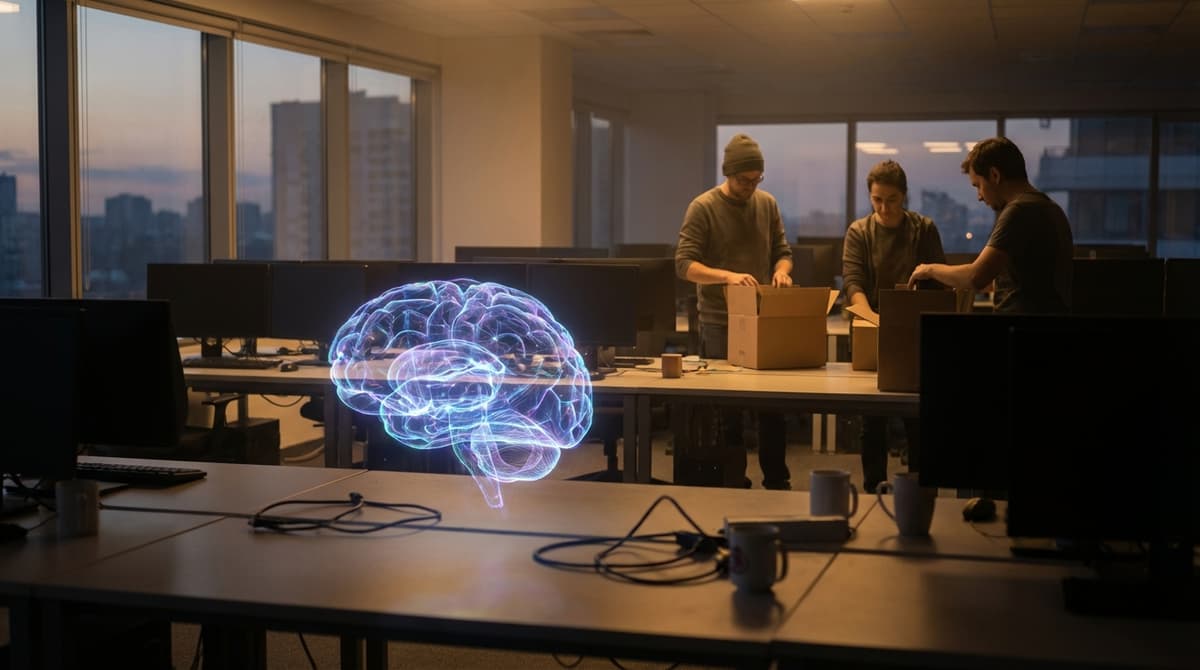
Executives, meanwhile, stay cautiously upbeat. Survey slices tend to show leadership more optimistic – not wildly, but noticeably – about AI’s benefits compared to rank-and-file creatives. When the people making the calls are the ones least likely to be replaced by a prompt, of course their vibes are different.
This is where AI game development ethics stops being a philosophical question and becomes a labor one. Who gets to decide what we automate? Who takes the hit when a studio swaps production artists for a text box that spits out “good enough” key art based on a stolen training set? And who pockets the money saved?
Slop isn’t a meme, it’s a warning label
Let’s talk about “slop,” because if you’ve played almost anything mid-budget in the last year, you’ve seen it.
It’s the “fantasy” armour set with extra fingers fused into the gauntlet because the model hallucinated them. It’s the background tavern painting where all the beer mugs melt into each other if you stare for more than two seconds. It’s the codex entry clearly stitched together from ten different vibes, where the tone shifts from grimdark to Marvel quips in three sentences.
We keep catching studios with generative assets in their marketing art or even their shipped games. Every time, the excuse is basically the same: “Those were just placeholders we forgot to swap.” I’ve worked with enough devs to know how placeholders actually work – they’re often deliberately ugly or watermarked so stuff like that can’t ship. The fact AI slop makes it into the final build means either QA is asleep at the wheel or someone decided it was fine.
And you feel it as a player. Games I love – the ones that really stick with me – have a coherent voice. Shenmue’s jank-obsessed detail, Dark Souls’s miserably beautiful world design, the focused art direction of something like Hades. You can sense there’s a team behind them arguing, iterating, and agreeing on what this world feels like.
Unregulated generative pipelines smash that cohesion. Pull a texture from one model, a character design from another, some “lore” paragraphs from a third, and your game starts to feel like a collage of stolen impressions rather than a place. It’s not just ugly; it’s hollow.

Ethically, that matters. Not because AI art is inherently soulless, but because it’s being produced in a way that treats existing artists as a free buffet. Models trained on copyrighted concept art and in-game assets without clear permission, scraped in bulk. Then the result gets sold back into the same industry that created the originals. That’s not “inspiration,” that’s enclosure.
The IP and ownership time bomb nobody wants to own
Lawyers are already sounding alarms about this stuff. Generative models don’t come with tidy little provenance tags: “Here’s the 1,000 images from Studio X we digested to make this swamp monster.” So when a game ships with an AI-designed enemy that just happens to look a lot like a boss from another company’s concept sheets, who’s on the hook?
Legal experts have been pointing out a few key problems:
- Training-data opacity – nobody really knows exactly what went into most of these foundation models.
- Downstream liability – if a licensed tool a studio uses spits out infringing content, the studio can still be the one sued.
- Likeness and publicity rights – generative models have already recreated actors’ faces and voices with eerie accuracy without consent.
- Live-service and monetisation – AI-powered content pipelines raise extra scrutiny around loot boxes, targeted offers, and behavioural profiling.
We’re starting to see governance efforts, at least on paper. The International Game Developers Association’s Serious Games SIG – and newer bodies like IGSA – are pushing “ethical AI best practices” as a living document, co-developed with regulators, to demand transparency and fairness. Places like the World Economic Forum are talking about sector-specific standards.
But “living document” feels very generous when you look at what’s actually happening. Regulation is patchy across countries, enforcement is slow, and in the meantime, executives are jamming generative tools into pipelines because shareholder pressure is immediate and clear, while legal risk is abstract and tomorrow’s problem.
Meanwhile, prominent critics like Meredith Whittaker keep hammering on the basics that should be obvious: we need binding safety standards, not vibes-based promises, and we need to protect human dignity in the face of tools that are very clearly being used to squeeze creative labour. The industry nods along in panels, then quietly keeps experimenting in production.
The messed-up part: AI also genuinely helps when it’s actually just a tool
Here’s where I have to look myself in the mirror: I use AI tools too.
When I’m tinkering with a small Unity prototype, I’ll absolutely paste a gnarly error into an assistant to get pointed in the right direction. I’ve seen level designers lean on AI to spit out basic collision meshes or greybox layouts that they then rip apart and rebuild. I’ve watched a solo dev buddy with ADHD finally ship something because AI-assisted scripting helped them over the parts of the workflow that always derailed them.
And when I think about the future of games I love – deep sims, reactive worlds, character-driven RPGs – I can’t pretend AI has nothing positive to offer. On-device, low-latency models could enable:
- NPCs who remember your behaviour across dozens of hours and actually adapt, not just flip a hidden morality flag.
- Accessibility tools that dynamically rephrase quest text, simplify combat patterns, or surface hints in a way tailored to each player’s needs.
- Smarter QA bots that hammer edge cases so human testers can focus on feel, not filing 500 duplicate collision bugs.
Those aren’t pie-in-the-sky fantasies; prototypes already exist. Around 97% of devs touching AI tools aren’t all mustache-twirling villains. A lot of them are just trying to ship something cool with fewer 3am emergency builds.
But even the promising stuff comes with landmines. Real-time behavioural modelling of players raises brutal data-privacy and manipulation questions. Do I really want my single-player RPG quietly building a psych profile of me so it can “optimize engagement”? Hell no. Do I trust most publishers not to cross that line if there’s money on the table? Also hell no.
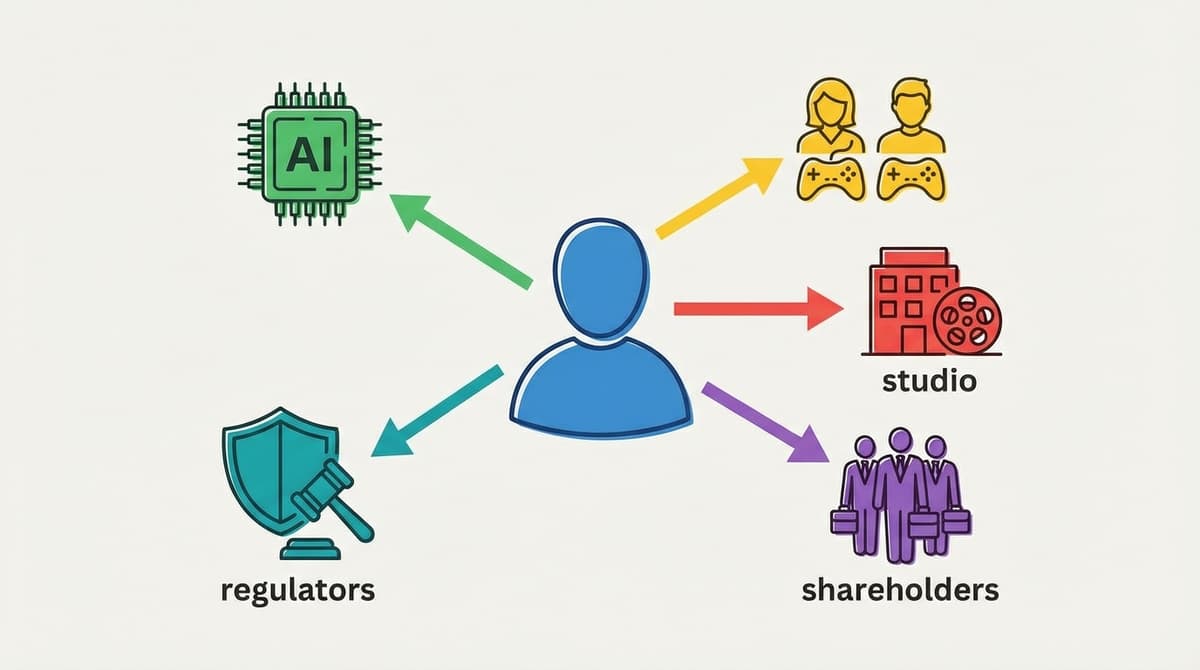
This is why I’m not in the “ban all AI in games” camp. I think that’s unrealistic and, frankly, misses places where it genuinely alleviates drudge work. But I’m also absolutely not in the “it’s inevitable, stop complaining” camp. The whole point of ethics is to draw lines on what we refuse to normalize, especially when something is inevitable technologically.
What ethical AI in game development would actually look like
If “AI game development ethics” is going to be more than a LinkedIn buzzphrase, we need hard rules, not vibes. Here’s where I land after watching this mess unfold:
- Consent and compensation on training data. If you want to use models trained on game art, audio, writing, or code, you should be able to show clear consent, attribution, and some form of compensation for the creators whose work you’re leveraging. No more “we scraped the whole internet, deal with it.”
- No replacement of currently occupied roles. Use AI to assist humans doing their jobs, not to wipe out existing positions. If you’re automating tasks that were someone’s livelihood last year, you owe your team more than “retraining opportunities” in a slide deck.
- Transparent labelling of generative content. If your key art, major character designs, or narrative beats are AI-generated or heavily AI-assisted, say so. Put it in the credits, in the store page, wherever. Let players decide what they’re comfortable supporting.
- Quality and cohesion review by humans with veto power. No asset should ship because it passed a model’s score. Not art, not VO, not quest text. A human with domain expertise should have the authority to say “this sucks” and bin it.
- Strict limits on player data and behavioural nudging. If you’re running on-device or server-side AI that profiles player behaviour, that needs explicit opt-in, clear boundaries, and regulatory oversight. No dark-patent “engagement algorithms” hidden in the patch notes.
Some of this is already showing up in early guidance from groups like IGSA and in policy talk from regulators. The problem is speed. Studios are adopting generative workflows now, while standards are moving at committee pace.
Meanwhile, prominent AI companies talk about “efficiency” in ways that are, frankly, dehumanising. When tech leaders publicly compare the energy cost of raising a human to the energy cost of training a model, it tells you exactly how they’re thinking about us: as inefficient machines to be optimised away. Meredith Whittaker’s warnings about protecting human dignity aren’t melodramatic; they’re a direct response to executives saying the quiet part out loud.
FinalBoss // Gear
Level up your setup
01Top-rated gaming headsetson Amazon→02High-refresh gaming monitorson Amazon→03Gaming chairson Amazon→04Discounted game keyson Kinguin→Affiliate links · As an Amazon Associate, FinalBoss earns from qualifying purchases.
Want to Level Up Your Gaming?
Get access to exclusive strategies, hidden tips, and pro-level insights that we don't share publicly.
Ultimate Gaming Strategy Guide + Weekly Pro Tips