
This caught my attention because corporate contributions should follow open-source norms-especially to a project as central to media tooling as FFmpeg. When a big hardware vendor’s patch raises cleanliness and review concerns, it isn’t just a nitpick; it’s a signal that internal processes or expectations may be out of sync with community standards.
Table of Contents (6)
AMD just got accused of submitting AI-style, unreviewed code to FFmpeg
- Key Takeaways
- FFmpeg contributors flagged an AMD patch as verbose and non-standard, warning it looked like unchecked AI-generated code.
- The change aimed to add HIP SDK support for Windows but was rejected on technical grounds-FFmpeg already has AMD GPU support via Vulkan.
- AMD’s contributor defended their rationale and offered to strip extra comments; AMD has been contacted for comment.
{{INFO_TABLE_START}}
Publisher|AMD / FFmpeg
Release Date|2026-01-30
Category|Open source / Software
Platform|FFmpeg
{{INFO_TABLE_END}}
What happened – the facts
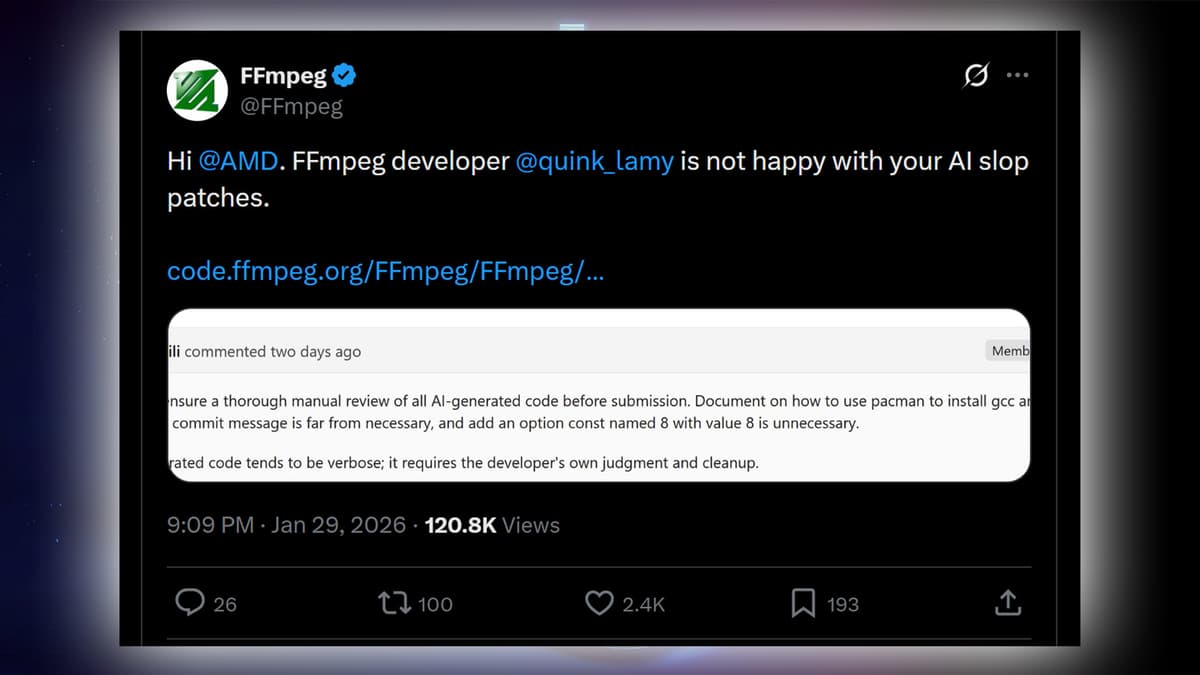
An AMD contributor submitted a patch to FFmpeg intended to add support for AMD’s HIP (Heterogeneous-compute Interface for Portability) SDK on Windows, which would ostensibly enable GPU-accelerated video processing on AMD GPUs. A project developer, Zhao Zilli, publicly asked the submitter to “ensure a thorough manual review of all AI-generated code before submission,” noting signs such as unnecessary comments and non-standard coding patterns.
Another FFmpeg team member amplified the criticism on X (formerly Twitter), bluntly calling the patch “your AI slop.” FFmpeg maintainers then rejected the commit on technical grounds; several reviewers pointed out that support for AMD GPUs already exists via Vulkan, reducing the need for a separate HIP path on Windows.

Why the reaction matters
Open-source projects like FFmpeg depend on small, careful, well-tested changes. Large vendors contributing code carry an added responsibility: their submissions are scrutinized because they can shift project direction or introduce hard-to-find regressions. The maintainers’ public irritation is a reaction to patterns the community has had to police—verbose AI-style code, insufficient testing, or non-idiomatic changes that add maintenance burden.
There are three practical concerns here:
- Correctness and testing: Machine-generated snippets can compile but still be logically wrong or unoptimized for real workloads.
- Maintainability: Extra comments, non-standard idioms, or a sprawling patch increase review time and long-term maintenance cost.
- Redundancy and architecture: Adding HIP support on Windows duplicates functionality that existing Vulkan integration already covers, creating potential fragmentation.
AMD’s response and the context
The AMD contributor pushed back, saying the added comments and steps reflected their real-world practices and were not the result of AI. They also offered to remove the extra commentary. That response matters—if it was human-driven, it’s a sign that corporate contributors may need clearer guidance on how much implementation detail and commentary to include when upstreaming changes.
FFmpeg maintainers noted the technical redundancy: AMP GPU acceleration on many AMD cards is already available through Vulkan-based paths. From a project perspective, introducing HIP-on-Windows support needs a strong justification—either measurable benefits, broader cross-platform consistency, or clear performance wins over existing routes.
What this means for users and the community
For end users and application integrators (Chrome, OBS, VLC, HandBrake), this likely has no immediate impact. FFmpeg remains widely supported and the maintainers are protective of its quality. But for AMD and other vendors, the episode is a reminder:
- Run internal human review and benchmarking before upstreaming changes—AI-assisted code is fine, but it must be curated.
- Coordinate with maintainers to avoid duplicate implementations and to provide clear tests and performance data.
- Keep patches minimal and idiomatic to lower review friction.
TL;DR — my takeaway
AMD’s patch sparked a necessary community reaction: whether AI was involved or not, the submission looked unpolished and redundant given existing Vulkan support. The fix is straightforward—better internal review, clearer upstream communication, and focused, well-tested patches. For FFmpeg, the maintainers did what they should: reject a change that didn’t meet technical or community standards. For AMD, this is a chance to align contribution practices with how open-source communities expect code to be presented.
I’ll be watching whether AMD follows up with a cleaned, benchmark-backed submission or a clarification of its contribution workflow. Either way, this row underscores a new reality: AI can speed development, but community trust still depends on human judgment and accountability.
FinalBoss // Gear
Level up your setup
01Top-rated gaming headsetson Amazon→02High-refresh gaming monitorson Amazon→03Gaming chairson Amazon→04Discounted game keyson Kinguin→Affiliate links · As an Amazon Associate, FinalBoss earns from qualifying purchases.
Want to Level Up Your Gaming?
Get access to exclusive strategies, hidden tips, and pro-level insights that we don't share publicly.
Ultimate Gaming Strategy Guide + Weekly Pro Tips