
Table of Contents (23)
AMD Ryzen 7 9850X3D review: living with the new gaming king
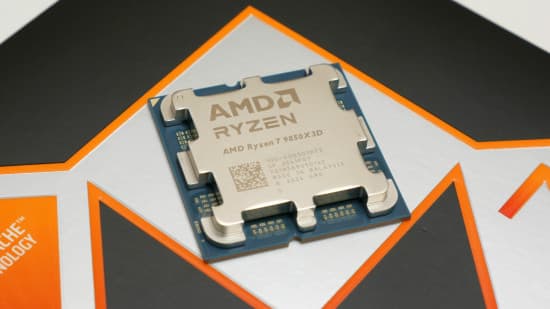
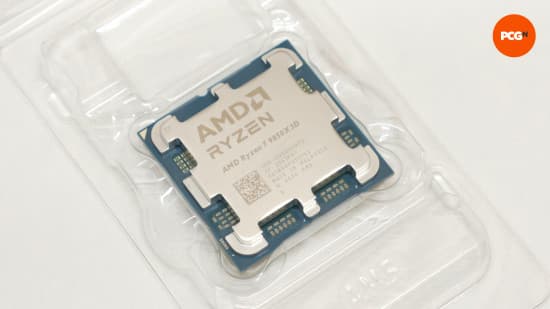
AMD’s Ryzen 7 9850X3D is the new top gaming CPU, offering a ~7.6% higher peak clock than the 9800X3D and stronger gaming performance thanks to 64MB of added 3D V-Cache. It delivers chart-topping frame rates with modest power draw and cooling demands, though its eight-core count and price make it less compelling for non-gaming multi-threaded workloads.
When I first dropped the Ryzen 7 9850X3D into my long-running AM5 test rig, I honestly wasn’t expecting much. On paper it’s the definition of incremental: same eight cores, same base clock, same cache configuration as the 9800X3D – just a 7.6% bump to the peak boost clock. It felt like the kind of upgrade you skip.
A few evenings of Cyberpunk 2077, a long weekend of Total War: Warhammer 3 campaigns, and too many CS2 deathmatches later, I had to admit: the gains are small, but they’re real – and in the right scenarios, you can actually feel them. The bigger question isn’t “is it faster?” (it is), but “is that last sliver of performance worth paying for?”
Key takeaways
- Fastest gaming CPU I’ve tested – consistently tops the charts, especially in CPU-bound and high-FPS scenarios.
- Small but measurable uplift over the 9800X3D — think ~3-6% in many games, larger in very CPU-limited titles like CS2.
- 3D V-Cache still works its magic — high frame rates even with less-than-cutting-edge DDR5, and excellent 1% lows.
- Eight cores is “enough” but not generous — fine for everyday multi-tasking, limiting for heavy rendering, encoding, or AI workloads.
- Cool and relatively power-efficient — easy to keep under control with a mid-range cooler, far tamer than Intel’s power hogs.
- Pricing is the sticking point — only about $20 above the 9800X3D’s MSRP, but real-world deals often make the older chip better value.
- Best for no-compromise gaming builds — for mixed gaming + productivity, a 12-16 core chip still makes more sense.
Rating: 9/10 as a pure gaming CPU; closer to 7/10 if you’re buying primarily for productivity. My overall verdict balances out around an 8.5/10.
My test setup and first impressions
For context, I’ve spent time with every X3D desktop chip AMD has released, from the quirky-but-brilliant 5800X3D to the ultra-high-end 7950X3D and 9950X3D. The 7800X3D and 9800X3D have been my go-to recommendations for “just game as fast as possible” builds.
The Ryzen 7 9850X3D went into my standard AM5 gaming test bench:
- Motherboard: Asus ROG Crosshair X870E Hero
- RAM: 32GB (2 x 16GB) G.Skill TridentZ 5 Neo RGB, DDR5-6000, CL28
- GPU: Nvidia GeForce RTX 4080 Founders Edition
- Storage: 2TB PCIe 5.0 NVMe SSD
- Cooling: Corsair H100x 240mm AIO
- PSU: Corsair RM1000x Shift
- OS: Windows 11 24H2, latest updates and BIOS
The install was uneventful: drop the chip in the AM5 socket, a quick BIOS update, enable EXPO for DDR5-6000, and I was booted into Windows in minutes. No weird scheduling quirks or special profiles to baby like the early dual-CCD X3D chips — it just behaved.
My first real impression came in Cyberpunk 2077. I’ve run that benchmark so many times across CPUs that I can almost feel when something is off or when it’s snappier than usual. With the 9850X3D, frame times felt just a touch tighter than on the 9800X3D, even in heavy ray-traced scenes that are largely GPU-bound. It wasn’t night and day, but it wasn’t imaginary either.
Specs and what actually changed vs Ryzen 7 9800X3D
On paper, the Ryzen 7 9850X3D is almost suspiciously similar to its predecessor:
- Cores / Threads: 8 cores / 16 threads (with SMT)
- Base clock: 4.7GHz
- Boost clock: up to 5.6GHz (vs 5.2GHz on 9800X3D)
- L2 cache: 8MB
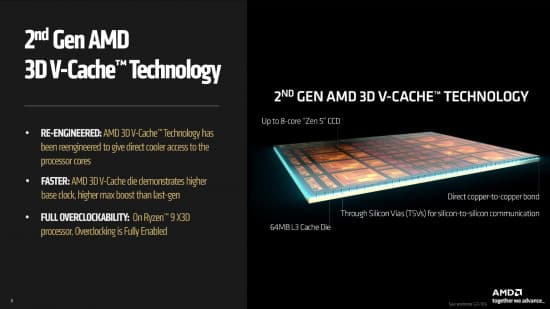
- L3 cache: 96MB total (32MB on-die + 64MB 3D V-Cache)
- TDP:
- Architecture: Zen 5
- Socket: AM5, DDR5-only platform
The important bit: the only real change vs the 9800X3D is that 7.6% increase in peak boost clock. Core count, base clock, cache layout, and TDP are all the same.
Under the hood, you still get the classic X3D layout: a single 8-core compute chiplet (CCD) paired with a separate IO die, and a 64MB slice of 3D-stacked cache bonded to the CCD. That extra slab of L3 cache is what makes these chips so potent for gaming: it keeps more of the game’s working set on-chip, cutting down on trips out to comparatively slow DDR5.
The end result in real use is simple: more stable frame times and less dependence on ultra-fast RAM. If you’re on a slightly older 5200-5600MT/s DDR5 kit, 3D V-Cache is your friend, especially in open-world and strategy titles that love cache space.
Gaming performance: where the 9850X3D earns its crown
I ran the usual mix of synthetic and real-world tests, but I care most about how a chip behaves in actual games. Here’s how the 9850X3D stacked up in my hours of testing.
Cyberpunk 2077: small lead, consistently on top
Cyberpunk is my “this is how people really play” test: 1080p, Ray Tracing Ultra, DLSS set to Quality. Even at 1080p, with those ray-traced settings it’s still largely GPU-bound on an RTX 4080 — which makes any CPU separation impressive.
Here, the Ryzen 7 9850X3D slotted straight into first place, about 3% ahead of the 9800X3D. That doesn’t sound huge, and it isn’t, but it’s also a bigger lead than the 9800X3D had over the old 7800X3D, and it matches the gap that chip enjoyed over the 9950X3D.
Switching to 1080p High with ray tracing disabled and DLSS off pushes the game into proper high-FPS territory (well north of 200fps). The gap between the slowest and fastest CPUs shrinks to around 13%, and the X3D trio still form a clear band of top performers — with the 9850X3D at the front.
Subjectively, it just feels right: no hitching when streaming into denser parts of Night City, and 1% lows that track very close to the average in my runs. It’s the sort of “smoothness” you start taking for granted until you swap back to a non-X3D chip.
Total War: Warhammer 3: weird charts, solid experience
Warhammer 3 is brutal on CPUs, especially in big battles and the Mirrors of Madness benchmark. It’s also one of those games where different scenes stress completely different parts of the pipeline, which makes for some funny-looking graphs.
In the more demanding Mirrors of Madness test, the 9850X3D pulls a comfortable lead over the 9800X3D, with the 9950X3D a touch behind and then a clear step down to Intel’s top parts like the Core i9-14900K. This is the kind of scenario where cache, IPC, and clock speed all line up nicely in AMD’s favour.
The Battle test is where the results get oddly inverted: the 9850X3D trails by about 5% (roughly 10fps) compared to its X3D siblings, and the 14900K sinks right to the bottom. The margins are small enough that you don’t feel it in play, but it’s a good reminder that benchmarks can be quirky and game engines sometimes just like certain microarchitectures more than others for no obvious reason.
In actual campaign play — big late-game fights, lots of AI factions, end-turn times — the 9850X3D never felt like a bottleneck. If anything, the sheer consistency of the frame pacing stood out more than the raw average FPS number.
F1 24: photo finish at the top
F1 24 is one of those games where practically everything at the high end feels overkill, and that came through clearly in testing. The 9850X3D landed as the second-fastest CPU I’ve tested in this title — just 1fps behind the 9950X3D and 1fps ahead of the 9800X3D.
Frame rates are so high here that differences are academic unless you’re chasing every last hz on a 360Hz+ esports monitor. But the 9850X3D is right where it should be: among the absolute best.
CS2 and ultra-high refresh gaming: where the boost matters
This is where I really felt the clock bump. Running CS2 at low settings, 1080p, chasing ridiculous FPS numbers, the Ryzen 7 9850X3D hit around 567fps in my test runs, compared to about 536fps on the 9800X3D.
That’s roughly a 5.8% uplift — very close to the theoretical 7.6% boost-clock advantage and absolutely the kind of scenario where that extra speed can show up. No, it won’t magically turn you into a pro, but it squeezes a few extra frames out of an already insane number, and at this level that’s exactly what people shopping for a “fastest gaming CPU” are paying for.
In moment-to-moment play, what stood out most wasn’t the raw FPS — it was how consistently the frame rate stayed pinned near the cap on my 360Hz display, even in chaotic utility spam and multi-smoke fights where some CPUs dip harder than others.
Productivity and everyday performance: good, not great
The big trade-off with the 9850X3D is the core count. Eight Zen 5 cores with SMT (8c/16t) are plenty for a gaming and general-purpose rig, but they’re not in the same league as 12–16 core chips once you lean hard into multi-threaded workloads.
Cinebench R24: surprisingly strong single-core, expected multi-core
In Cinebench R24’s single-core test, the 9850X3D punched above its weight. It came in about 5% ahead of the 9950X3D and roughly 9% ahead of the 9800X3D. That’s a bigger gap than the raw clock speed uplift would suggest, which lines up with what I felt in desktop snappiness and light-threaded tasks.
Multi-core Cinebench told the other half of the story: you can’t cheat core count. The 9850X3D’s eight cores lag well behind the 16-core 7950X3D and 9950X3D and trail Intel’s 20-core Core Ultra 7 265K in heavy parallel workloads. If you spend hours a week encoding video, running local AI models, or doing big 3D renders, those chips simply chew through jobs faster.
In my day-to-day use — lots of browser tabs, Discord, game launchers, music, streaming, plus a game — the 9850X3D never felt constrained. Even light video editing and some code compilation were perfectly comfortable. You only really “hit the wall” with serious multi-thread workloads, and by then you probably already know you should be shopping for a 12–16 core CPU anyway.
Thermals and power: easy to cool, refreshingly efficient
One of the nice bonuses of AMD’s eight-core X3D parts is how civilised they are to cool. That tradition continues here.
Temperatures
With my 240mm AIO and all cores hammered in a Cinebench R24 multi-core loop, the Ryzen 7 9850X3D topped out at about 84°C. That’s essentially identical to the 9800X3D in the same setup and well within comfortable limits for modern Ryzen chips under sustained load.
In a more realistic gaming workload — Cyberpunk 2077 at 1080p, Ray Tracing Ultra — the CPU settled around 69°C. That’s a couple of degrees warmer than the 9800X3D in my rig but still firmly in “no worries” territory. You absolutely don’t need a monster cooler here; a good dual-tower air cooler or mid-range AIO will do the job without screaming fans.
Power draw
My original power meter died halfway through testing (classic reviewer luck), so I had to re-baseline with a new one. The absolute wattage numbers aren’t directly comparable to my older logs, but what mattered was the relative gap between the 9800X3D and 9850X3D, and that was basically nonexistent in both Cinebench multi-core and Cyberpunk runs.
In short: the 9850X3D draws very similar power to the 9800X3D under heavy load, and it’s noticeably more efficient than Intel’s fastest gaming chips like the 14900K, which can guzzle power and spike to much higher temperatures for similar gaming performance.
From a practical standpoint, that means you don’t need an overkill PSU or exotic cooling just to tame your CPU. For high-end builds that already have a beefy GPU sucking down power, that’s one less headache.
3D V-Cache and RAM: why this chip is kinder to older DDR5
One of the underrated perks of AMD’s X3D chips is how they soften the blow of not having top-tier RAM. Because the 9850X3D carries that extra 64MB of 3D V-Cache, it spends more time fetching data from on-chip cache and less from system memory.
In practice, that means:
- Less sensitivity to RAM speed in many games compared to non-X3D CPUs.
- Better 1% lows in big, streaming-heavy games (open-world RPGs, large RTS battles).
- The option to stick with a decent but not insane DDR5 kit instead of paying a premium for the absolute fastest modules.
Based on what I’ve consistently seen across multiple X3D generations, you absolutely don’t have to chase 7200MT/s+ RAM kits to get great frame rates from this CPU. That can save you a decent chunk of budget that’s probably better spent on a faster GPU or more storage.
Price, value, and how it stacks up to alternatives
This is where the Ryzen 7 9850X3D stops being an easy yes for most people.
MSRP and real-world pricing
The Ryzen 7 9850X3D launches at an MSRP of $499.99. For an eight-core CPU, that’s undeniably steep, even if it is the fastest gaming chip around.
For context:
- Ryzen 7 9700X launched at $359.99.
- Ryzen 7 9800X3D has an MSRP of $479, but has already dipped under $400 during sales and has commonly sat below $450.
On paper, a $20 (about 6.4%) MSRP premium over the 9800X3D for roughly a 7.6% clock bump actually makes the 9850X3D slightly better value — if you only compare at MSRP. In the real world, that logic falls apart quickly when you can often grab a 9800X3D on sale.
Given that the typical gaming uplift over the 9800X3D is often in the low single digits (3% or less in many titles, exceptions like CS2 aside), most people are not going to notice the difference in practice.
Key alternatives and who they’re for
Ryzen 7 9800X3D — For most gamers, this is the obvious alternative. If you can find it for noticeably less than the 9850X3D, you’re giving up tiny slices of performance for a meaningful chunk of cash saved. I’d tell most friends to buy this instead and put the savings toward a better GPU or monitor.
Ryzen 7 9700X — If you’re on a tighter budget and don’t care about absolutely maxing frame rates, the 9700X is cheaper and still very capable for gaming and productivity, just without the X3D magic in cache-heavy titles.
Ryzen 9 7950X3D / 9950X3D — These are the chips to consider if you want strong gaming performance and serious multi-threaded muscle. They’re more expensive, but they crunch video encodes, 3D renders, and AI workloads much faster thanks to double the core count.
Intel Core i9-14900K / Core Ultra 7 265K — If you’re already invested in an Intel platform, these are the obvious rivals. In pure gaming, they just don’t keep up with AMD’s X3D parts consistently, and they tend to run hotter and draw more power. But for mixed workloads on an existing Intel build, they can still make sense.
The short version: the 9850X3D is a “want” CPU, not a “need” CPU. It’s what you buy when you’re already deep into a high-end build and are happy to pay for that final few percent of performance, not when you’re trying to maximize frames per dollar.
Who should actually buy the Ryzen 7 9850X3D?
After living with it for a while, here’s how I’d draw the line.
Buy it if:
- You want the fastest gaming CPU available today and are willing to pay a premium for single-digit gains over already fast chips.
- You’re building or upgrading a high-end AM5 rig with a serious GPU (RTX 4080+ / RX 7900 XTX-class) and a high-refresh 1080p or 1440p monitor.
- Your workload is 90% gaming, 10% light productivity — browsing, streaming, light editing, maybe some casual content creation.
- You’re on older DDR5 and want a CPU that still delivers great frame rates without having to buy the most expensive RAM on the market.
Skip it (or consider something else) if:
- You already own a 7800X3D or 9800X3D. The uplift just isn’t big enough to justify an upgrade.
- You do heavy multi-thread work like serious video editing, 3D rendering, or AI — a 12–16 core CPU will serve you far better.
- You’re on a budget-conscious build. Your money is almost always better spent stepping up a GPU tier than chasing this CPU.
- You’re on Intel and not ready for a full platform swap. The performance and efficiency are great, but AM5 + DDR5 + this chip is a substantial investment.
Bottom line: phenomenal for gaming, narrowly focused overall
After a good stretch of living with the Ryzen 7 9850X3D in my main test rig, my feelings are pretty clear:
As a gaming CPU, it’s outstanding. It sits at the top of every meaningful chart, delivers exceptional frame times, doesn’t demand exotic cooling, and doesn’t punish you for not having the absolute fastest DDR5 kit money can buy.
As an all-rounder, it’s merely good. Eight modern Zen 5 cores are fine — better than fine, really — for typical PC use and light creation work. But in the face of 12–16 core monsters that tear through heavy workloads, you’re clearly paying for gaming-first silicon here, not a workstation.
And as a value proposition, it’s nuanced. At MSRP, the uplift over the 9800X3D is technically priced fairly. In the real world of sales and street pricing, the older chip usually makes more sense for anyone who isn’t obsessed with owning the “absolute fastest.”
So my personal verdict:
- For pure gaming-focused builds: 9/10 — this is the chip to get if money is a secondary concern and you want the best.
- For mixed gaming + heavy productivity: 7/10 — you’re better served by more cores.
Overall, averaging those contexts out, I land at an 8.5/10. The Ryzen 7 9850X3D does exactly what it sets out to do: it keeps AMD securely on the gaming throne, just with diminishing returns that only the most dedicated enthusiasts will truly appreciate.
TL;DR
- Yes, it’s the fastest gaming CPU I’ve tested.
- The uplift over the 9800X3D is real but modest — think 3–6% in many titles, more in extreme CPU-bound scenarios like CS2.
- Eight cores and 16 threads are plenty for gaming and normal use, but heavy creators should still eye 12–16 core chips.
- Thermals and power draw are very manageable, especially compared to Intel’s high-end parts.
- At $499.99, it’s an expensive way to chase the last few percent of performance. Most gamers will be happier (and wealthier) with a discounted 9800X3D instead.
FinalBoss // Gear
Level up your setup
01Top-rated gaming headsetson Amazon→02High-refresh gaming monitorson Amazon→03Gaming chairson Amazon→04Discounted game keyson Kinguin→Affiliate links · As an Amazon Associate, FinalBoss earns from qualifying purchases.
Want to Level Up Your Gaming?
Get access to exclusive strategies, hidden tips, and pro-level insights that we don't share publicly.
Ultimate Reviews Strategy Guide + Weekly Pro Tips