
Table of Contents (6)
Apex Legends’ latest hack actually took over players’ inputs – and that matters
This caught my attention because input-hijack attacks are far scarier to players than the usual aimbot drama – someone literally took control of other people’s characters mid-match. Respawn Entertainment confirmed an “active security incident” on January 9 where a bad actor was able to remotely control another player’s inputs in Apex Legends. The studio says it mitigated the issue within hours, but the community is rightly asking for more than a reassuring tweet.
- Attackers could remotely control another player’s inputs during live matches.
- Respawn claims no evidence of arbitrary code execution (RCE), and says the incident was resolved in hours.
- Players reported forced disconnects, characters that kept acting like bots, and avatar hijacks including name changes.
- The community wants a full technical breakdown – and reassurance that their machines weren’t compromised.
What Respawn said — and what that wording actually means
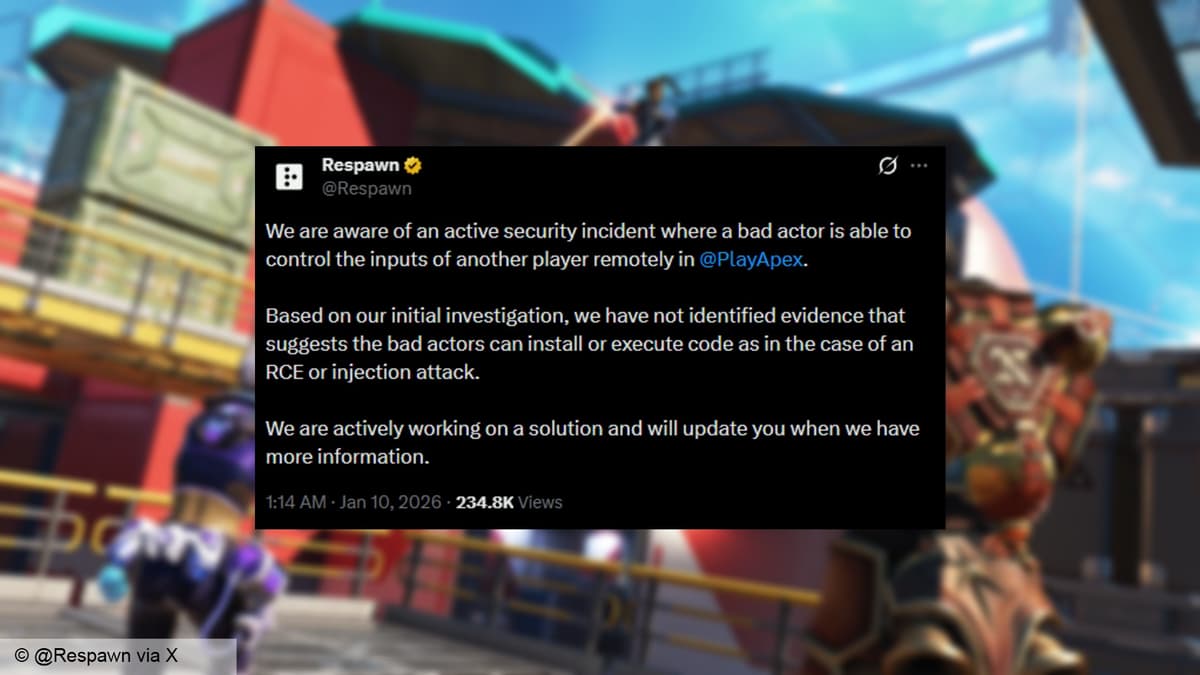
Late on January 9 Respawn posted: “We are aware of an active security incident where a bad actor is able to control the inputs of another player remotely in Apex Legends. Based on our initial investigation, we have not identified evidence that suggests the bad actors can install or execute code as in the case of an RCE or injection attack. We are actively working on a solution and will update you when we have more information.”
That’s useful but incomplete. Saying there’s “no evidence” of RCE is not the same as proving the exploit couldn’t do deeper harm — it just means initial checks didn’t find code execution on victims’ machines. The immediate, visible problem was gameplay control: players being kicked, their avatars continuing to move and shoot, and accounts showing altered names. Respawn says the issue was mitigated within a few hours, but the studio hasn’t published a post-mortem or technical write-up yet.
Player reports: forced disconnects, bot-like play, and avatar swaps
Community posts paint a chaotic picture. On Reddit one user described teammates being disconnected one by one while their characters continued to run and fight like AI puppets. When a hijacked avatar was killed, the next person in the squad would get booted and the cycle repeated. Victims who reconnected found their characters had moved across the map — proof someone else was controlling them in their absence.
There are also reports of hijacked characters getting renamed, and an eerie claim that a particular naming suffix — something like “tryingPC” — showed up tied to multiple incidents. That could be coincidence, or it could point to a pattern or a single actor — but community sleuthing isn’t a substitute for an official technical explanation.

Why “not RCE” doesn’t mean you should shrug it off
From a gamer’s perspective, losing control of your character is a huge deal: you lose matches, climb or ranking progress, and trust in the platform. From a security perspective, the distinction Respawn makes between input control and RCE matters, but it isn’t an all-clear. Input hijacks can be executed in different ways — malformed packets, man-in-the-middle manipulation, or abusing game-server logic — and some of those vectors could expose or rely on other vulnerabilities.
Respawn’s anti-cheat team has historically been in a constant cat-and-mouse game with cheaters. That’s normal for big multiplayer games, but players have a right to expect more transparency when the attack affects remote control of gameplay. A post-incident technical breakdown would tell us whether this was a server-side logic flaw, a client exploit, or abuse of account/session handling — and whether consoles or only PCs were affected.
What gamers should do right now
- Update the game immediately when patches appear and let clients fully restart.
- Run antivirus and integrity checks on your system if you noticed odd behavior — better safe than sorry.
- Change passwords and enable two-factor authentication on EA accounts if you suspect account-level tampering.
- Wait for Respawn’s full technical post-mortem before assuming your machine wasn’t affected beyond gameplay inputs.
Yes, this incident was fixed fast according to Respawn — six hours is a respectable response time — but “fixed” without details leaves room for mistrust, especially in a competitive title where every ranked match matters and reputations/earnings can be affected.
TL;DR
Someone found a way to remotely control other players’ inputs in Apex Legends. Respawn says it mitigated the problem within hours and found no evidence of arbitrary code execution, but players experienced forced disconnects and hijacked avatars. The studio needs to publish a technical breakdown so players can be sure the fix was comprehensive and that their systems are safe.
FinalBoss // Gear
Level up your setup
01Top-rated gaming headsetson Amazon→02High-refresh gaming monitorson Amazon→03Gaming chairson Amazon→04Discounted game keyson Kinguin→Affiliate links · As an Amazon Associate, FinalBoss earns from qualifying purchases.
Want to Level Up Your Gaming?
Get access to exclusive strategies, hidden tips, and pro-level insights that we don't share publicly.
Ultimate Gaming Strategy Guide + Weekly Pro Tips