
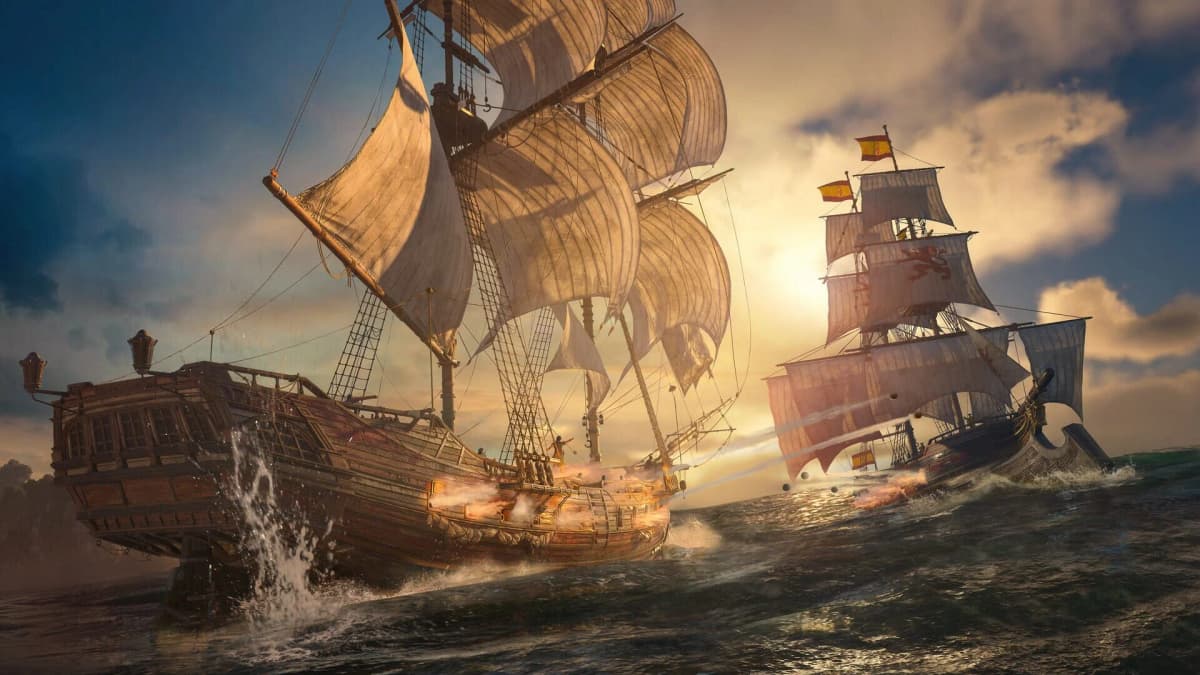
The 2013 codebase could not be carried forward into Assassin’s Creed Black Flag Resynced. Ubisoft rebuilt the game’s underlying systems for the current Anvil technology stack, including its rendering pipeline, assets, world streaming, stealth, combat, and physics. That is the material distinction behind the “ground-up” label: the Caribbean’s story and broad world design remain familiar, while the machinery running beneath them has been replaced.
For players, the upgrade is less about counting individual graphical effects than removing the seams that used to interrupt Black Flag’s rhythm. Sailing, docking, infiltrating a fort, escaping through a crowded street, and returning to the Jackdaw are meant to play as parts of one connected system. Whether that ambition holds up depends on frame-time consistency, animation response, and how well the remake’s modern mechanics sit inside an older open-world structure.
Table of Contents (9)
Resynced’s Technical Baseline
| Area | Resynced implementation | Direct player impact |
|---|---|---|
| Engine foundation | Modern Anvil build with a reconstructed codebase | Allows rebuilt rendering, animation, AI, physics, and streaming systems rather than layering upgrades onto 2013 technology. |
| Lighting | Ray-traced global illumination and reflections | More natural indirect light in interiors, more convincing wet surfaces, and stronger visual contrast between sun, shade, storms, and dusk. |
| Geometry | Micropolygon virtual geometry with aggressive detail streaming | Higher-detail cliffs, foliage, ships, and city structures with fewer abrupt level-of-detail changes at range. |
| World streaming | Unified Caribbean world with quality-based asset streaming | Major ports and cities can load as the Jackdaw approaches instead of breaking sailing flow with traditional docking loads. |
| PC storage path | DirectStorage support | Faster asset delivery from an SSD, reducing the risk of texture and geometry pop-in during rapid traversal. |
| Combat | Animation-driven hit detection and parry-focused encounters | Attack impacts, defensive timing, and rooted movement should align more closely with what is visible on screen. |
| Progression | Rope Dart available from Sequence 3 | More vertical assassination and chain-combat options through the middle of the campaign rather than near its end. |
| Platforms | PC and PlayStation 5 | SSD-backed runtime streaming is central to the remake’s seamless-world design. |
A New Anvil Foundation Matters More Than a Visual Pass
A remaster generally inherits the original game’s rules: its loading boundaries, animation assumptions, memory limits, and often its AI behavior. Resynced does not have that constraint. The game preserves Black Flag’s pirate-assassin premise, major locations, and mission framework, but its systems have been reconstructed around current hardware and a newer Anvil pipeline.
That gives Ubisoft room to alter the parts players feel but rarely see in a trailer. A character can transition between movement states more smoothly. A guard reaction can be attached to a modern detection system instead of a legacy trigger. A ship, a shoreline, and a dense city can coexist in memory without the hard hand-off that previously made each area feel like a separate stage.
The limitation is structural rather than technical. Black Flag’s campaign was designed around 2013-era pacing, navigation, mission scripting, and encounter density. A new engine can smooth the transitions and improve the controls, but it cannot automatically make every inherited mission idea feel contemporary. Reports on the finished remake point to exactly that tension: meaningful upgrades are present, while performance, pacing, cutscenes, quest flow, and navigation can still feel uneven when newer systems meet an older foundation.
World Streaming: The Docking Problem Has a Technical Answer
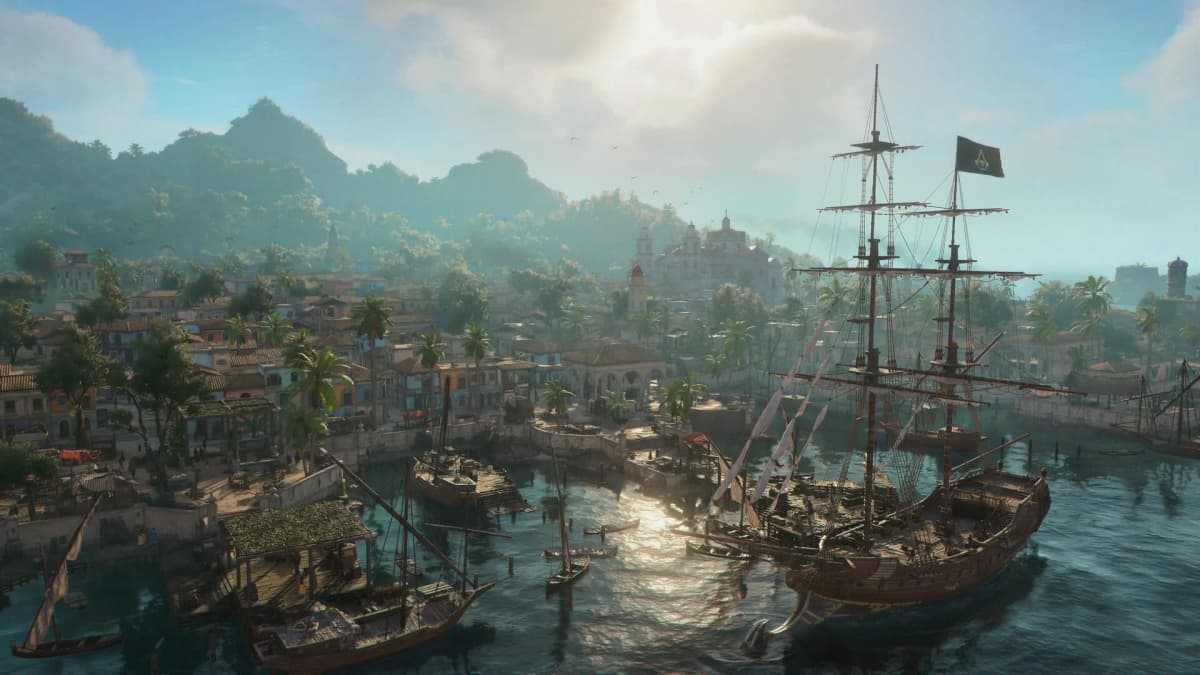
The most consequential change may be the least glamorous. Original Black Flag frequently treated major destinations as separate spaces. Reaching Havana or Nassau could end in a fade-out, a load, and a new playable area. Resynced’s Caribbean is built as a larger base world, with key cities and locations merged into the sailing space through streaming cells designed around sea travel.
The intended result is straightforward: approach a port, steer the Jackdaw into harbor, disembark, and enter city streets without a conventional loading interruption. That is important because Black Flag’s strongest loop has always been movement across scales. The game asks players to go from horizon-level exploration to ship combat, then to a rooftop route or a close-range assassination. Every forced transition weakens that loop.
Resynced’s streaming system also prioritizes visible image quality rather than relying only on distance. In practical terms, the engine can spend memory budget on the fort wall, ship mast, cliff silhouette, or city skyline currently defining the view, while reducing detail on minor objects that contribute little to the frame. The technique is designed to make distant landmarks resolve cleanly and to reduce the obvious geometry swaps that undermine a wide ocean vista.
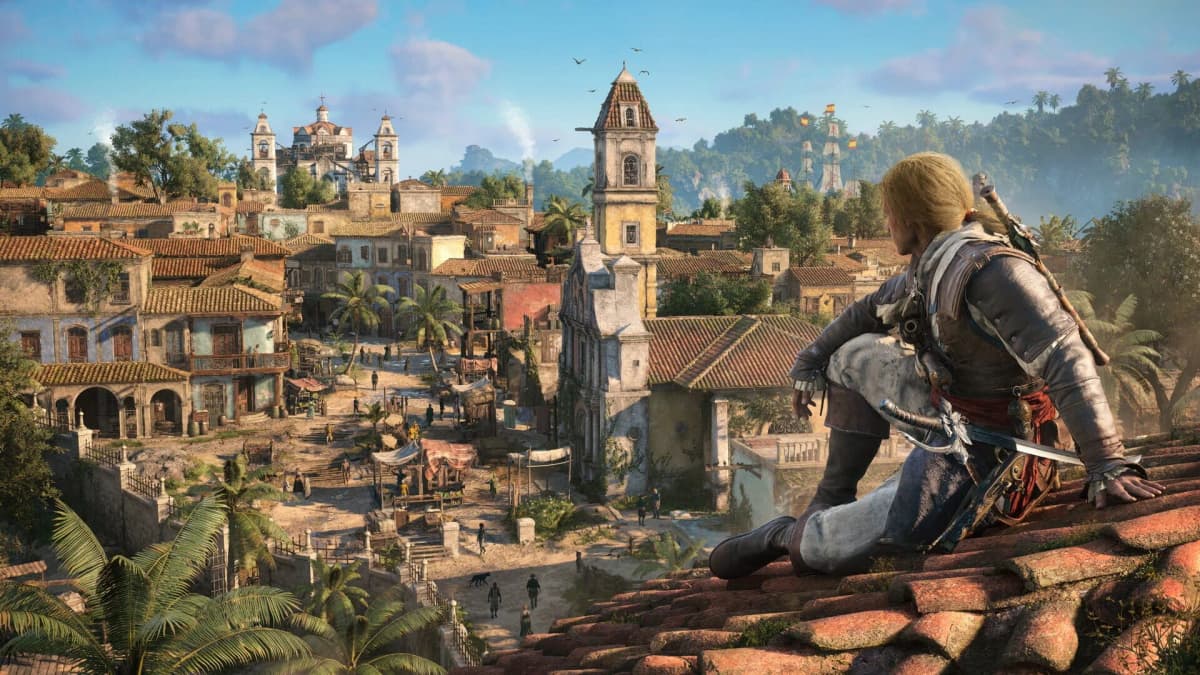
On PC, DirectStorage is part of that design. The feature allows the game to move and decompress asset data through a faster SSD-oriented path, easing CPU pressure during rapid movement. It does not make a slow storage drive perform miracles. A PCIe SSD, sufficient free drive space, and stable GPU drivers remain practical requirements for a game that expects to pull in city geometry, textures, crowds, water effects, and weather data while the player keeps moving.
What to Check During the First Major Sail
- Approach a major city from open water: distant walls, towers, masts, and streets should gain detail gradually rather than popping through several obvious geometry states.
- Dock without fast travel: the transition from ship control to land exploration should avoid a fade-to-black loading screen and should retain consistent frame pacing.
- Turn the camera quickly at the harbor edge: this is where late textures, missing geometry, and asset-streaming hitches tend to reveal themselves.
- Sprint from the dock into a dense district: crowd loading, shadow updates, and interior transitions should not produce repeatable stutters.
- Return to sea during bad weather: water, fog, rain, and distant land are a heavier combined test than a clear daytime sail.
Ray-Traced Lighting Changes Visibility, Not Only Screenshots
Ray-traced global illumination is the visual change with the clearest gameplay relevance. The original game relied on older baked lighting and screen-space techniques. Those methods could produce attractive scenes, but they had limited information about indirect light: the warm light reflected off a sunlit wall, the darkness deep inside a warehouse, or the relationship between a stormy sky and wet stone.
Resynced uses ray-traced global illumination for diffuse light and extended reflections. Diffuse lighting determines how illumination bounces around a scene. Reflections affect water, damp streets, ship hulls, and other reflective materials. Together, they should make the Caribbean’s lighting conditions more legible: a tavern interior should remain visibly distinct from a shaded alley, while a rainstorm should alter both the sea and the surfaces around a fort.
That matters for stealth because concealment works best when the environment communicates its rules clearly. A shadow needs to look meaningfully different from direct sunlight. A torch-lit corridor needs readable sightlines. If the lighting model is more coherent, the player’s visual read of exposure should be more trustworthy. The stealth system still has to communicate detection states cleanly through UI and guard behavior; realistic darkness alone does not solve a poorly explained alert model.
Water benefits from the same overhaul. Modern material work, GPU-driven simulation, dynamic weather, and ray-traced reflections should give calm water, rough seas, rain, foam, and ship wakes more distinct behavior. For a game built around the Jackdaw, that is not cosmetic filler. Sea state is part of the atmosphere, navigation read, combat presentation, and the sense of distance between islands.
Stealth and Combat: Better Animation Can Change the Entire Rhythm
Resynced’s stealth and combat systems have been rebuilt alongside the engine. The important technical shift is animation-driven interaction: attacks, parries, impacts, and enemy reactions are tied more closely to movement animation and contact frames. The purpose is to reduce the familiar mismatch where a character appears to connect, then the game’s response arrives late or lands somewhere that does not visually make sense.
Parry-focused combat places extra pressure on this system. Defensive action only feels fair when the incoming strike, the timing window, the sound cue, and the hit response agree. A combat model can have technically generous timing, but it still feels sluggish if the enemy animation obscures the moment that matters. Conversely, a tighter window can remain readable when attack wind-up, impact, and counter animation are synchronized properly.
The Rope Dart’s earlier placement in Sequence 3 is a more concrete gameplay consequence. In the original progression, that tool arrived much later. Moving it forward gives the middle stretch of the campaign more assassination routes and combat options, particularly in spaces with vertical structure or multiple enemies. It also makes the revised stealth and chain-combat systems relevant for a larger share of the game rather than reserving them for late progression.
The risk is that more responsive systems can clash with missions designed around older assumptions. If an encounter was originally paced for slower detection, simpler enemy states, or more rigid traversal, a modernized toolkit can expose the seams. This is where Resynced will be judged less on feature count and more on consistency: guard awareness, animation lock-in, camera behavior, and tool use need to support the same tempo.
The Practical PC and PS5 Considerations
PC players should treat SSD performance as part of the game’s baseline rather than an optional luxury. Runtime streaming is doing substantial work throughout the Caribbean, and slow storage can turn a seamless-world design into texture pop-in and frame-time spikes. Ray-traced global illumination also places a heavier load on the GPU than the original game’s lighting model, especially during storms, at sunset, and in dense ports where reflections, foliage, NPCs, and water all occupy the frame.
Frame pacing deserves more attention than a single average frame-rate number. Black Flag’s core loop involves long traversal, abrupt camera changes, dense city approaches, combat, and weather effects. A system that averages well but stalls while loading a city or rotating the camera will undermine the remake’s biggest promise. A stable frame-time graph during sailing and docking matters more than a benchmark taken in a static inland scene.
PlayStation 5 benefits from the same SSD-first design, with the platform’s storage path supporting fast reloads and continuous runtime asset delivery. The key test remains identical across platforms: dense locations should arrive without disruptive pauses, and the game should maintain responsive control while streaming the world around the player.
Pros and Cons of the Rebuild
What the Overhaul Means in Practice
Assassin’s Creed Black Flag Resynced has the technical profile of a remake rather than a remaster. The old game’s design has been transferred into a new Anvil foundation because the original code could not serve the current project. The strongest player-facing outcome is a more continuous Caribbean: fewer interruptions between ocean, port, city, interior, and combat space.
The rebuild is worth prioritizing for players who value Black Flag’s exploration loop and wanted its world to feel less segmented. Those returning mainly for the original campaign should expect familiar structure with more capable technology around it, rather than a wholesale redesign of every mission. On PC, install it on a fast SSD and evaluate performance during a stormy sail into a major city; that single sequence stresses nearly every system Resynced claims to improve.
FinalBoss // Gear
Level up your setup
01Top-rated gaming headsetson Amazon→02High-refresh gaming monitorson Amazon→03Gaming chairson Amazon→04Discounted game keyson Kinguin→Affiliate links · As an Amazon Associate, FinalBoss earns from qualifying purchases.
Want to Level Up Your Gaming?
Get access to exclusive strategies, hidden tips, and pro-level insights that we don't share publicly.
Ultimate Tech Strategy Guide + Weekly Pro Tips