
Table of Contents (8)
Open earbuds finally made sense to me in Counter-Strike 2
I’ve bounced off traditional in-ear buds for years. Every time I’ve tried to use them for PC gaming, it’s gone the same way: an hour of decent sound, followed by that creeping “get this silicone out of my ear canal” irritation. So I’ve stuck with chunky over-ear headsets even when I’d rather have something lighter and less sweaty.
The Asus ROG Cetra Open Wireless are the first gaming earbuds that seriously challenged that habit. They’re $230 open-style buds that rest on your ears instead of sealing inside them, with big 14.2mm drivers and a low-latency 2.4GHz dongle aimed squarely at PC (and handheld) gamers. On paper it sounds like a weird mash-up: a fitness-style, air-through “open” design married to PC-grade positional audio and a gaming price tag.
Putting them through their paces meant jumping into my usual audio torture chamber: Counter-Strike 2. If an audio setup messes up positional cues, footsteps through smokes, or subtle reload sounds behind a wall, you feel it immediately in CS2-usually on the death screen.
What surprised me is how quickly the Cetra Open Wireless went from “this feels strange” to “I don’t want to take these off,” especially during long CS2 sessions. They’re not perfect, and the asking price is high, but they fill a niche I didn’t realize I’d been waiting for.
Fit and design: more running buds than RGB gamer bling
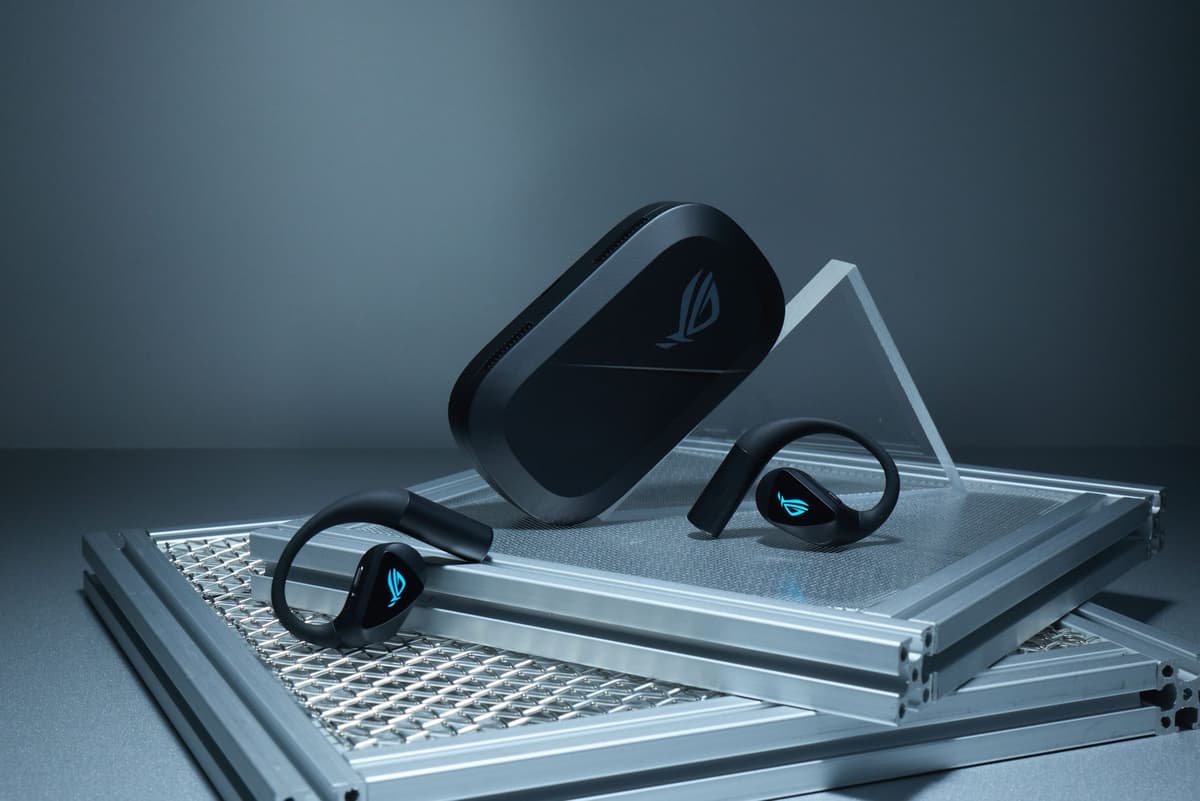
Out of the case, the Cetra Open Wireless don’t scream “gamer” the way a lot of ROG gear does. They look more like sport earbuds: small, curved houses that sit just outside your ear canal with a soft ear hook that loops around the top of your ear. No silicone tips, no deep insertion, nothing wedged in your head.
The first time I put them on, my brain did that double-take it always does with open earbuds: “Wait, is that it? Are they actually on properly?” You don’t get that suction or seal you’re used to from in-ears. Instead it feels like a very lightweight object gently braced against your ear. After a few minutes of poking at them and adjusting the hooks, I stopped thinking about the fit at all-which is really the best compliment you can give any audio gear.
Comfort-wise, they hit the exact audience Asus is clearly targeting: people who hate anything burrowing into their ears, or who want something they can wear for hours without heat build-up. I did a full evening of CS2, some browsing, and a bit of YouTube without that itchy, pressurized feeling I get from normal buds. Over-ear headsets still distribute weight better for truly marathon sessions, but these are so light that ear fatigue just wasn’t a factor.
The ear hooks are doing a lot of the work here. I shook my head around, bent down to plug cables in behind my PC, and even did a quick test run on a treadmill. They stayed put the whole time. Combined with the IPX5 water resistance rating, they’re very obviously meant to double as running or workout buds, not just “sit at a desk and stare at a monitor” gear.
One thing I really appreciated: physical buttons. Each earbud has a small clickable button instead of those vague capacitive touch zones that love to trigger when you scratch your head. The buttons are tiny and need a bit of accuracy, but once I got used to the layout, media control and volume tweaks became muscle memory.
The chunky case and clever 2.4GHz dongle
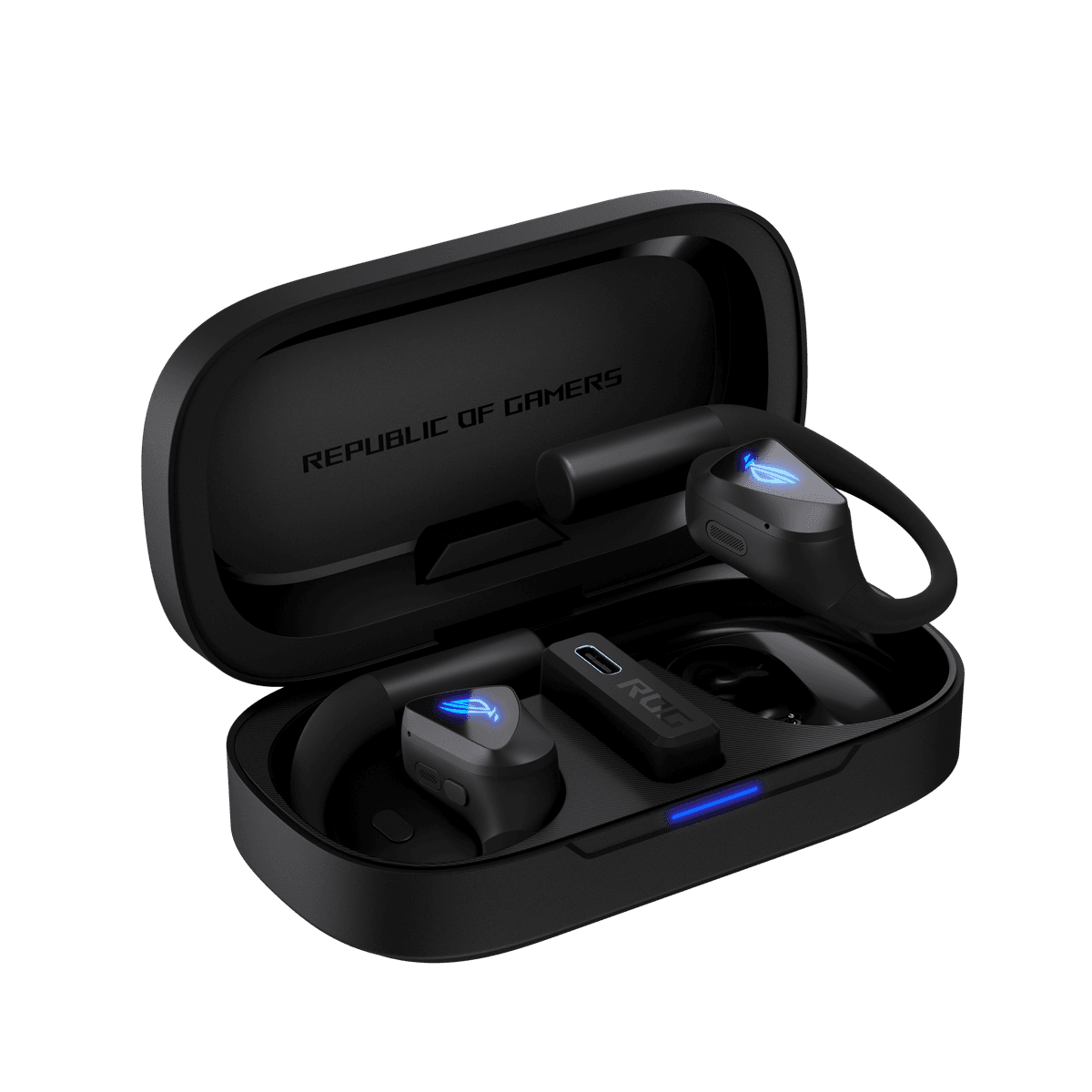
The price of that open, hooky form factor is a chunkier case than you might expect. It’s longer than a typical true wireless case, more like a small glasses case than a pillbox. It still fits in a pocket, but we’re talking hoodie or coat pocket, not skinny jeans.
Inside, the earbuds lie flat, magnetically snapping into place. There’s a central cavity where the real star of the show lives: the USB-C 2.4GHz dongle. Asus built a passthrough USB-C port into the dongle itself, so if you plug it into the front USB-C on your PC or into a phone/handheld, you don’t “lose” that port-you can still charge through it.
That tiny detail sounds minor, but in actual use it mattered. I had the dongle living in the front USB-C of my desktop, where ports are at a premium, and I could still charge a gamepad or phone through it. It’s also perfect for handhelds like the Steam Deck or ROG Ally style devices, where you want low-latency audio without sacrificing charging.
The overall build feels very “good plastic” rather than “luxury metal.” There’s some light ROG branding, but nothing so aggressive you’d be embarrassed to pop these out in a café. Asus clearly prioritized function over fashion here, which I’m okay with at this price, but it’s worth knowing these don’t feel quite as premium as some similarly-priced lifestyle buds from the likes of Sony or Bose.
Connectivity and features: low-latency where it counts
The headline spec for PC and console players is the 2.4GHz wireless connection, alongside Bluetooth 5.3. You can keep the dongle plugged into your PC and still pair your phone over Bluetooth, with two connections running at once. For me that meant CS2 audio over 2.4GHz and Discord on my phone over Bluetooth, which worked exactly how you’d want: game audio first, but phone notifications and calls still coming through.
Latency on the 2.4GHz link felt indistinguishable from a wired setup. I tried the usual test of spam-clicking guns in CS2 while watching muzzle flashes and listening for any delay, and nothing jumped out. Swapping to straight Bluetooth, the lag was more noticeable in games (as expected) but completely fine for music, videos, and podcasts.
Battery life is one of the Cetra Open Wireless’s hidden strengths. Asus rates the buds at up to 16 hours on their own, with the case adding another 48 hours, for a total of 64 hours if you’re not hammering the mic and RGB. With everything on—mic active, lighting enabled, 2.4GHz running—I landed closer to the 8-10 hour mark per charge on the buds, which still covered a full day of mixed use.
Wear detection is another “once you have it, you miss it everywhere else” feature. Pull a bud off and your audio auto-pauses. No more taking your earbuds out to answer the door and coming back to realize your podcast has sprinted three episodes ahead.
Counter-Strike 2 with an open soundstage: surprisingly legit
Here’s where things got interesting. Open earbuds are usually fun for music and background listening, but competitive shooters are unforgiving. I went in expecting to enjoy the comfort and then quietly plug my wired headset back in when ranked play started. That didn’t happen.
The combination of a very open presentation and those 14.2mm diamond-like carbon drivers produced a soundstage that felt wider than most in-ear options I’ve tried. On Mirage, standing in CT spawn, I could easily distinguish footsteps from top mid versus underpass versus cat. The “left/right” imaging was precise, but there was also a good sense of distance—enough that I could tell if someone was near bench in B apps or just rotating through T apartments.
Directional audio through smokes and over utility felt tight as well. One specific moment that sold me: playing Inferno, anchored A site, full execute coming in. Smoke blooms on Long, flashes over, full chaos. Normally I’m relying hard on my headset’s staging to decide whether someone slipped through the smoke to Pit or faked and fell back. With the Cetra Open Wireless, the difference between a player hard-pushing Long and shuffling back towards Top Mid was crystal clear. I didn’t feel like I’d sacrificed any information compared to my usual over-ears.
Footstep clarity is where a lot of bassy gaming headsets fall apart—they smear the low end so badly that everything turns into a mush of thumps. The Cetra Open Wireless walk a fine line. There’s definitely a warm tilt to the sound, but midrange cues like reloads, scope toggles, and ladder movement still cut through cleanly in CS2.
The bigger trade-off isn’t the tuning; it’s isolation. Because these are open and sit outside the canal, you hear your room. Keyboard clacks, fans, roommates talking, traffic if your window’s open—all of it bleeds in. In my quiet office that was actually a bonus; I could hear someone call my name without ripping the buds out. In a loud house or cramped LAN environment, though, that background noise will absolutely eat into your ability to pick subtle audio cues.
Music and everyday listening: purposeful, not party earbuds
Outside of games, I fed them what I usually use to test new audio gear: a mix of classic rock, prog, and some jazz fusion. The bass was the first pleasant surprise. For open-style buds that don’t seal, they have more low-end heft than you’d expect.
On Rush’s “YYZ”, the kick drum and bass lines had a satisfying punch. You’re not getting the sub-bass rumble you’d feel from a good pair of over-ear planars, but there’s a firm, supportive weight that keeps the music from sounding thin. Mids sit slightly forward—vocals and guitars on Marillion tracks came through with good clarity—and there’s enough treble sparkle on something like Steely Dan’s “Do It Again” to keep cymbals and keys alive without turning harsh.
I’d describe the overall tuning as “purposeful” more than “exciting.” These aren’t super-V-shaped, club-ready buds. They feel voiced to keep footsteps and voices intelligible first, with enough fun baked in for music when you’re off the clock. If you’re into bass-head EDM or want your skull rattled, they’ll underwhelm. If you want a clean, slightly warm sound that doesn’t fatigue, they strike a smart balance.
One unexpected upside of the open design for music and podcasts: no “occlusion effect.” You don’t hear your own chewing or footsteps booming inside your head the way you do with sealed in-ears. Walking around the house listening to a podcast felt closer to wearing lightweight on-ears than earbuds.

Mic quality, leakage, and being a decent human on the train
The built-in microphones land in that “better than average gaming earbuds, worse than a proper boom mic” zone. In Discord calls, teammates said I sounded clear and natural, with only a bit of compression when I spoke quietly. It’s absolutely fine for in-game comms and work calls, and noticeably better than some other true wireless gaming buds I’ve tried, which can get very thin and hissy.
Despite the open nature, sound leakage wasn’t as bad as I expected. At normal listening volumes, you’d have to be sitting quite close to hear anything intelligible. If you crank them to “this is hurting me” levels, sure, someone a couple of feet away will hear your music, but at that point your hearing is the bigger problem. For commutes or shared office use, used sensibly, they’re not the obnoxious “phone speaker” guy.
Price, competition, and who these are really for
Here’s the hard part: the ROG Cetra Open Wireless cost around $230. That’s a premium price for earbuds that don’t have noise cancellation and intentionally leak sound in both directions.
At the same or lower price, you can grab:
- More conventional gaming buds like the SteelSeries Arctis GameBuds, with a sealed in-ear fit and similarly low-latency modes.
- Excellent ANC lifestyle buds from Sony or Bose that smash these for isolation, flights, and commuting.
- Even some decent wired or wireless over-ear gaming headsets with dramatically larger drivers and more “cinematic” sound for single-player titles.
So where do the Cetra Open Wireless make sense?
- You hate in-ear tips or get discomfort from them. If that’s been the main thing keeping you on heavy headsets, these immediately jump way up the list.
- You want awareness of your surroundings. Kids in the house, doorbell, partner talking to you—these let in just enough of the real world that you can respond without yanking them off.
- You game and exercise with one device. The ear hooks, IPX5 rating, and secure fit make them genuinely usable for running or gym work, then you can sit at your PC and swap to 2.4GHz for CS2.
- You value soundstage and imaging over isolation. For competitive shooters in a controlled environment, the width and positional accuracy are legitimately impressive.
If you don’t tick at least two of those boxes, the value proposition gets shakier. For most people simply wanting “good wireless earbuds for games and music,” a more conventional, cheaper in-ear option is going to be easier to recommend.
FinalBoss // Gear
Level up your setup
01Top-rated gaming headsetson Amazon→02High-refresh gaming monitorson Amazon→03Gaming chairson Amazon→04Discounted game keyson Kinguin→Affiliate links · As an Amazon Associate, FinalBoss earns from qualifying purchases.
Want to Level Up Your Gaming?
Get access to exclusive strategies, hidden tips, and pro-level insights that we don't share publicly.
Ultimate Editor's Pick Strategy Guide + Weekly Pro Tips