

Battleplan turns D-Day into a pencil-and-map RTS — promising, bold, and risky
Game intel
Battleplan
Where fun meets chaos: Set in Pixel Vault's mashup universe, step in, apply your strategy and compete in our 3v3 auto-battler.
Why this caught my eye
Every WWII RTS claims to put you “in the general’s seat,” but Battleplan is the first recent game to actually build its core around that fantasy: you draw your plan on an authentic map and then fight to make it work. Slitherine and Foolish Mortals Games showed a full opening mission on Twitch, and as someone who plays a lot of strategy-everything from Steel Division 2 to Panzer Corps 2-this one immediately pinged my radar. It’s operational-scale decision-making with a tactile twist, and that’s not something we see often in a genre obsessed with micro and twitchy APM.
Key Takeaways
- Draw-to-command is a legit mechanic, not a UI skin-your arrows become movements, barrages, and axes of advance.
- Operational focus (divisions, not squads) could make this more about intent and timing than micro.
- 11 Western Front missions, veterancy, officers, requisition points: progression matters across the campaign.
- Big unknowns: AI interpretation of plans, pathfinding in bocage, and whether “accessibility” survives late-game chaos.
Breaking down the announcement
The Twitch premiere walked through the opening mission and laid out Battleplan’s loop. You start with an intel briefing and a wide, archival-map view of Northern France. Instead of placing waypoints or cycling menus, you literally sketch arrows to plot troop movements, mark artillery targets, and define offensive lines. Then the battle starts. Your intent is translated into orders, and you react in real time—merging or splitting divisions, grabbing high ground, calling recon flights, sending fighter-bombers to crack armor, or ordering carpet bombing to soften fortifications. Day-night cycles tweak visibility and pacing, which is a clever, underused pressure valve in real-time operations games.
Progression carries across 11 historical missions—from Cherbourg and Caen to the Bulge and the push into Germany. Divisions gain veterancy, officers unlock abilities, and losses must be replenished. You can spend requisition points on historic formations or roll your own, which hints at genuine list-building decisions rather than a static puzzle. The maps lean on real archives, with period photos pinned to their approximate locations. It’s an immersive touch, and it fits Foolish Mortals’ DNA; if you played Radio General, you’ll recognize the love for maps-as-theatre and the idea that a commander’s best weapon is information.
The real hook: intent over micro
What makes Battleplan interesting is not just the pencil gimmick—it’s what the pencil represents. At operational scale, your biggest skill isn’t selecting the right grenade; it’s setting a tempo, choosing objectives, and staging logistics so your plan hits hard without stalling. Too many WWII RTS games (and I enjoy them!) devolve into whack-a-mole micro even when the scope says “armies.” Drawing a plan forces the game to respect intent first, execution second, and that could dramatically change how we play.
It also sidesteps a classic barrier to entry. If Battleplan translates good arrows into sensible movements, newcomers can focus on understanding the map and objectives instead of struggling with 50 hotkeys. That said, “accessible” isn’t automatic. The moment your perfect arrow meets a blocked road, a stubborn strongpoint, or a panzer counterstroke, the simulation needs to adapt without collapsing into click spam. The line between “I’m a general” and “I’m fighting the UI” is razor thin.
Where it fits in the genre
Slitherine’s audience spans grognards who live in combat results tables and players who just want a clean, readable fight (see Panzer Corps 2, Battlesector, Starship Troopers: Terran Command). Battleplan looks like the middle ground: the historical heft and operational choices without drowning you in counters and hexes. Compared to Company of Heroes, this is a bigger-picture game; compared to Steel Division 2, it looks less about unit micro and more about the geometry of an operation—how you shape a salient, where you punch a corridor, when you rotate exhausted divisions out of the line.
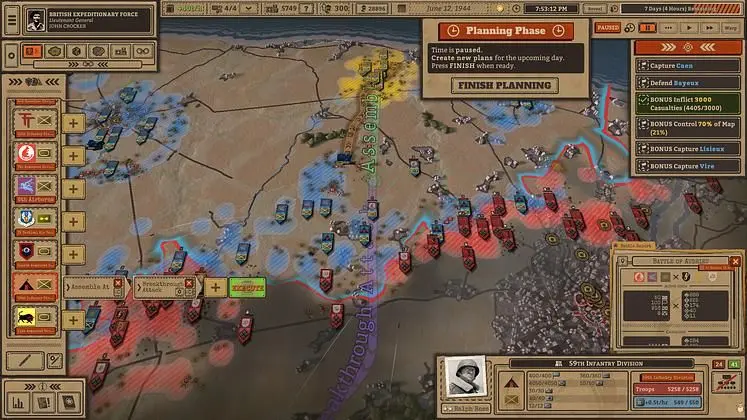
Foolish Mortals also has form here. Radio General used maps and voice commands to immerse you in command-by-briefing. Kaiju Wars showed they can stylize systems in readable ways. Battleplan feels like a synthesis: map-first UI with a clearer real-time layer. If the team nails AI behavior and pathfinding, this could carve out a niche that’s been weirdly empty since most WWII titles slid toward either hardcore WEGO sims or micro-heavy skirmish RTS.
Want to Level Up Your Gaming?
Get access to exclusive strategies, hidden tips, and pro-level insights that we don't share publicly.
Ultimate Gaming Strategy Guide + Weekly Pro Tips
Questions that will make or break it
- Plan interpretation: When I draw a sweeping envelopment, does the AI understand phases and synchronization, or do my divisions simply trace the line and die piecemeal?
- Pathfinding in the bocage: Normandy’s hedgerows break lesser games. Will units reroute intelligently around blocked lanes, traffic jams, and contested crossroads?
- Fog of war and recon: Recon flights sound great, but can they meaningfully alter your picture—or are they just cooldowns on a timer?
- Pacing and pause: The demo showed real-time adaptation. Is there pause-and-plan for deep thinkers? If not, how does the game keep intent legible when the front erupts?
- Campaign economy: Requisition points and replacements imply scarcity. Will the game reward cautious, historical tempo—or push players into arcade aggression?
I like the stated philosophy. As Slitherine’s Marco Minoli put it, the team wants you to feel the weight of command. That resonates. But feeling like a general depends on trust: if the game consistently executes reasonable intent from my map sketches, I’ll buy in. If I spend half my time redrawing arrows because units don’t respect roads, supplies, or formation integrity, the pencil becomes a gimmick.
Looking ahead
Right now, Battleplan is wishlistable on Steam with release details “coming soon.” That’s fine—better to show a mission early and stress test the concept in public than hide behind boilerplate. If Slitherine and Foolish Mortals take feedback on AI behavior, UI legibility, and late-game clarity, this could be the rare WWII RTS that actually rewards operational thinking. And if they go the extra mile—proper after-action reports, phase lines, timed objectives, and a planning layer you can iterate on—the pencil might become the most powerful weapon on the Western Front.
TL;DR
Battleplan’s draw-to-command idea is fresh, tactile, and exactly the kind of perspective shift WWII RTS needs. The concept works on paper—now the AI, pathfinding, and campaign economy have to prove it on the battlefield.