
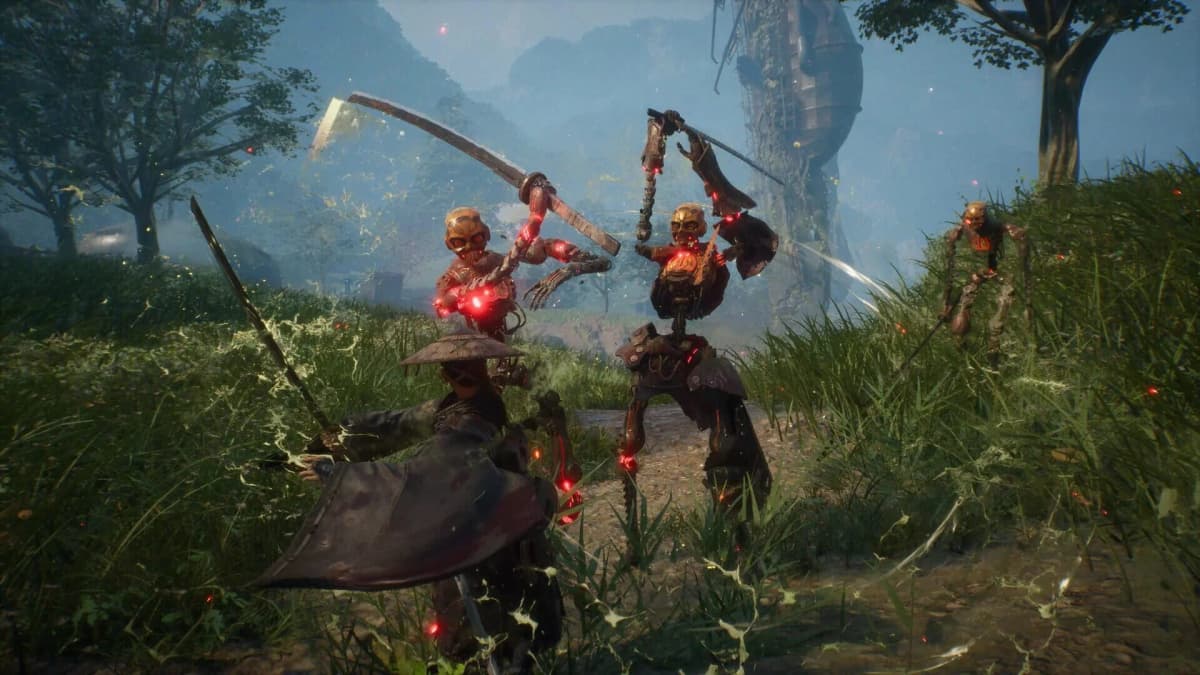
Game Freak has made non-Pokémon games before, but not recently and not at this size, so Beast of Reincarnation arrived carrying a question it never asked for: can the most profitable studio on earth build something that isn’t a monster-collecting RPG? The answer is strange. There is a real combat system here, and it’s theirs, not a Sekiro tribute act. There is also a twenty-hour game built out of roughly ten hours of content, and you feel the seams from the third zone onward.
The setup: post-apocalyptic Japan, ruined by a corruption called the Blight that turns living things into monsters known as Malefax. You play Emma, who is Blight-stained — shunned by what’s left of society, useful to it precisely because the Blight can’t finish the job on her. She travels between zones aboard a mobile home base that walks around on legs, hunting the region-sized Malefax called Nushi and absorbing their Blight to face the title creature, which resurrects every hundred years no matter how often it’s killed. Koo, an enormous dire wolf, comes with her. Kagura cooks. The lore is better than the story told on top of it: the golems you spend the game cutting apart are people, human souls poured into machine bodies to escape the apocalypse.
Table of Contents (5)
The Parry Is a Currency, Not a Defence
Here’s the part worth stealing. There is no stamina bar. Instead there’s a row of flower-petal charges along the bottom of the screen, and everything expensive — the finishers, the bloom arts you buy on the skill tree — spends them. Attacking fills the meter slowly; blocking or getting hit drains it. A perfect parry fills a whole charge instantly and triggers the effect bolted to whichever sword you’re carrying, because every blade has its own on-parry payload: an element, a status ailment, a buff. So the parry isn’t the option you take when you’re scared. It’s the economy.
When that loop closes it’s genuinely great, and Koo is the clearest sign of who made this. He fights on his own using passive skills you equip, but you can also pause the action and pick an ability from a menu — the Final Fantasy VII Remake gesture executed with a very Pokémon sensibility. You can order him to assassinate a target outright, which chews a startling chunk off a boss health bar, and he learns new skills by researching them after you kill elite enemies, research that advances by enemies killed rather than by a clock.
There’s a real disagreement about how demanding the parry window is, and resolving it decides who should buy this. Some players find it so forgiving that ordinary encounters collapse into a rhythm game with no failure state; others find the perfect-parry timing fussier than it needs to be. Both are right, and the meter explains why: a normal deflection is easy and does almost nothing for you, while the perfect one — the version that refills a charge and fires your blade effect — is tight.
Around that sit a crossbow and a bow with swappable ammunition, a skill tree that turns ranged weapons into tracking, piercing, chain-lightning nonsense, and a stealth mode with sneak-attack kills that isn’t a full playstyle but gets you over the game’s one real difficulty hump. Amber, the upgrade currency, isn’t dropped on death.
Then It Runs Out of Enemies and Keeps Going
The bestiary is roughly three or four robot archetypes and three or four beasts, and the robots barely differ: an archer, a basic sword golem, a big samurai who will genuinely hurt you, a dual-katana version who will hurt you faster. You have met all of them inside the first two hours, and nothing new arrives afterwards. That’s the quiet catastrophe here, because the skill tree keeps handing you arts for a combat puzzle that has stopped changing.
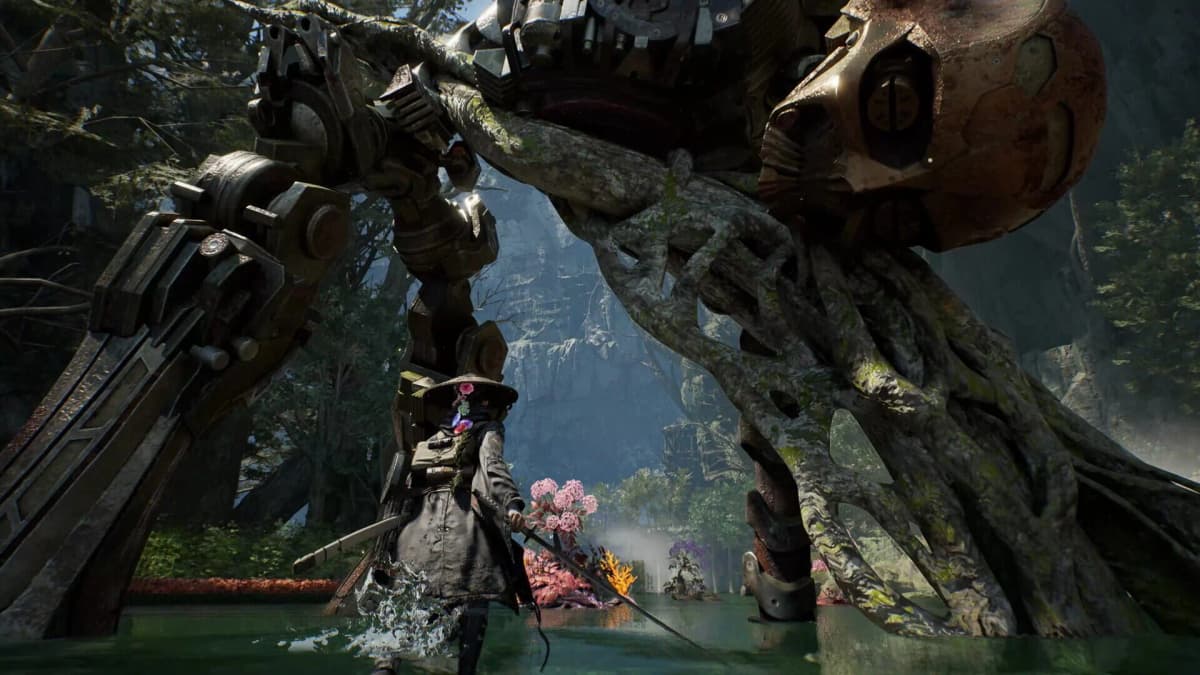
The bosses are worse. Most Nushi are enlarged versions of beasts you already fight, and almost every one has a second phase — justified in-fiction as the Malefax pulling in more Blight as it weakens — that reuses most of the first phase’s moveset. You are routinely made to fight a boss partway through a zone and then fight the identical creature again at its end; the opening chapter has you kill the same giant elk repeatedly while it uses essentially one attack. By the second half the game stops pretending and drops in bosses you have already killed, at a higher level, same animations, same transition. Across a full completion run only about three bosses are fought exactly once.
Environments follow the same curve. The first zone is the best area in the game — big, genuinely explorable, full of reasons to go sideways — and completely unrepresentative. What follows is wide but linear canyons, quarries and factories with the occasional short branch, all in the same overgrown-ruin palette until a wasteland and a late city change the colour. One late level looks enormous and turns out to be a three-kilometre cable-car ride where you stand still and look down at geometry that exists to be looked down at.
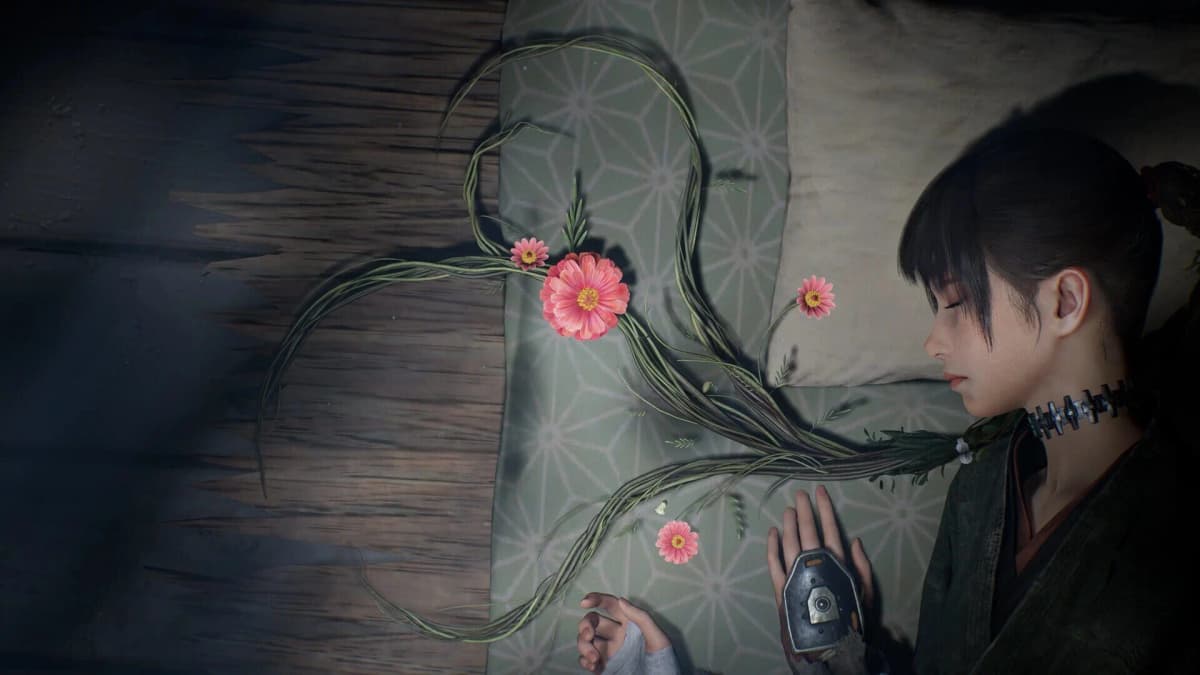
Traversal is the thing that improves rather than decays. Emma’s hair is the toolkit: a grapple line, a vine walkway you extend to bridge a gap, and a held jump that grows a vine plinth to lift you rather than double-jumping. It takes an hour to stop fighting it, and routing efficiently around a zone is the one skill the game keeps rewarding. Exploration feeds it — forty dragon shrines, each ten of which buys an extra healing charge; lock boxes opened by a directional-input mini-game or by a code you get off a nearby elite; upgrade parts that unlock the base facilities you need before you can meaningfully improve your blades. And cooking is a real system: the first time Kagura serves a dish, the stat bonus is big enough that skipping it is a mistake.
Where the Challenge Goes
You get Easy, Normal and Hard from the start, and what they adjust is how much damage you take. On Normal the opening is legitimately punishing; then you cross a threshold, your build comes online, and the game stops resisting for the rest of its length. Beating it unlocks Reincarnation, the New Game Plus difficulty, which scales enemy attack power but leaves enemy health alone — while you keep the absurd post-game abilities you just earned, mostly cheap area-of-effect explosions. The result is a “harder” mode that is easier than the first run.
The story does eventually go somewhere, and that isn’t faint praise: the last stretch is the best writing in the game. But it arrives after fifteen-plus hours of unskippable cutscenes with flat performances, a second bout of amnesia layered on the first, a ghost girl who isn’t there, an unaccountable volume of dialogue about food, and a fade-to-black-then-wake-up-in-bed cadence after nearly every boss. A story that only works if you endure four-fifths of it on faith hasn’t really worked.
Length, Price and Platforms
It’s $60 for the base game and $70 for a deluxe edition whose skins and progression trinkets aren’t worth the difference. Length is genuinely contested — estimates run from about twenty hours to closer to thirty-five — and the gap is real, because how long this lasts depends on how much optional collecting you keep doing after the rewards stop mattering.
Performance varies by platform. On a high-end PC it runs well, though the Steam reviews fill up with complaints from weaker machines, and there’s a persistent bug where the game crashes during story cutscenes often enough to force repeated restarts; switching cinematics to the 24fps Cinematic Mode option reduces it without ending it. Xbox was the disaster — at launch, effectively unplayable at single-digit frame rates, and it needed a patch to fix a state it should never have shipped in. PS5 is reported to be fine, but we haven’t tested that build ourselves. Steam Deck is officially Unsupported and won’t launch; the Steam Machine is officially Verified and, in practice, also won’t launch.
Two things are worse than the frame rate. The image is persistently, oddly blurry in a way that looks baked into the renderer rather than into a setting you can switch off, and the lighting is either fully on or fully off — blown-out god rays and cave shafts that white out the space you’re exploring. And the combat camera is bad: it swings constantly, never recentres, and the stick that moves it also switches lock-on targets, with no option to rebind. Against a large boss with adds, the lock-on grabs a head you can’t reach and you swing at air.
Proof of Life, or a Competent Soulslike With Nothing to Say?
I’ll take a side. This isn’t Game Freak proving it can build a game outside Pokémon — it’s Game Freak proving it can design a system. The parry-as-currency economy, the way Koo’s gauge charges off your own aggression, the on-parry blade effects: that’s original, coherent design work any studio would be glad to have invented. Everything wrapped around it — level design, bestiary, boss roster, pacing, image quality — is the output of a team that ran out of time or money and padded to a runtime instead of finishing. The system deserves a sequel. This game is the pitch deck for it.
Beast of Reincarnation
The parry-as-currency system and Koo’s kit are good enough to carry a game roughly half this long, and that’s the 7. Everything else is on a downward curve: the bestiary is exhausted in two hours, the Nushi start repeating outright in the second half, the zones settle into the same overgrown palette, and the image quality and combat camera are the kind of problems a patch doesn’t reach. The last stretch of the story is genuinely good. Getting there is the price.
- Perfect parry refills charges and fires blade effects
- Koo is a real partner, not decorative AI
- Hair-vine traversal that keeps rewarding practice
- Amber isn’t lost on death; cooking bonuses matter
- The final act finally earns its premise
- Whole bosses copy-pasted in the second half
- Seven or eight enemy types for twenty hours
- Combat camera shares a stick with lock-on
- Persistent blur and blown-out lighting
- Cutscene crashes on PC; Steam Deck won’t launch
Buy it for the combat system and the wolf. Wait for a sale if you need the world, the story, or the frame rate to hold up alongside them.
FinalBoss // Gear
Level up your setup
01Best-selling PS5 gameson Amazon→02DualSense controllerson Amazon→03PS5 SSD upgrades (M.2 NVMe)on Amazon→04Discounted game keyson Kinguin→
Affiliate links · As an Amazon Associate, FinalBoss earns from qualifying purchases.
Want to Level Up Your Gaming?
Get access to exclusive strategies, hidden tips, and pro-level insights that we don't share publicly.
Ultimate Reviews Strategy Guide + Weekly Pro Tips