
Table of Contents (12)
Big Hops Review – A Tiny Frog With Huge Momentum
The exact moment Big Hops clicked for me was about an hour in, when I accidentally strung together a wall-run, a tongue swing, a mid-air belly slide, and a last-second climb onto a floating island I probably wasn’t “supposed” to reach yet. Instead of punishing me, the game just… let it happen. No invisible walls. No fail state. Just a little frog named Hop, standing there like, “yeah, you pulled that off.” That’s when I realized Big Hops isn’t just a cute 3D platformer – it’s a full-on celebration of movement freedom.
Developed and published by Luckshot Games, Big Hops is a modest-sized 3D platformer that dares to stand shoulder-to-shoulder with the genre’s heavyweights. It wears its inspirations openly – you’ll see shades of Super Mario Odyssey, Super Mario Galaxy, Breath of the Wild, and even Titanfall – but it never feels like a knockoff. Instead, it cherry-picks what works, then wraps it all in its own strange, heartfelt story about a frog who just wants to see the world… and then go home again.
Key Takeaways
- Movement-first design: Wall-running, climbing, grappling, and sliding feel instantly natural and deeply satisfying to chain together.
- Traversal “toys” are the star: Fruit- and seed-based gadgets turn every level into a sandbox puzzle you can tackle your own way.
- Combat-light, platforming-heavy: Aside from a few bosses, it’s you vs. the environment – no enemy gauntlets, just pure movement challenges.
- Flexible progression system: Dark Drips and trinkets let you tune difficulty and playstyle, though a proper loadout system is sorely missed.
- Story shines in small arcs: World-level fables land well, but the overarching plot with Diss wobbles near the end.
- Occasional missteps: A mine cart sequence and brief design constraints clash with the game’s otherwise joyous freedom.
First Impressions: Mario DNA in a Frog’s Body
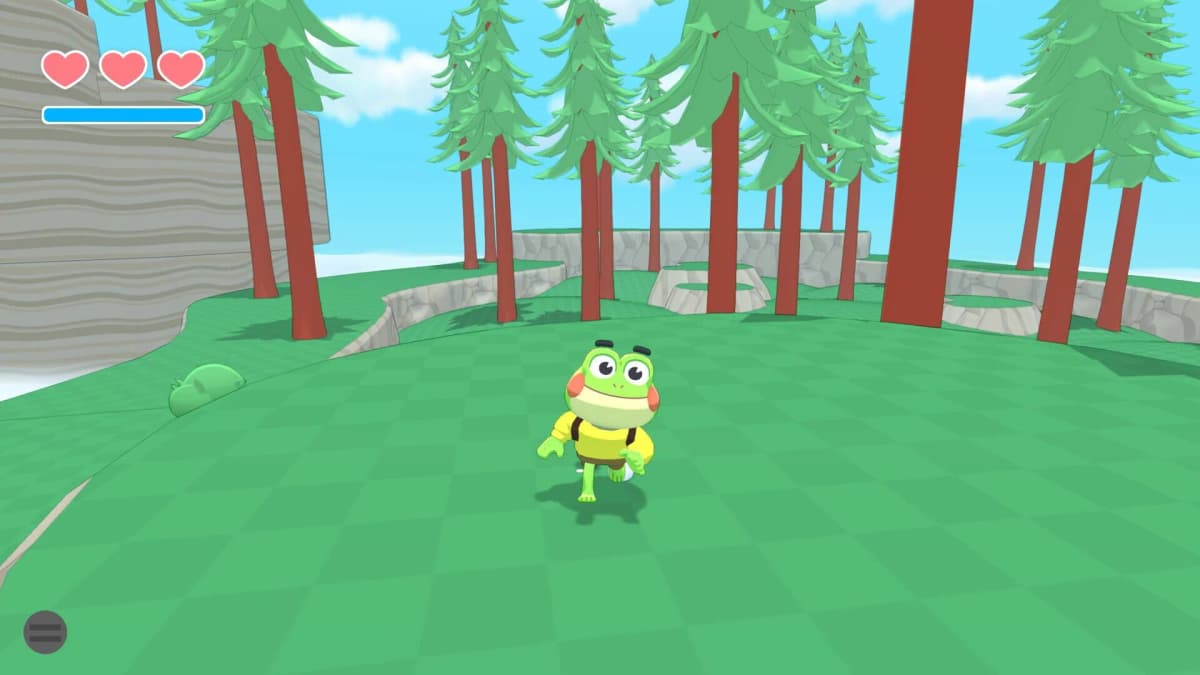
From the first few minutes in Hop’s cozy little forest home, the inspirations are loud and clear. The way Hop accelerates into a run, the arc of his jumps, the satisfying thump of his belly slide – it all immediately reminded me of Mario in Super Mario Odyssey. That’s high praise, and Big Hops earns it.
But the game doesn’t stop with Mario-style platforming. Almost right away, it starts layering on mechanics that feel pulled from some of the best movement systems in games:
- Wall-running that evokes Prince of Persia or Titanfall, letting you dash along vertical surfaces with just enough leniency to feel cool, not frustrating.
- Freeform climbing on almost any surface, clearly inspired by The Legend of Zelda: Breath of the Wild, complete with a stamina meter that governs how long you can cling.
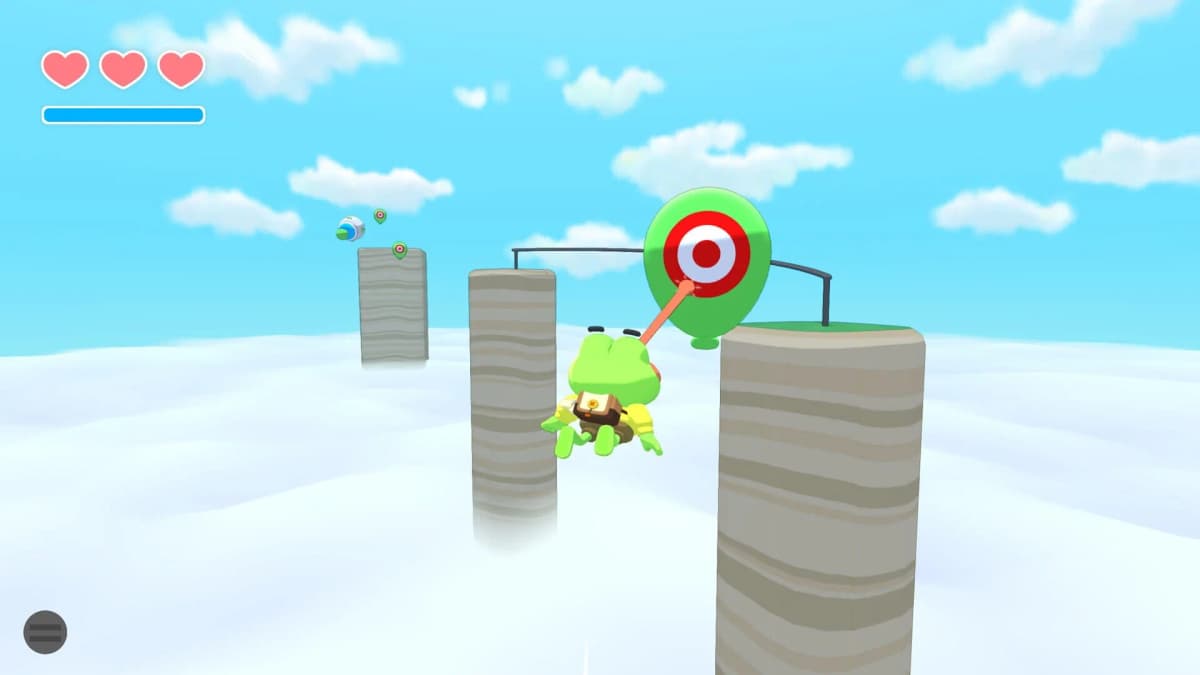
- A grappling tongue that doubles as a swing, a hook grab, and a long-range grab for bugs and fruit.
- A belly slide that isn’t just a flourish – it’s a serious movement tool for maintaining momentum.
The striking part is how quickly it all feels natural. Within the first hour, I wasn’t thinking “now I’ll wall-run” or “now I’ll tongue grapple.” I was just moving. Hopping up a cliff, slingshotting across gaps, catching a ledge at the last second with a climb – it’s a suite of moves that hums when you start linking them together.
The Void, Diss, and Stories That Don’t Wrap Up Neatly
Once Hop’s wanderlust gets the better of him, he crosses paths with Diss – a snarky, extradimensional imp who whisks him into The Void, a strange in-between space where gravity curls in on itself. The first time I leapt off a platform and found myself landing upside down on another, I had a very specific Super Mario Galaxy flashback. The difference here is that Big Hops trusts you to already be comfortable with your moves, so these gravity flips don’t feel like a gimmick; they just expand your playground.
Diss claims Hop must gather Dark Drips – little globules of dark energy – from various worlds. Why? Diss won’t say. In the very first world, Hop also meets a kindly mechanic who offers another carrot: find the right parts, and she’ll build an airship that can send him home.
From there, the game settles into an elegant rhythm: each of the three main worlds has its own inhabitants, its own cultural conflicts, and its own questline tied to the airship parts. The stories here are surprisingly grounded for a game about a reality-hopping frog:
- A rabbit family business ignoring a growing sinkhole that’s terrifying the town.
- An otter-run oil pumping operation torn apart by a nasty split between its founders.
- Other small-scale culture clashes that feel more like fables than epic sagas.
What I liked most is how these arcs almost resolve, but not perfectly. Conflicts simmer down, problems are addressed, but not everything is magically fixed. It feels intentional, like the game is quietly pointing out that real-life disputes don’t always get clean endings.
The overarching story with Diss and the Dark Drips, though, doesn’t land quite as gracefully. As the game accelerates towards its finale, events start to blur together, and I found myself struggling to keep track of who was doing what and why. It’s not disastrous – the emotional tone is still clear enough – but the clarity dips just when the story is trying to go big.
Pure Platforming: Obstacles, Not Enemies
One of the most distinctive choices Big Hops makes is cutting combat down to almost nothing. Outside of a couple of boss encounters, there are no traditional enemies roaming the worlds. The game isn’t about stomping foes; it’s about conquering space.
Each level is built like a dense platforming gym. Dark Drips line the main paths and hide in nooks and crannies. Optional side routes tempt you with shiny bits just out of reach. Vertical shafts, slanted walls, dangling grapple points – they all beg you to experiment with your move set rather than your attack button.
If you’re the kind of platformer fan who groans whenever a game interrupts a fun movement section with a random combat wave, Big Hops will feel like a breath of fresh air. If you live for enemy variety and combat challenges, you may feel like something’s missing. Personally, I loved how committed it is to the idea of movement as the main challenge.
Dark Drips, Trinkets, and a Wonderfully Flexible Build System
Dark Drips aren’t just a narrative MacGuffin – they’re the backbone of a surprisingly flexible progression system. Gather enough of them and you can trade with Diss for trinkets, each of which tweaks how you play:
- Reduced stamina costs, making long climbs more forgiving.
- Extra friction on belly slides, letting you stick trickier landings.
- Compass indicators for specific collectibles, perfect for cleanup runs.
- Shop discounts so you can splurge on cosmetics and items.
- And, hilariously, a trinket that grants permanent invincibility at the cost of every other trinket slot.
I loved how much control this system gives you. Struggling with precision platforming? Equip safety-focused trinkets. Want to maximize exploration? Turn on those collectible compasses. Feel like turning the whole thing into a laid-back toybox? Slap on invincibility and just vibe your way through the worlds.
The one real pain point is how fiddly it is to swap builds. Big Hops practically begs you to tailor your setup to whatever you’re doing – bug hunting, story progression, tricky platforming sections – but there’s no loadout system. I found myself wishing for a quick preset swap instead of manually toggling trinkets over and over.
On top of Dark Drips, there’s a healthy layer of side collectibles:
- Coins in pots and corners to spend on outfits and practical items like stamina potions.
- Bugs you can snag with your tongue, each one unlocking a little educational blurb the first time you catch it.
- A dedicated bug-obsessed shopkeeper who hands over unique rewards if you commit to catching as many species as possible.
There’s a gentle, almost cozy rhythm to wandering into a new area, spotting a new bug, and getting that tiny science lesson pop-up. It’s a small touch, but it gives the world this weirdly wholesome, curious energy that fits Hop’s personality perfectly.
The Real Magic: Fruit and Seed-Based Traversal Toys
As good as the basic movement is, the game’s real genius lies in its strange fruits and seeds scattered across the worlds. These aren’t just one-off power-ups; they’re fully fledged traversal tools that you can store and deploy where you want (with one key limitation: they must hit a surface or object to activate, not mid-air).
They start simple:
- An acorn that, when tossed on the ground, explodes into a towering climbable vine, giving you instant verticality.
But then they escalate into wonderfully weird territory:
- Fruits that spawn bouncy bubbles to chain high jumps or cushion big drops.
- Seeds that shift local gravity, letting you re-orient yourself and access impossible angles.
- Explosive fruits that can blow open hidden paths or create new routes.
- Items that generate a floating zero-G void zone, turning a chunk of the level into anti-gravity playground space.
You can stuff a handful of these into your backpack and carry them into totally different parts of the level. That design choice is crucial: it means the game doesn’t strictly dictate when and how you use each tool. More than once I caught myself thinking, “There’s no way this is the intended solution,” as I chained fruits and movement tricks to reach some awkward ledge… only to find a collectible waiting there, like the designers were grinning along with me.
That’s where Big Hops feels borderline magical: it wants you to feel like you’re breaking it, even though it’s quietly accounting for your chaos behind the scenes. The surface-activation limitation is just enough of a constraint to keep things from devolving into total cheese, but it never feels like it’s slamming the door in your face.
When Freedom Vanishes: The Mine Cart Misstep
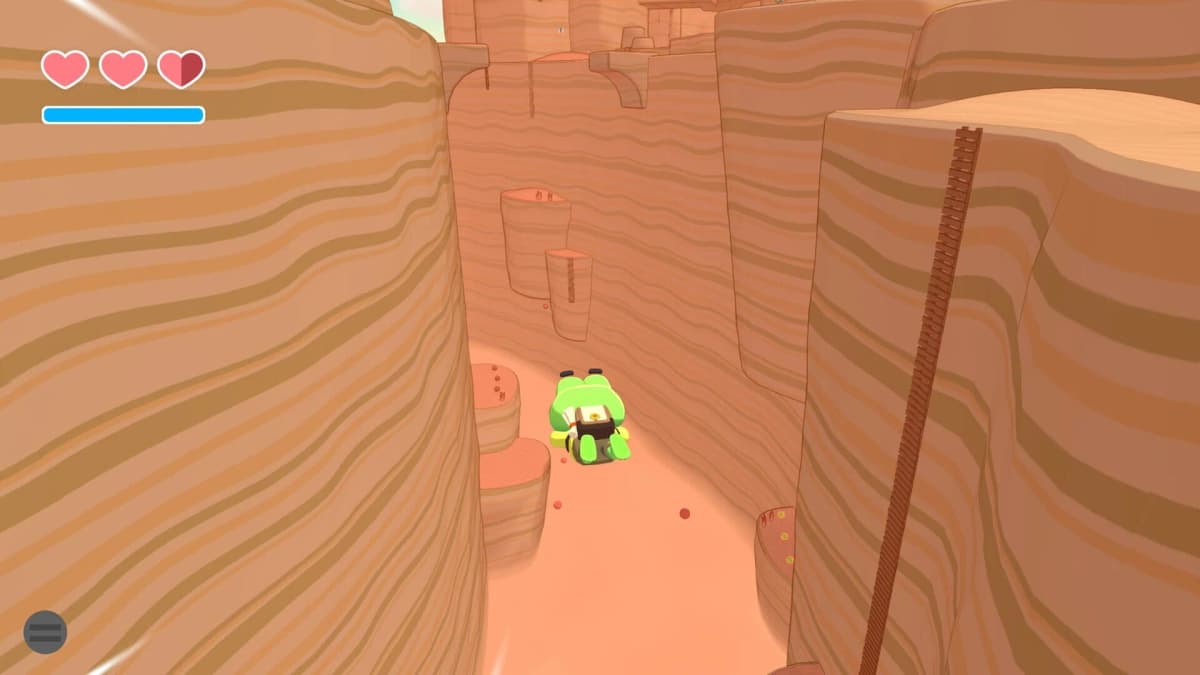
Because the game is so good at embracing freedom, the moments when it clamps down stand out sharply. The worst offender lives in the third world: an extended mine cart sequence that had me gritting my teeth.
Suddenly, instead of freeform, multi-route platforming, you’re literally on rails. The controls feel looser and more janky than the finely tuned on-foot movement, and there’s no clever way to circumvent the set-piece. It’s not broken, but it is a noticeable dip in quality – like being yanked out of a parkour session and shoved into a carnival ride you didn’t sign up for.
It’s a small portion of the overall game, but it underlines how much better Big Hops is when it remembers what it does best: messy, player-driven traversal where you’re allowed to improvise.
Visuals, Voice Acting, and Indie-Scale Polish
For a smaller-scale game, Big Hops looks and sounds genuinely impressive. Hop and Diss are instantly memorable character designs – Hop with his earnest wide-eyed look, Diss with that mischievous extradimensional vibe. The worlds themselves are colorful and vibrant without feeling noisy, each with a clear visual identity that matches its story.
The real surprise is how many characters are fully voiced, and well. Performances are expressive and warm, helping sell the lighter fable-like stories and the more prickly culture clashes alike. It gives the game a level of personality that a lot of indie 3D platformers struggle to reach.
That said, you can occasionally see the seams. NPCs don’t usually walk from point A to B; they simply disappear and reappear further along your path. Certain scenes feel like they’re cleverly staged to avoid showing too much animation complexity. None of this ruined anything for me, but it’s a reminder that you’re playing something ambitious made within visible constraints.
Who Big Hops Is (and Isn’t) For
After spending real time with Big Hops, a few audiences jump out as perfect fits:
- 3D platformer fans who love Mario, A Hat in Time, or Psychonauts and want something fresh that still feels familiar.
- Explorers and completionists who enjoy poking at every corner of a world, experimenting with systems, and figuring out weird traversal routes.
- Players who prefer movement over combat, and don’t mind that most of the challenge comes from navigation rather than enemy encounters.
- Older kids and families who want something mechanically rich but not relentlessly punishing, with a story that’s thoughtful without being grim.
On the flip side, it might not fully hit the mark if:
- You’re looking for deep, intricate combat systems or enemy variety – that’s just not what this game is about.
- You need your overarching stories to be crystal clear and tightly plotted all the way through; the big-picture narrative gets muddy near the end.
- You get easily frustrated by occasional jank or brief stretches (like the mine carts) where the design tightens up in less fun ways.
Bottom Line
Big Hops feels like a love letter to the idea that simple, well-tuned movement is enough to carry an entire game. Hop doesn’t have an absurd arsenal of moves – no triple-layered ability wheels or baroque skill trees. What he has is a tight, coherent toolkit, plus a bag full of weird fruit that lets you bend the rules in just the right ways.
Across its three worlds, Luckshot Games gives you vibrant spaces that feel more like playgrounds than gauntlets. The best moments are when you’re trusted to experiment: chaining wall-runs, improvising fruit usage, and finding routes that feel uniquely yours. The worst moments are when that trust tightens into scripted constraints, but those stretches are short enough that they don’t define the experience.
The story lands beautifully in its small-scale fables and stumbles a bit in its big-picture ambitions, yet it never loses the emotional throughline of a frog who thought he wanted adventure and then realizes, more than anything, he just wants to get home.
For me, this sits comfortably as a 9/10 experience – not flawless, but easily one of the most joyful and confident 3D platformers I’ve played in a long time, and a statement piece from a studio that clearly gets what makes movement fun.
TL;DR
- Big Hops is a movement-obsessed 3D platformer where you play as Hop, a frog who can leap across worlds and dimensions.
- Its core moves – wall-running, climbing, grappling, and sliding – feel immediately satisfying and only get better as you learn to chain them.
- Fruit- and seed-based traversal tools turn every level into a flexible sandbox where creative “solutions” are usually rewarded, not punished.
- The Dark Drips and trinket system lets you customize difficulty and playstyle, though the lack of quick loadouts is a nuisance.
- World-level stories about cultural conflicts are charming and nuanced, but the overarching plot with Diss and the Dark Drips stumbles near the finish line.
- A mine cart sequence and occasional signs of budget constraints hold it back slightly, but the overall package is still standout.
- If you care more about the feel of moving through a world than fighting in it, Big Hops is an early contender for one of 2026’s must-play platformers.
FinalBoss // Gear
Level up your setup
01Top-rated gaming headsetson Amazon→02High-refresh gaming monitorson Amazon→03Gaming chairson Amazon→04Discounted game keyson Kinguin→Affiliate links · As an Amazon Associate, FinalBoss earns from qualifying purchases.
Want to Level Up Your Gaming?
Get access to exclusive strategies, hidden tips, and pro-level insights that we don't share publicly.
Ultimate Reviews Strategy Guide + Weekly Pro Tips