
Table of Contents (9)
The co-op moment that still makes me cringe
There’s a specific moment from a Destiny 2 raid that lives in my head rent-free. It’s not a clutch boss kill or some wild loot drop. It’s me, in silence, failing to explain a mechanic because my mic had decided to die mid-sentence. Everyone else is talking, laughing, calling out symbols. My character is just standing there, vaguely bobbing, while I hammer push-to-talk at a dead input and type a panicked half-sentence in team chat.
We wiped. Not because the encounter was hard, but because I couldn’t bridge the gap between my brain and their ears fast enough. Nobody yelled. Nobody was toxic. It was fine. But that hot, stupid little knot of embarrassment – that sense of “I am the weak link in this hangout” – has stuck way harder than any actual combat fail.
That’s why Big Walk has me both fascinated and slightly terrified. House House have basically taken that tiny social failure cocktail – missed cues, awkward silence, half-finished jokes – and built an entire game structure around it. Not competitive failure. Not survival failure. Social failure.
Big Walk is pitched as a chilled, co-op “walker-talker” from the Untitled Goose Game devs: an open, national-park-ish space full of Crystal Maze-style puzzles, toys, and proximity voice chat. No monsters, no combat, nothing trying to kill anyone. Just a bunch of lanky bird-people pottering about together, solving light puzzles and… existing in shared space.
On paper that sounds like the comfiest thing in the world. In practice, based on what House House and early previews are showing, it looks like one of the most emotionally exposed multiplayer designs in years. And I genuinely can’t decide if that’s brilliant or if it’s going to be weaponised second-hand embarrassment through Steam.
From honking at humans to being the weirdo bird in the group
Untitled Goose Game was simple: you were the chaos. Humans were the straight men. The comedy was externalised; the butt of the joke was always some poor NPC trying to rescue their slipper from your evil beak. It was slapstick with a safe distance between player and humiliation.
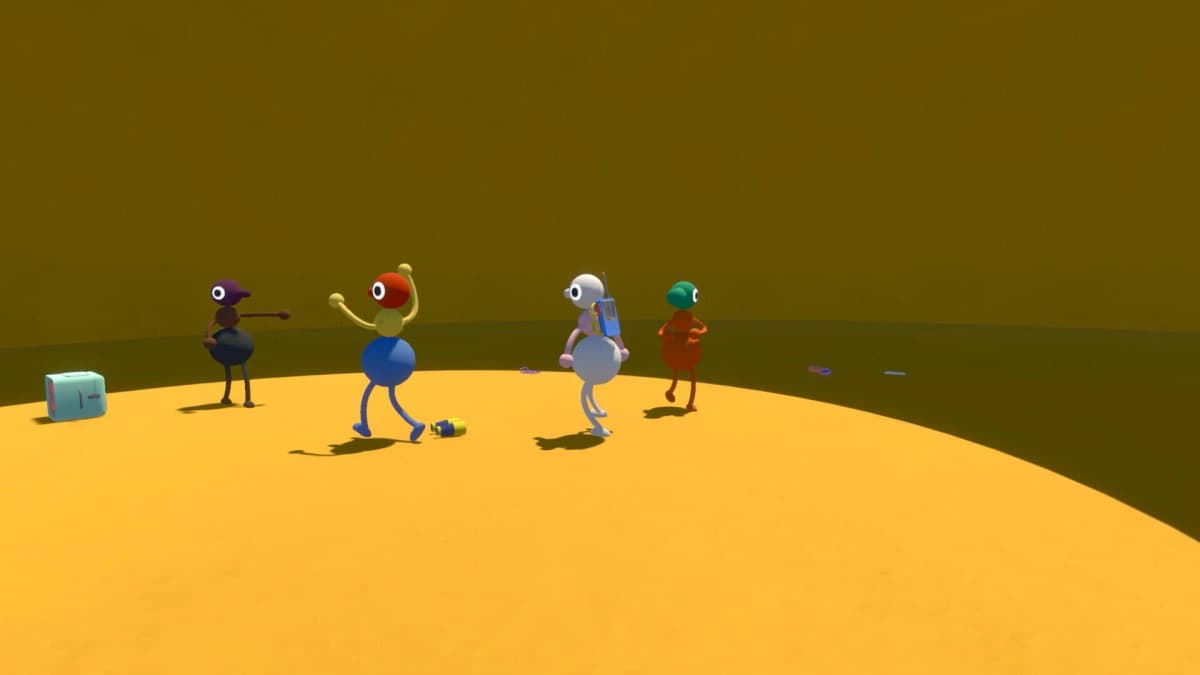
Big Walk flips that. Instead of being the untitled goose wrecking someone else’s day, you’re a tall, goofy bird-body wandering through a shared park with other real humans. The “untitled goose walk” vibe is still there – the characters have that same comedic physicality, all stringy limbs and overcommitted animations – but this time the target of the joke is very likely the person holding the controller.
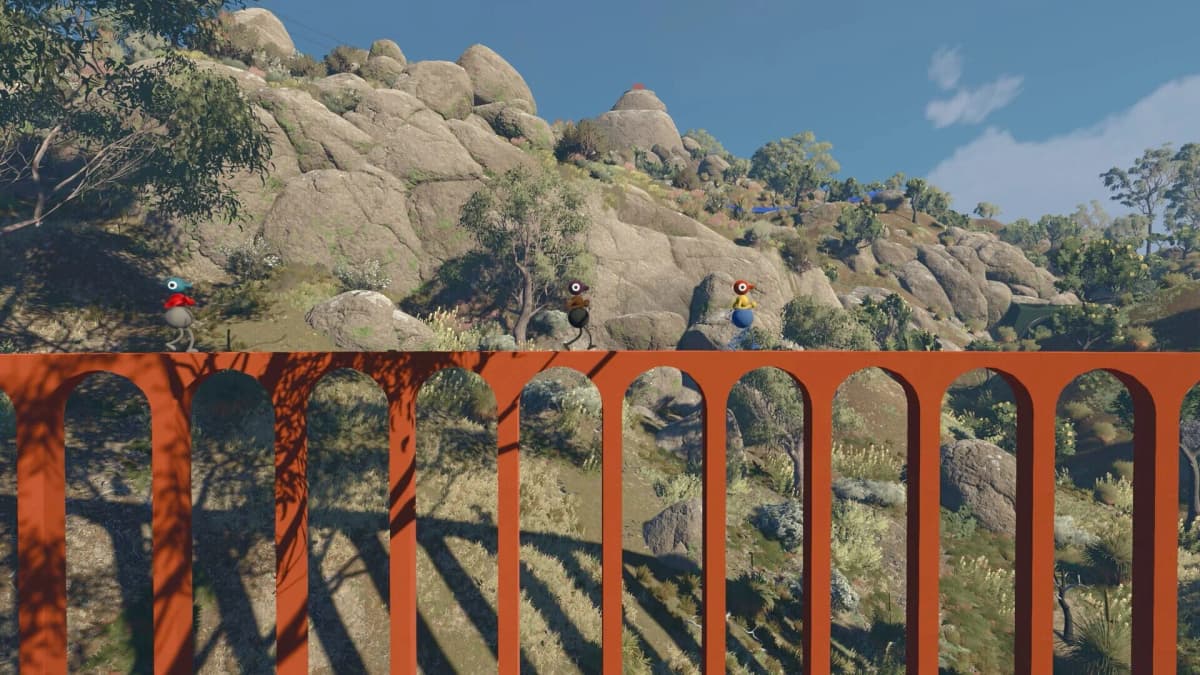
The setting is this stylised, Wilsons Promontory–inspired national park: swaying grasses, big chunky rocks, little pockets of weird architecture that look like they’ve been air-dropped from a game show. Early previews talk about puzzles where someone’s locked in a room reading out symbols, while the rest of the group rummage through tiles outside; or climbing structures that only work if everyone literally stands on each other’s shoulders and shouts vague directions.
Nothing is out to hurt anyone. There’s no stealth meter, no oxygen gauge ticking down while everyone fumbles. If someone falls off a cliff and into the ocean, it’s an inconvenience and a funny story, not a wipe. Think less Lethal Company, more disorganised school trip where the teachers are too chill and somebody’s lost the map.
That’s the genius and the problem: if the game isn’t really stressing anyone mechanically, the only real friction is the people. Late, distracted, shy, overbearing, silent, too loud – Big Walk looks like it’s built to surface these micro-frictions instead of drowning them out with constant danger.
An open world full of toys, not threats
Most co-op games frame downtime as a break between “real” content. In Deep Rock Galactic, you drink and dance until it’s time to go get mauled by space spiders. In Sea of Thieves, the beautiful ocean is mostly a commute between server drama and skeleton nonsense. Even the more “wholesome” sessions eventually default to optimization: farm mats, chase achievements, clear missions.
Big Walk, if the previews are accurate, stretches that downtime into the entire game. The park is full of weird little fixtures that don’t exist to test skill so much as to give people excuses to be around each other.
- Sound shrines where walking in circles changes the notes and everyone just… hums along.
- Paintbrushes to doodle on each other’s wobbly bird-bodies.
- Flare guns and other visual tools for saying “hey, over here” without a minimap ping.
- Glowing ball lamps you can roll down hills, just to see what happens.
There are proper cooperative puzzles, and they reportedly scale up for 2–4 active problem-solvers while allowing more bodies in the world just hanging out. But there’s no fail-state treadmill. No XP bar. No loot to min-max in a wiki. It’s a 10-ish hour jaunt you tackle with friends (or strangers), with the emphasis on the “walker” and “talker,” not the “gamer.”
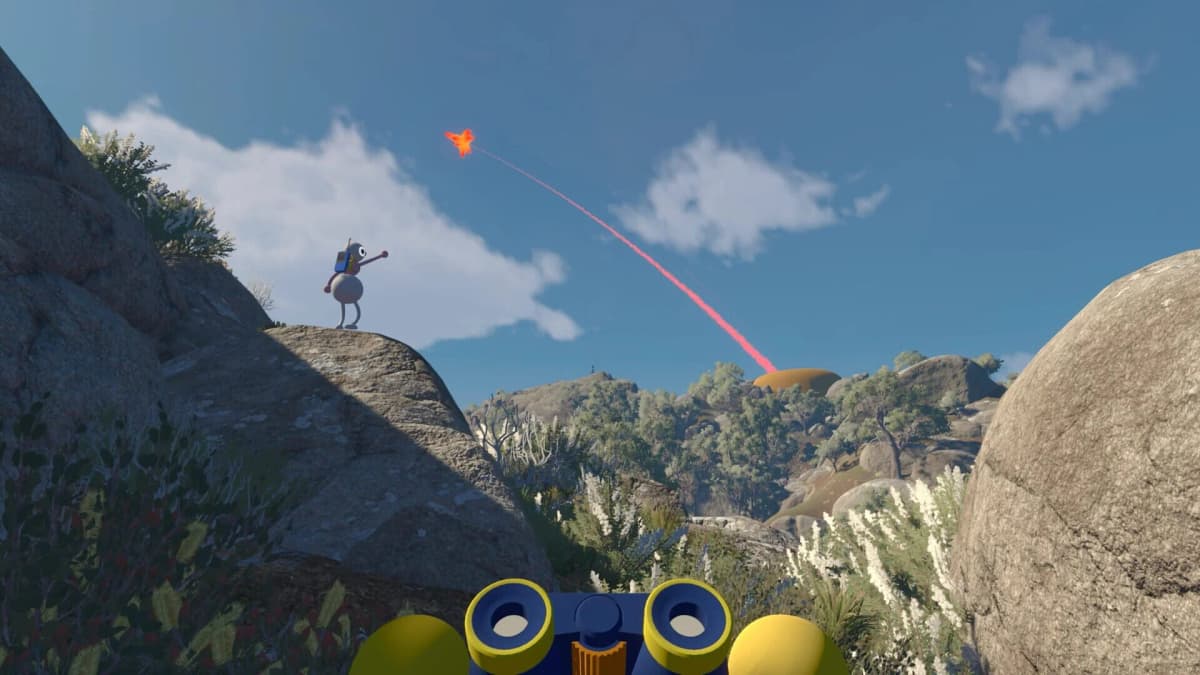
That alone already puts it at odds with the current co-op zeitgeist, where “friendslop” usually means throwing buddies into a meat grinder like Lethal Company and laughing when someone gets yeeted into orbit by a bad jump and worse netcode. Those games are great, but the laughter is at least half nervous relief: thank god it wasn’t me this time.
Big Walk is slower, softer, almost aggressively gentle. The only thing that can really go “wrong” is the social chemistry, and that feels way more dangerous than any horror monster.
Proximity voice as a social pressure cooker
Here’s the part that either makes Big Walk a quiet masterpiece or an anxiety machine: the voice system.
House House are going full spatial audio. Talking isn’t a global Discord blob; it’s local, direction-based, and tied to where characters are actually standing and looking. To hear someone properly, it sounds like you need to be near them and facing their little bird head while it wobbles along in time with their voice.
That changes the social contract completely. In most multiplayer games, you can sort of half-listen. Character looking one way, eyes on a different monitor, conversation happening in your headset like a podcast while your avatar sprints in circles. If you check out mentally, nobody really knows.
In Big Walk, looking away from someone who’s talking is literalised. Your character body is calling you out: you’re staring at a bush while your friend asks a question. You’re drifting off mid-conversation to go poke a puzzle prop while someone’s still answering. Suddenly the default “videogame rudeness” – hoovering up loot while someone’s in a cutscene, running ahead during dialogue – is visible and legible in a way it usually isn’t.
And if the mic isn’t working? Then the body becomes the entire performance. You’re flapping your arms, scribbling on in-game whiteboards, drawing arrows, desperately trying to mime “this lever resets the sequence” while everyone else is just… talking like normal human beings.
The usual fallback – text chat – suddenly looks painfully slow in a space that’s intentionally intimate. Voice is close, directional, warm. Typing feels like barging into a dinner party with a stack of cue cards and a broken mic stand.
That’s the kind of design choice that sounds minor until remembering how much of modern online life is built on being able to switch presence on and off. Muted in a call, but listening. In the party, but on another server mentally. Big Walk narrows that gap. The more honest the representation of presence, the more exposed everyone suddenly feels.
That’s the kind of design choice that sounds minor until remembering how much of modern online life is built on being able to switch presence on and off. Muted in a call, but listening. In the party, but on another server mentally. Big Walk narrows that gap. The more honest the representation of presence, the more exposed everyone suddenly feels.
🎮 Get This Game at the Best Price
Compare prices instantly and save up to 80% on Steam keys with Kinguin — trusted by 15+ million gamers worldwide.
*Affiliate link — supports our independent coverage at no extra cost to you
Soft failure hits harder than dying to a boss
There’s a trend in RPG and narrative design lately – games like Zero Parades leaning hard into mechanical failure as content. Miss a check, screw up a skill roll, and the game doesn’t slap a “Game Over” on screen; it pivots, lets things get messy, trusts that the player can roll with it.
Big Walk feels like it’s doing something similar, but on the social axis instead of the mechanical one. Falling behind, failing a jump, misreading a symbol – none of that matters much. What sticks is the small, stupid stuff:
- The joke that lands half a second after everyone’s moved on.
- The time three people lined up eagerly to hear a story and there was nothing to say.
- The moment of silence after asking a dev a question and realising the mic has been off the whole time.
- The friend who zones out and stares at the horizon while someone’s giving instructions, and everyone notices.
Traditional game failure is clean. Health reaches zero, screen fades to black, checkpoint reloads. You can blame latency, build choices, bad RNG. Social failure is sticky. The brain replays it at 3am, years later, completely disconnected from the actual stakes at the time.
Designing a co-op game that centres those tiny embarrassments, instead of trying to drown them out with constant stimulus, is quietly radical. It’s also a huge risk. Not everyone wants their chill Friday session to double as an exposure therapy tool for social anxiety.
But that’s why Big Walk feels important, even before wider access. So much marketing around games leans into capital-E Emotion – sadness, rage, triumph, “satisfying” gunfeel, the whole prestige drama complex. This thing looks much more interested in the small social grains: mild awkwardness, shared giggles over nothing, the weird intimacy of just walking next to someone and humming at a fake shrine.
The industry keeps yelling; Big Walk is whispering instead
Something that grates across a lot of modern multiplayer is how loudly everything has to announce itself. Battle passes. Seasonal grinds. Alert popups screaming about limited-time cosmetics. Co-op has become big business, which means it’s also become incredibly noisy. If attention isn’t constantly being grabbed, churn kicks in, players bounce, revenue graphs slump.
Big Walk appears to want almost nothing to do with that arms race. No FOMO treadmill. No sense that this Wilsons Prom–inspired space is secretly just a 3D menu for a store. It’s finite, modest, oddly self-contained. A handful of hours, some puzzles, some toys, a long, silly hike. A “friendslop” game that is actively uninterested in chewing through people’s entire social lives.
That’s glorious. It’s also commercially scary as hell. Because being a slow, quiet game about soft, awkward intimacy is one thing when people can drop in and out on Game Pass like it’s Netflix. Being a standalone purchase on PC in a world trained to chase battle passes and “content updates” is another.
House House already broke the internet once with a honking meme machine. The safe play would have been Untitled Goose Game 2: More Goose. Instead, they’ve gone for an untitled goose walk game about being present with people and occasionally humiliating yourself in 3D. There’s no obvious viral hook in “I walked slightly too far ahead while my friend was talking and now I feel bad,” but that’s the exact sort of moment this design seems built to produce.
The tension, for me, is this: the thing that makes Big Walk interesting is the exact thing that makes it hard to recommend casually. It doesn’t look like a background game. It doesn’t look like something to alt-tab out of. It looks like something that quietly demands: be here, with these people, fully.
Who is Big Walk really for?
There’s an obvious crowd that’ll bounce off this immediately: anyone whose idea of “co-op” is primarily about mastery. The DPS spreadsheeters, the speedrunners, the min-max Discord captains. Big Walk has nothing for that mindset beyond maybe some puzzle efficiency racing, and even that feels beside the point.
Then there’s the “wholesome games” audience, who get written off a lot, sometimes fairly, as wanting vibes without texture. Big Walk isn’t that, either. It’s cute, yes. No guns, no gore, beautifully soft art direction. But “no danger” doesn’t mean “no edge.” The edge is just social instead of physical. For people who find a full Discord call more intimidating than any boss fight, that edge is razor sharp.
Honestly, it feels aimed straight at the messy middle: people who like co-op but are burnt out on sweaty lobbies; people who enjoy just existing in a virtual space with others but are tired of sandboxes that only care about engagement metrics. It’s for friend groups that already treat games as an excuse to hang out, not the other way around.
The catch is that those are also the players who are most sensitive to bad vibes. One person trolling too hard with the paintbrush. One stranger spamming a handbell in a way that stops being funny five minutes in. One player with a busted mic who starts feeling, very quickly, like the NPC in their own session.
House House can’t design away that risk without ruining what makes the whole thing interesting. The open world, the proximity chat, the slow puzzles – all of it is tuned around trust. Trust that people will approach this like a picnic, not like a ranked queue. Trust that awkwardness will be laughed with, not at.
Why I’m rooting for it anyway
Personally, I’m split down the middle. Part of me – the part that still winces at that broken-mic Destiny raid – looks at Big Walk and thinks: absolutely not, this is a machine for manufacturing tiny humiliations. A game where the most memorable story is going to be the time someone disappeared off a cliff for ten minutes and everyone quietly wondered if they were rage-quitting.
The other part of me, the one that misses the feeling of genuinely hanging out in Journey with strangers, or sitting on a cliff in Sea of Thieves strumming shanties for no reason, sees something rare here. A design that respects co-op as a social space first and a mechanical challenge second. A willingness to say: the interesting thing about playing with other humans isn’t just winning; it’s all the fragile, embarrassing, funny nothing-moments in between.
Most games treat those moments as waste. Dead airtime between objectives. Idle time that needs filling with markers, collectibles, side quests, alerts. Big Walk leans into them, hands you a paintbrush and a walkie-talkie, and says, in its own quiet way, that those moments are the game.
If that lands, Big Walk could end up being one of those titles people remember less for specific puzzles and more for oddly tender snapshots: arms stretched out pretending to be a plane; four bird-people stacked up like a totem pole under a sunrise; someone finally getting their mic working and blurting out three pent-up jokes at once.
And if it doesn’t land? If it turns into a slightly awkward walk-and-talk that most groups bounce off after an evening? Even then, it’ll have done something valuable just by existing. It’ll have pushed back, a little, against the idea that co-op has to be loud, endless, or aggressively rewarding.
Either way, I want more games to be this brave about being small, soft, and socially uncomfortable on purpose. Big Walk looks like the rare untitled goose walk game where the punchline isn’t the NPC getting pranked, but the player realising they care, just a bit too much, about how silly their own digital body looks when it tries to say hello.
FinalBoss // Gear
Level up your setup
01Top-rated gaming headsetson Amazon→02High-refresh gaming monitorson Amazon→03Gaming chairson Amazon→04Discounted game keyson Kinguin→Affiliate links · As an Amazon Associate, FinalBoss earns from qualifying purchases.
Want to Level Up Your Gaming?
Get access to exclusive strategies, hidden tips, and pro-level insights that we don't share publicly.
Ultimate Gaming Strategy Guide + Weekly Pro Tips