
Table of Contents (11)
Snow, neon, and second chances: my first night in Seattle
I booted up Vampire: The Masquerade – Bloodlines 2 on a cold, real-world Seattle night, which felt like method acting with a space heater. I’m that person who replays Troika’s Bloodlines every couple of years just to chase that Malkavian run high, so I came in hungry and wary. After 90 minutes, I messaged a friend: “The vibes are right. The blade is dull.” That became the theme of my next 28 hours across two clans.
My setup for context: Ryzen 7 5800X, RTX 3080, 32GB RAM at 1440p on a G-Sync display. I started with mouse and keyboard, then swapped to controller for a chunk of my Toreador run to see if aiming or movement felt better (it didn’t, really). I played on the default difficulty, then bumped it up for my Tremere playthrough to test scaling and survivability. I tried to be good about talking to everyone, digging into side content, and poking at systems to see what snapped.
What struck me first-and how that feeling changed
My first impression was the mood. The Chinese Room nails the melancholy, conspiratorial tension of the World of Darkness. The snow-slick streets, the hum of a neon sign outside a pawn shop, that low-grade dread of being an unwelcome guest in a centuries-old argument-it’s all here. I stood in a coffee shop called Wake the Dead for a long minute just watching Tremere Magister Mrs. Thorn’s patrons talk, listening to the music, soaking in the cozy menace. Then I stepped out, looked down the block, and felt a gut-sink: most doors wouldn’t open, and the ones that did often led to brief errands rather than rabbit holes.
By hour ten, the pattern set in. Seattle looks the part-especially Chinatown, which is gorgeous—but too many spaces feel like a backdrop for cutscenes rather than a city you tease apart. There’s a dive bar for the Anarchs with walls that might as well say “SPORTS!” in impact font; it made me laugh, then it made me sigh because it’s arm’s-length from the charm this universe deserves. You’ll catch glimmers of the old magic: Ysabella’s art-choked studio, a bone sculpture in a Toreador’s back room, knickknacks in Aurora Pawn that imply a life lived for too many lifetimes. Then you’ll notice a repeating portrait in a plush penthouse and an NPC idling on a hair-twirl loop during a tense conversation, and the spell wobbles.
Fabien steals the show (and maybe the whole game)
Characters are where Bloodlines 2 finds its pulse. The writing is sharp, specific, and performed with real teeth. Lou Graham, the former prince, oozes capability with a streak of opportunism so thick you feel sticky after talking to her. Ysabella’s slow, glittering drawl is almost a seduction technique. Safia—the Tremere “friend” who smiles like a knife—made my skin crawl in the best way. But the star is Fabien, the Malkavian voice in your head, brought to life by Ronan Summers with the kind of sly warmth that makes you lean in whenever he speaks.
Mechanically, Fabien inserts a gumshoe streak into your story: noir-tinged investigations with a Malkavian tilt. I’ll admit I rolled my eyes at first—I’m a dyed-in-the-wool Malk player and the idea of “outsourcing” that clan experience felt like a hedge. But a few hours in, I caught myself choosing dialogue just to hear how Fabien would riff on it. Some of the best laughs I had (and a few poignant beats) sit in these detours, which is why it stings that a chunk of that flavor is paywalled behind the Santa Monica Memories DLC. Without him, the protagonist Phyre can read as flat—a deliberate cipher you color with clan and choices, sure, but not a showstopper on their own.
Combat: fast, flashy, and frequently frustrating
I went Toreador first because I wanted to zip across rooms, turn bullets into choreography, and kiss someone into cooperation before pirouetting away. The fantasy is there on paper. In practice, a few missing ingredients tank the flow: there’s no lock-on, no proper block, and dodges feel inconsistent enough that I kept thinking a hidden stamina system was throttling me. Every clan has a relocation ability—Blink for Toreador—and once you convert a foe with a charm, targeting who you want is like trying to thread a needle on a rollercoaster.
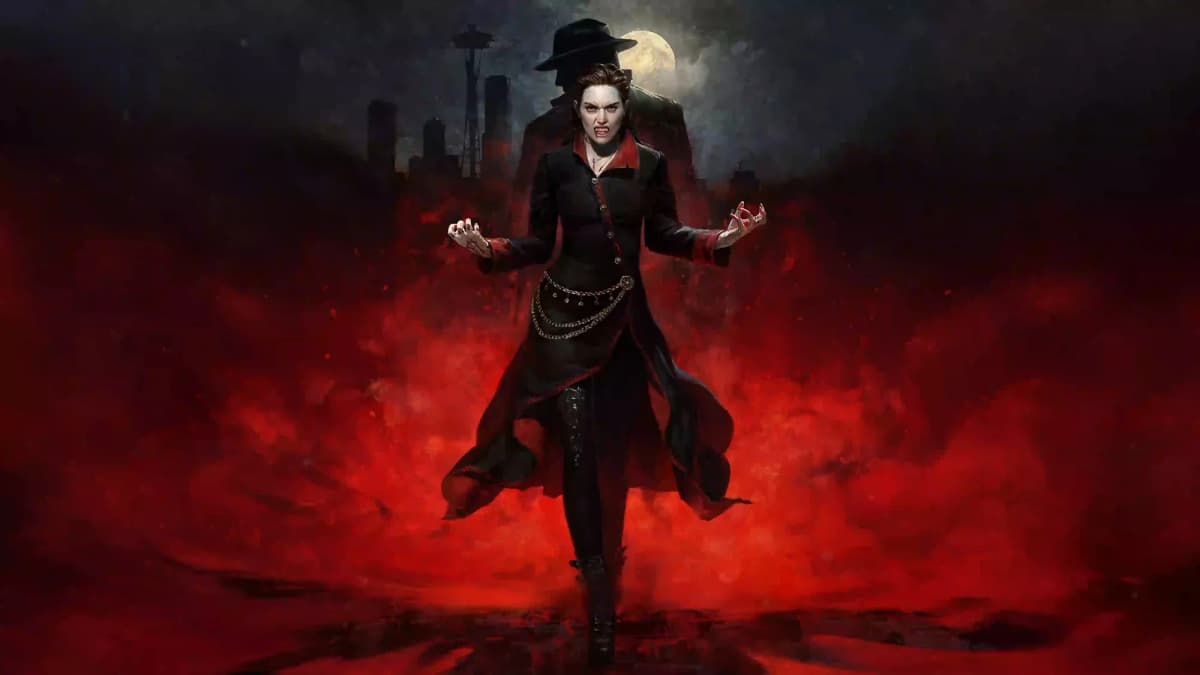
The engine also struggles with speed. During big fights, my frame rate dropped into the high 40s at 1440p High with FSR set to Quality, and micro-stutters turned precision into mashed potatoes. The low point was a late-game boss where the arena crowded with enemies and my camera slewed around while I tried to heavy-attack through a guard. I died three times to the same “I can’t face the right guy” problem. Switching to Tremere on my second run smoothed things out—hanging back with blood bolts and utility disciplines works better with the game’s read on spacing—but I missed the finesse I wanted from a faster, trickster build.
Enemy scaling also undercuts power fantasy. As Phyre levels, so do the squads you face, and while I’m not allergic to scaling, it landed here as longer time-to-kill without richer mechanics. Mid-game pushes you toward firearms, thanks to a telekinesis hook that lets you yank guns into your hands. It’s cute the first few times—and the slow-mo finishers when you snipe someone are undeniably slick—but it empties the vampiric flavor from the room when a centuries-old Elder is essentially playing a budget FPS with boutique powers on the side.
There are bright spots. One boss strips you of disciplines and forces honest, sweaty brawling; it’s not brilliant, but it’s a welcome shake-up. Crowd control and space denial feel better tuned for Tremere than for Toreador, and I’d recommend controller for ranged builds (right stick smoothing beats wild mouse flicks when the frame pacing wobbles). But taken together, the combat system rarely sings—it buzzes, it blares, it occasionally sparkles, then it short circuits mid-solo.
Progression and clans: the tabletop DNA pokes through
Here’s where Bloodlines 2 feels like a love letter to the TTRPG rather than a postcard. Each clan carves a distinct path: Toreador are chaos sprites with mobility and charm; Tremere are methodical problem-solvers who stack debuffs and delete from afar; dipping into Ventrue tools gives you domineering control, while sampling Lasombra or other disciplines through cross-pollination lets you craft a weird, wonderful chimera build. It’s not as breakable as Troika’s sandbox, but it’s flexible enough that my second run felt materially different from my first.
Resonance Points—a currency earned by drinking certain blood types—fuel this growth. Investing outside your clan’s three core trees costs more, echoing tabletop restrictions. As a Toreador, I got Celerity-adjacent speed tools on the cheap; as Tremere, buying into that same zip came with a steeper price. It nudges you into identity without strangling experimentation. It’s smart, clean, and I loved the internal negotiation: “Do I save for that marquee discipline or grab two off-brand utilities right now?” I wish the combat sang loudly enough to match the build craft’s ambitions.
Side quests and romance: errands in eyeliner
The side cast is tantalizing: Primogen like Mrs. Thorn and Niko are the perfect kind of terrifying—polite, patient, ancient. I wanted storylines that spiraled into obsession. What I got was an armful of errands with great banter at the edges. Mrs. Thorn’s jobs often boil down to package pickup with a ritual garnish. Niko’s assassination gigs come with a cool artifact’s backstory and not much else. Sometimes you’ll get a lore drip or a potion—useful, but rarely memorable. The romance system feels like a rough sketch: flirt, flirt, flirt, credits. No sharp corners, no messy consequences.
This stings because the original Bloodlines lived in the margins: the accidental frenzy in the wrong alley, the email you hacked that unlocked a cruel joke or a genuine clue, the humanity hit you debated after you got away a little too hungry. Here, the systemic friction is sanded down. There’s less of that “did I just break the quest, or did the city bend around my mistake?” tension. The A-to-B-to-C structure is legible and, honestly, safer—just don’t expect the city to push back unless a quest flag tells it to.
Seattle itself: pretty postcards, locked doors
Seattle’s snow is a striking choice. The white hush makes neon pop and gives late-night missions an after-hours menace. But the hubs are too often underused. Chinatown, a jewel at the city’s center, almost never factors into the main arc beyond a simple objective. Another area feels imported from an earlier draft of the game: it teases a connection to the 2004 classic, then resolves into a light puzzle sequence. The result is a series of sets you admire rather than neighborhoods you learn. You can sense a more systemic city underneath; the one you get is a well-dressed corridor with scenic overlooks.
Asset reuse doesn’t help. I caught triplicate photographs in Lou’s penthouse within a few steps of each other and a recycled portrait popping up in a police station after a lore drop told me it was someone’s relative. None of this is a hanging offense—game dev is hard and reuse is normal—but it breaks the masquerade when the mask slips that often. On the flip, when the game slows down and lets a space breathe—Wake the Dead’s amber light, the oddities in Aurora Pawn, a Toreador back room crawling with bone art—it’s intoxicating. I just wish those moments weren’t islands in a big, cold sea.
Performance, bugs, and settings I tweaked
On my rig, 1440p High with FSR Quality delivered 60-90 fps in quieter areas and mid-40s during the busiest fights as Toreador. Frame pacing was the real villain; camera whips would hitch just enough to throw off rhythm, especially when Blink landed me in the wrong pocket and I had to snap to a new target. Turning off motion blur, dropping volumetrics to Medium, and capping at 60 fps stabilized things more than chasing higher numbers. Frame generation improved averages but made input feel slightly gummy; I preferred it off for melee builds and on for Tremere’s ranged toolkit.
Bugs? A short list but a loud one. I had one soft lock after a boss when the game thought I was still in combat, two T-posing cops during a stealth entrance, and a ragdoll that vibrated itself across an entire lobby like a Roomba from hell. The good news: no progress-killing crashes for me. The bad news: the vibe-killing jank stacks with the combat woes until irritation becomes a companion character you didn’t invite.

What works for me—and what doesn’t
- Works: The cast. I’d listen to Ronan Summers’ Fabien narrate my grocery run. Lou, Ysabella, and Safia all chew the right scenery.
- Works: Clan expression and buildcraft. Mixing disciplines with Resonance costs that echo tabletop rules hits a sweet spot.
- Works: The mood. Snowy Seattle is a strong aesthetic frame, and a few interiors are unforgettable.
- Doesn’t: Combat readability. No lock-on or block and unreliable evasion break fast builds’ flow.
- Doesn’t: Hub density and reactivity. Pretty streets, too many locked doors, not enough systemic chaos.
- Doesn’t: Side content repetition. Great delivery on drab errands; romance is a limp handshake.
- Doesn’t: Performance consistency. Frame pacing hiccups during the exact moments you need precision.
Comparing the bite to the original
We can stop pretending Bloodlines 2 needs to be the 2004 game. It’s not, and it isn’t trying to be a direct sequel. But it invites comparison every time it borrows a term, a tone, or a dream of a living city. Troika’s Los Angeles felt absurdly alive—every email a rabbit hole, every alley a dare. Bloodlines 2 trades that cacophony for a cleaner, more directed experience. Sometimes that helps—fewer broken quests, fewer “did I just nuke my save?” heart attacks. More often, it flattens the texture that made the World of Darkness feel dangerous in the mundane. I wanted to slip, to recover, to feel the systems buckle. I mostly followed quest markers and watched great actors make the ride feel grander than it is.
Who should sink their teeth into this
If you’re here for the politics, the strange personalities, and the moody city nights, there’s a dinner’s worth of flavor. Fans of the tabletop will appreciate how clan identity shapes play, especially if you like tinkering with builds. If you loved the original primarily for its messy, emergent sandbox or you want tight, character-action combat with immaculate feedback, this will test your patience. I’d also caution completionists: the side content looks generous, but most of it plays like a chore wheel.
FinalBoss // Gear
Level up your setup
01Top-rated gaming headsetson Amazon→02High-refresh gaming monitorson Amazon→03Gaming chairson Amazon→04Discounted game keyson Kinguin→Affiliate links · As an Amazon Associate, FinalBoss earns from qualifying purchases.
Want to Level Up Your Gaming?
Get access to exclusive strategies, hidden tips, and pro-level insights that we don't share publicly.
Ultimate Reviews Strategy Guide + Weekly Pro Tips