
Table of Contents (22)
Early Priorities in Cell Survivor (What Actually Matters)
Most players who stall around Chapter 15–20 in Cell Survivor are not losing to “skill” – they are losing to coins and gems spent on the wrong things. Fix the upgrade order and the weapon core, and the same chapters that hard-wall you turn into consistent clears.
Updated 14 September 2026 for Cell Survivor v3.8 (iOS, released 3 September 2026 with “new events and characters”; the Android build uses its own numbering, currently 2.19, and the Steam game called Cell Survivor is an unrelated title by a different developer – this guide covers the mobile game by Snap Brain Games / WINLON).
Quick answer – upgrade priorities in order: (1) Put coins into Attack first and keep it well ahead of everything else; (2) run the Golden Pig instance daily so you never run dry on coins; (3) build every early run around Sterile Swab plus one area-coverage skill; (4) bank gems until you can afford a 3,000-gem 10x weapon pull, never singles; (5) unlock and star up pets for their account-wide stat bonuses, but do not pour materials into pet levels yet. Everything else – Artifacts, skins, event shops – waits until you have a stable farm chapter.
| Early upgrade | Priority | Why it matters before Chapter 20 |
|---|---|---|
| Attack (coin upgrade) | 1 – always | Boss HP jumps hard every few chapters; raw damage is the only stat that keeps pace. |
| Golden Pig instance | 1 – daily | Chapter rewards alone do not fund Attack; this is the main coin income. |
| Sterile Swab upgrades | 2 | Focused, repeating damage on the target – your early boss-killer. |
| Crit Chance / Cooldown | 3 | The other two permanent coin stats; level them when Attack costs spike. |
| Pet star-ups | 3 | Star upgrades add character stats whether or not the pet is equipped. |
| 10x gem pulls (3,000 gems) | 4 – batched | Better odds at Red weapons than drip-feeding single pulls. |
| Artifacts, skins, Capsule | Skip for now | Small or late-scaling gains compared with Attack and a real weapon core. |
The sections below break down currencies, upgrades, weapons, pets, instances and bosses so you can avoid the standard early mistakes.
Currency Management: Stop Wasting Coins and Gems
Coins – Fuel for Real Power
Coins (gold in some translations) are what you spend most during normal play, and the classic early mistake is keeping everything evenly upgraded. Early bosses get steep HP spikes, and the stat that keeps up is Attack (your basic damage). Spreading coins around makes you mediocre at everything. A better order:
- Upgrade Attack aggressively until the cost jumps to a painful level.
- Only then, put a few levels into Crit Chance, then Cooldown. Community guides report the three coin stats advance in ten-level blocks, so you will have to touch the other two eventually – just not first.
- Survivability comes mainly from in-run HP picks, level-ups and later pet star bonuses, not from the coin screen.
Once Attack is the clear leader, damage stops falling off in the last two or three minutes of a stage, and bosses that were timer-checks start dying on time.
Gems – Only Spend in 3,000 Chunks
Gems (diamonds) are the premium currency, and they are painfully easy to waste. Single weapon pulls whenever you hit a wall do almost nothing for your roster.
The game favours the 10x regular weapon pull at 3,000 gems: more chances at rarer (Red) weapons per gem, and a faster route through pity-style thresholds. Players also report a more expensive Legendary/red-chest route – roughly 4,500 gems for ten openings – which is not worth touching until you already own a Red weapon you want fragments for. Rules to stick to:
- Never spend gems on single pulls.
- Ignore refreshes, cosmetics and minor boosts that cost gems.
- Save until you hit 3,000, then do one big 10x summon.
- During events that offer a 10-draw for 3,000 gems, that is usually the best use of the batch – event Reds and Artifacts are otherwise mostly paywalled.
Energy – When to Push, When to Farm
Energy is a soft limiter on how much you can play. Early on, a simple pattern works:
- Whenever you feel strong, push the highest chapter you can.
- Once you hit a wall (consistent fails), drop back and farm the last chapter you beat for coins and materials.
- Spend your daily instance attempts (Golden Pig first) and chest energy rewards (see below) before pushing again.
Base Upgrade Path: Stats That Actually Win Runs
Priority Order for Permanent Coin Stats
When you are putting permanent coins into character stats, this order gives the best returns for Chapters 1–20:
- Attack – Max this as far as your coins allow at each stage.
- Crit Chance – Once Attack is comfortably ahead, crits multiply the damage you already have.
- Cooldown – Worthwhile after the above feel solid; more casts of Sterile Swab is more boss damage.
Keeping Crit and Cooldown close to Attack in level is how players stall in the low teens. Letting Attack get “ugly high” compared with everything else is how those same stages start falling, with breathing room for mistakes.
Skill Upgrade Logic
Skills (weapons) have their own upgrade tracks. The important mindset is that your upgrade focus should change as you unlock stronger weapons. Do not dump permanent resources into something you intend to replace in a few chapters.
- Early: focus on Sterile Swab and one or two strong supporting skills.
- Mid chapters (around 10–20): start prioritising the Red weapons you have unlocked.
- As you unlock more: bench old favourites if their stat scaling falls behind. Late-game players concentrate materials on one Red at a time and let the others creep up from fragments.
“Upgrade what you own” in a flat way wastes materials. “Upgrade what you will actually run in the next few chapters” gives a much smoother power curve.
Best Early Weapons and Skills (Chapters 1–20)
Sterile Swab – Your Early-Game MVP
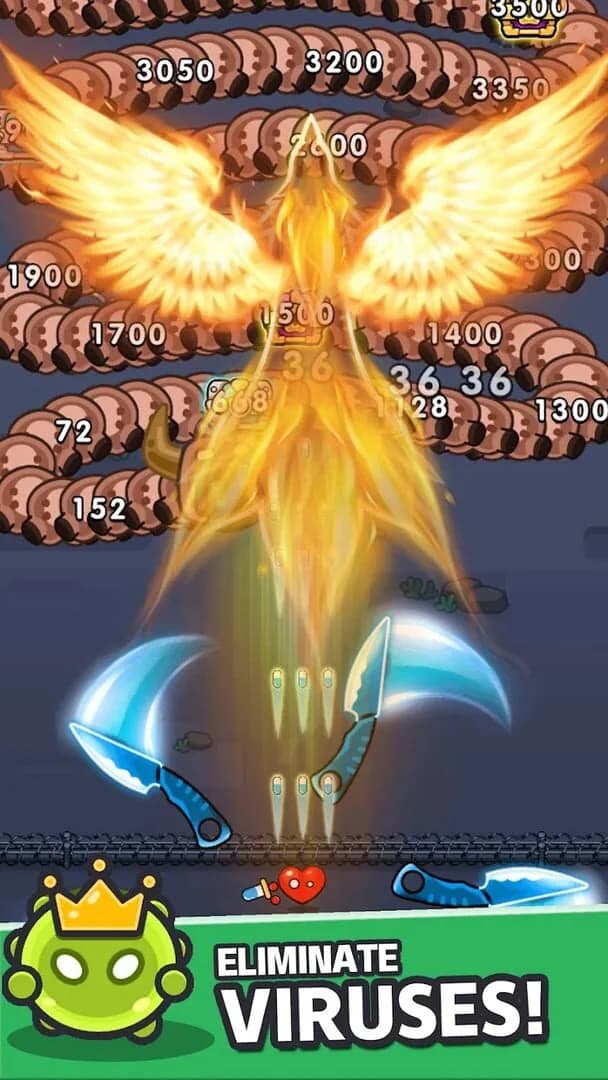
Sterile Swab is the most reliable early weapon in the game. It specifically targets virus heads and delivers focused, repeating damage in a controllable area, which is exactly what you need when bosses show up with massive HP pools.
To get the most out of it:
- Take every in-run upgrade that increases the size and duration of the swab area.
- Position yourself so bosses and elite mobs stay inside the swab zone.
- Treat it as your primary damage engine and build the rest of the loadout to keep enemies inside it.
Secondary Early Options: What Pairs Well with Swab
Build the early loadout around Sterile Swab plus a mix of these, depending on spawn and stage type:

- Small Medical Tower (often just called Medical Tower) – Static damage and control. Holds chokepoints and shines when enemies rush from all sides.
- Acupuncture – Solid supplemental damage, especially against packed waves.
- Massage Stick – Simple but effective continuous damage at close range.
- Disinfectant Bubble – Bouncing bubbles that explode; great for covering movement and kiting through mobs.
- Spinning Dagger – 360° protection when densities get high.
Aim for a mix of focused single-target power (Swab, Tower) and reliable area coverage (Bubble, Dagger). That way you can melt bosses without getting overwhelmed by trash mobs.
What to Skip: Capsule and Early Artifacts
Capsule is the default starter weapon and is widely considered the weakest thing in your loadout: it eats a slot and dilutes early chest upgrades with affixes you do not want. It can only be unequipped with the paid lifetime pass – the one purchase players consistently recommend if you spend at all. Free-to-play, never spend materials levelling Capsule.
Artifacts are similar in the early game: they provide small stat bumps that do not move the needle compared with raising Attack or unlocking a better weapon. The newer event Artifacts added in late August/September 2026 are strong but bought with event currency or real money. Until you have:
- At least one or two Red weapons you intend to main, and
- A stable chapter farm where you are not barely scraping by
…you are better off ignoring Artifacts and dumping resources into core power instead.
Pets: Unlock and Star Up, Don’t Over-Level
Pets arrived with the Pet System update in mid-2026 (App Store history lists the pet and multiplayer overhaul at v3.4, refined through v3.5) and are now a standard part of early accounts. Pets come from Pet Hatching with eggs earned from login rewards, ads and packs; most hatches give enhancement materials rather than a pet, so the roster builds slowly. Two pets can be equipped at once. The advice from experienced players is counter-intuitive for a new account:
- Star upgrades matter, levels barely do. Levelling a pet adds a little damage; star-ups (which use pet fragments) unlock character stat bonuses and special abilities, and those bonuses apply whether or not the pet is equipped.
- Unlock as many pets as you can before worrying about which one is “best” – every pet you own is another set of star bonuses.
- Equip your two highest-power pets and move on. The consensus favourites are the Cactus (cooldown reset) and the seasonal ice-cream pet, but there is no single agreed best pet and pets are not a substitute for Attack levels.
- Do not spend gems on pet eggs before Chapter 20; save them for the 3,000-gem weapon pull.
Instances: Golden Pig First, Every Day
Instances are daily side modes that pay out what chapters do not. Two matter early:
- Golden Pig – The coin-farming instance. Run it every day; ordinary chapter rewards do not fund Attack upgrades on their own, and this is where most of your coins come from. Higher Golden Pig stages depend on upgrade rolls, so if a stage walls you, come back after a few Attack levels rather than burning attempts.
- Ancient Invasion – A co-op boss mode used for pet and skin materials. Not an early priority.
Spawn Location and Loadout: Bottom vs Center
Your spawn position changes which weapons feel good far more than most players expect. Running the same setup everywhere and blaming stats when a chapter feels bad is a common trap; some maps simply suit certain skills better.
Bottom Spawn
When you spawn near the bottom of the map, enemies pile in from above and the sides. You have less room to kite downward, so you need tools that clean up in front of you and create safe zones.
- Sterile Swab – Keep it where enemies funnel in; stand slightly below it.
- Massage Stick – Chews through anything that reaches your hitbox.
- Disinfectant Bubble – Lets you push through walls of enemies when you are cornered.
- Acupuncture – Shreds larger clusters in the approach lanes.
On bottom spawns, lean into “forward pressure” – clearing a path ahead rather than trying to sit still.
Center Spawn
Center spawns are the opposite. Enemies come from every direction almost immediately, and if your damage is lopsided you get flanked and chipped down.
- Small Medical Tower – Centralised, radial damage.
- Spinning Dagger – Consistent 360° coverage as you weave through mobs.
- Sterile Swab – Still strong; keep it in the main flow you expect to stand near.
- Any other circular or rotating skill that does not require precise aiming.
On center spawns, play like a “rotating blender,” constantly moving in small circles to keep enemies in your overlapping damage zones.
Boss and Chest Strategy: Beating Early Walls
Understanding Chest Checkpoints
Bosses do not just gate progress; a stage also pays out extra rewards at fixed progress checkpoints, so even a failed attempt is not wasted energy:
- At around 25% stage progress, you get a chest with coins.
- At around 50% stage progress, a second chest gives double the coins plus 10 energy.
Treating a hard chapter as “win or waste of stamina” is the wrong frame. Reaching the 50% chest returns energy, which makes repeated attempts at a wall part of your farm plan rather than a loss.
General Boss Tactics for Chapters 1–20
Boss patterns vary, but the same fundamentals solve most early walls:
- Arrive with a full build: Do not rush the boss timer. Use the wave time to get Sterile Swab, area skills and key evolutions fully online.
- Stay in your own damage: Kite the boss through your Swab and other static zones instead of chasing it.
- Prioritise survival over greed: Losing two or three seconds of damage is better than getting clipped and losing the run.
- Keep escape lanes open: Especially on bottom spawns, never let adds trap you against the map edge.
The jumps around Chapters 9–10 and again near 18–20 feel huge, but the answer is nearly always the same: a bigger Attack stat and a cleaner build. The next real plateaus players report are much later, around Chapters 70–80 and 90–98, where event Reds start to decide progress.
Skill Management: Don’t Lock Yourself into Bad Loadouts
Brute-forcing every new chapter with the same favourite setup holds a lot of accounts back. Treat your loadout as dynamic:
- When you unlock a new skill, run a few stages where you force-pick it to feel its strengths and weaknesses.
- Between chapters, review your last few runs – did you die because you lacked area coverage, boss damage, or mobility?
- Adjust the next run’s build to target that problem: more 360° skills if trash mobs swarm you, or double down on Sterile Swab and single-target damage if bosses are the issue.
- Stop upgrading a skill you consistently drop from the active loadout. Shift those materials to weapons that are clearly sticking.
Upgrading and equipping based on what the next few chapters actually demand is what gets accounts past the Chapter 20 wall without feeling constantly underpowered.
What to Ignore Until You’re Past Early Game
Cell Survivor has added a lot of systems in 2026 – pets, multiplayer, mythic skills, weekly event weapons – and most are not worth touching until you are comfortably past Chapter 20.
- Skins and mythic skills – Skins are no longer purely cosmetic: since the mythic-skill change they carry weapon-specific passives, and experienced players rank God of Fortune first, then Monkey King, for the event currency (“lipsticks”) that buys them. That is a mid-game decision – spend zero gems on skins early.
- Artifacts – Early on, their incremental buffs are overshadowed by Attack and weapon upgrades. They become relevant when you have spare resources and are chasing min-maxed builds.
- Event weapon banners – Every few weeks there is a new event Red (Scarlet Blade in the current Foxfire Night event). They are strong but mostly paywalled; do not blow your 3,000-gem batches chasing one before your core is set.
- Off-meta weapons you “kind of like” – If a weapon does not clearly perform in the first minute of a run, bench it for now. Experiment later once core progression is safe.
Focusing only on what directly increases clear speed and survival – Attack, Golden Pig coins, core weapons like Sterile Swab, pet star-ups and batched gem pulls – keeps your account lean and strong instead of scattered and underpowered.
FinalBoss // Gear
Level up your setup
01Mobile gaming controllerson Amazon→02Top-rated gaming headsetson Amazon→038BitDo controllerson Amazon→Affiliate links · As an Amazon Associate, FinalBoss earns from qualifying purchases.
Want to Level Up Your Gaming?
Get access to exclusive strategies, hidden tips, and pro-level insights that we don't share publicly.
Ultimate Guide Strategy Guide + Weekly Pro Tips