
Chains of Lukomorye: Slavic Folklore Meets WWI Grit
Game intel
Chains of Lukomorye
A WWI soldier journeys into Slavic folklore to reclaim his lost love. Third-person action, dark mythology, and a story of love and fate in a fractured world.
When I first encountered the trailer for Chains of Lukomorye, I admit I was skeptical. “Dark fantasy shooters” often fall into one of two traps: either they tack on folklore as window dressing, or they prioritize spectacle over solid gameplay. Yet this project caught my attention by weaving Pushkin’s Ruslan and Ludmila and Slavic folk monsters into a WWI setting complete with bayonets, trenches, and mythic spirits. Here’s a deeper look at how Chains of Lukomorye tries to balance mechanics, narrative, and art direction—and why it matters for anyone seeking something fresh among today’s shooter offerings.
Mechanics and Folklore Integration
At the heart of Chains of Lukomorye lies a deliberate tension between two combat styles: historical firearms combat and supernatural abilities. The trailer teases bolt-action rifles that jam in muddy trenches, stormtrooper-style trench guns, and improvised melee weapons like trench clubs and sharpened entrenching tools. These are faithfully modeled on early 20th-century technology, emphasizing recoil, reload times, and the unpredictability of wartime gear.
In parallel, players unlock arcane powers drawn from Eastern European myths. Early segments suggest a ritual called “Spirit Binding,” which temporarily summons the Leshy to confuse enemy patrols. Another ability, “Baba’s Curse,” coats a blade in spectral flame for close-quarters engagements. These powers appear to consume a separate resource meter—one you refill by offering the remnants of battlefield offerings, such as shattered medals or spent brass casings. That economy encourages tactical choices: spend your last bullet on a rifle shot, or save it to unleash a devastating magic attack?
Moreover, the single-player campaign introduces a companion mechanism: you undertake missions as an anonymous soldier haunted by visions of Sirin, a demon-girl guide. At certain narrative junctures, you can hand off control of Sirin to a second player in local or online co-op. Unlike some shooters that bolt on multiplayer as an afterthought, Chains of Lukomorye seems to integrate Sirin’s aerial mobility and ethereal projectiles into core puzzle and combat scenarios. Her ability to phase through corroded barbed wire or reveal hidden runes suggests genuine synergy, rather than two separate mini-modes.
Narrative and Thematic Depth
Most WWI games focus on trenches, strategy, or single-soldier heroics. Chains of Lukomorye stakes its claim on a less-explored question: what haunts soldiers once the guns go silent? The story—hinted at in cinematics and voiceover—follows a decorated infantryman bargaining with a slavic spirit for his wife’s soul. This premise directly evokes Orpheus’s descent into the underworld, yet it remains grounded in the mud and blood of 1916 Eastern Front battles.
Dialogue snippets in the trailer quote 19th-century verses, and cutscenes show characters reciting lines from Ruslan and Ludmila before loading their rifles. Such literary nods risk feeling pretentious, but when paired with crumbling sandbags and gas-scorched uniforms, they assert that this world’s mythology is both real and urgent. If the final release sustains this integration—letting poetry alter the environment or trigger side quests—it could mark a rare example of narrative and mechanics reinforcing one another.
Art Direction and Audio Design
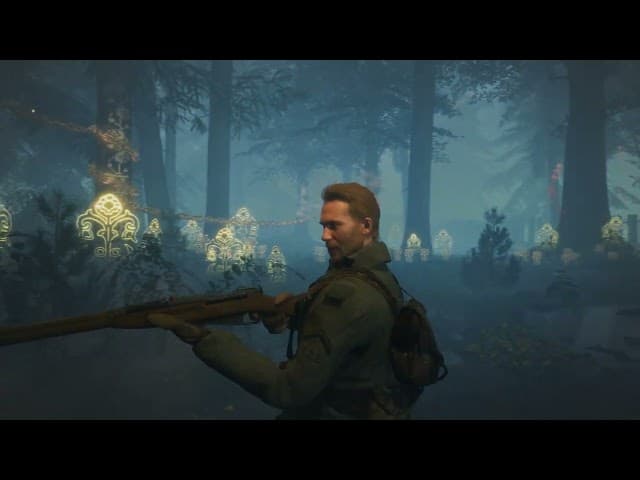
Visually, Chains of Lukomorye splits its time between muddy trenches shot in desaturated browns and swollen greens, and surreal, ghost-lit forests where gnarled trees loom like silent sentinels. Ruined palaces flicker with torchlight that casts dancing shadows on crumbling columns. The art style avoids a generic “grimdark” palette by accenting mythic set pieces with vibrant glyphs and runic motifs.
Sound design also appears central. The trailer’s audio mix contrasts the metallic crack of gunfire with low, resonant choral chants in Old Church Slavonic. Footsteps in muck are punctuated by distant, echoing owl hoots—an infamous omen in Slavic folklore. These elements underscore the developers’ commitment to immersion, suggesting that every trench walk becomes a journey between the earthly and the ethereal.
Potential Challenges and Caveats
No ambitious blend of genres is without risk. Balancing credible WWI weapon physics against mythic magic powers can lead to one system overshadowing the other. If guns feel weak or magic seems overpowered, players may ignore one half of the design entirely. Similarly, narrative-driven co-op must maintain pacing: unfolding a dark folk tale while coordinating two players can bog down momentum.
Performance is another unknown. Early footage looked polished, but detailed weather effects, large crowds of NPCs, and dynamic spirits strain even high-end PCs. Network stability for Sirin’s co-op role will be crucial—nothing kills immersion faster than teleporting companions or laggy audio cues.
Finally, there’s the question of tone. Dark fantasy and trench warfare both carry heavy themes. Mishandling either can feel exploitative. The developers must respect historical suffering while honoring Slavic traditions—without letting one undermine the other. My optimism rests on the respectful portrayal seen in the trailer, but only hands-on previews will confirm whether the game sustains that balance in 10 or 20 hours of play.
Want to Level Up Your Gaming?
Get access to exclusive strategies, hidden tips, and pro-level insights that we don't share publicly.
Ultimate Gaming Strategy Guide + Weekly Pro Tips
What This Means for the Shooter Genre
If Chains of Lukomorye delivers on its promises, it could redefine what a shooter can be. Rather than endless run-and-gun sequences, players confront moral choices: sacrifice ammunition or offer a war relic to summon a spirit, trade a friend’s safety for narrative insight, or risk a bayonet charge in exchange for fragile ammunition reserves. These decisions infuse tension beyond simple enemy encounters.
Furthermore, its focus on Slavic folklore adds much-needed cultural diversity. While vampires, zombies, and Norse myths saturate the market, the rich pantheon of Eastern Europe remains underutilized. By rooting powers, enemies, and even environmental puzzles in that tradition, the game could inspire other developers to explore less-trod mythological paths.
Specifications at a Glance
| Feature | Details |
|---|---|
| Publisher | TBA |
| Release Date | TBA |
| Genres | Shooter, Dark Fantasy, Folk Horror, Action-Adventure |
| Platforms | PC confirmed; consoles unannounced |
Conclusion: Wait and Watch
Chains of Lukomorye stakes an intriguing claim: a war story that feels haunted, a mythic adventure grounded in historical brutality, and a co-op system that entwines two destinies. I’m cautiously optimistic. For gamers fatigued by formulaic shooters or craving folklore that intersects with gameplay meaningfully, this title belongs on your radar. But until we see extended playtests, I’ll withhold full endorsement. Myth and musket rarely mix cleanly—if Chains of Lukomorye can pull it off, it may become a standout in a crowded field.