
Table of Contents (9)
Why This Expansion Caught My Eye
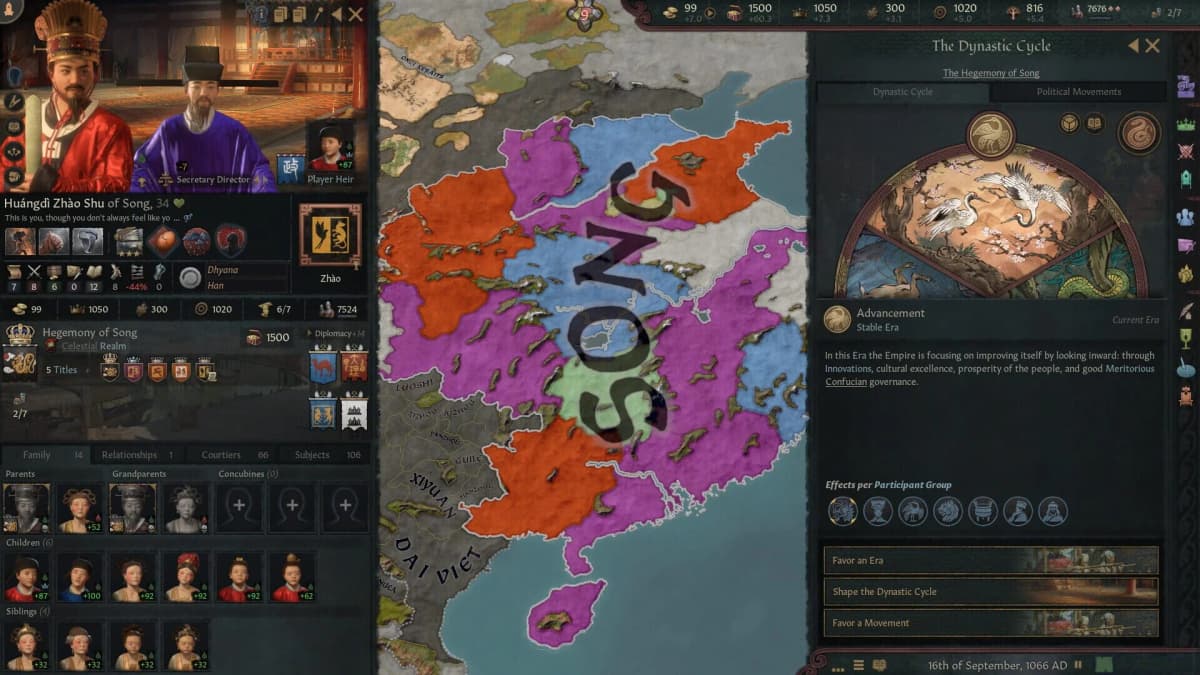
Crusader Kings 3’s All Under Heaven is the kind of DLC that makes longtime CK players both giddy and nervous. Giddy because we finally get China, Japan, and Southeast Asia on the actual map instead of as off-map abstractions. Nervous because anyone who’s pushed CK3 into the 1200s knows how a big realm can turn speed 5 into a slideshow. So when Paradox says the map is jumping by roughly 30-40% in playable land and rulers-and that it won’t tank performance-that’s worth digging into.
Key Takeaways
- The map grows by about a third with East Asia and Southeast Asia, expanding dynastic sandboxes and trade routes.
- Paradox says simulation “tick” optimizations make mid-to-late game performance comparable to-or better than—the current build.
- Character bloat is being trimmed at the source to cut down on invisible guests and CPU-hogging filler.
- Minimum specs rise to Intel i5-750/AMD FX-4300 with 8GB RAM, reflecting CK3’s heavier CPU load.
Breaking Down the Announcement
Paradox’s technical lead Joel Hansson puts the scale up front: “With All Under Heaven included, the game is about 30% to 40% bigger, in the sense of the amount of playable land and playable living characters.” That’s not just cartography bloat—CK’s simulation tracks rulers as the core building block, and more rulers equals more work every tick. Hansson notes there’s a 32% increase in baronies (and rulers), which would typically throttle throughput.
The counterpunch is optimization. The team’s been shaving down “simulation tick duration”—how fast the game resolves all those events, AI decisions, paths, and pregnancies—so the new build lands “comparable to the current live version.” Their testing shows a slightly slower early game, but faster tick rates in the mid-to-late years where CK3 usually struggles. If true, that’s the right place to win back frames.
They’re also attacking a very CK-specific pain point: character bloat. Rather than a blunt-force culling mod like Population Control, Hansson says they “reduced or eliminated a bunch of ‘sources’ of characters that generate boring, useless, random, or invisible characters that then linger in guest pools.” That’s the kind of unglamorous systems work that matters more than any single feature bullet.
Why Performance Promises Matter
CK3 is a CPU-first game. Even on a beefy GPU, the bottleneck is the simulation—the daily ticks of diplomacy, succession, pathfinding, and war. The moment you add a region as dense and historically complex as East Asia, the AI’s decision tree gets wider and taller: more vassals to evaluate, more wars to consider, more marriages to compute. CK2 dodged this by keeping China off map; CK3 is doing the brave thing and bringing it on-map.
That’s why I’m cautiously optimistic about the “mid-to-late game is faster” claim. If the optimization work targets the years when empires consolidate and armies balloon, it addresses CK3’s sorest spot. I want to see how it holds up at Speed 5 in 1300 while juggling multiple empire titles and a crusade firing halfway across the world. If the tick rate holds there, Paradox will have earned back a lot of trust after the messy Coronations pack.
Hardware Reality Check
Paradox is nudging the minimum CPU to Intel i5-750 or AMD FX-4300 and 8GB RAM. They called out older chips like the i3-2120 struggling “under heavy load,” which tracks with what I’ve seen: CK3 punishes old dual-threads and weak per-core performance. If you’re sitting on 8GB RAM, expect to be ruthless about background apps; CK3 can spike memory usage when the map gets busy.
The bigger story is that the studio is comfortable retiring truly old CPUs to maintain predictable performance. That’s a good sign for the game’s future—provided the optimizations actually offset the map’s new weight for most players.
What This Changes for Players
Beyond the benchmarks, the fantasy here is massive. East Asia and Southeast Asia mean new dynastic arcs, shogunate power plays, and Silk Road-style ambitions that connect Europe to the Pacific. CK is at its best when emergent stories collide, and this expansion should inject fresh rivalries, long-distance marriages, and trade-fueled conflicts that ripple across continents.

The flip side: more moving parts can amplify AI quirks. Merchant republics, tributaries, and sprawling imperial courts (depending on the feature set) often strain logic trees. If Paradox’s character-source pruning works, it could curb the “guest soup” and event spam that snowballs late game, especially in massive realms.
Open Questions (And Healthy Skepticism)
After Coronations landed with a thud, the community’s patience is thinner. All Under Heaven needs clean systems and tight balance on day one. Here’s what I’m watching:
- Multiplayer stability and desyncs on the larger map, especially during continent-spanning wars.
- AI pathfinding to and from Japan and island-heavy Southeast Asia.
- Late-game save file size and autosave stutter with the expanded character pool.
- Mod compatibility—popular performance and map mods might need rework.
- How early-game slowdown feels in practice; “a little slower” can be subjective.
Looking Ahead
If Paradox actually ships a 30-40% bigger CK3 that runs as fast—or faster—in the mid-to-late game, that’s a rare win for both content and tech. It also sets a higher bar for future DLC: build big, but make it run. All Under Heaven launches on Tuesday, October 28, and it’s poised to be the studio’s make-good after a rough DLC cycle. I’m excited to start a dynasty on the edge of the Pacific and watch the ripples hit Europe—but I’ll reserve final judgment for when my 1350 save still cruises at Speed 4.
TL;DR
All Under Heaven expands CK3 with China, Japan, and Southeast Asia and claims mid-to-late game performance gains thanks to tick-time optimization and character bloat cuts. The raised CPU minimum is fair warning, and the real test will be big saves, big wars, and multiplayer stability.
FinalBoss // Gear
Level up your setup
01Top-rated gaming headsetson Amazon→02High-refresh gaming monitorson Amazon→03Gaming chairson Amazon→04Discounted game keyson Kinguin→Affiliate links · As an Amazon Associate, FinalBoss earns from qualifying purchases.
Want to Level Up Your Gaming?
Get access to exclusive strategies, hidden tips, and pro-level insights that we don't share publicly.
Ultimate Gaming Strategy Guide + Weekly Pro Tips