
Table of Contents (18)
Why Contexto 1271 Feels So Weird (And How I Finally Cracked It)
After burning through more than 70 guesses on Contexto #1271, I realized this was one of those puzzles that punishes tunnel vision. I got stuck in “breakfast food mode” for way too long, chasing CEREAL, OAT, and CORN variations while the real answer was sitting just one abstraction level above what I was typing.
The breakthrough came when I stopped thinking about what the food was and started thinking about the form it takes – little pieces, particles, and yes, flakes. Using #1271 as a case study, I’ll walk you through the answer, the key hints, and the step-by-step solving approach I now use on every Contexto.
Quick Answer: Contexto 1271 Solution (March 12, 2026)
If you just need to save your streak and get out, here’s the direct spoiler.
Contexto #1271 Answer for March 12, 2026
The secret word for Contexto puzzle 1271 (March 12, 2026) is:
FLAKE
“Flake” is one of those tricky words with multiple senses: cereal flakes, fish flakes, snowflakes, paint flaking off, a flaky person. That’s exactly why so many of the clue words feel close but never quite hit it.
Spoiler-Light Hints for Contexto 1271
If you haven’t solved it yet and want guidance without an outright reveal, these are the exact kinds of nudges I wish I’d had:
- The word is 5 letters long.
- Some of the closest clue words include:
CHOP,COARSE,GRAIN,ALMOND,CINNAMON,ONION,CORN,OAT,SPRINKLE,CEREAL. - Think less about “a specific food” and more about the form things take when you process or sprinkle them.
- There’s a strong connection to small pieces or particles, not just ingredients.
- The answer can describe both food and non-food things.
If those hints already nudged you to the solution, skip ahead to the strategy section. That’s where the long-term improvement happens.
How I Solved Contexto 1271: Step-by-Step Thought Process
Contexto plays very differently from letter-based games like Wordle. The secret isn’t letter positions; it’s semantic distance. Each guess gets a rank based on how close its meaning is to the target. In #1271, the real trap is that the game showers you with food words that are “nearby” but not quite on target.
Step 1 – Start with Broad Anchor Words
These days I always open a new Contexto with a few broad, high-coverage words to figure out the general neighborhood. For #1271, my early guesses looked like this:
THINGOBJECTFOODPERSONPLACE
On #1271, FOOD shot up as one of my best early ranks, while PERSON and PLACE were way off in the red. That instantly told me I was probably dealing with something you eat, cook, or at least find in a kitchen.
Why this matters: Contexto uses an AI algorithm that’s pre-trained on text, so generic, frequently-used words like FOOD or OBJECT are like lighting up the map. Once one of them lands in the green (rank 1-300), you know which direction to explore.
Step 2 – Follow the Food Trail… But Don’t Get Stuck There
On puzzle 1271, the closest words people kept bumping into were things like:
GRAINCEREALCORNOATALMONDCINNAMONONIONSPRINKLE
My mistake at first was treating these as “what” clues instead of “how” clues. I spent way too long trying words like PORRIDGE, MUESLI, and brand-style ideas like CORNFLAKE, when the game was gently nudging me toward form and texture.
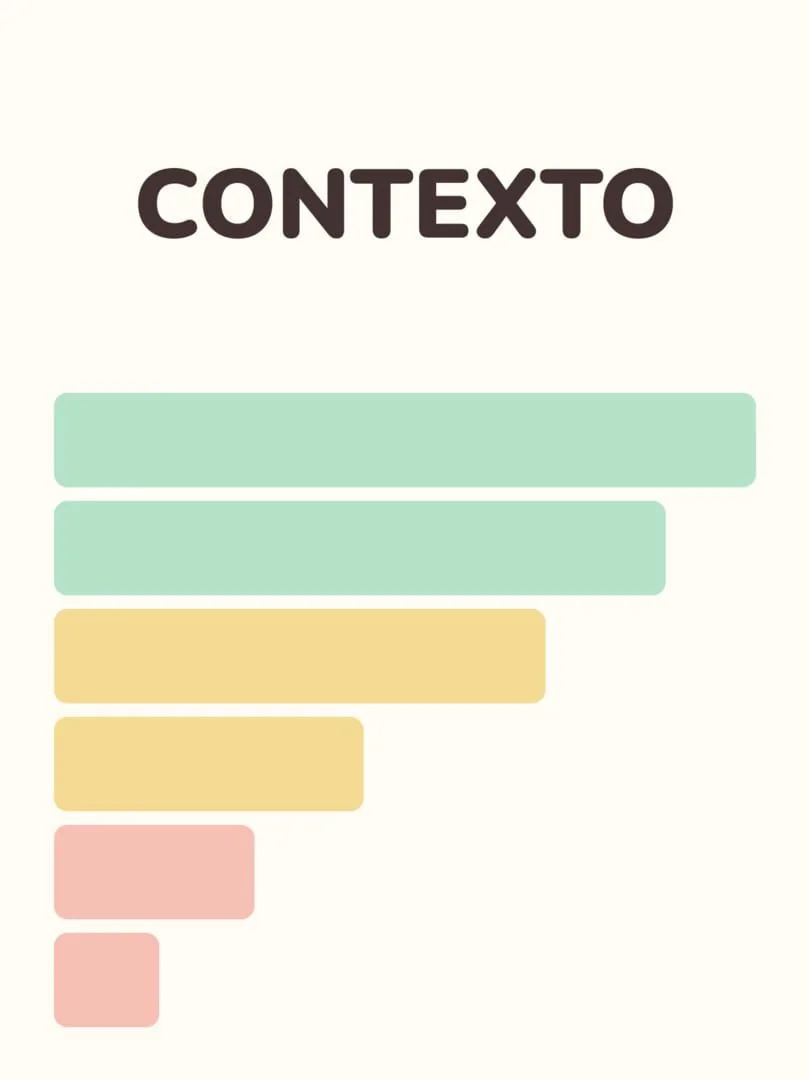
This is where the rank colors help a ton:
- Green zone (≈ 1–300): Very close conceptually. For me, words like
GRAINandCEREALwere in this band. - Yellow zone (≈ 301–1500): Related but not super tight. Think of this as “same scene, different object”.
- Red zone (>1500): Probably the wrong concept family. Time to pivot categories.
Once I noticed multiple grain-based foods in the green, I stopped trying individual dishes and asked a different question: “What do all these grains and sprinkles have in common?”
Step 3 – Use Category Jumps, Not Tiny Tweaks
Something I’ve learned (the hard way) is that Contexto punishes micro-variations. Guessing CEREALS, CEREALLY, CEREALITY and so on usually just burns guesses without new information.
Instead, I use what I think of as a “five-category jump” method. From the strong clue words in #1271, I deliberately tested different conceptual categories:
Instead, I use what I think of as a “five-category jump” method. From the strong clue words in #1271, I deliberately tested different conceptual categories:
🎮 Get This Game at the Best Price
Compare prices instantly and save up to 80% on Steam keys with Kinguin — trusted by 15+ million gamers worldwide.
*Affiliate link — supports our independent coverage at no extra cost to you
- Food item:
BREAD,PASTA,SOUP– these stayed yellow/red. - Ingredient:
FLOUR,SUGAR,SPICE– some improved, but didn’t beatGRAIN. - Texture:
CRUNCHY,CRISPY,COARSE– these started creeping toward better ranks. - Form/size:
CRUMB,GRANULE,POWDER– this category got me my best green ranks yet. - Action:
CHOP,CRUSH,SPRINKLE– again, very close, but clearly verbs rather than the target noun.
When I saw words like GRANULE, POWDER, and CRUMB jumping up the list, it was clear the game wanted “a small piece of something” rather than a meal or a dish.
Step 4 – From Particles to FLAKE
Once I was in the “particle/fragment” mindset, #1271 became much clearer. Here’s the rough chain that finally got me there:
GRAIN– very closeCRUMB– also closeGRANULE– strong rankFLECK– getting warmerFLAKE– boom, rank #1
You can see the mental shift: instead of guessing another breakfast (MUESLI, GRANOLA, etc.), I started naming shapes and fragments. Flake sits nicely in that cluster along with granule, crumb, bit, speck, fleck, and chip.
What really helped me was remembering that “flake” isn’t just cereal. Snowflakes, paint flaking, fish flakes, pastry flakes – the AI model has seen this word in lots of contexts, so it’s naturally tied closely to any word about small pieces or textured surfaces.
General Contexto Strategy: Using 1271 as a Blueprint
Even if you’re done with puzzle 1271, you can use the same approach to clear future Contextos faster and with fewer random guesses. Here’s the playbook I now use every day.
1. Always Open with Broad “Compass” Words
I treat my first 5–8 guesses as a scouting mission, not real attempts at the answer. Typical openers for me:
THING,OBJECTPERSON,HUMANPLACE,CITYFOOD,ANIMAL,TOOL
I then commit to chasing whichever one lands highest in the rankings. On #1271, that was clearly FOOD, which is why grain and cereal guesses naturally made sense.
2. Read the Color Zones Aggressively
Contexto’s rank colors aren’t just cosmetic – they’re a cheat sheet for how drastic your next guess should be:
- If you’re in green (1–300), stay in the same concept but change role: if you guessed a food, try an ingredient, texture, or tool related to that food.
- If most guesses are yellow (301–1500), you’re probably in the right general setting (e.g., kitchen), but wrong kind of thing (you’re guessing dishes instead of actions, for instance).
- If you’re stuck in red (>1500), run a hard pivot: new domain, new category, maybe even a totally different part of speech.
In 1271, seeing GRAIN, CEREAL, and SPRINKLE consistently in green told me “you’re in the kitchen, around breakfast foods and toppings – but not directly naming any of them.”
3. Jump Between Noun, Verb, and Adjective Forms
One trick that helped on #1271: when verbs like CHOP and SPRINKLE ranked high, I tried related nouns (CHOPPER, SPRINKLER, CHOPPING, etc.). Even when those weren’t close to the final answer, they told me which role the secret word played:

- High-scoring verbs → maybe the answer is an action.
- High-scoring nouns → maybe it’s an object or substance.
- High-scoring adjectives → maybe it’s a quality or texture.
For 1271, particles like GRANULE and CRUMB as nouns were the big tell: we weren’t dealing with the act of sprinkling, but with the bits themselves.
4. Use Synonym Chains Instead of Random Stabs
When something scores well, don’t just shrug and move on. Milk it. For #1271, once I saw CRUMB and GRANULE doing well, I walked a whole chain of synonyms:
CRUMB→BIT→PIECE→FRAGMENTGRANULE→GRAIN→FLECK→FLAKE
That second chain is what finally landed the answer. The key is to move sideways in meaning, not just spam plurals or add -ing/-ed to everything.
5. Don’t Overfit to Yesterday’s Puzzle
I’ve seen people try to “predict” future Contextos based on previous days, but puzzle 1271 is a good reminder that the game jumps themes a lot. If yesterday’s answer was abstract, today’s might be concrete; if yesterday was a person, today might be a verb or, like here, a physical fragment.
It’s fine to keep a mental list of common types of answers (objects, actions, qualities), but don’t assume any long streak of similar themes. Focus on what your high-ranked guesses are telling you today.
Common Mistakes I Made on 1271 (So You Don’t Have To)
- Getting stuck on one reading: I kept treating the puzzle as “breakfast food” instead of thinking of flakes as particles, snow, paint, etc.
- Micro-tweaking instead of jumping: Wasting guesses on tiny spelling changes instead of trying new categories like texture or form.
- Ignoring mid-ranked clues: Words like
COARSElooked mediocre at first, but they were actually screaming “think about texture!” - Forgetting non-food contexts: If I’d thought of
SNOWorPAINTearlier, I probably would have reachedFLAKEmuch faster.
Wrapping Up: Turning One Tough Puzzle into Long-Term Skill
Contexto 1271’s answer, FLAKE, is a perfect example of how this game rewards flexible thinking. It sits at the intersection of food, texture, and tiny particles, and the only way to get there confidently is to:
- Open with broad “compass” words to find the right domain.
- Watch which clues land in the green and ask what concept they share.
- Jump across categories (food → texture → fragment) instead of repeating similar guesses.
- Walk synonym chains once you’re near the target idea.
If this puzzle gave you trouble, that’s actually good news: it’s the exact kind of word that trains you to think beyond obvious categories. Apply the same method tomorrow, and you’ll notice your guess counts dropping steadily. If I could turn a messy 70-guess slog into a structured path to FLAKE, you can absolutely do the same on the next daily Contexto.
FinalBoss // Gear
Level up your setup
01Top-rated gaming headsetson Amazon→02High-refresh gaming monitorson Amazon→03Gaming chairson Amazon→04Discounted game keyson Kinguin→Affiliate links · As an Amazon Associate, FinalBoss earns from qualifying purchases.
Want to Level Up Your Gaming?
Get access to exclusive strategies, hidden tips, and pro-level insights that we don't share publicly.
Ultimate Guide Strategy Guide + Weekly Pro Tips