
Table of Contents (12)
Copa City Preview – The First Football Game That Made Me Feel Sorry For Stewards
I’ve spent a good chunk of my life orbiting football stadiums. Home and away for Liverpool for over a decade, planning weekends around kickoff, lining up in the cold hours earlier than I needed to just to hear the crowd start to swell. I’ve shouted at stewards, cursed at ticket lines, rolled my eyes at police cordons, and eaten truly awful food because I didn’t dare leave the stand at the wrong time.
Not once in all those years did I seriously wonder how any of it actually works. I just showed up and treated everything outside the white lines as set dressing for the real show.
Copa City is the first game that grabbed me by the scruff of the neck and said: “No, this is the show you’ve been ignoring.” It’s a football game about everything except the football – and somehow, in this preview build, it got under my skin in a way I wasn’t ready for.
Key Takeaways From The Preview Build
- Angle: You’re a “city captain” running match-day logistics – fan zones, safety, catering, seating – not tactics or transfers.
- Emotional punch: Surprising sense of stress and responsibility when satisfaction drops and crowds start to turn.
- Licensed clubs: Arsenal, Bayern Munich, Beşiktaş, Flamengo and more give the whole thing a grounded, serious feel.
- UI & camera: Clunky at times, with fiddly menus and awkward angles that slow down otherwise smart systems.
- Performance: Rough around the edges on PC and absolutely not ready for Steam Deck right now.
- Overall: Fascinating and genuinely enlightening, but very much a work-in-progress that needs polish before launch.
Football Without the Football: What Copa City Actually Is
When I first saw Copa City’s trailer, I shrugged it off. Dramatic helicopter shots over stadiums, huge crowds, bits of UI flying around – it had that too-good-to-be-true sheen that screams “proof of concept that’ll never work” or, worse, some blockchain-adjacent nonsense.
Booting up the preview build on PC wiped that smugness off my face pretty fast. The core idea is simple: you’re the “city captain”, the person responsible for everything surrounding a big match day. That means:
- Planning fan zones around the city
- Managing crowd flows from train stations to squares to stadium
- Balancing catering, entertainment, and safety
- Assigning stands, ticket prices, and segregation once the stadium opens
You don’t pick formations. You don’t sign wonderkids. The ninety minutes on the pitch are mostly a cutscene payoff to the real game: whether you actually got all those bodies in and out of the ground without riots, empty blocks of seats or starving supporters.
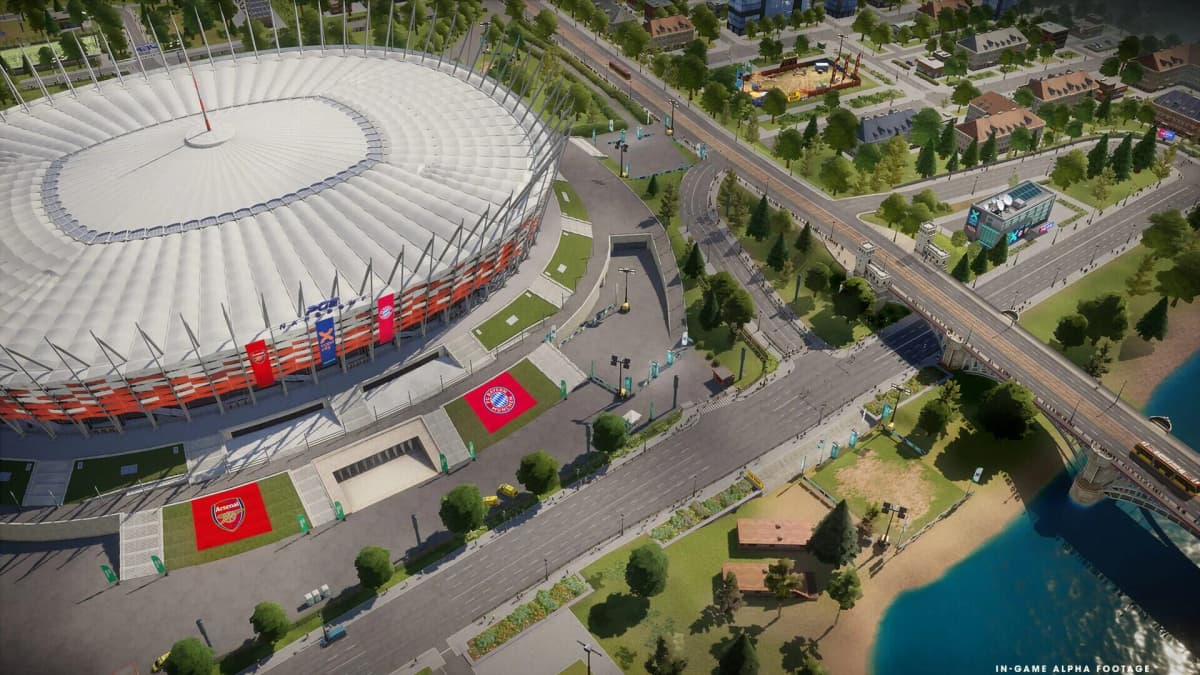
The preview I played is wrapped around a youth tournament in Warsaw – an under-21 “Stars of Tomorrow” match. It sounds small and harmless; it isn’t. The scale hits you when the first wave of fans pulls into the city and every street junction suddenly matters.
Crucially, Copa City already has licensed clubs in the build I played. Seeing names like Arsenal, Bayern Munich, Beşiktaş and Flamengo in a game about crowd logistics does something weird to your brain. It stops feeling like a quirky indie experiment and starts feeling like someone handed you a tiny slice of actual responsibility.
There’s a light narrative framing, too. The intro talks about a missed penalty and that awful hollow noise when the ball hits the post and a season dies in a second. As someone who still remembers Gerrard slipping like it was yesterday, that landed. It’s a clever move: they show they understand the emotion of football, then they drag you away from the pitch and dump you into a city map.
Packs, Advisors and That “Oh No, Is This FUT?” Moment
One of the first things Copa City asked me to do was open a pack. My soul left my body for a second. Football plus packs has meant one thing for years: microtransactions and a slow bleed of your will to live.
Here, packs are more like card-based unlocks for buildings, staff, and buffs. The developers have said the full release will be a standard purchase with no microtransactions. In the preview there’s no store, no premium currency, nothing like that – but I’d be lying if I said I didn’t flinch every time the game flashed a shiny pack animation. This is an area where trust will have to be earned over time.
You also have voiced advisors nudging you along – talking heads tied to specific disciplines like safety or fan engagement. They’re there to do light tutorial work and sprinkle in a bit of flavour. Right now they’re more functional than memorable, but they stop the early game from feeling like an Excel sheet.
My First Match Day in Warsaw: Stress, Toilets and Ultras
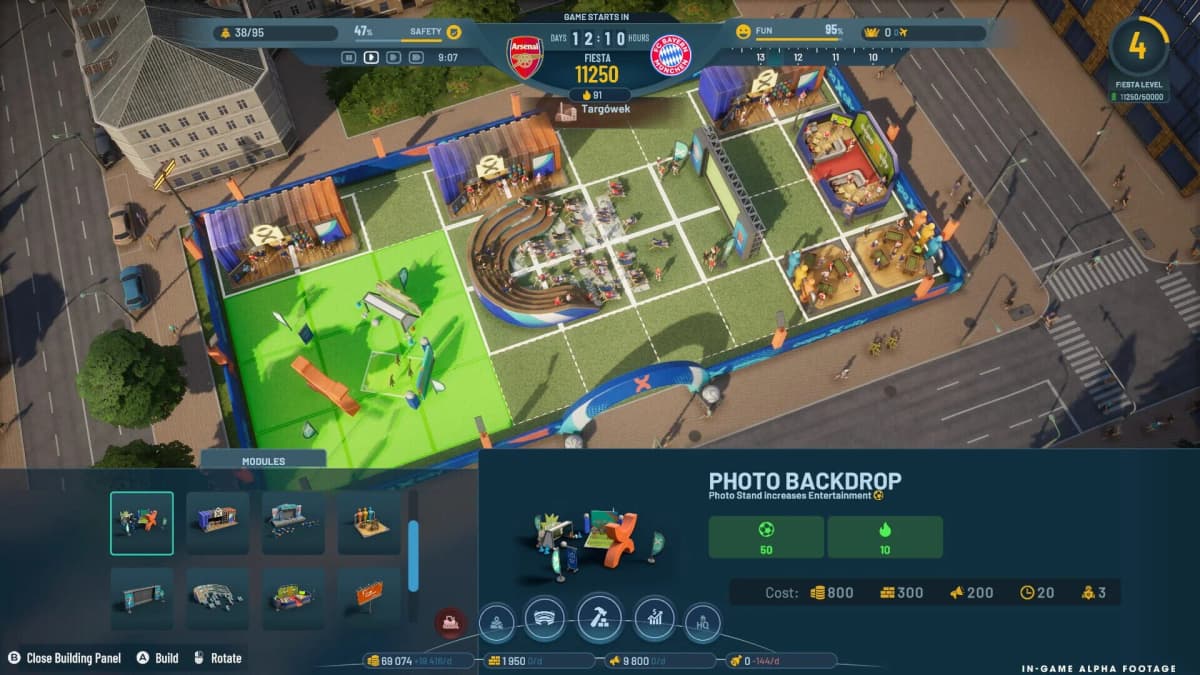
The real magic of Copa City clicked about thirty minutes into my first scenario. I’d plopped down a few fan hubs around Warsaw – think branded mini-fan parks marked by Copa City logos – and was feeling quite pleased with myself. Plenty of food stands, a couple of foosball tables, some security, job done.
Then the fans actually started arriving.
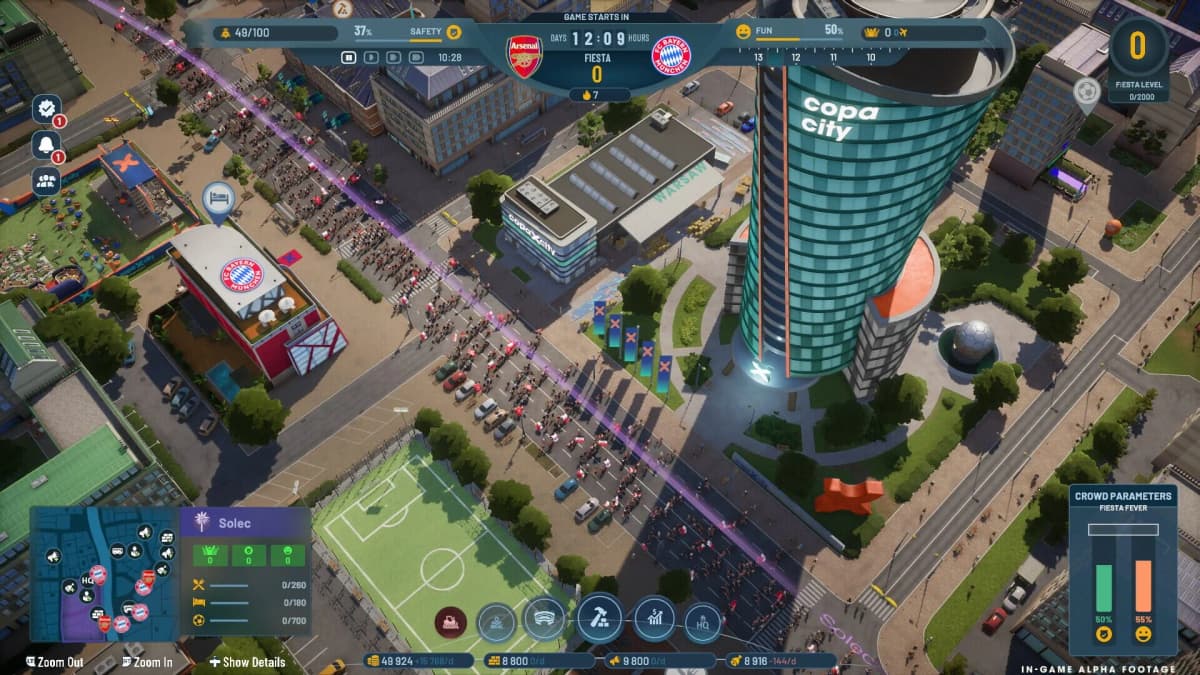
They come in waves, and they’re not just a sea of identical dots. Families drift towards certain hubs. Ultras pour into others, wanting singing space, cheap food, and their corner. Neutral tourists hang around wherever looks fun. Each group has a slightly different mix of requirements, and everything in Copa City orbits three core needs:
- Catering – Do they have enough to eat and drink?
- Fun – Is there anything to do besides stand in a queue?
- Safety – Are they secure without feeling like they’re in a police state?
At the top of the screen is a satisfaction bar judging your every move. If it hits zero, the match is straight-up cancelled. No dramatic rescue, no “barely got away with it” cutscene. Everyone goes home, and you sit there staring at a failed scenario because you didn’t build enough burger stands near the station.
The first time that bar dipped into the danger zone, I felt a very real spike of stress. I caught myself frantically slapping down extra catering modules and toilets like I was about to get a furious call from the club chairman. It’s absurd, but that’s the moment Copa City really worked for me: when an abstract gauge on a UI suddenly felt like thousands of angry supporters chanting outside my virtual office.
The game constantly pushes you to think about flow. Too many ultras funneled through a family hub? Trouble. Not enough security at the right pinch points? Fights can break out and satisfaction tanks. Concentrate all your fun stuff in one zone? Congestion nightmare. It’s not a hardcore sim yet, but it absolutely captures the anxiety of trying to predict human behaviour at scale.
As I watched the little fan groups snake through the streets, I kept flashing back to news footage of actual clashes outside stadiums – that helicopter view where it all looks like ants swarming. I’ve always watched those and thought, “What a mess.” Playing Copa City, I got a faint hint of what it might feel like to be the person whose plan either prevents that mess or fails to.
Inside the Ground: Ticket Prices, Segregation and the Bits Nobody Cheers For
Eventually, the stadium gates open and the whole focus shifts. Suddenly you’re assigning stands: deciding where the ultras go, where families sit, how many away fans you’re willing to house, and how expensive each section should be.
I’ve spent years obsessing over where to sit for maximum atmosphere. I’ve paid a premium to be near a loud singing block. I’ve sulked when I got stuck near away fans or a dead part of the ground. I never – honestly, never – stopped to consider just how many tiny decisions go into that seating chart before anyone even logs onto a ticket portal.
Copa City doesn’t go fully granular, but it does ask you to juggle a lot of variables: demand for specific stands, who can safely be next to whom, whether a dirt-cheap family stand is worth having if its catering is a disaster and everyone leaves miserable.
Even concessions inside the stadium matter. You can have a perfectly run fan zone outside, and still lose satisfaction because the inside of one stand doesn’t have enough kiosks or rubbish starts piling up. It stacks, and it stacks quickly. Fix one bottleneck, another appears three menus away.
What really hit me was the emotional flavour of success. When I finally got everyone into the stadium with decent satisfaction, no cancelled match, and no big incidents, I didn’t feel triumphant. I felt… relieved. Tired. Like I’d just finished holding my breath for an hour.
That’s so different from the dopamine rush of winning a title in Football Manager. This isn’t about lifting trophies. It’s about the quiet, invisible work that means everyone else gets to care about trophies in the first place.
UI Headaches and Camera Fights: Where the Design Trips Over Itself
For all the smart ideas, this is absolutely a preview build, and it shows. The first and most consistent friction point for me was the interface.
Copa City has a lot of overlapping systems – fan needs, district modifiers, staff, structures, ticketing, security coverage – and they all fight for space on the screen. Tooltips pop up where you don’t quite want them, some buttons don’t feel intuitive, and I regularly dug through two or three menus just to find a basic piece of information like which zones were actually unhappy and why.
The camera doesn’t help. Shifting from a broad city view to detailed placement can be awkward; sometimes I’d be trying to rotate around a fan zone and end up wrestling with a tree or clipping through a building. It’s not disaster-level bad, but it adds friction to what should be a smooth dance of placing, adjusting and reacting.
This is exactly the sort of thing that can be tuned with time – better context-sensitive buttons, clearer overlays, snappier zoom presets – but right now, the UI feels like a layer of static between my brain and the clever simulation underneath.
Performance & Steam Deck: Not Ready for Handheld Primetime
On my mid-range PC, Copa City ran… okay. Not great, not unplayable – just clearly in need of optimization work. As the city filled up and more fans appeared, I hit noticeable frame drops, especially during fast camera pans over dense areas. Nothing crashed, but I wouldn’t call it smooth yet.
On Steam Deck, it was rougher. The build I played felt decidedly not Deck-friendly in its current state. Stutters were frequent, loading took a while, and the UI isn’t really designed with a small screen in mind – lots of text, nested menus, and tiny icons that don’t translate well to handheld distance.
This is a shame, because on paper Copa City sounds like a perfect “play a scenario on the couch” kind of game. Right now, though, I’d strongly recommend sticking to a desktop or laptop until the developers explicitly talk about optimizations and UI scaling for Deck and other handheld PCs.
That said, this is still pre-release. There’s time. The core simulation is already engaging; it just needs a smoother frame to sit inside.
Reframing Fandom: The Part That Actually Stayed With Me
After a few hours with the preview, I shut the game down and did something I wasn’t expecting: I thought about the people who run real match days.
All those tiny annoyances I’ve complained about for years – the slow-moving queues, the blocked-off streets, the steward checking my ticket three times between the turnstile and my seat – suddenly looked different in my head. Someone, somewhere, is juggling a hundred spreadsheets and phone calls trying to make that whole ecosystem not collapse every weekend.
Copa City doesn’t turn you into a real stadium operations expert. It’s still a video game, still streamlined, still colourful and exaggerated. But it does something I really respect: it reframes what it means to be a football fan for a few hours. It nudges you away from “Why is this line so long?” and towards “How the hell do they stop this from getting dangerous every single time?”
That emotional shift, more than any specific mechanic, is why I’m going to keep an eye on this one. There are plenty of games about the glory and misery of results. Very few bother with the plumbing that makes those results possible.
Who Copa City Is (and Isn’t) For
If your idea of a football game is blasting through seasons in EA FC or sweating over tactics in Football Manager, Copa City lives in a very different part of the stadium.
- If you enjoy city builders and management sims like Cities: Skylines or Transport Fever and you also love football culture, this sits squarely in your wheelhouse.
- If the thought of planning toilets, food stalls and crowd control sounds like work rather than play, it might leave you cold no matter how clever it is.
- If you’re curious about the behind-the-scenes reality of big events – not just football, but concerts and festivals too – Copa City scratches a very specific itch.
It’s worth remembering this is a preview based on the demo-era build. The full release, coming to PC and consoles, is still a little way off. There’s room for deeper scenarios, more polished interfaces, and better performance… or for it all to wobble under its own ambition. Right now, though, the foundations are genuinely interesting.
Bottom Line: A Powerful Idea Buried in Preview Jank
I went into Copa City thinking, “Why would I want to manage food stalls and police lines?” I came out thinking, “How does this entire system not collapse every single weekend in real life?”
The game is far from finished. The UI is clumsy, the camera’s fussy, bugs pop up, and performance – especially on Steam Deck – is not in a good place yet. Those aren’t tiny issues; they actively get in the way of enjoying what’s unique about the game.
But the core of Copa City – the way it makes you feel the weight of thousands of fans as more than numbers, the way it transforms queues and toilets and steward lines into a tense puzzle – is strong. Strong enough that, even with all the rough edges, I walked away impressed and a bit humbled.
Preview score (subject to change at full release): 7/10. A fascinating, emotionally resonant sports sim concept that needs serious polish and optimization, but already made me look at match day with much more respect.
TL;DR
- Copa City swaps tactics for logistics: you’re managing fan zones, safety and stadium operations, not playing the match.
- Emotionally surprising: made me feel genuine stress and responsibility for virtual crowds, and rethink real-world match days.
- Licensed clubs add weight: seeing Arsenal, Bayern, Beşiktaş, Flamengo etc. sells the fantasy in a big way.
- UI, camera and bugs are real problems: menus are clunky, the camera is awkward, and the build feels early.
- Performance is rough, especially on Steam Deck: playable on PC with hiccups, but not handheld-ready yet.
- Huge potential for fans of management sims and football culture, but you need patience for jank in its current state.
- Provisional rating: 7/10 based on preview – could rise if the polish and optimization arrive before launch.
FinalBoss // Gear
Level up your setup
01Top-rated gaming headsetson Amazon→02High-refresh gaming monitorson Amazon→03Gaming chairson Amazon→04Discounted game keyson Kinguin→Affiliate links · As an Amazon Associate, FinalBoss earns from qualifying purchases.
Want to Level Up Your Gaming?
Get access to exclusive strategies, hidden tips, and pro-level insights that we don't share publicly.
Ultimate Reviews Strategy Guide + Weekly Pro Tips