
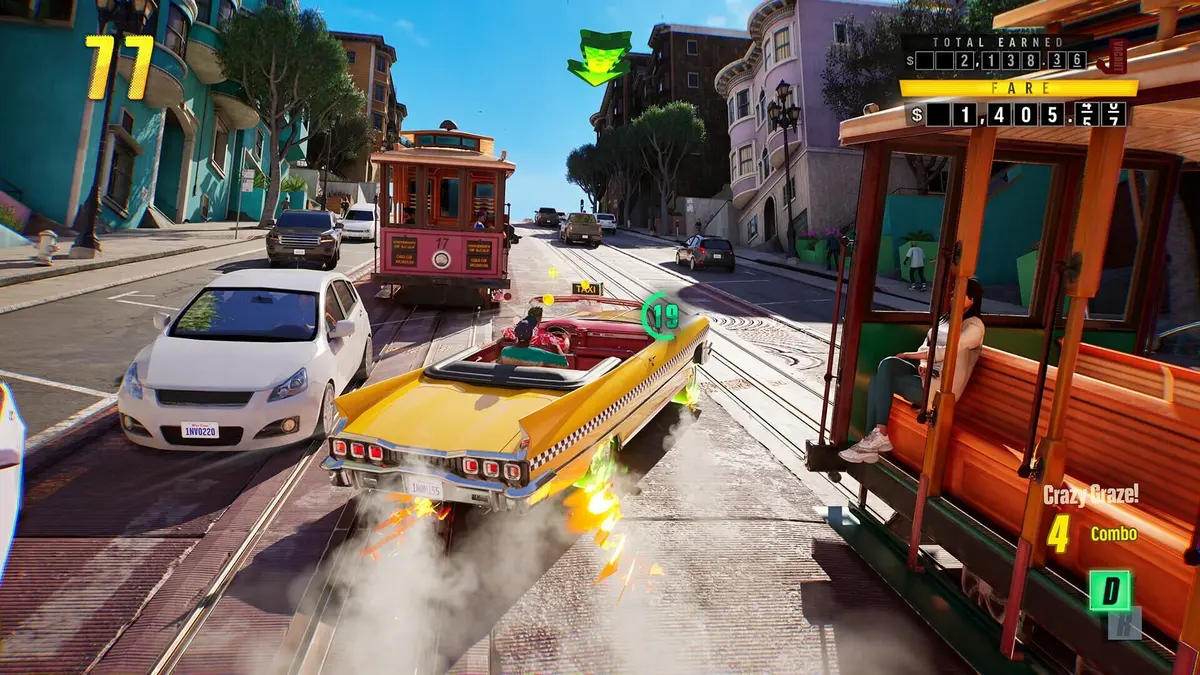
In June 2026, Crazy Taxi: World Tour’s Steam disclosure drew a strangely specific boundary: generative AI had supported development, but it had not been used in relation to the game’s performers. That answered one concern while leaving environmental art hanging. A player reading the statement could reasonably understand that performances were protected without understanding what would appear on screen.
The subsequent explanations became more precise. SEGA described AI support for background assets, with generated material reviewed by the development team. Series creator Kenji Kanno explained that artists used generated images as references, then created the actual assets themselves. A later clarification placed that use in the initial research and idea-development phase for background objects and said generated content would not appear in the final game.
Those distinctions matter. So does the fact that players needed several explanations to reach them. I welcome SEGA’s commitment to human-led creative work, but “very cautious” is too soft a standard to carry the argument. Crazy Taxi: World Tour needs a disclosure that explains the workflow plainly, rather than requiring its audience to reconstruct it from successive statements.
Table of Contents (5)
SEGA has drawn a useful boundary around creative responsibility
In October 2026, Tsuyoshi Saito, SEGA’s senior executive officer and deputy chief business officer, said the company was “very cautious” about AI in game development and was “not entrusting the creative aspects of games to AI.” He also described its use for publishing efficiency, corporate work and business ideas.
I support that division. Automating an internal administrative task and deciding what a game’s city should look like carry different creative stakes. Players experience the latter directly, and the people responsible for it need the authority to make decisions — not merely approve whatever a tool supplies.
The Crazy Taxi explanation also demonstrates that SEGA’s position allows some involvement before finished assets exist. Generated references were part of the development process even though the company says generated assets will not ship. Anyone interpreting the pledge as a complete prohibition on generative AI throughout production is expecting more than SEGA has promised.
The appropriate expectation for future SEGA announcements is human responsibility for the creative work, accompanied by a precise account of any generative assistance. Saito’s statement gives players a principle against which to judge those announcements. It does not supply a complete, project-by-project account of how that principle will be enforced.
Background art matters to Crazy Taxi’s identity
“Background objects” can sound like an insignificant corner of production. In a driving game, the environment occupies most of the screen and supplies the character of the journey. Buildings, roadside objects and visual landmarks help make a route memorable. Treating that work as creatively disposable would be a terrible fit for Crazy Taxi.
World Tour’s Germany stage contains five areas: an airport, a city, a walled city, mountains and the Autobahn connecting them. That layout gives the art team distinct spaces to define. An airport approach and a route through a walled city should have different visual identities, beyond a change in road geometry.
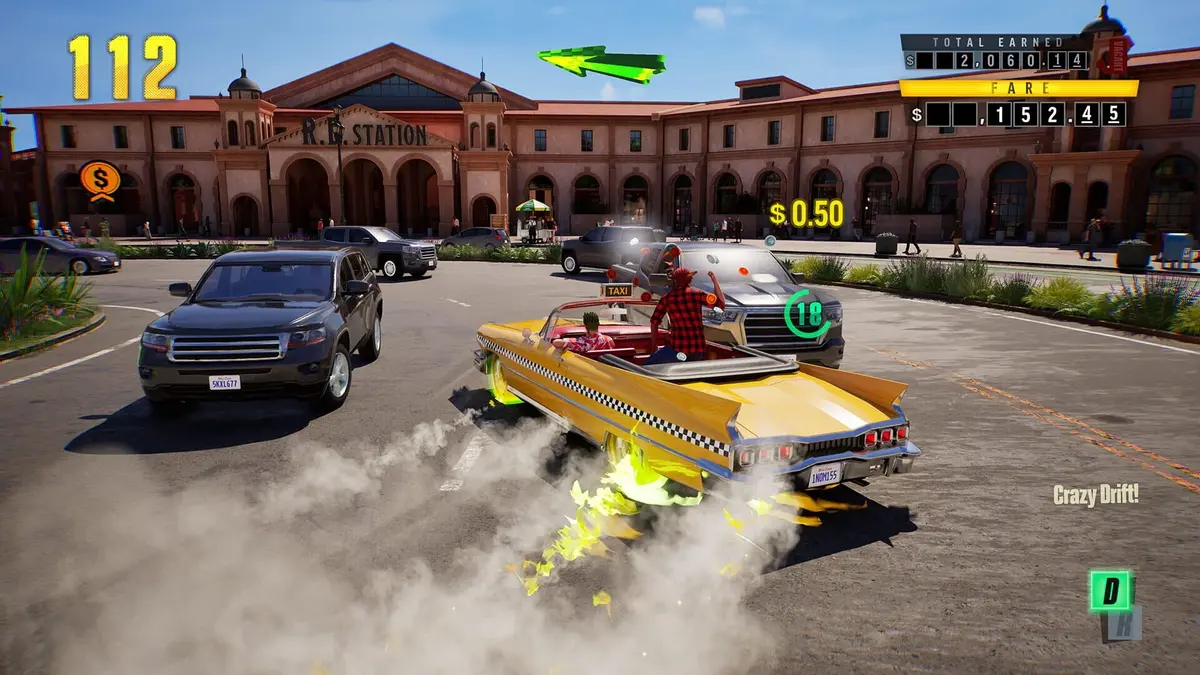
The driving systems supply the familiar urgency: Crazy Dash provides a speed boost, Crazy Stop slams the brakes, and Crazy Drift is triggered with a shoulder button. Crazy Rush centres on timed passenger pick-ups and drop-offs, with trick combinations multiplying the final fare. Those mechanics make environmental readability consequential. At speed, a distinctive landmark can help a player recognise a turn; clutter can compete with information the player needs.
That is why I care about who makes the environmental decisions. An artist deciding which shapes, colours and objects belong beside a route is contributing to the game’s identity and its usability. Human authorship should cover those judgments, rather than becoming a label attached to the person who produced the final file.
None of this establishes that AI references damaged World Tour’s setting. A concern about environmental character cannot identify the tool responsible for it. Blaming a bland object or an awkward scene on generative AI without a connection would be as lazy as dismissing every objection to the technology as resistance to progress.
Human-created assets leave a second question open
Kanno’s explanation provides an important distinction: the artists created the actual assets rather than inserting generated images into the game. Their work deserves to be described accurately. Calling the finished game AI-generated would erase that distinction and overstate what SEGA has said.
But a reference image can influence a design without contributing any pixels to its final version. It might suggest a silhouette, an arrangement of objects or a visual direction. The creative chain therefore begins before the finished asset. A policy focused exclusively on what ships can miss decisions made during research.
The strongest defence of this workflow is that artists interpret references rather than mechanically reproduce them. They can reject a generated suggestion, alter it substantially or combine it with their own ideas. That is a meaningful exercise of judgment. I would not treat every use of generated reference material as equivalent to replacing an artist.
Nevertheless, the tool’s training data and permissions remain relevant. Creating the final object by hand does not explain whether the model behind the reference was trained on work its creators authorised for that purpose. SEGA should address those rights directly. The assurance that no generated assets will ship answers an output question; it leaves the underlying model’s provenance to be explained.
There is also a difference between human review and human creative control. Reviewing generated material can catch defects. It does not, by itself, establish who originated the direction or whether an artist could reject it. I want SEGA’s policy to protect that decision-making authority, because retaining people while reducing them to approvers would hollow out the promise.
The AI committee needs to govern more than wording
SEGA has established a Generative AI Committee. Its AI Task Force develops in-house tools and coordinates distribution-platform disclosure requests with North American and European PR departments. That creates an organisational route for handling AI use instead of leaving every team to invent its own explanation.
The value of that structure depends on its responsibilities. A committee that helps teams complete disclosure forms can improve consistency. A committee that also sets acceptable uses, checks tool permissions and assigns responsibility for exceptions can protect the creative boundary Saito described.
World Tour exposes the cost of stopping at broad terminology. “Support tools,” “background assets” and “reference images” describe different aspects of a workflow. Using them without explaining their relationship leaves players trying to determine whether the underlying practice changed or only the description did.
SEGA should apply one disclosure standard across internal teams, contractors and outsourced work. It should also specify how its creative commitment applies to adjacent work such as localisation and marketing art. Those are policy requirements, not accusations that those departments have breached the pledge. A company-wide principle needs a company-wide scope.
What a useful World Tour disclosure should contain
With Crazy Taxi: World Tour targeting a 2027 release on PC, PlayStation 5, Nintendo Switch 2 and Xbox Series X|S, SEGA has an opportunity to publish a single, coherent explanation before launch. I would judge it against these concrete requirements:
- Finished content: State whether any generated images, text, audio, animation or other material will appear in the released game. Preserve the current assurance about generated assets without burying it beneath the phrase “AI-assisted.”
- Development stage: Identify what was generated for background-object research, how artists used it and where that use ended. Distinguish references from prototypes and production assets.
- Creative authority: Explain who selected the references and approved the resulting work, including whether artists could reject generated suggestions.
- Tools and rights: Identify the relevant models and explain the training-data permissions or safeguards behind their use.
- Coverage and responsibility: State whether the same rules apply to contractors and outsourced assets, and identify the team responsible for checking compliance.
This would let players distinguish a research aid from generated production work without decoding corporate language. It would also give SEGA a stable account to stand behind if its workflow remains the same — and an obligation to update that account if it changes.
FinalBoss // Gear
Level up your setup
01Top-rated gaming headsetson Amazon→02High-refresh gaming monitorson Amazon→03Gaming chairson Amazon→04Discounted game keyson Kinguin→Affiliate links · As an Amazon Associate, FinalBoss earns from qualifying purchases.
Want to Level Up Your Gaming?
Get access to exclusive strategies, hidden tips, and pro-level insights that we don't share publicly.
Ultimate Gaming Strategy Guide + Weekly Pro Tips