
Table of Contents (14)
Greymane Camp in a Nutshell: What to Focus on First
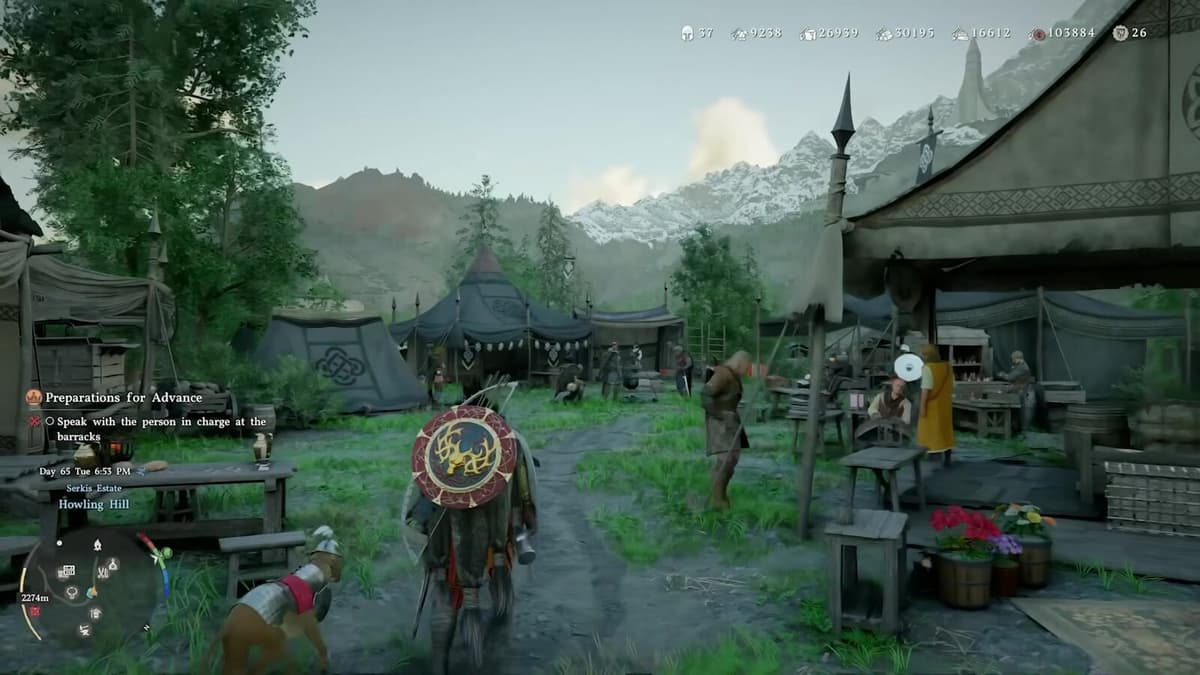
The Greymane camp becomes available in Chapter 3, and the game barely explains how powerful it can be. The short version: start the camp questlines as soon as they unlock, keep dispatch missions running 24/7, prioritize camp funds and core resources for expansions, then layer in trust, trade wagons, and the farm/ranch to turn the camp into a long-term resource engine.
The main quest that opens everything is tied to Howling Hill and leads into three Greymane faction lines:
- Grounds of the Sunrise – core camp building and expansions.
- Scattered Embers – broader faction story, less about the camp systems.
- Greymane Commissions – character quests, trust gains, and inventory upgrades.
From experience, the smoothest route is: push Grounds of the Sunrise whenever it appears, do Commissions between time-gated steps, and always have dispatch missions running in the background.
Unlocking and Stabilizing the Camp (Early Priorities)
Once your camp is founded in Chapter 3 via the main quest, talk to the key NPCs at camp:
- Marius – your camp overseer; he points you toward recruitment (“Rumor”) quests and drives the camp’s expansion storyline.
- Ross – the dispatch coordinator; you assign and track dispatch missions through him, including the expansion orders sent to Howling Hill.
- Carl – the supply manager; he handles donations, the camp supply chest and trade-goods storage.
The game lets you ignore all of this and just keep adventuring, but that’s how you end up underfunded later. I made that mistake once, then restarted a save and did this instead:
- As soon as the camp unlocks, start the first Grounds of the Sunrise quest.
- Complete Marius’s early recruitment missions so you have a basic roster of comrades.
- As soon as Ross is available, start at least one dispatch mission and get used to checking it regularly.
The first camp upgrade is cheap compared to later ones (a small amount of food and camp funds, with an 18 in-game hour completion time), but it sets the rhythm: upgrades and many Grounds of the Sunrise steps are time-gated. The earlier you start those timers, the less you’ll feel the wait later.
Dispatch vs Vendor Comrades: Who Does What
Comrades come in two functional types, and understanding the difference changes how you treat them:
- Dispatch comrades – you send them on missions to gather food, materials, camp funds, and trade goods.
- Vendor comrades – they stay at camp and run services (shops, farm, ranch, etc.).
Recruitment via Grounds of the Sunrise alternates between “go find these comrades” and “expand camp so more can move in”. Never sit on a recruitment quest: the more comrades you have, the more missions you can run and the more stable your economy becomes.
Several vendors are especially important:
- Brice – his commission unlocks wagons and proper trading.
- Ben – manages the ranch (animals, meat, milk, sale stock).
- Kamu – manages the farm/orchard (crops and trees).
When given a choice, I always prioritized recruits that unlocked new systems (farm, ranch, trade) over pure combat NPCs, because those systems snowball your resources over time.
Running Efficient Dispatch Missions (The Real Engine of the Camp)
Dispatch missions are accessed by talking to Ross at camp or, more conveniently, from the world map:
- Open the map and switch to the faction view.
- Hover over a location with a mission icon on the top-right of its marker.
- Inspect it, tab over to Missions, and assign comrades or cancel existing runs.
Each mission consumes some camp resources and returns others. The trick is to match the right Greymane to the right job, without overusing your best specialists.
Skill Matching and Tier Bonuses
Every dispatch comrade has skills like Logger, Miner, Farmer, Escort, and so on, each with up to three tiers:
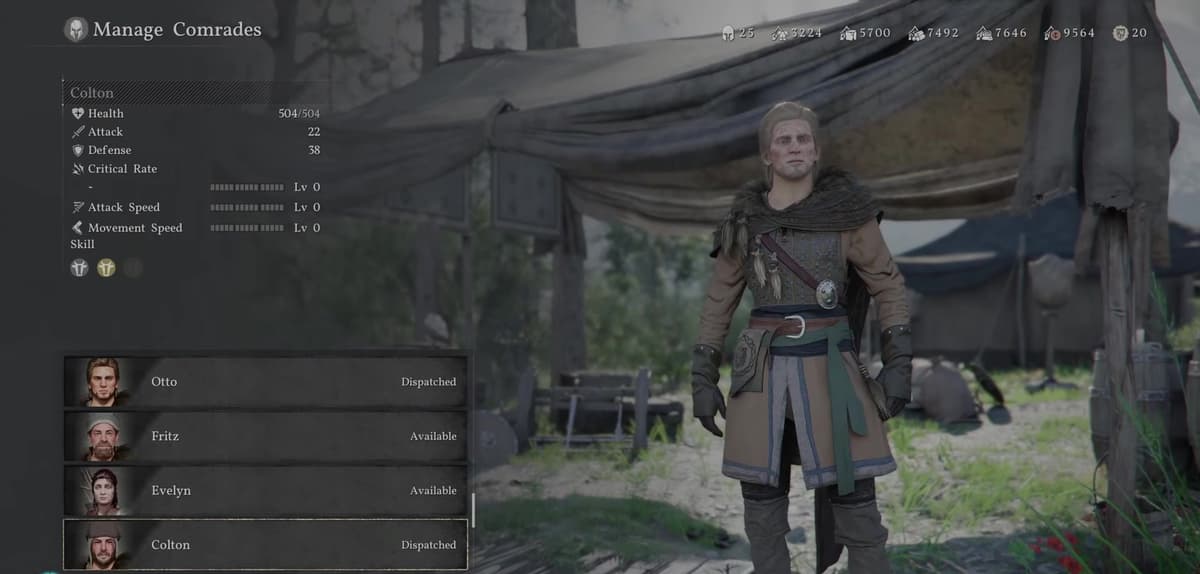
- Novice – +10% yields for matching mission type.
- Skilled – +30% yields.
- Expert – +60% yields.
Tiers on the same comrade stack. So if someone is Novice + Skilled in mining, they give +40% on mining missions; if they have all three tiers, that’s +100%. However, you can’t stack bonuses from multiple comrades for the same skill. Only one needs to have the matching skill to get the full bonus.
What finally clicked for me was this simple rule: assign exactly one highly skilled specialist to each mission to trigger the bonus, then fill the rest of the slots with whoever is free.
Extra Workers, Church Conversion, and Auto-Repeat
On top of skill tiers, you can boost a mission three other ways:
- Overfilling slots: send more than the minimum required comrades. Each extra one adds about a 20% bonus up to the mission’s max capacity.
- Church donations: donating at churches increases your blessing level in that region. Each level adds around +2% “conversion” to that region’s dispatch missions, shown in the dispatch UI; stacked high enough it can nearly double those rewards.
- Auto-repeat: when a mission finishes, it automatically starts again using the same team and costs. This is great, but it will keep draining whatever input resource it needs, so check now and then that you’re not burning through camp funds or food.
I once let a high-cost trade good mission auto-repeat overnight and woke up broke. Since then, I keep the auto-repeat running mainly on food and basic material missions, and I check fund-heavy missions every couple of cycles.
Contribution Workers: Filling Gaps Without Wasting Specialists
Later – around Chapter 8, after defeating the Flame Knight and earning the Seal of Devotion – you unlock contribution workers. These are hired civilians you can slot into dispatch missions using regional contribution points, and those points are refunded when the mission ends, so hiring them is effectively free.
The way I use them:
- Put one skilled comrade on a mission to trigger the tier bonus.
- Fill remaining required workers with contribution workers instead of burning more of my limited named comrades.
This lets your specialists cover more missions at once and keeps your roster free for combat or quests.
Camp Expansions Without Bankrupting Yourself
Grounds of the Sunrise will periodically hit a wall where the next step says you must expand the camp. Expansions are ordered as dispatch missions to Howling Hill via Ross.
- Select the Howling Hill expansion mission from Ross’s list.
- Assign enough comrades to meet the requirement.
- Wait out the long in-game timer (the first real upgrade is around 18 in-game hours; later ones feel like multiple in-game days).
Time can pass naturally while you adventure, by resting at bonfires, or by sleeping, but those have cooldowns. For the last major expansion, I literally left the game running while I did other things in real life because I didn’t want to burn my limited rests.
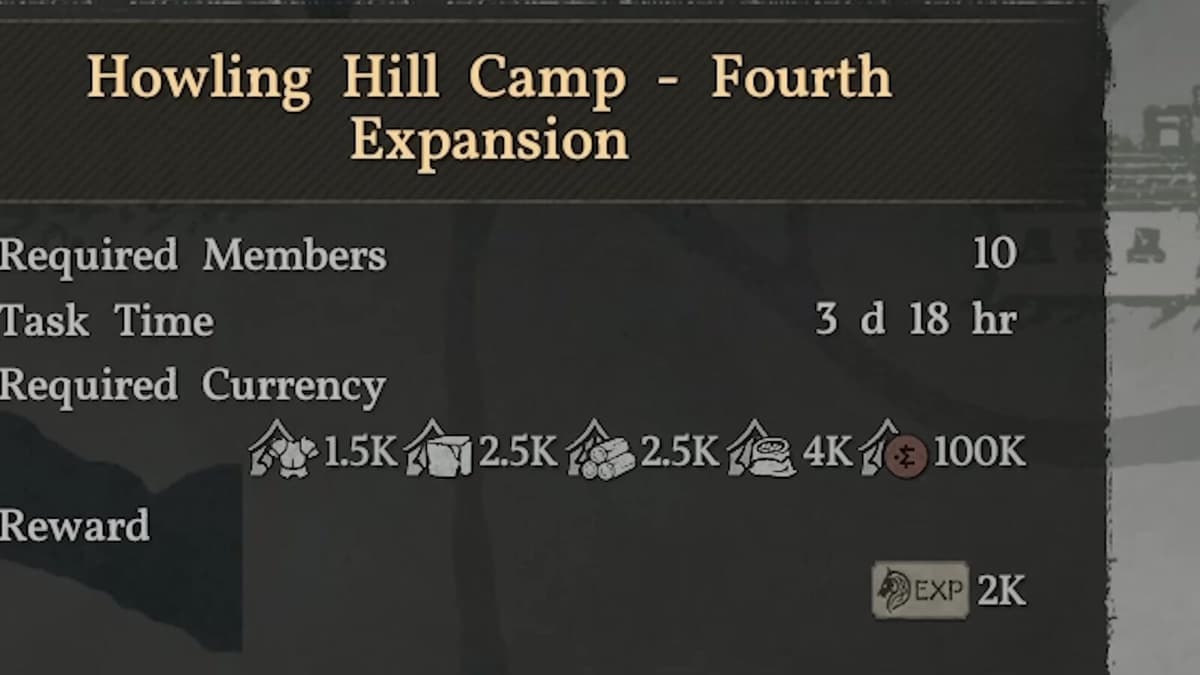
Expansions do two big things:
- Unlock more camp space so additional comrades and facilities can appear.
- Level up dispatch comrades, granting new skills or higher tiers, which directly increases dispatch yields.
The catch is cost. Early expansions are gentle, but by the fourth one, I had plenty of materials and food yet was tens of thousands of camp funds short – that fourth expansion alone runs to roughly 100,000 camp funds on top of stone, timber, food and armaments. (Camp funds are the camp’s shared treasury, kept separate from the silver in your own purse; you top it up by converting silver at 100 funds per silver, or by donating gold bars.) To fix this, I cancelled every dispatch that cost camp funds and left only Estate Security missions running, since they consume other resources but add funds to the camp reserve.
If you don’t want the same headache, always keep at least one or two fund-generating missions running, and don’t spend camp funds frivolously until you’re through the main expansion chain and big rebuild projects.
Greymane Commissions, Trust, and Inventory Space
Commissions are personal quests from both dispatch and vendor comrades. They’re deceptively important for three reasons:
- Each completed commission gives you +3 inventory slots.
- They give big trust boosts with that Greymane.
- Higher trust improves vendor stock and quantities.
You can start a commission by talking to the relevant comrade at camp. If they’re out on a dispatch, you’ll need to cancel their mission first so they actually appear at camp – this tripped me up for a while when I couldn’t find Brice.
Trust reaches 100 via:
- Completing that comrade’s commissions.
- Greeting them daily.
- Gifting them items they like.
At 100 trust, camp vendors sell more items and larger quantities, and external vendors you’ve befriended may sign trade agreements so their goods appear at camp. Maxing the camp and trust basically centralizes almost every item you can buy into one hub.
Don’t miss Brice’s commission. Once he’s in camp and his quest appears, talk to him to start the line that leads to Timberturner Wainwright – the wagon workshop northeast of camp – and the construction of your first wagon. You’ll also need a comrade with the Engineer skill (such as Arnold, recruited from “A Rumor in St. Halssius”) before a wagon can actually be built.
Wagons and Trading: Big Money, Fragile Wheels
Wagons are your main tool for high-volume trade and late-game money. Brice’s quest teaches the basics, but there are a few things the game doesn’t spell out nicely.
- Drop trade goods you’ve collected with Carl at camp so he can pack them.
- Ride your wagon to a trade post (the nearest early one is the Gold Leaf merchants) and sell your packed goods.
- While you’re there with the wagon, you can also buy trade goods to haul elsewhere.
Prices fluctuate, so sometimes you’ll buy low at one post and sell high at another, and sometimes you might even profit by selling back to the same post on a better day. When I started paying attention to prices instead of just dumping everything, camp funds stopped being a problem.
The risk: wagons are incredibly fragile. If you drag them over rough terrain, steep slopes, or slam into obstacles, they can literally shatter and force you to build a new one.
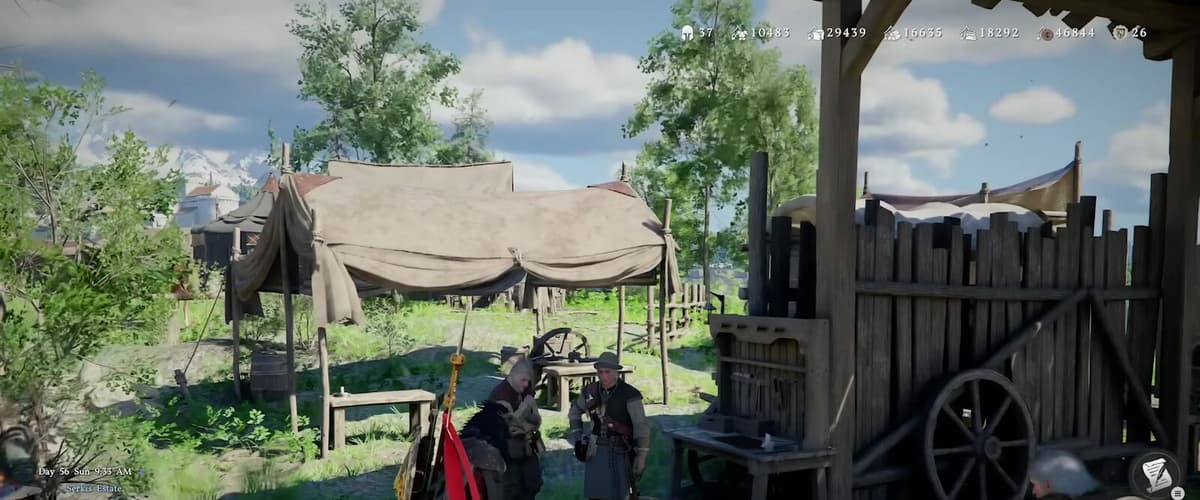
- Stick to roads wherever possible.
- Slow down on hills and tight corners.
- Avoid cutting cross-country with a fully loaded wagon unless you know the route is safe.
The first time I tried to “save time” by going off-road, my wagon exploded near a ravine, taking a truckload of trade goods with it. Since then, I treat wagons like glass.
Farm and Ranch: Infinite Food and Extra Income
Once you recruit Ben (ranch) and Kamu (farm), the camp becomes much more self-sufficient.
Ranch (Ben): Animals, Breeding, and Quality
Out in the world you can capture animals like goats, pigs, and cows and bring them back to Ben’s ranch. The key is to have both genders of each species you care about – they will eventually breed and produce offspring.
Ranch animals are useful in three ways:
- Females periodically produce resources like milk.
- Animals can be sold as livestock for money.
- They can be butchered for meat and other materials.
Feeding them matters. Put food into the ranch feed bin to raise animal quality level. Higher quality means better yields from butchering or higher sale prices. I usually fed them surplus crops and low-value food items.
Farm (Kamu): Seeds, Trees, and Harvest Cycles
Kamu’s farm lets you plant trees and crops that produce fruit and vegetables after a few in-game days. Seeds come from three main sources:
- Buying from Kamu (limited stock initially).
- Buying from external vendors that sell seeds.
- Breaking down existing produce in your inventory: hold the use button and choose Obtain Seed.
Once planted, just let time pass – hence why having dispatch missions and camp expansions ticking away in parallel works so well. Harvested crops can be:
- Used to cook healing food.
- Fed to ranch animals.
- Sold or donated if you’re overflowing.
Between a stocked farm and a well-fed ranch, I effectively stopped worrying about food for both healing and camp missions.
A Practical Greymane Camp Routine
Putting it all together, this is the loop that’s kept my Greymane camp humming and expansions funded:
- When you load in: open the map’s faction view, collect finished dispatch rewards, and reassign missions with proper skill matching. Keep at least one fund-generating mission running.
- Before a long quest chain: start any available camp expansion from Ross, then go quest while the timer runs.
- Back at camp: harvest the farm, feed ranch animals, collect ranch outputs, and dump extra materials or trade goods with Carl.
- Between big story beats: knock out a batch of Greymane commissions to grow inventory space and push trust toward 100, especially for vendors and Brice.
- When funds dip: run a wagon route with goods from Carl and bought trade items, sticking to safe roads and watching prices.
Handled this way, the Greymane camp quietly shifts from a side distraction into the backbone of your economy, feeding you resources, money, and gear while you focus on the rest of Crimson Desert.
FinalBoss // Gear
Level up your setup
01Top-rated gaming headsetson Amazon→02High-refresh gaming monitorson Amazon→03Gaming chairson Amazon→04Discounted game keyson Kinguin→
Affiliate links · As an Amazon Associate, FinalBoss earns from qualifying purchases.
Want to Level Up Your Gaming?
Get access to exclusive strategies, hidden tips, and pro-level insights that we don't share publicly.
Ultimate Guide Strategy Guide + Weekly Pro Tips