
Table of Contents (12)
The moment DAMON and BABY stopped being cute and started wearing me out
There’s a point, midway through DAMON and BABY, where you’re wrestling through a demon-infested grocery store. Shelves are tipped over, fluorescent lights buzz overhead, and a giant moth is spamming projectiles from off-screen. I was trying to line up a Baby Jump – the game’s teleport-dash – over a row of cereal boxes, only for my arc to snag on the geometry, cancel early, and drop me right into a spread shot that shredded my health bar.
Then I died, respawned at a chair three encounters back, and realized I had to redo two mini-bosses and a gauntlet of trash mobs just to take another swing. That was the moment the game’s charm cracked for me. Up to then, I’d been riding pretty high on the Ghibli-esque art, the goofy demon dad energy, and some actually solid twin-stick gunplay. But DAMON and BABY kept turning its best bits into chores.
Arc System Works clearly wanted this to be one of their “weird little side projects” – something to ship between massive fighting game releases. On paper, it’s a great pitch: overhead twin-stick shooter, light Metroidvania-style exploration, ridiculous demon lord babysitting a celestial infant, all wrapped in painterly art that looks ripped out of a prestige anime film. In practice, it’s a fascinating, frustrating tangle of good ideas dragged down by save systems, muddy platforming, and half-baked progression.
A demon dad road trip that really does look like anime cinema
DAMON and BABY works best as a thing you look at. Damon, a former demon lord stripped of his powers, is stuck escorting a baby to Sedona, a gateway to the Celestial Realm. It’s a simple premise, but the game milks it with a tone that swings between hardboiled and absurd. One minute Damon is grumbling like a tired noir protagonist, the next he’s haggling for cheeseburgers in a shop full of demons buying snacks.
That shop is still burned into my brain: light streaking in through dirty windows, dust motes floating in the beams, walls crammed with jars, talismans, and old food tins. The old man on a step ladder at the register, a demon in a suit casually ordering fast food, Damon looming in the doorway with a baby carriage. It really does evoke that “everyday magic” vibe you get from Studio Ghibli backgrounds, where the mundane and the fantastical sit comfortably side by side.
The arenas and dungeons keep that energy going. A mall fountain turning into a demonic killbox, suburban houses whose wardrobes literally burst to life and chase you, a maze of stacked books that doubles as a cramped bullet hell arena — the environmental art is dense, specific, and almost always worth pausing to take in. Character designs, especially bosses, continue that streak: they’re weird, memorable silhouettes that feel like Ishiwatari and crew had a lot of fun sketching nightmare versions of everyday stuff.
The saddest part is that the fights attached to those boss designs usually don’t live up to how good they look. Visually, though? DAMON and BABY punches way above “experimental side project.” If ArcSys told me this was an animated movie pitch they turned into a game, I’d believe it.
Twin-stick shooting that feels great… until the game asks too much of it
Moment to moment, pulling the triggers in DAMON and BABY feels solid. This isn’t some janky overhead shooter. You move with the left stick, aim with the right, and Damon’s guns have a satisfying kick and punchy sound to them. There’s a mix of weapon archetypes — handguns, shotguns, beam weapons, faster bullet hoses — and cycling between them mid-fight to manage ammo and ranges feels good in the hands.
Combat arenas usually toss in enough cover and vertical layering that you’re not just circle-strafing in a flat box. You’re ducking behind kiosks, weaving around pillars, baiting enemies into chokepoints, and occasionally pulling off that perfect line-up where a charged shot cuts through a row of demons like a railgun. In those moments, DAMON and BABY scratches the same itch as something like Nex Machina or Assault Android Cactus: clean, readable chaos where the inputs just click.
The problem is that the game can’t quite decide if it wants to be a true bullet hell — where you’re always dashing, always moving, dancing between patterns — or a heavier, more methodical shooter where positioning and a few well-placed shots matter more. It tries to be both and lands in a sloppy middle ground.
Enemy waves come at you from all sides, and projectile spam ramps up fast, but Damon’s base movement and animation timings feel too sluggish for pure bullet hell. At the same time, there’s so much visual noise — debris, enemies, overlapping AOEs — that the slower, more deliberate style doesn’t quite fit either. It’s not that the controls are unresponsive; they’re not. It’s that the encounter design expects hyper-agility from a character who handles like a grumpy tank with a good roll.
The Baby Jump: clever on paper, awkward in the heat of battle
Central to that identity crisis is the so-called Baby Jump. Mechanically, it’s your dash: you hold a button, a ghostly arc appears showing where you’re going to “throw” the baby, then you release and Damon warps to that spot. While you’re aiming, you get invulnerability frames. In theory, it’s a stylish twist that ties the teleport to the story. In practice, it’s one of those “this sounded cooler in a design document” features.
The input rhythm is the first hurdle. Most twin-stick shooters map dodge to a quick tap; your brain starts to form that reflex. Here, you have to hold, aim a landing arc, then release. The invulnerability happens during the aiming, which is backwards to how your instincts want to treat it. More than once I hesitated, ate a bunch of damage while trying to line up a safe landing spot, and only barely blinked out in time. It always felt like I was fighting my learned habits from other games.
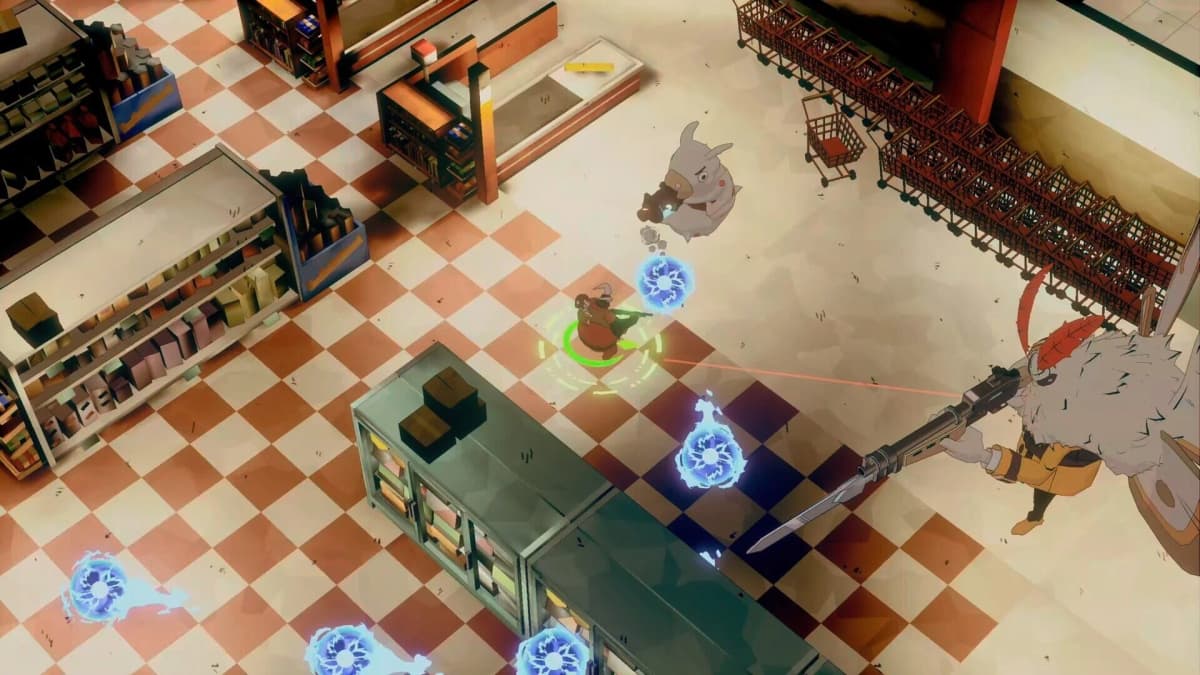
Then there’s the precision issue. Because of the forced overhead perspective and all the gorgeous clutter in the world, your arc is constantly getting snagged on corners, railings, and invisible bits of level geometry. I’d aim a clean Baby Jump over a fountain, only to watch Damon teleport into a railing, cut the distance short, and land inside a cone of incoming fire. Or I’d try to hop a narrow gap in a library, catch the edge of a stack of books, and slide off into hazard damage.
The Baby Jump is supposed to be your main defensive tool and movement trick for platforming puzzles. Instead, it’s a constant source of “that’s not what I meant to do” moments. Combine that with enemies that love to shoot you from off-screen and through bits of cover, and the game’s core dodge tool ends up amplifying frustration more than it alleviates it.
Checkpoints, chairs, and the grind between them
The biggest structural problem in DAMON and BABY is how it handles saving and checkpoints. You don’t just autosave after encounters or at every new room. You need to find specific chairs scattered around the world. Sit down, get a little flavor text, your progress locks in. Miss a chair, or push a bit too greedily past one, and the game is happy to punish you with long stretches of lost progress.
In a game built around tight, replayable runs, this could work. Here, with meaty exploration segments and some fairly chunky fights, it often means replaying 10-20 minutes of content because you died two rooms short of the next safe seat. The demon density between chairs ramps up fast, especially in mid-game dungeons like the mall. Dying on the way back from a side path, arms full of loot and ingredients, hits harder when you realize that none of that mattered because you hadn’t found a chair yet.
Fast travel technically exists, but you unlock it later and only by paying at each node. Until then, backtracking to shops or earlier areas means hoofing it past respawned enemies, bleeding resources you were trying to save. Even once you’ve opened up some shortcuts, fast travel costs money you often want to spend on upgrades or healing. It’s not that the game is brutally hard; it’s that its save structure is tuned just wrong enough to feel like it’s wasting your time.
There are a couple of sequences where this really grates. One chain near the mall’s upper levels had me clearing a tricky platforming room, then a miniboss arena, then an exploration fork with two nasty groups of ranged enemies — all before the next chair. When a stray projectile clipped me from off-screen and I realized I was about to redo the whole chain, my enthusiasm for “one more run” dropped through the floor.
Exploration that swings between cool vignettes and empty wandering
Structurally, the game borrows from Zelda and light Metroidvania design. You explore dense, interconnected areas, grab new abilities (double jump, bombs, traversal tools), and use them to unlock fresh routes in older zones. On a broad level, that structure suits the game. Areas like the mall, suburban streets, and demon-infested homes feel like believable, if twisted, spaces you’re carving back-and-forth paths through.
Up close, though, the level design is inconsistent. Some zones are overly cramped, cluttered with tiny objects you can get stuck on while enemies pelt you from outside your immediate view. Others are sprawling in a way that feels less “adventurous” and more “I hope the objective is somewhere in this direction.” The mall in particular is guilty of this — multi-level, visually busy, and not always clear on where story progression actually wants you to head next.
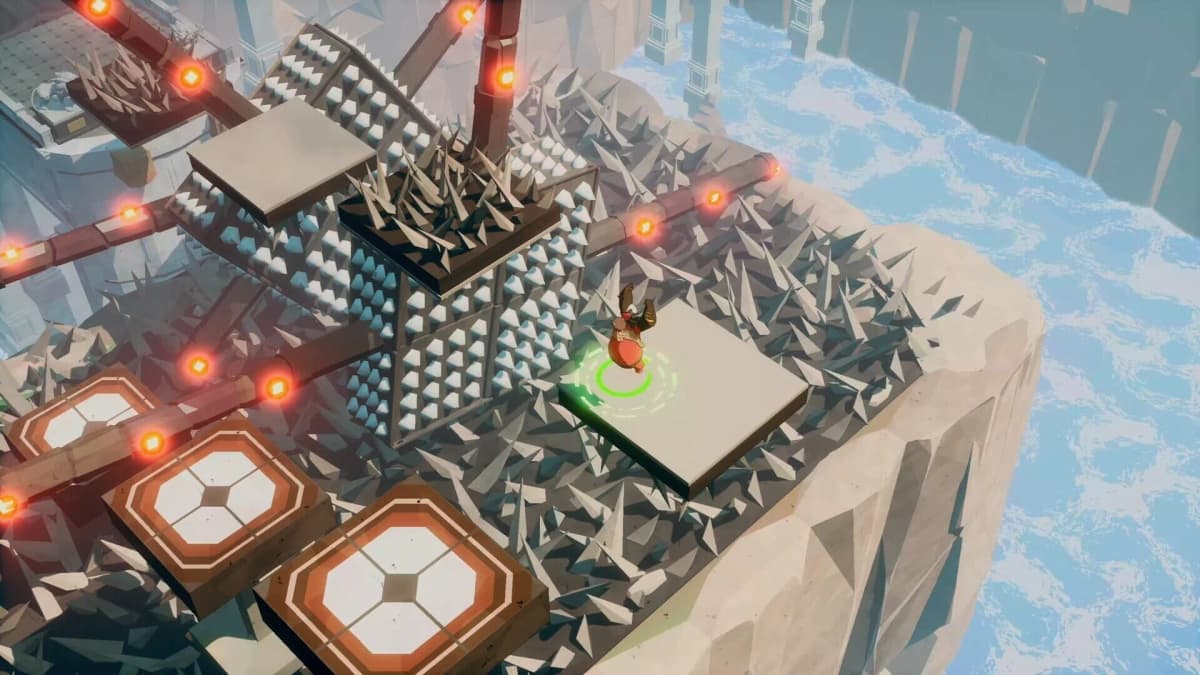
The game does have sparks of brilliance tucked into its corners. Little one-off platforming challenges built around creative Baby Jump usage, short cutscenes that flesh out Damon’s reluctant dad routine or the weird ecology of demons just trying to get by. Stumbling into those felt great. The issue is that they’re outnumbered by detours that end in “here’s another handful of generic loot and cooking ingredients.” When a risky jump or extended combat sidetrack ends with three mushrooms and some coins, you start ignoring side paths altogether.
The game does have sparks of brilliance tucked into its corners. Little one-off platforming challenges built around creative Baby Jump usage, short cutscenes that flesh out Damon’s reluctant dad routine or the weird ecology of demons just trying to get by. Stumbling into those felt great. The issue is that they’re outnumbered by detours that end in “here’s another handful of generic loot and cooking ingredients.” When a risky jump or extended combat sidetrack ends with three mushrooms and some coins, you start ignoring side paths altogether.
🎮 Get This Game at the Best Price
Compare prices instantly and save up to 80% on Steam keys with Kinguin — trusted by 15+ million gamers worldwide.
*Affiliate link — supports our independent coverage at no extra cost to you
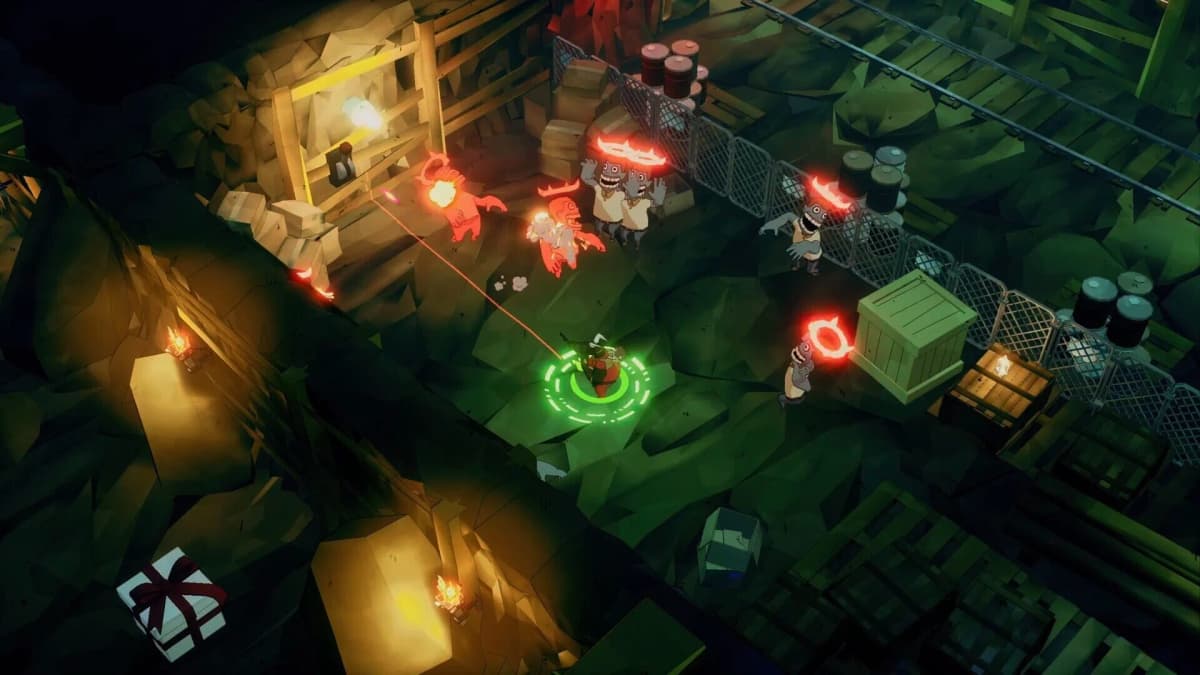
More than once, I realized I was just wandering, checking doorways and hallways at random, hoping to trip over the flag that would actually progress the story — and silently praying I wouldn’t get bodied and sent back to the last chair in the process. That’s not the kind of tension the game wants to build, but it’s the one its systems create.
Loot that looks different, feels the same
For a game that throws so many guns at you, DAMON and BABY doesn’t get much mileage out of its loot system. Drops and shop stock mostly boil down to a mix of guns and stat sticks — tiny bumps to damage, fire rate, or gimmick properties that rarely change how you actually play. Swapping from one pistol to another might adjust your numbers by a few percent, but there are few real build-defining weapons that force you to adapt.
That sameness wouldn’t be as bad if inventory management weren’t such a drag. Guns take up a lot of space, and your carry capacity starts off stingy. Because fast travel is gated and limited, you’re often forced into awkward runs back to a shop or stash chest just to unload. It’s not a deep, interesting tension — you’re not making meaningful choices about what to keep — you’re just shuffling items in and out because the game said you’re full.
Eventually, once you’ve unlocked more storage and fast travel, this eases up, but the damage is done by then. A loot loop is supposed to make you excited to crack open a chest or chase a rare drop. Here, picking up another gun often felt like a chore: “Okay, which nearly identical thing do I have to ditch this time so I can grab this one?”
The cooking system that sabotages itself
On top of guns and gear, there’s a full cooking system. You’ll find ingredients in nooks and crannies, unlock recipes, and cook food that heals you or gives small buffs like increased damage. On paper, it’s a nice thematic fit — the demon dad making meals on the road — and a way to push players towards exploring side pockets of the map.
Then you meet the shop prices.
A basic hamburger that heals a decent chunk of health costs around 300. The raw meat you need to cook that same burger? 1500. That’s not a typo — the ingredient costs several times more than the final product. I ran into this over and over: one ingredient for a buff-granting dish costing more than just buying multiple finished healing items outright.
The implied design intent is clear enough: powerful food should be harder to make. In execution, it kneecaps the whole system. If I can stock up on cheap burgers that heal me just fine, why would I sink precious currency into rare ingredients for a tiny 1.15x damage boost? Especially in a game where death can wipe significant progress and force you to burn those consumables just clawing back to where you were.
You can find ingredients while exploring, which helps. But the moment you’re one mushroom short of a recipe and consider buying it from the shop, the illusion breaks. When an entire cooked meal costs less than that one mushroom, it feels like someone inverted a bunch of numbers in a spreadsheet and never went back to stress test the economy.
Boss fights: amazing silhouettes, forgettable patterns
Bosses are where the game’s contradictions are most obvious. Visually, they’re great. A giant moth turning a grocery store into a toxic light show, warped guardians of the mall fountain, bizarre demonic fixtures animated into life — these are the kind of designs you could imagine headlining an anime movie’s key art.
Mechanically, most of them boil down to “shoot, dodge, repeat” with only minor wrinkles. There aren’t many distinct phases or inventive gimmicks forcing you to rethink your loadout or movement style. Add in the Baby Jump’s finicky behavior and projectiles that sometimes feel like they’re clipping you even when you’re behind cover, and several boss arenas cross the line from “tough but fair” to “irritating.”
The moth in particular felt like a low point. Shelves kept breaking my line of sight in awkward ways, my teleport jumps constantly caught on geometry, and its shots seemed happy to ignore level walls while mine dutifully respected them. After a few failed runs and the realization that each death sent me back a depressing distance, any awe I had for the design evaporated.
Performance, sound, and everything in between
Technically, the game runs reasonably smoothly, at least on the hardware I used. Frame drops weren’t the main source of difficulty. The bigger issue was readability. Between the lavish art, busy environments, and swarms of projectiles, it’s easy to lose track of your health or an incoming threat on the edge of the screen. A few sound effects — especially some gunshots and hit barks — come in hotter than they need to, which doesn’t help in already chaotic arenas.
Music-wise, DAMON and BABY sits in the “good but not quite iconic” tier. There are tracks that fit the tone — moody, off-kilter, occasionally jazzy — and a few boss themes that go harder, but nothing that stuck with me once I put the controller down. It’s serviceable atmosphere rather than a standout soundtrack, which is a bit surprising given ArcSys’ usual reputation for ripping tunes.
Who DAMON and BABY is actually for
Despite all of this, I don’t think DAMON and BABY is a write-off. It’s very specifically aimed at a certain kind of player.
If you’re the sort of person who can forgive mechanical rough edges in exchange for bold art direction and a strange, specific world, there’s a lot to chew on here. The demon-dad escort premise, the Ghibli-adjacent backgrounds, the humor of demons queueing for burgers while the apocalypse bubbles under the surface — that stuff is genuinely memorable.
If, on the other hand, you come in expecting a razor-sharp twin-stick shooter with tight encounter design and a satisfying progression loop, you’re going to bounce off all the little frictions. The chair-based checkpointing, the awkward Baby Jump input, the shallow loot variety, the lopsided cooking economy — these are the sorts of design quirks that add up fast, especially when you’re dying in the same cluttered hallway for the third time because your teleport caught a bookshelf corner.
FinalBoss // Gear
Level up your setup
01Top-rated gaming headsetson Amazon→02High-refresh gaming monitorson Amazon→03Gaming chairson Amazon→04Discounted game keyson Kinguin→Affiliate links · As an Amazon Associate, FinalBoss earns from qualifying purchases.
Want to Level Up Your Gaming?
Get access to exclusive strategies, hidden tips, and pro-level insights that we don't share publicly.
Ultimate Reviews Strategy Guide + Weekly Pro Tips