
Table of Contents (10)
Six Hours Inside Deadpool’s Head: First Contact With Marvel’s Deadpool VR
The first thing Marvel’s Deadpool VR did was grab my hands.
I’m standing in my living room with the Meta Quest 3 on, and Deadpool is right in my face, poking at my controllers, making fun of my “floaty gamer hands” and asking why I paid so much money to let a red-suited lunatic yell at me in VR. Within five minutes he’s broken the fourth wall, the fifth wall, and probably my dignity.
I went into Marvel’s Deadpool VR expecting a throwaway tie-in: a short, jokey wave shooter to ride the movie hype. After about six hours to roll credits (plus a couple more replaying missions and messing around with different Deadpool variants), I came away genuinely surprised. This isn’t a lazy cash-in. It’s a sharp, funny, very physical VR action game… that also has some seriously annoying rough edges.
I played the whole thing on a Meta Quest 3, standing, with smooth locomotion and snap turning, and I’m still a bit sore in the shoulders from swinging katanas like a cosplayer who doesn’t know when to stop.
Story, Mojo TV & Deadpool Being Peak Deadpool
What caught me off guard first wasn’t the combat; it was the writing. Deadpool games live or die on whether the devs actually “get” the character, and Twisted Pixel clearly does.
The setup is classic Deadpool nonsense. After a brilliantly stupid intro where he roasts you, Meta, the game, and himself, Deadpool crashes an attack on Nick Fury’s heli-carrier. The villain Flag-Smasher muscles in, stuff explodes, and after one intense brawl you get thrown through a portal and dumped into the Mojoverse – an intergalactic TV hellscape where ratings matter more than lives.
Mojo, the disgusting TV overlord, ropes Deadpool into a contract to kidnap and drag various super-villains from across the multiverse into his show. Of course the contract has tiny print. Of course Deadpool doesn’t read it. Of course things spiral into absolute chaos.
The important bit is this: the story isn’t just an excuse for shooting. It’s constantly entertaining. References and meta-jokes hit every few seconds. At one point Deadpool dunks on Dragon Ball Evolution having the worst rating on a French movie site, and it’s such a specific, absurd joke that I burst out laughing in the middle of a firefight. He tears into other Marvel characters, into the concept of VR trophies, even into your playstyle if you’re being boring.
Twisted Pixel uses VR smartly for the storytelling too. Deadpool leans uncomfortably close to your face. Mojo looms above you as a massive, greasy presence. Cameras float around you like annoying drones. It sells the TV show theme beautifully, and the whole journey stays in that ultra-unhinged Deadpool tone all the way to the ending, which is exactly as over-the-top as it should be.
Combat: When VR, Katanas & Guns All Click
After about half an hour, I stopped thinking of Marvel’s Deadpool VR as a “licensed game” and started thinking of it as “oh, this is my new VR stress relief app.” When the combat flows, it’s ridiculously fun.
Your loadout is pure Deadpool fantasy: katanas on your back, guns on your hips, grenades on your left forearm, and a grappling/utility tool low on your back. You physically reach for everything. Reach behind your shoulder to grab a katana, cross both in front of you to parry bullets or melee swings, then flick your wrists to slice through enemies. Drop them, and with a quick motion your hands find your pistols at your hips, and you’re John Wick in a red suit.
The motion feels natural once you get used to it. During my first session I kept reaching a bit too high for my katanas and smacking the edge of my headset – very Deadpool energy – but after a while it became muscle memory. Sliding, jumping, and double-jumping with the controller buttons turns every arena into a playground. You can sprint into a slide, slash through someone’s legs, pop up into a double jump, slow down, and nail two headshots mid-air. It looks awesome, and more importantly, it feels awesome.
The game pushes you to be stylish via a “ratings” meter that’s visualised as how hyped the Mojoverse audience is. If you just stand there and spam pistols, your rating crawls. Mix melee, grenades, grapples, and aerial kills and the crowd meter spikes, unlocking new gear to buy back in Mojoworld. It’s a simple system, but it fits the whole TV-show gimmick perfectly: be flashy, be violent, keep the ratings up.
On top of that, you’ve got an ultimate ability tied to Deadpool’s sheer ridiculousness. As you land varied hits, a circular bar fills. When it’s ready, Spiral teleports in mid-mission and hands you some gloriously overpowered weapon based on what you equipped beforehand: Gambit’s explosive cards, Star-Lord’s energy blasters, and other fan-service toys. For a precious few seconds you’re just demolishing everything, and in VR that power trip hits harder than on a flat screen.

The only real downside: after about four hours, the enemy mix and encounter structure start to repeat. New weapons and tweaks help, and the core feel of aiming and slashing never stops being satisfying, but you can absolutely feel the game stretching a bit to reach its runtime.
Platforming & Level Design: Funny, Vertical… and Kind of Janky
Deadpool in VR sounds like the ideal playground for wild traversal. The game does try: there’s a decent amount of verticality, some grappling, and plenty of jumping between platforms. In practice though, this is where Marvel’s Deadpool VR feels the most clumsy.
Jumps feel floaty, almost “moon-like.” Sometimes that’s fun – launching yourself off a pad and gunning down enemies mid-air – but on tighter platforming sections it becomes frustrating. A couple of times I was absolutely sure I’d landed on a ledge, only to watch my feet clip the edge and slide straight into the void. You respawn quickly and the game is generous with checkpoints, but after the third or fourth fall in the same area, the joke wears thin.
Collisions can be weird as well. Certain bits of scenery feel like they should be climbable or interactable but are basically invisible walls with textures. Deadpool will even crack jokes about how cheap the set looks, which is funny the first time and slightly annoying when you’re genuinely trying to see if that ledge is real or just set dressing.
The missions themselves are structurally linear. You move through corridors and arenas, crack some jokes, fight waves, repeat. The vertical layouts do keep it from feeling like a pure hallway shooter, but if you were hoping for immersive-sim levels of environmental freedom, this isn’t that. It’s a heavily directed VR ride, and it leans on Deadpool’s commentary to justify its more plain design choices.
Mojo Arenas: Brilliant Joke, Repetitive Reality
Between capture missions, you keep coming back to Mojoworld, which acts as a hub and as the backbone of the game’s structure. It’s here that Marvel’s Deadpool VR reveals its biggest love-it-and-hate-it feature: the arenas.
After almost every big mission, you get shoved into a huge arena where you have to complete three back-to-back challenges. Feed a ravenous monster (or Headpool) more food than your opponents, destroy waves of turrets in something that feels suspiciously like a parody of MOBA lane pushing, survive increasingly chaotic enemy swarms – it’s all clearly mocking popular multiplayer modes from other games.
The first couple of times, I loved it. The commentary is sharp, and the way Deadpool rattles off lines about “content padding” while you’re very literally stuck in content padding shows Twisted Pixel is completely self-aware.
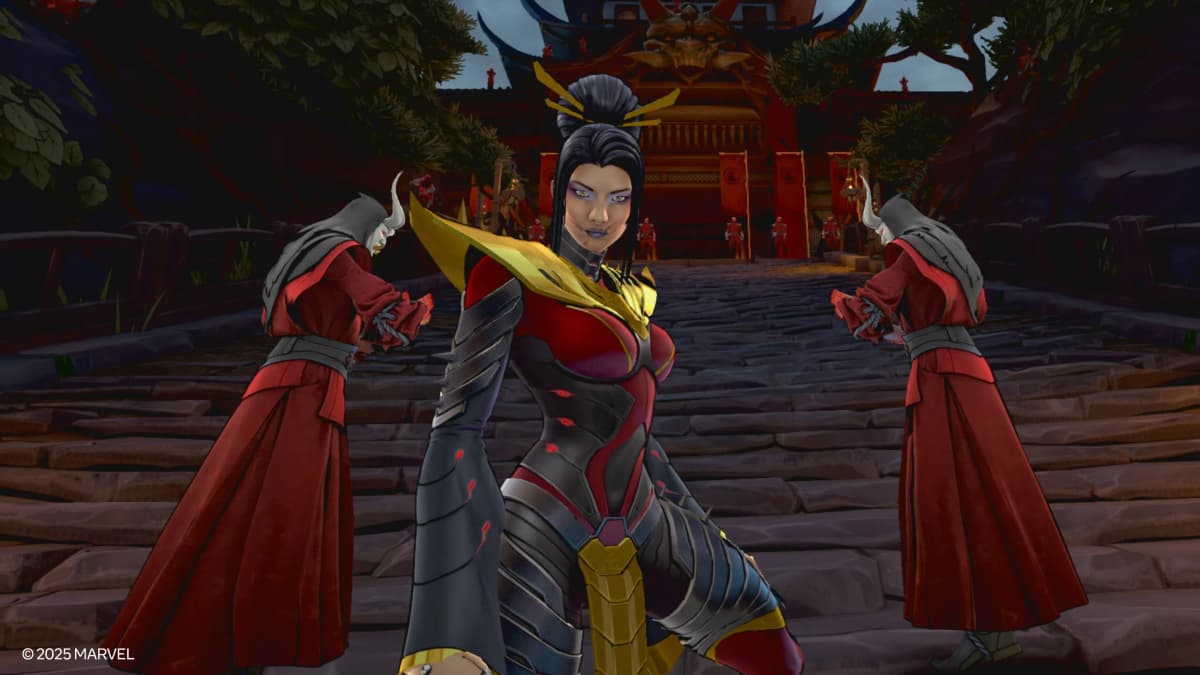
But then you hit hour five, and the loop becomes painfully obvious: capture mission, cutscene, three-arena run, shop, repeat. The jokes don’t fully mask the repetition. One late-game arena gauntlet went on so long that I caught myself checking my real-world watch between waves, which is not a great sign in VR where you’re supposed to be fully immersed.
The arenas aren’t bad mechanically – the combat system is still fun there – they’re just overused. If the game had dialed them back by a third, the pacing would feel much tighter.
Deadpool Corps, Shop Systems & Replay Hooks
The progression and customization side is surprisingly solid, even if it’s not super deep.
Back in Mojoworld, you can hit the shop to spend the goodies you’ve earned from keeping the ratings high. You can swap out:
- Katanas (different looks and slight stat tweaks)
- Pistols and other firearms
- Grenades
- Your “ultimate” weapon (Gambit cards, Star-Lord blasters, etc.)
- And crucially, which Deadpool you play as
This is where the Deadpool Corps comes in. You can unlock and play as various versions of the character: a golden-age style Deadpool, TheDeadpool Kid, Lady Deadpool and others. Mechanically, they all control the same, so don’t expect wildly different playstyles, but each brings unique voice lines and extra flavor. Deadpool would absolutely monetize alternate versions of himself, so it fits the character almost too well.
Some secret levels and optional content are even locked to specific Deadpools. Replay an older mission with the right variant equipped and you’ll find new paths or challenges opening up. It’s a smart way to squeeze more value out of the same levels without feeling like pure grind… as long as you’re still having fun with the core combat.
There are also collectible comics hidden in missions that you can admire back in the hub. It’s nothing revolutionary, but as a Marvel nerd I did enjoy finishing a tough encounter, spotting something shiny in the corner and realizing it was another comic for my virtual shelf.
All of this helps stretch the game beyond that ~6-hour main-story window if you want to hunt everything. I ended up spending closer to eight hours total, mostly because I wanted to hear what Lady Deadpool had to say about pretty much every situation.
Visuals, Audio & Performance on Meta Quest 3
Twisted Pixel went with a bold cartoon style instead of chasing gritty realism, and it was absolutely the right call for standalone VR hardware.
On Quest 3, character models look sharp and expressive. Deadpool’s suit has just enough texture to feel tangible without turning into a muddy mess up close. Villains and allies all sit comfortably in that comic-book-meets-Saturday-morning-cartoon space. Some background textures and far-off scenery are understandably low-detail, and the “audience” sometimes looks like flat, looping shapes rather than a real crowd, but during combat you rarely notice.
Lighting is stylized but effective, especially in the Mojoverse arenas with their gaudy TV spotlights. Effects like explosions, sword trails, and impact flashes are readable without being overwhelming, which is crucial in VR where overload can make you queasy fast.
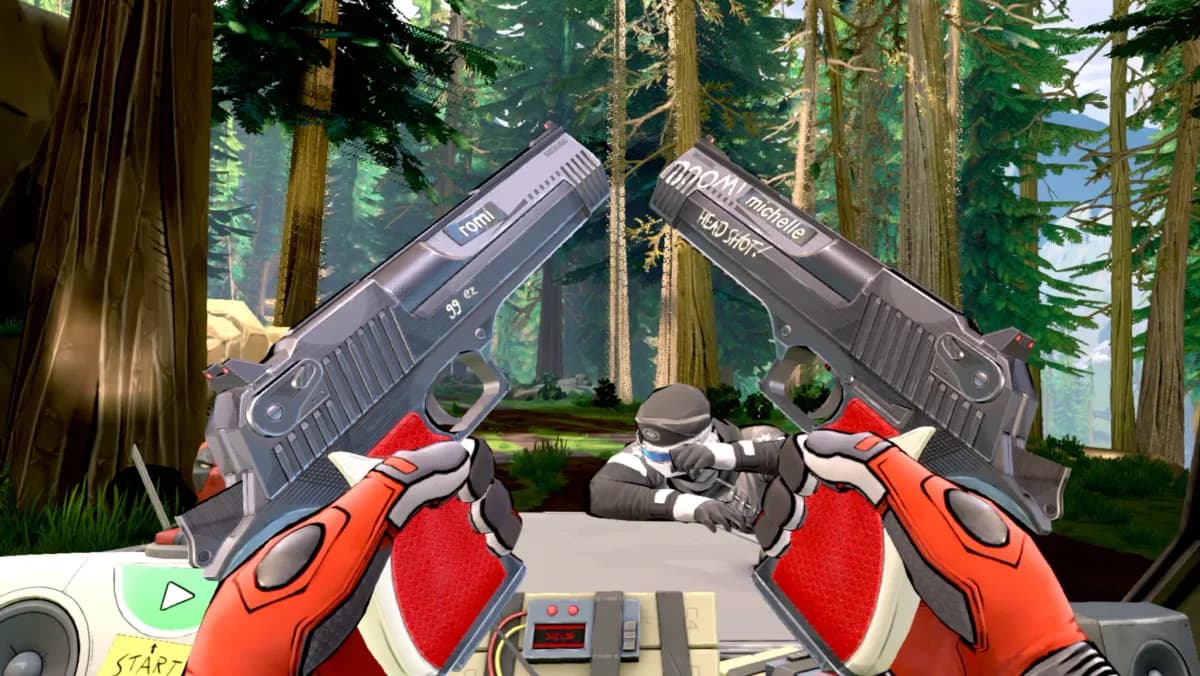
Performance-wise, Quest 3 handles the game well. Across my playthrough it stayed smooth the vast majority of the time. I did notice a few framerate dips during particularly chaotic moments – usually when my headset battery was low – but nothing that made me want to rip the headset off. Tracking for sword swings and aiming felt consistently tight.
Comfort options are decent: smooth locomotion, teleport, snap or smooth turning, and vignette settings for movement. I played standing with smooth movement and snap turn, and had no nausea, but the double-jumps and vertical sections might bother very sensitive players. If you’re prone to VR sickness, I’d enable teleport and a stronger vignette at first.
Audio is a highlight. Deadpool’s voice work lands – rapid-fire, obnoxious in the best way, and varied enough that I didn’t feel like I was hearing the same two jokes loop every fight. The music leans into rock and punchy TV-show stings, and spatial audio helps you track enemies in 360 degrees. One standout moment for me was sliding behind cover purely because I heard a rocket whistling in from behind my right shoulder.
Who Should Actually Play Marvel’s Deadpool VR?
This isn’t a blanket recommendation kind of game. It nails some specific things, and if those line up with your tastes, you’ll have a blast. If not, you might bounce off hard.
- If you love Deadpool or Marvel comics: This is easily the best use of Deadpool in a game since, well, his last game. The tone, fourth-wall breaks, and deep-cut references all feel right.
- If you enjoy arcade-style VR action: Think along the lines of Pistol Whip, Superhot VR, or Blood & Truth – short, intense bursts of stylish violence in directed levels. This sits comfortably in that space.
- If you want open-world, deep systems or long RPG grinds: Look elsewhere. This is a linear, 5–7 hour campaign with some replay hooks, not a 40-hour epic.
- If repetition annoys you quickly: The arena structure and limited enemy variety will probably get on your nerves, especially late-game.
- If you’re new to VR: The game is fairly forgiving in difficulty and has good comfort settings, but the movement is active and jump-heavy. Great first “show-off” game if you don’t mind moving around.
Bottom Line & Score
After finishing Marvel’s Deadpool VR and then jumping back in with different versions of Deadpool, my feelings settled into something pretty clear:
As a Deadpool experience, it absolutely works. I laughed out loud more than in most “funny” games. The comic-book art direction, the constant meta-humor, the Mojo TV framing – it all comes together into a package that feels true to the character in a way that doesn’t feel focus-tested to death.
As a VR action game, it ranges from brilliant to slightly burnout-inducing. The core sword-and-gunplay is some of the most satisfying I’ve had in a licensed VR title, but the repetition of arena segments, janky platforming, and the occasionally too-long finale keep it from being an instant all-time great.
Still, when I think back to my time with it, what I remember most are the ridiculous boss QTEs where I’m miming haymakers at a supervillain’s face in my living room, or the moment I realized I could parry a rocket with crossed katanas and send it back like some deranged samurai. Those highs are high enough that I can forgive a lot.
TL;DR
- Playtime: About 5–6 hours for the main story, 7–9 if you chase secrets and try all the Deadpool variants.
- Best bits: Razor-sharp humor, fantastic comic-book art, satisfying sword-and-gun VR combat, excellent use of the Deadpool license.
- Annoyances: Repetitive arena structure, floaty/janky platforming, linear level design, some late-game fatigue.
- Performance on Quest 3: Generally smooth and clean; minor dips during heavy chaos or low battery, but nothing game-breaking.
- For who: Deadpool/Marvel fans, VR action junkies, and anyone who wants to swing katanas and crack jokes in first person.
- Skip if: You need deep systems, hate repetition, or get motion sick from lots of jumping and fast movement.
- Final verdict: Not perfect, but easily one of the most entertaining licensed VR games I’ve played in years.
FinalBoss // Gear
Level up your setup
01Meta Quest 3on Amazon→02PSVR2 accessorieson Amazon→03Gaming chairson Amazon→Affiliate links · As an Amazon Associate, FinalBoss earns from qualifying purchases.
Want to Level Up Your Gaming?
Get access to exclusive strategies, hidden tips, and pro-level insights that we don't share publicly.
Ultimate Reviews Strategy Guide + Weekly Pro Tips