
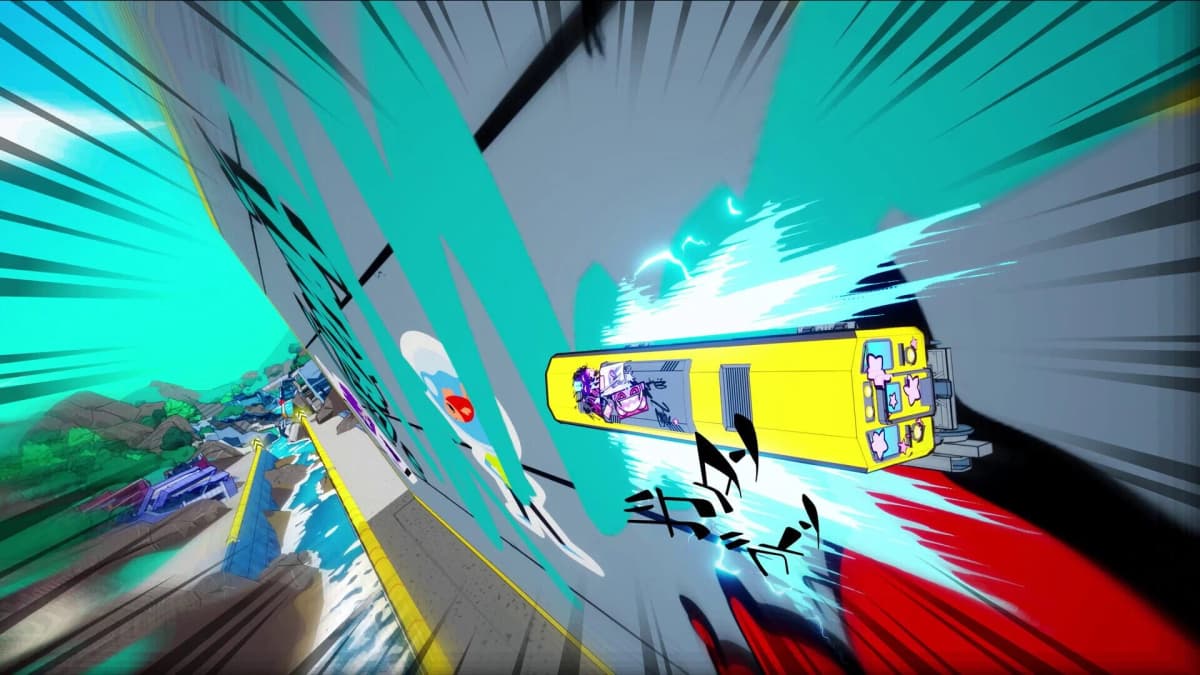
Emi Araki’s train hit a downhill bend at full speed while I was still trying to read the clutter around the next junction: a wall ride to my left, a gap ahead, hazards squeezing the route, and a score chain that would die if I hesitated. I missed the clean line, clipped the wrong surface, and watched the combo vanish. Then I restarted from a generous checkpoint, took the upper path, nailed the sequence, and understood exactly why Denshattack! got under my skin. Undercoders has built an arcade game that demands route knowledge and rewards nerve with a ridiculous amount of momentum.
This is a loud, punk-rock train-trick game set in a future Japan divided by vast protective domes. Inside, life has been shaped by the authority of Miraido; outside, people scrape by in harsher conditions. Emi, a ramen delivery driver and chef with a train built for far more than deliveries, rides through that conflict at blistering speed. The setting has neon attitude, anarchic energy, and the colorful visual punch of a Dreamcast-era fever dream. The story itself remains familiar, though. I enjoyed its restless mood more than its plot beats, and I wanted the game to trust its arcade strengths instead of repeatedly parking the action for dialogue.
Table of Contents (7)
Key Takeaways
- The train-trick system has real depth. Clean runs depend on chaining tricks, protecting momentum, and learning which route supports the next section of a combo.
- Stages reward repeat attempts. Multiple paths, medal grades, collectibles, shortcuts, and changing objectives gave me reasons to return beyond simply clearing the campaign.
- The opening is unnecessarily rough. Fast movement, busy environments, and dense mechanics arrive before the game gives new players enough space to read the track.
- Boss fights are a highlight. Their patterns turn the game’s speed and trick-based combat into focused tests rather than pure visual chaos.
- The campaign runs roughly 10-15 hours. I found the best value in replaying stages for cleaner routes and stronger medal results rather than racing straight to the credits.
The Train Is the Skateboard, and the Track Is the Puzzle
Denshattack! has an instantly readable premise: ride a train, build tricks into combos, reach the finish, and look impossibly cool doing it. That simplicity lasts about five minutes. Soon, every track becomes a moving puzzle built around speed preservation, timing, positioning, enemy pressure, and route selection. The train carries its own inertia, so I could not treat every ramp, wall, and turn as a separate input. A successful run required me to think several seconds ahead: where I would land, which branch had enough space for the next trick, and whether taking a collectible was worth sacrificing the safer line.
That makes the core loop far more satisfying than a novelty premise has any right to be. I felt the difference between merely surviving a stage and actually owning it. The first time through, I was often reacting late and slamming into trouble because the screen was moving faster than my understanding. On a repeat run, I began seeing the track as a connected sequence of opportunities. A raised rail was no longer background decoration; it was the start of a high route. A side passage was no longer a dangerous detour; it was where I could extend a chain that had no room to breathe on the main line.
The game earns its comparisons to Jet Set Radio and Tony Hawk through attitude and score-chasing rhythm, but its own identity comes from the train. Emi is not freely skating through an open city. She is hauling a heavy machine through tightly constructed courses, and that constraint gives every decision weight. There is a thrilling sense of controlled recklessness when a long combo holds together across a difficult series of turns. I kept replaying stages because I knew a better line existed, not because the game nagged me to inflate a checklist.
Routes Make Repetition Feel Like Practice, Not Padding
The multi-path level design is where Denshattack! proves it has substance. Early runs can feel like being thrown into a carnival ride while someone hands you a manual one page at a time. Once I learned the shape of a track, though, alternate routes became the game’s best feature. A safer lane could protect a clear, while a riskier one offered more room to score, pick up a collectible, or keep a trick sequence alive. The levels encourage a useful kind of repetition: every retry taught me something concrete about distance, flow, and timing.
The medal system sharpened that urge. Clearing a course is only the first layer; chasing a stronger grade asks for more precision, better movement, and a willingness to revisit the same terrain with a plan. I appreciated that the checkpoints are forgiving enough to keep failure from becoming a slog. When a run fell apart near a difficult segment, I could get back into the action quickly instead of replaying a long, solved opening over and over.
That generosity matters because the game is hard in a very specific way. I was rarely confused about the broad objective. I was confused about what the track expected from me in the next split second. Hazards, scenery, branching rails, trick opportunities, and enemies can pile into the same slice of screen space. The visual excess fits the game’s punk-anime identity, but it occasionally works against the action. I lost runs because I read the environment poorly, and those mistakes never felt as clean or educational as missing a timing window in a boss fight.
The Opening Throws Too Much at Emi Too Quickly
Denshattack! keeps introducing mechanics throughout its campaign, and I respect the ambition. There are varied objectives, set-piece courses, collectibles, side activities, and moments that interrupt the standard race-to-the-finish structure. The problem is the early onboarding. The game teaches movement and tricks while also asking players to process its relentless speed, hostile routes, score logic, and narrative setup. I had to absorb too much before the fundamental joy of riding a train through a course could settle in.
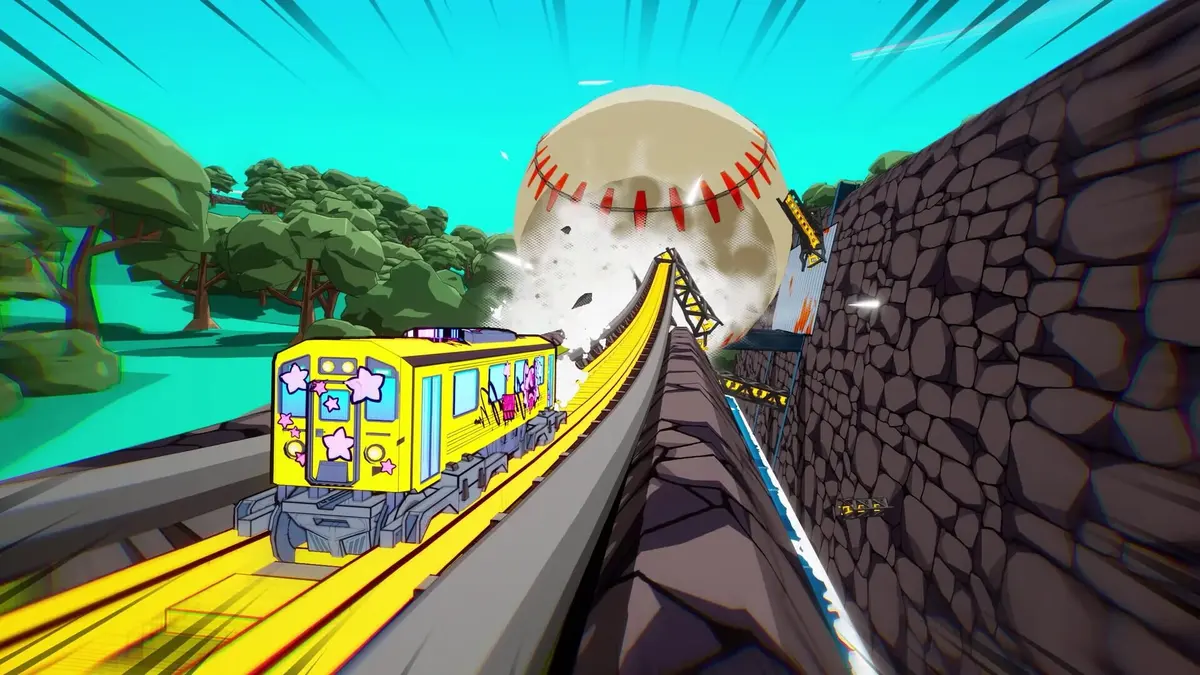
The first stretch therefore contains more repetition than it needs to. I replayed early stages less because I was hungry for mastery and more because I was trying to establish basic visual literacy. A cleaner introduction could have let the game’s systems breathe: one lesson for reading routes, another for extending chains, another for dealing with combat pressure. Instead, it often stacks those lessons together, then asks for confidence before confidence has had time to form.
Map navigation also could have been more direct. The campaign’s structure sometimes makes finding the next point of progress less elegant than the tracks themselves. That friction is minor next to the mechanical highs, but it sticks out in a game designed around momentum. Every pause between rides risks breaking the spell.
Boss Fights Turn Speed Into a Proper Test
The boss battles saved several of the campaign’s busiest stretches for me. They take the loose panic of a normal run and give it a target. Learning a boss pattern, finding the opening, and keeping the train moving while preparing the right trick-based response created a satisfying rhythm. I could feel myself improving in a way that was immediately visible: less flailing, fewer wasted movements, cleaner attacks, and more control over the arena.
These fights also show how well the combat belongs inside the score-chasing structure. They are not detached arenas bolted onto an arcade racer. Momentum remains part of the pressure, and style still matters. The bosses made me use the game’s tools with intention, then rewarded execution rather than brute persistence. I wanted more moments built around this kind of readable challenge, because it exposes the precision beneath Denshattack!’s chaos.
Customization, Fanzines, and a World With Real Texture
Emi’s train customization gives the game a welcome personal layer. I liked making the machine feel more like my own between missions, especially after spending a stage learning every ugly little mistake I had made with it. The collectible hunt has more character than a pile of anonymous tokens, too. Fernando, the budding journalist and photographer, brings his fanzines into the game’s wider world, tying its collectibles and story flavor together in a way that fits the setting’s scrappy, anti-establishment mood.
The dystopian future Japan backdrop gives the campaign energy, even when the plot walks familiar ground. Miraido’s domed society and the people shut out beyond it establish a strong visual and social contrast. Emi’s ordinary ramen-delivery life colliding with this high-speed rebellion is a fun hook. I enjoyed the character work most in smaller scenes and bits of environmental flavor, where the game did not have to stop and explain its whole world at once.
I also loved being able to switch between Japanese and English voice performances on the fly. It is a small feature, but it suited a game so committed to its audiovisual vibe. The soundtrack does heavy lifting here: hard-driving, stylish, and loud enough to keep a restart from feeling like punishment. When I was replaying a difficult route for the fifth time, the music kept that loop energized instead of tedious.
Style Carries the Ride, But the Story Slows It Down
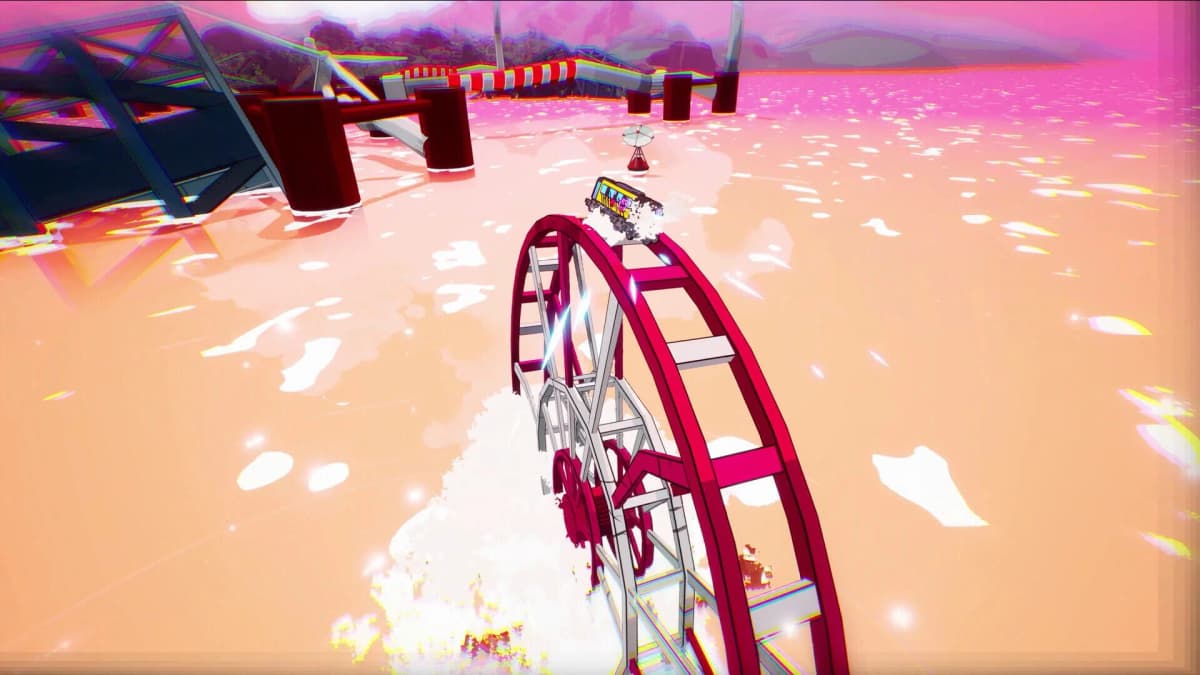
Undercoders understands presentation. The neon color, exaggerated effects, dense cityscapes, and animated punk energy give Denshattack! a visual personality that never fades into generic sci-fi. Every course feels built to be seen at speed, and the game’s best moments carry that wonderful arcade sensation of barely controlled motion. The train, the music, the routes, and Emi’s determination all point in the same direction.
The campaign sometimes mistakes more story for more momentum. Dialogue can linger where I wanted another track, another challenge, or another chance to improve a medal. The central conflict and rival-champion material provide enough context for Emi’s journey, but they never matched the mechanical electricity of the game’s strongest stages. I remembered a difficult route and a hard-fought boss pattern more vividly than most of the narrative turns around them.
That imbalance does not sink the game. It does make the campaign feel longer in the wrong places. A 10-15 hour run has enough space for its characters and world, yet the arcade core is so sharp that every slower narrative interruption feels like a brake being pulled on a train built to fly.
FinalBoss // Gear
Level up your setup
01Top-rated gaming headsetson Amazon→02High-refresh gaming monitorson Amazon→03Gaming chairson Amazon→04Discounted game keyson Kinguin→
Affiliate links · As an Amazon Associate, FinalBoss earns from qualifying purchases.
Want to Level Up Your Gaming?
Get access to exclusive strategies, hidden tips, and pro-level insights that we don't share publicly.
Ultimate Reviews Strategy Guide + Weekly Pro Tips