
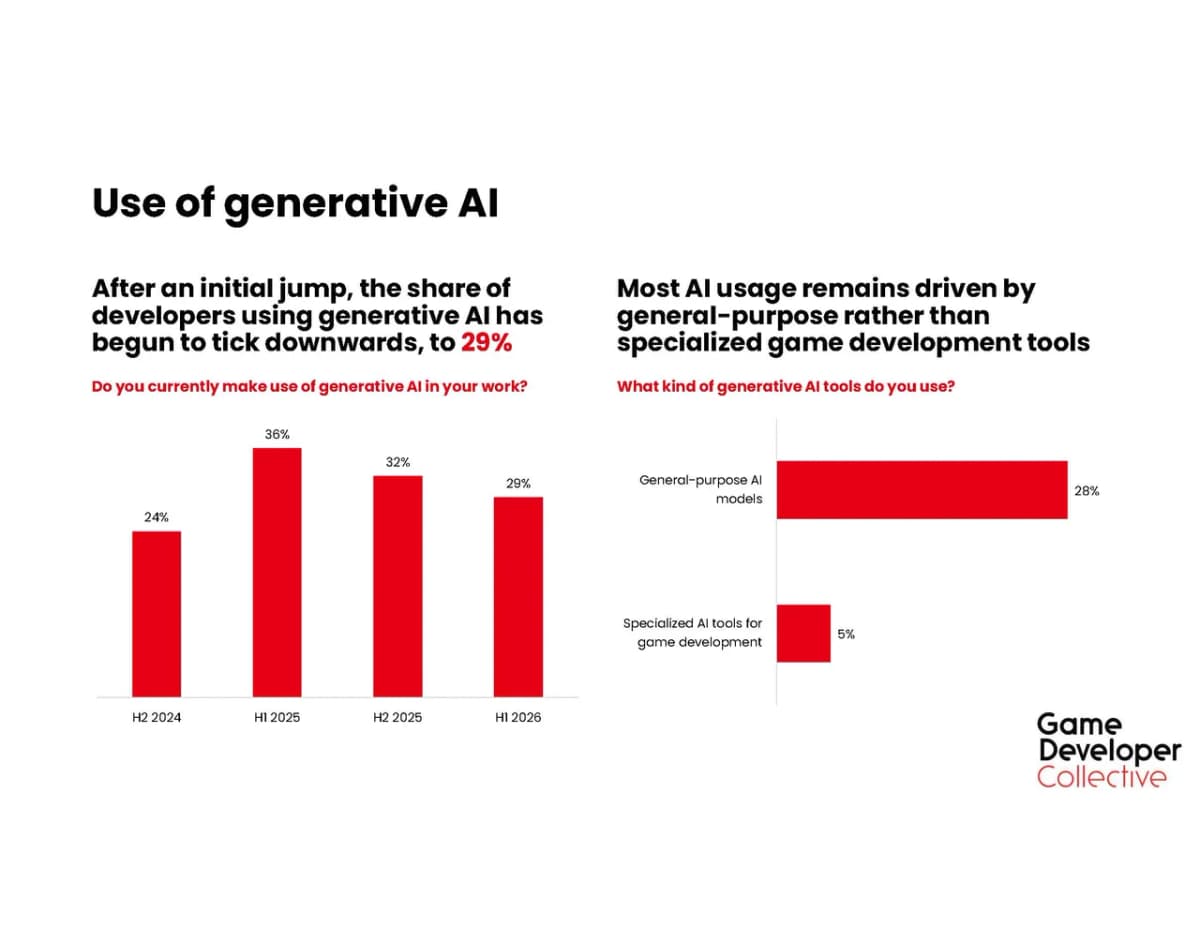
The buzz around generative AI in games has cooled. New data from the Game Developer Collective, produced with Omdia, shows reported developer use of generative AI fell to 29% in early 2026 from 36% a year earlier – reversing the sharp uptake seen in 2024-25. More than a statistical quirk, that drop lines up with a growing body of developer skepticism about quality, costs, and ethics.
Table of Contents (7)
Key takeaways
- Reported gen‑AI use dropped from 36% to 29% year‑over‑year, after a spike from 24% to 36% in 2024-25 (Game Developer Collective/Omdia).
- Developers increasingly say AI harms game quality (about 47% in prior data) and fewer expect cost savings – the share who think AI will raise costs jumped year‑over‑year.
- Adoption and sentiment vary by region: Japan shows higher usage in some reports, while North America and Europe dominate many surveys.
- This looks less like a rejection of AI tooling than a learned pause: teams are reassessing where AI helps versus where it creates hidden work and risk.
Why adoption is cooling – and why that matters
Generative AI was pushed as a productivity shortcut: faster asset creation, cheaper localization, even automated programming help. The reality developers report is messier. The Collective’s data shows optimism about cost reductions has declined (from about 27% bullish in H1 2025 to 21% in early 2026), while the share who expect costs to rise has increased. That’s the uncomfortable metric most PR decks omit: AI can replace some grunt work, but it creates new workstreams — prompt engineering, quality control, legal vetting, creative iteration and environmental accounting.
When nearly half of respondents worry AI hurts game quality (a figure the Collective found last summer and which stayed roughly static into 2026), you have an appetite problem. AI can produce large volumes of content, yes. But volume ≠ craft. This echoes arguments from outlets like IGN suggesting AI will produce bigger but potentially hollow worlds, driving a countertrend back to smaller, human‑led projects that prize subtlety and emotional design.
The PR story vs. what studios are telling surveys
Publicly, tool vendors still sell cost‑savings and speed. Internally, teams are running the arithmetic and tallying downstream costs: licensing headaches, content cleanup, staffing to oversee models, and higher energy or cloud bills. The Game Developer Collective’s numbers suggest those bills are showing up in planning meetings. If I were on a call with a PR rep right now, I’d ask: can you point to measurable, audited projects where end‑to‑end costs fell because of generative AI, not just “asset production time”?

Regional noise and notable exceptions
Not all regions move together. Other surveys note roughly one‑third adoption in GDC’s polling, while reports in The Nikkei indicate higher uptake in Japan (around 51% in one report). Google Cloud/Harris Poll results from mid‑2025 showed much higher usage numbers in some developer samples. These discrepancies come from sampling differences — hobbyists vs. AAA studios, platform specialists vs. service providers — and they tell us adoption is uneven, not universally collapsing.
Context matters: this debate will be loud at GDC 2026, where AI remains a top agenda item, and it’s being discussed alongside hardware and optimization pressures that affect budgets and tool choices (see recent reporting on graphics‑card shipment shifts and component costs).
The uncomfortable observation
Game makers wanted a magic button. What they got was a set of powerful, immature tools that shift costs around and expose questions about quality, IP, and environmental impact. Public comments from tech leaders and viral clips about AI’s energy footprint have deepened developer unease; this isn’t just nitpicking, it’s a risk calculation studios now have to make.
What to watch next
- GDC 2026 sessions and post‑show surveys (March 2026) — look for hard case studies, not marketing demos.
- Studio postmortems from 2026 releases that used AI — did schedules, budgets, and quality metrics improve or worsen?
- Regulatory and licensing developments — any legal rulings or new model‑licensing terms will change cost math fast.
- Cloud and energy cost disclosures from major AI vendors — if cloud bills climb, so will skepticism inside studios.
Frank Lantz and other designers have already started asking the design questions that tools can’t answer: why we make certain games and what we lose when craft gets automated. That’s the conversation that will determine whether generative AI is a toolbox or a detour.
TL;DR
Game Developer Collective/Omdia data shows generative AI use among developers fell to 29% in early 2026, reversing last year’s spike. The decline maps to rising concerns about game quality and new evidence that AI can increase, not decrease, development costs. Watch GDC case studies, studio postmortems, and vendor‑cost disclosures to see whether this is a tactical slowdown or the start of a more permanent recalibration.
FinalBoss // Gear
Level up your setup
01Top-rated gaming headsetson Amazon→02High-refresh gaming monitorson Amazon→03Gaming chairson Amazon→04Discounted game keyson Kinguin→Affiliate links · As an Amazon Associate, FinalBoss earns from qualifying purchases.
Want to Level Up Your Gaming?
Get access to exclusive strategies, hidden tips, and pro-level insights that we don't share publicly.
Ultimate Gaming Strategy Guide + Weekly Pro Tips