
Dogpile Review: A Cozy Merge Roguelike That Runs Out of Steam
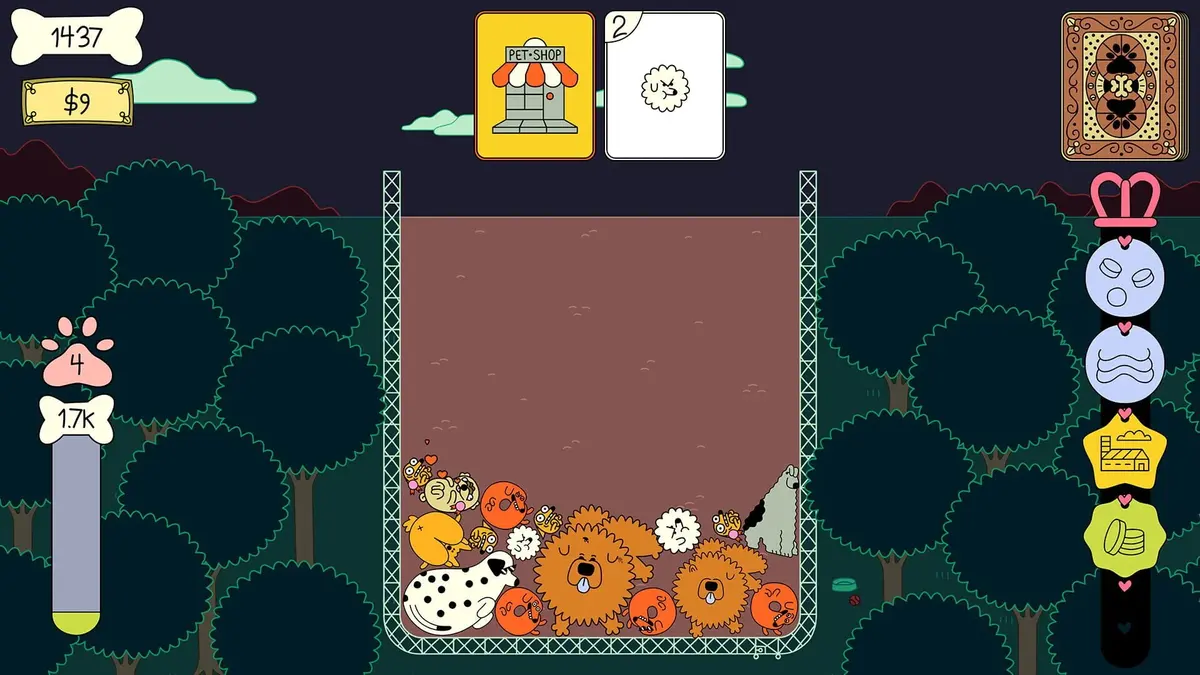
Dogpile earns my affection and tests my patience through the same compact idea: two matching dogs meet, become one larger dog, and leave just enough room for the next decision to matter. That rhythm is immediately satisfying. The yard starts as a friendly little puzzle, then tightens into a cramped board where a poor drop can ruin an otherwise promising run. Yet the longer I consider its systems, the clearer the limitation becomes. Dogpile has enough smart variation to enrich the merge game, but not enough lasting depth to fully outgrow it.
Studio Folly and Toot Games have made a game with a strong central contradiction. Dogpile is wonderfully readable: match identical dogs, clear space, grow the pile, and keep the board alive. It also layers Traits, Dog Tags, the Pet Shop, and Dog Wash progression over that tactile foundation. Those additions make each run more deliberate than a simple score chase. They also place a lot of responsibility on a merge loop that eventually starts repeating its best ideas.
What matters in Dogpile
- Dogpile turns a Suika Game-style spatial merge puzzle into a roguelike deckbuilder where two identical dogs merge into bigger dogs.
- Runs depend on managing a limited yard, where early placement mistakes can snowball as the board fills.
- Traits such as Barky, Showdog, Fleas, Sleepy, Timid, Cool, Stinky, and Zoomy give individual dogs more tactical identity.
- More than 100 Dog Tags can modify dogs and strengthen Trait synergies, giving a successful run a build-driven purpose.
- The Pet Shop and Dog Wash add progression and upgrade structure, but they do not fully solve the game’s long-term repetition.
The board is Dogpile’s strongest argument
Every good decision in Dogpile starts with space. Dogs are placed into a confined yard, where identical types merge when they touch and become bigger dogs. Clearing one pocket of the board can create a chain of options; blocking that same pocket can leave a pile of awkward pieces that no longer fit together. The rules are simple enough to understand instantly, but the board develops real pressure once space becomes scarce.
That tension gives Dogpile its cozy-but-demanding personality. The artful part of a run is not merely spotting a possible merge. It is deciding which merge preserves room for later dogs, which side of the yard can support a larger chain, and when a tempting immediate match will cause a more expensive problem. The game’s dog hierarchy provides the forward motion, while the physical pile supplies the resistance.
More than 15 animated dogs give the progression a playful sense of escalation, and the basic act of building toward larger dogs has the same tactile appeal that makes Suika-style games so easy to return to. Dogpile understands the pleasure of turning clutter into order. A packed board can become manageable in a single merge, and that little reversal is powerful enough to make a failed run feel worth restarting.
Still, spatial management remains the whole foundation. A player who loves that specific form of pressure will find a lot to enjoy here. A player who finds merge boards repetitive will reach Dogpile’s ceiling much faster, because every upgrade system eventually returns to the same question: where can this dog safely go?
Traits give runs a reason to change
The roguelike layer matters because it gives the board more texture than pure placement skill. Traits alter how dogs behave during a run, turning familiar merges into pieces of a broader build. Barky, Showdog, Fleas, Sleepy, Timid, Cool, Stinky, and Zoomy establish a vocabulary for runs that can lean in different directions rather than simply asking for cleaner stacking every time.
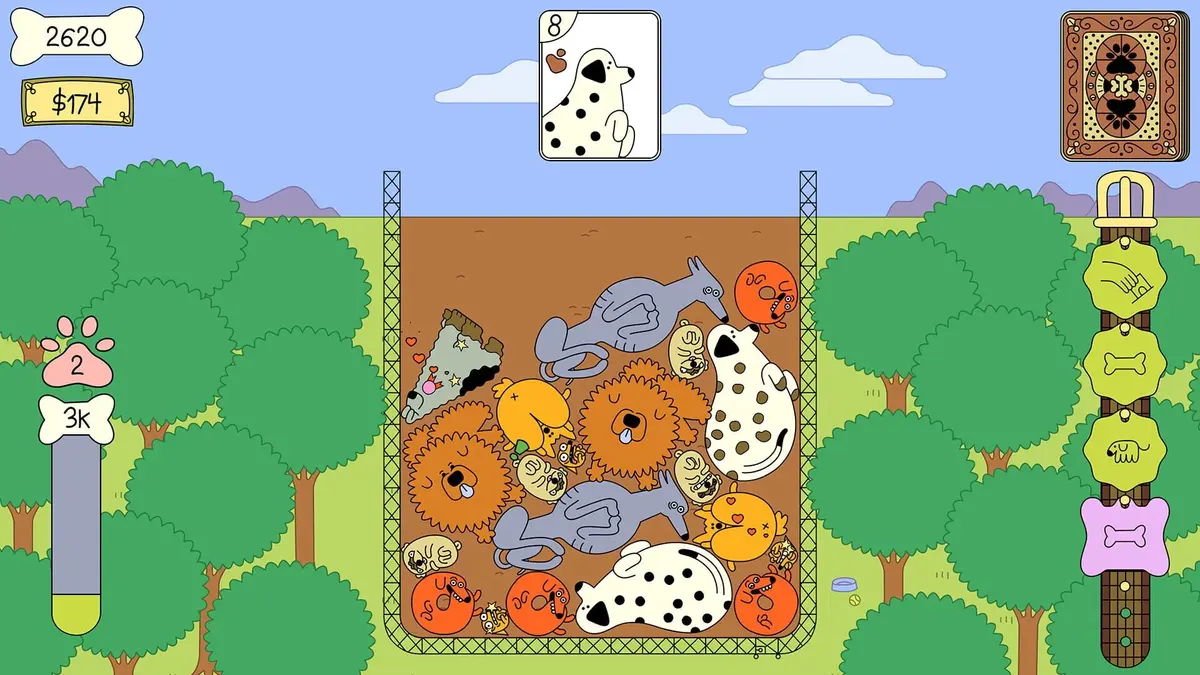
Dog Tags are the system that makes those Traits feel connected. With at least 100 Dog Tags available, Dogpile has room to reward a focused approach instead of treating every pickup as a generic boost. Tags modify how dogs and Traits function, and their value comes from synergy: a run becomes more interesting when its choices reinforce one another instead of merely adding isolated bonuses.
This is where the comparison to Balatro makes sense, even though Dogpile has nothing to do with poker. The shared idea is the pleasure of run-defining modifiers. A good Dogpile build changes priorities on the board. Merges remain important, but the best path through a run can shift depending on the Traits in play and the Dog Tags supporting them. That added layer makes Dogpile more thoughtful than a straightforward Suika Game imitation.
My mixed feeling is that the modifier systems are clearly the right answer to the base concept, yet they do not transform the base concept into something radically deeper. Dogpile produces varied runs, but they still orbit a familiar board-management rhythm. The Tags enrich the puzzle; they do not replace it.
FinalBoss // Gear
Level up your setup
01Graphics cardson Amazon→02Gaming laptopson Amazon→03High-refresh gaming monitorson Amazon→04Discounted game keyson Kinguin→Affiliate links · As an Amazon Associate, FinalBoss earns from qualifying purchases.
The Pet Shop and Dog Wash cannot carry the long game alone
Dogpile gives its runs some connective tissue through the Pet Shop and Dog Wash. The Pet Shop functions as part of the game’s economy and upgrade structure, while Dog Wash progression helps manage negative Traits. Both systems make the roguelike framing feel more purposeful, because they give the player decisions beyond the immediate placement of the next dog.
Dog Wash is particularly important because it acknowledges that Traits can create friction as well as advantages. A run should not be a frictionless parade of upgrades. Negative conditions force a player to weigh cleanup, space, and build direction against each other. That is a meaningful addition to a game that could otherwise be reduced to dropping dogs and waiting for matches.
The problem is scale. The Pet Shop, Dog Wash, Traits, and Tags all provide useful structure, but Dogpile eventually reveals that its meta-progression is lighter than its immediate loop. Repeated runs remain pleasant, and the next merge is frequently satisfying, but the broader progression does not keep expanding at the same rate as the player’s understanding of the board.
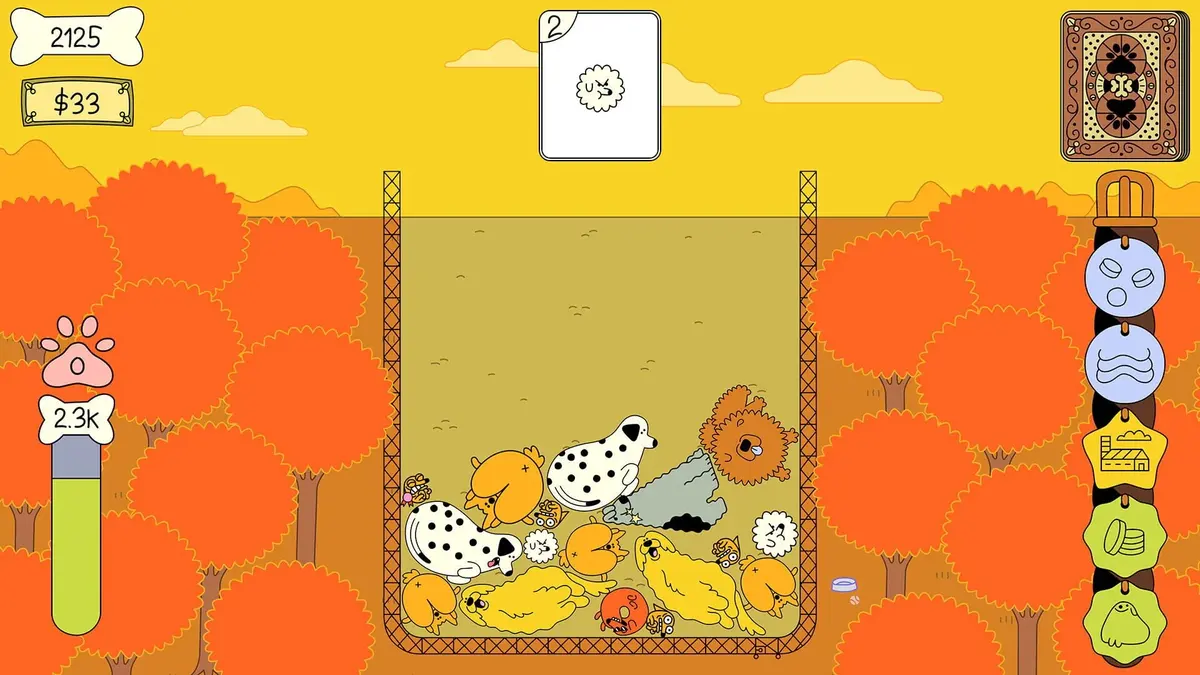
That leaves Dogpile in an awkward but honest position. It is far more engaging than a bare merge toy because it has build choices and run-altering mechanics. It is also less absorbing than the best long-term roguelikes because its systems do not continually produce new strategic terrain. The game’s charm lasts longer than its novelty, but its novelty still fades.
Want to Level Up Your Gaming?
Get access to exclusive strategies, hidden tips, and pro-level insights that we don't share publicly.
Ultimate Reviews Strategy Guide + Weekly Pro Tips
Platform choice comes with one important Switch caveat
Dogpile launched on PC through Steam on December 10, 2025. It is also available on Nintendo Switch 2, Nintendo Switch, iOS, and Android, with Studio Folly and Toot Games beginning distribution across those console and mobile platforms on August 20, 2026. The game’s short-run structure suits every one of those formats: its board is readable, its goals are immediate, and a single attempt has a clear beginning and end.
Nintendo Switch 2 and Nintendo Switch owners should keep one limitation in mind: the two versions use separate save files, with no save-data compatibility between them. That boundary matters for anyone moving between Nintendo hardware, especially in a game built around gradual progression and repeated runs.
Who Dogpile suits
I recommend Dogpile to players who want a cozy puzzle roguelike built for short sessions. Its best qualities are immediate: cute dogs, clear rules, satisfying merges, a board that steadily raises the stakes, and enough Trait-and-Tag interaction to make one run feel different from the next. The game has a pleasant tactical sharpness beneath its friendly presentation.
Players who need a long campaign, deep meta-progression, or a constantly evolving endgame should approach with lower expectations. Dogpile has more structure than a simple merge game, but its structure never fully escapes the repetition of the merge board. The same loop that makes it accessible also defines its limits.
Bottom line
Dogpile is a good puzzle roguelike with an excellent immediate hook and a modest long-term ceiling. The dog-merging board is tactile, cozy, and strategically demanding once space starts disappearing; Traits and Dog Tags give that board real variety, while the Pet Shop and Dog Wash provide useful support around the edges. I admire how much character Studio Folly and Toot Games bring to such a compact idea. I just do not think the progression has enough weight to sustain the game after the merge loop loses its initial spark. Dogpile earns a 7/10.