
Don’t Starve has always been about reading the map and dying anyway. Don’t Starve Elsewhere’s big swing is simple: Klei just made that map vertical, then wrapped it in a moving, sanity-shredding fog. That’s not just a new sequel – it’s a hard pivot in how this series wants you to play.
Table of Contents (9)
Key takeaways
- First true new mainline Don’t Starve in nearly a decade – a standalone PC/Steam entry built around online co-op out of the gate.
- Worlds are no longer flat: multi-level terrain, jumps, cliffs, caves and biomes turn navigation and positioning into new ways to live – and die.
- The spreading “Fog” is the real antagonist, hiding resources, crushing sanity and forcing you to push deeper instead of turtling forever.
- Series survival DNA stays intact – crafting, base-building, night horrors – but Elsewhere leans harder into roguelike runs and shared progression.
Klei isn’t just making more Don’t Starve – it’s changing the rules
Elsewhere is Klei’s first proper new Don’t Starve game since Don’t Starve Together in 2016. In between, the studio’s been busy with Oxygen Not Included, Griftlands, and an endless stream of DST updates and skins. The pattern looked clear: Don’t Starve had become a live-service garden they’d just keep trimming forever.
Announced during the Triple-i Initiative 2026 showcase, Don’t Starve Elsewhere breaks that pattern. It’s a standalone PC title (for now Steam-only) that keeps the hand-drawn, dark storybook look and cruel survival loop, but rebuilds the world tech and encounter design around three ideas:
- Co-op as default – solo is still there, but everything is clearly framed around playing with friends.
- Vertical, multi-tiered maps – hills, mountains, rivers, seas and caves stacked on top of each other, plus a literal jump button.
- A moving Fog system – a creeping, cursed weather/event layer that hides resources and drains your sanity as it closes in.
Most outlets will tell you this is “Don’t Starve, but now in 3D with fog and co-op.” The more honest read is that Elsewhere looks like Klei trying to drag their classic survival sandbox into the modern, run-based, co-op survival space that Valheim, Sons of the Forest and Palworld have been eating alive for the last few years.
Verticality is the biggest change this series has ever taken
Up to now, Don’t Starve’s worlds have basically been lethal board games: flat tiles, clean silhouettes, all about reading danger at a glance. Elsewhere tears that up. Klei is talking about “multi-tiered environments” – snowy peaks, raised cliffs, rivers you actually have to cross, cave systems beneath it all – and yes, a dedicated jump.
That sounds small until you remember how Don’t Starve fights and pathfinding work. In the old games, you kite in circles, abuse clean hitboxes and tight movement. With elevation and platforming, suddenly you have:
- New threats – enemies chasing you along narrow ridges, knockback that can throw you off ledges, water and chasms as real hazards.
- Positional strategies – building bases on plateaus, funneling monsters through choke points, using height to manage line-of-sight.
- Environmental puzzles – reaching specific resources or altars by navigating vertical routes instead of just walking around.
Klei’s own line – “this time there are hills” – is underselling it. This is closer to the jump from top-down Terraria to something flirting with isometric survival platformer. The question I’d ask Klei straight up: how much of classic Don’t Starve’s readability and precision are you willing to sacrifice for cinematic terrain?
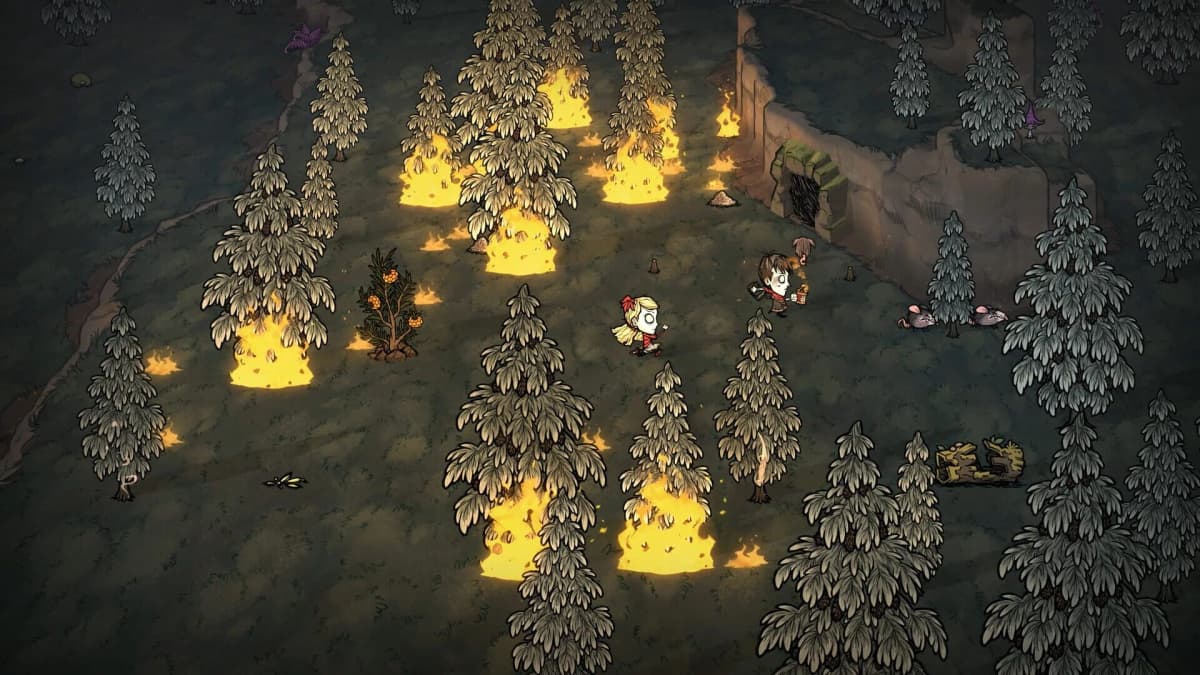
The series’ cruelty has always felt fair because it was legible. If Elsewhere’s depth and elevation make it harder to read enemy attacks or nighttime threats, that could turn “I screwed up” into “I couldn’t see anything,” which is much less fun.
The Fog is a sanity bomb disguised as a feature
The headline mechanic is the Fog: a creeping, mobile hazard that rolls across the map, hiding resources, messing with visibility and hammering your sanity the longer you stay inside it. Think battle royale circle, but tuned for slow dread instead of hot drops.
On paper, it solves a real design problem. Long-time DST players know the drill: once your base is stable – farms up, crock pots placed, armor crafted – the edge comes off. The world stops pushing back. Klei’s answer seems to be:
- You can’t just bunker forever. The Fog will eventually make your “perfect” base unlivable.
- Exploration isn’t optional. Resources and safer pockets of the map sit beyond the encroaching murk.
- Sanity pressure is global, not just a night-time toggle. You’re managing mental health against a literal approaching storm.
That’s smart systemic design, and it fits Klei’s obsession with intertwined meters (hunger, health, sanity, temperature, now humidity and climate). But it’s also the mechanic most likely to split the fanbase.
Don’t Starve has always been a weird hybrid: hardcore survival with a heavy sandbox-builder streak. A lot of players are there for elaborate mega-bases and years-long worlds. A moving Fog that keeps you packing up and moving camp shifts the game towards shorter, sharper, roguelike-style runs, where each “world” is something you eventually abandon by design.
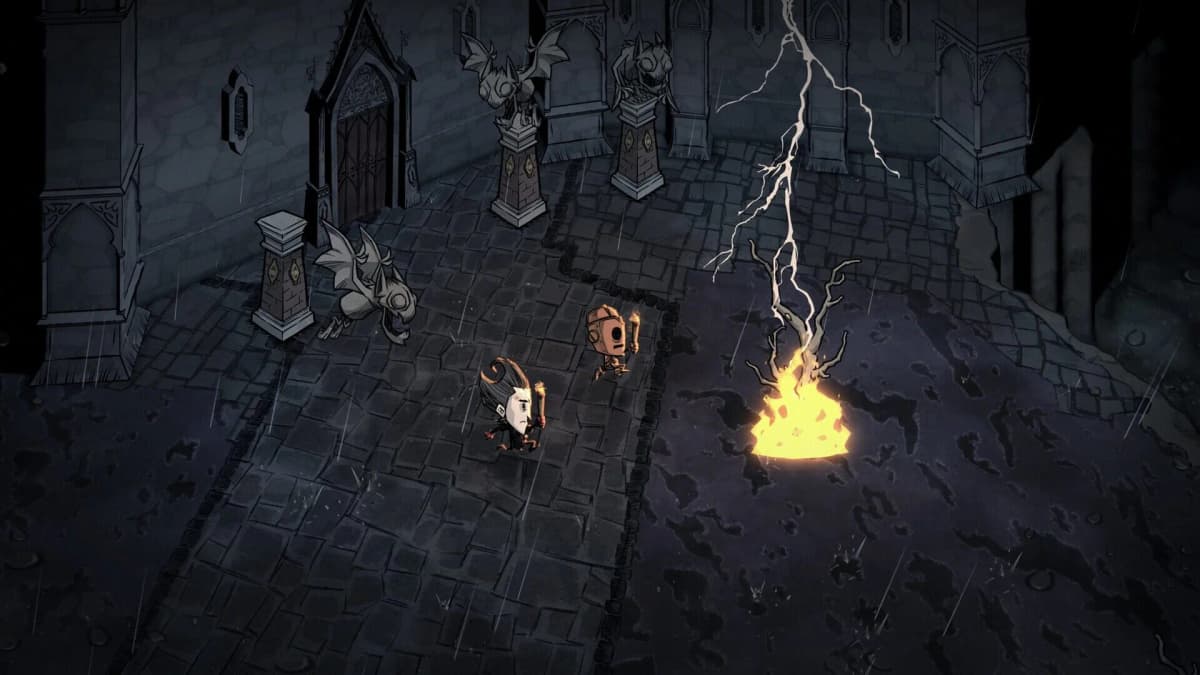
That’s great for replayability and co-op session flow, but if Elsewhere makes permanent bases basically impossible, it’s not just “more Don’t Starve.” It’s a philosophical reboot.
Co-op first means solo players need to read the fine print
Elsewhere supports solo play, but everything about the reveal – the trailer, the press materials, the pitch – is tuned for groups. Survive alone or “with friends,” online co-op front and center, shared exploration of procedurally generated worlds, and a structure that screams “one more run” with the squad.
That matters because Don’t Starve Together started as a bolt-on experiment and slowly became the de facto main game. Balance skewed toward multiplayer economies, boss design often assumed multiple roles, and solo players had to work harder for the same outcomes.
Elsewhere looks like it’s starting from that co-op baseline. That could mean:
- Chunkier, more directed content – dungeons, events or vertical set-pieces designed to be “played through” in a session. <li<strong>Harder scaling – bosses and world threats tuned around 2–4 players, with solo being technically possible but punishing.
- Shared unlocks – meta-progression or cosmetic rewards that persist across runs to keep groups coming back.
If you’re a solo-only Don’t Starve player, the big unanswered question is whether Elsewhere will feel like a full-fat experience alone, or like playing Left 4 Dead with three bots. Klei hasn’t shown enough moment-to-moment UI, scaling or AI behavior yet to call it either way.
Where does this leave Don’t Starve Together?
The awkward thing Klei doesn’t have to talk about in a reveal trailer: they already run one of PC’s most successful survival co-op sandboxes. Don’t Starve Together is still healthy, still getting updates, still selling cosmetics.
Dropping Elsewhere into that ecosystem raises some pretty obvious questions:
- Is Elsewhere a replacement or a sibling? If Klei shifts its live team to the new game, DST could quietly slow down.
- Will cosmetics and characters carry over? So far, there’s no sign of cross-ownership bonuses or shared progression.
- How different will the tone and structure be? Elsewhere is pitched as a “roguelike RPG” by some outlets, with more fantasy and magic on top of the usual science-gothic weirdness.
Historically, Klei has been good about not abandoning old games overnight. Mark of the Ninja and Oxygen Not Included both enjoyed long tails. But there’s no universe where maintaining two parallel Don’t Starve live ecosystems is cheap.
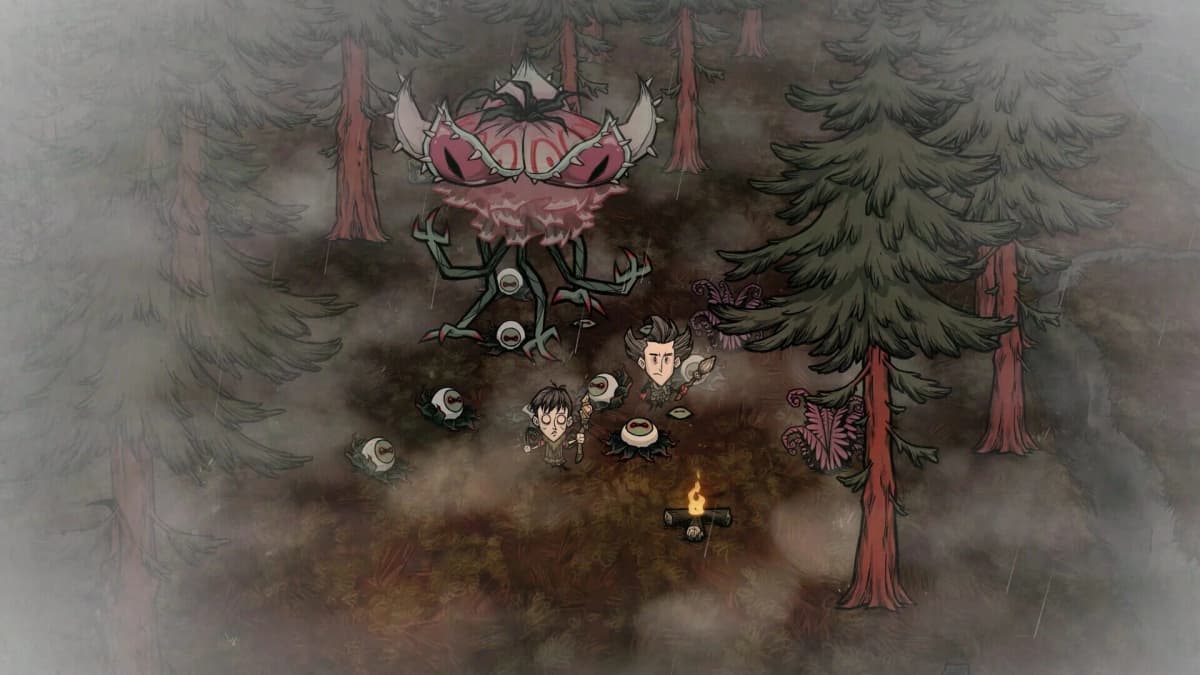
If you’re already invested in DST – both time and cosmetic money – the thing to watch is language. If future Klei posts start calling Elsewhere “the future of Don’t Starve,” or DST updates switch to purely maintenance-mode patches, you’ll have your answer.
Klei’s track record is the best argument for optimism
Strip away the marketing and Elsewhere is a risky move: new world tech, new core hazard, shifted pacing, stronger co-op tilt. Normally that would set off alarm bells. With Klei, it mostly triggers cautious optimism.
This is the studio that:
- Took Don’t Starve from a brutal niche oddity to a mainstream survival staple without sanding off its edges.
- Built Oxygen Not Included into one of the most intricate colony sims on PC with years of thoughtful updates.
- Has generally avoided gross monetization, sticking to cosmetic packs and expansions that add real systems.
The footage we’ve seen of Elsewhere looks like Klei doing what Klei does: layering systems until everything is two steps away from killing you, but in a way that still lets you feel clever when you survive. The new climate and weather effects, the distinct biomes, and the blend of magic with old-school science weirdness all feel like natural evolutions rather than brand drift.
The uncomfortable question isn’t “will this be polished?” – it probably will. It’s whether Elsewhere is still the same flavor of suffering longtime fans signed up for, or a different beast wearing a familiar face.
What to watch next
- Deep-dive gameplay preview: The first 15–30 minute raw demo will tell us how readable the new vertical camera is, and how oppressive the Fog feels in practice.
- Release model: Klei hasn’t said if Elsewhere will hit Early Access or go 1.0. Given their history, an EA launch with relentless iteration seems likely – and smart.
- Monetization details: Expect cosmetics, but the split between base price, DLC, and skin packs will show how seriously Klei sees Elsewhere as a second live-service pillar.
- Communication about DST’s future: Any roadmap, dev blog, or Q&A addressing how the two games will coexist is crucial for an already-invested community.
- Platform expansion: Right now it’s “PC via Steam.” Watch for mentions of consoles or cross-play – co-op games live and die on where your friends can access them.
TL;DR
Don’t Starve Elsewhere is Klei’s first new mainline entry in years, taking the familiar survival-crafting nightmare and rebuilding it around co-op, vertical worlds and a sanity-crushing Fog that never stops closing in. It matters because it doesn’t just add content; it rewires the series’ pacing from endless base-tending toward sharper, roguelike-style runs, and potentially sets up a future where Don’t Starve Together isn’t the main show anymore. If you care about this series, keep an eye on how aggressive the Fog really is, how fair the new 3D-ish perspective feels, and what Klei says – or doesn’t say – about the long-term fate of DST.
FinalBoss // Gear
Level up your setup
01Top-rated gaming headsetson Amazon→02High-refresh gaming monitorson Amazon→03Gaming chairson Amazon→04Discounted game keyson Kinguin→Affiliate links · As an Amazon Associate, FinalBoss earns from qualifying purchases.
Want to Level Up Your Gaming?
Get access to exclusive strategies, hidden tips, and pro-level insights that we don't share publicly.
Ultimate Gaming Strategy Guide + Weekly Pro Tips