
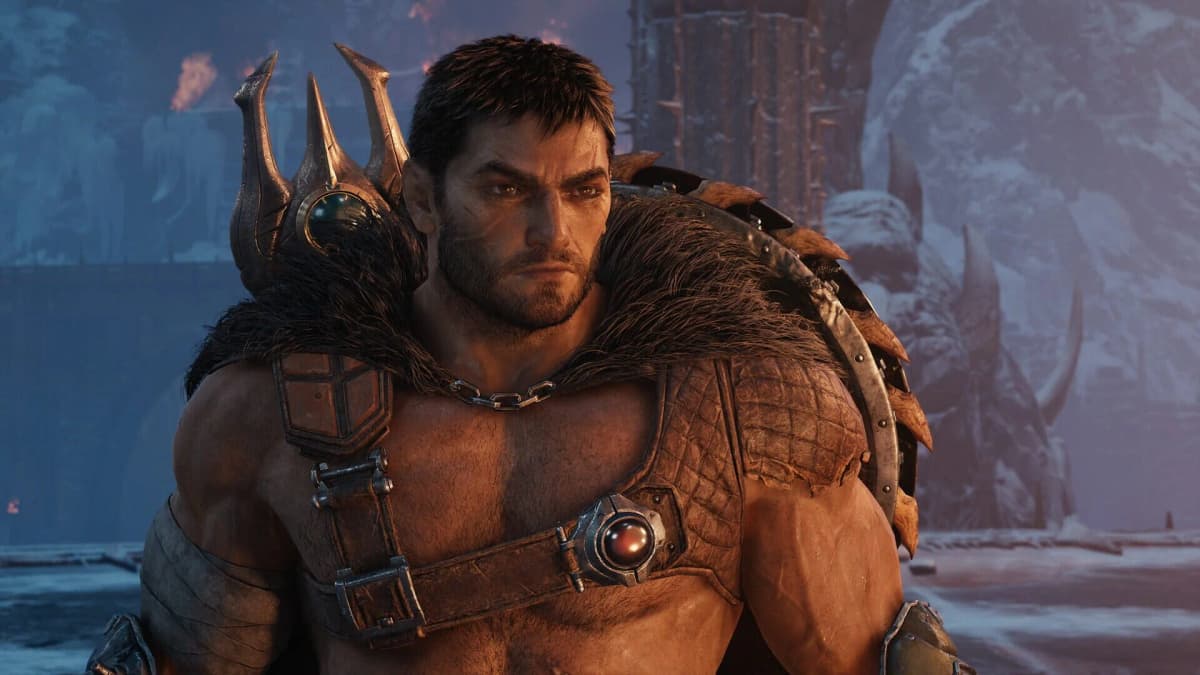
The prologue does something Doom expansions never do: it beats you. The Slayer goes after the Infernal Council — six demons who now sit at the top of Hell’s chain of command — using an artifact called the Oracle to get an audience. It is a trap. The chamber probes the soul of anyone who enters, and an unpurified soul can be bent, so when Belias steps up the fight is already lost. Your shield breaks. You are thrown into Purgatory. And when the actual campaign starts you have no BFG, no shield, and health, armour and ammo capacity reset to their most basic tier, which you claw back over the following ten hours. Starting a paid expansion by stripping the player is a nervy decision, and it is the reason the whole thing works.
Table of Contents (5)
The Chain Spear Is Eternal’s Meat Hook Wearing Medieval Armour
The shield bash was a teleport: point at a demon, arrive at that demon. The chain spear is not that. You throw it into a target and reel yourself in more slowly, with full directional control the whole way, so you decide whether you come out above the thing, behind it, or in its face. It is the Super Shotgun meat hook from Doom Eternal, transplanted almost function-for-function, and it drags Eternal’s air-time-heavy pace into a game deliberately built to be grounded. The dash returns with it, two charges, and I had forgotten how badly The Dark Ages missed it. You no longer plant your feet and answer a chain of attacks in sequence. You can leave.
Parrying changes shape too. The spear’s parry is a slash, a clash you time into the incoming green attack, and it’s the thing that breaks superheated armour — the throw doesn’t. Land it, or perfect-dodge a hell surge, and you charge a red meter on the blade that pays out in a javelin throw, a piercing stab that stuns, or an aerial slam that flattens a crowd. The upgrade tree, bought with platinum at the Hollow Shrines, is Eternal’s weapon-versus-enemy matchmaking rebuilt inside one weapon: the stab hits heavy melee demons harder, the throw hits flyers harder and can be upgraded to pierce the fence of projectiles a Mancubus throws out, and the slam can be made to spill health out of anything caught in the blast.
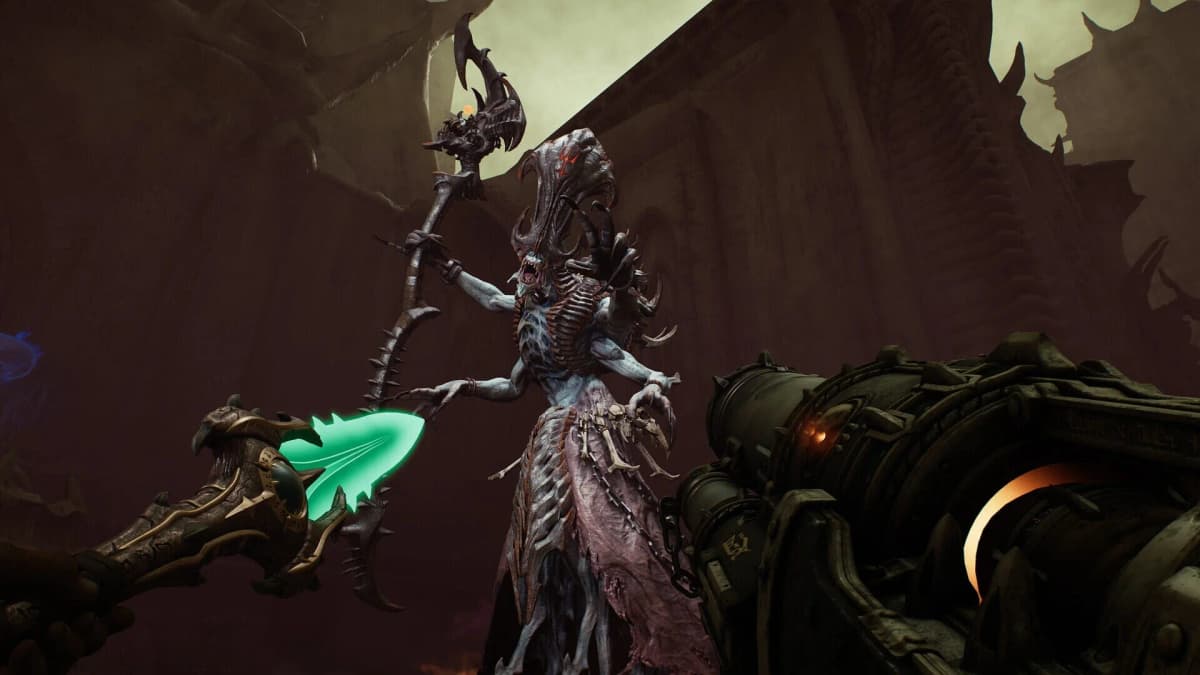
Which brings us to the argument everyone is having, so here’s where I land: taking the shield saw away was correct, and giving it back was the mistake. For the first stretch you have only the spear, and that constraint teaches you to play the DLC properly: the answer to a room full of demons stops being “absorb it” and becomes “get above it.” Then the shield returns, hot-swappable at any time, and several puzzles need one interaction from each, so the game pushes you to flip constantly. That is where it curdles. The two sub-weapons don’t share a button map: the throw is on a different input for each, the parries are on different inputs, and your brain will scream “parry!” while your finger presses the spear’s throw and launches you into the middle of the arena you were trying to survive. On PC it is worse: the spear’s keybinds ship completely unassigned, so you build a control scheme before playing a minute of it, and with this many overlapping functions there is no clean one to build. Nobody is really upset about losing the shield. They are upset about the hand confusion of holding both.
Purgatory Is the Smartest Thing Here After the Spear
Instead of a mission list, Revelations gives you Purgatory: a hub with few enemies, a lot of puzzles, colour-coded keycards, teleporter codes, and gates locked from the far side. Four levels hang off it, spread across Hell, the Cosmic Realm and Argent D’Nur, and they are more corridor-shaped than the semi-open sprawl of the base game, which is fine, because corridors are what id has been perfecting since 1993. The structure is closer to Hexen than to anything modern Doom has tried, and coming back with a new tool to open something you walked past three hours ago is the best pacing device here. Purgatory and the core of Hell are rendered as ice rather than lava, which sounds minor until you have spent thirty hours in orange.
The collectible design is meaner and better for it. Secrets no longer appear on the map when you get near them; you get a radar counting how many you have missed and nothing else, and a check mark only once you have found the thing. The real problem is structural: until you finish the story there’s no level replay and no fast travel between shrines, so a collectible left behind a point of no return is gone for the rest of the campaign. Worse, there’s no mission select even afterwards — you can revisit zones from Purgatory, but the prologue, the boss fights and the mandatory arenas can’t be replayed, which is exactly what you want to do once the spear is fully upgraded and you finally know what you’re doing.
The Bestiary Does the Heavy Lifting
The Archvile is back and he is the headline. He cages himself in shields and summons reinforcements, so you break the cage, then chew through enough health to interrupt the ritual, while the reinforcements he already called mob you. There are armoured variants, because of course there are. Around him: circular-saw demons that read as early prototypes of the Slayer hunters, all giant shield and cybernetics; warlocks, which buff nearby demons and spew a fog that makes the arena unreadable; and cosmic elementals, pain elementals rebuilt from Cosmic Realm energy, circling above and feeding you homing spawn one at a time. Base-game enemies return in variants that explode, leave pools, trail hazards or go stealth. Three proper boss fights punctuate the campaign, and they are the cleanest encounters in the DLC precisely because there is one target and nobody shooting you in the back.
The fair difficulty complaint is not the enemy count, it is the rooms. Too many deaths come from a shot out of a blind angle, an arena small enough that everything piles on at once, or a lava floor draining you while you solve the actual problem. When the environment does the killing rather than the demons, the game is cheating a little. The counter-play is to stop standing on the ground at all: hook one demon, fire in the air, hook the next, and most of that pressure evaporates.
The Endgame Is Where the Twenty Dollars Goes
Finish the story and you assemble the master key, opening purple doors across the four levels and Purgatory. Behind them: power rituals, scored time trials against a demon quota; Praetor fights, huge waves capped by a mini-boss and comfortably the hardest standard encounters here; and remade classic Doom levels where pixel geometry sits under HD demons. Clear those and you assemble the ’93 shotgun, which sits dead centre of the screen like it is 1993 and occupies the BFG slot. It has two flaws: you cannot use the chain spear while it is out, which stalls the rhythm the whole DLC is built on, and you get it so late you barely fire it.
The challenges pay out astral key fragments, which unlock Salgorot — a cosmic entity the codex describes as capable of unmaking universes, and which id has designed as a cosmic elemental scaled up five times. The fight is excellent, a bullet-sponge choreography that forces spear and shield together and real pattern memorisation, demanding without being cheap. The look is a letdown for something with that backstory. Beat it and four master arenas open, and clearing those feeds new arenas into Horde Mode 3.0. Post-story progression runs on blood iron and Praetor essences, the red-tier equivalents of platinum and leader essences, locked until the credits — which is why your spear is still missing half its upgrades when the story ends. That is the one progression call I would reverse.
The Lore Finally Explains the Praetor Suit
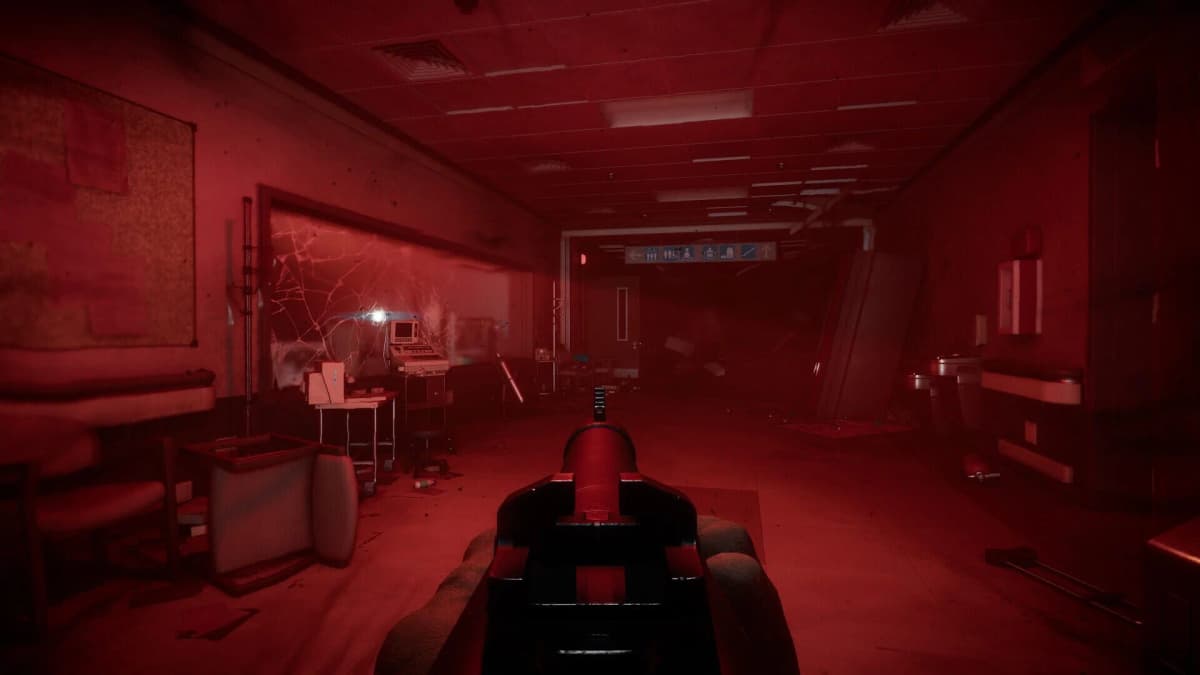
Revelations tells its story through codex pages more than cinematics, a reversal from the base game that works better than it should. Playable flashbacks put you in the boots of Corporal Flynn Taggart in 2044, on a hospital siege where a well-connected superior named Joshua Wims orders explosives detonated with civilians still inside: twelve dead, as many missing, including a girl with a stuffed rabbit. The pet therapy afterwards is where Daisy comes from. Ten years of Doom lore about a rabbit, resolved. The Architect, meanwhile, turns out to have built both the prison you are escaping and, eventually, the Praetor suit the Slayer wears in Doom 2016.
Twenty dollars standalone, seven to ten hours for the campaign and closer to twelve with the endgame, and it runs well beyond some stuttering cinematics and the odd texture bug. It shipped roughly two days after id Software reportedly lost about half its staff to Xbox layoffs, which makes the confidence on display hard to read without wincing. Revelations gets an 8 because its one big new idea is genuinely great and the game around it is generous, and it doesn’t get more because a mechanic this good shouldn’t require you to rebuild your control scheme before you can feel it.
DOOM: The Dark Ages – Revelations
Revelations takes the one tool everyone leaned on, breaks it in the prologue, and replaces it with a chain spear that pulls Doom Eternal’s verticality into The Dark Ages without turning it into Eternal. The four levels, the Purgatory hub and an endgame of power rituals, Praetor fights, Salgorot and four master arenas make twenty dollars look cheap. What holds it at an 8 is the handover: two sub-weapons with mismatched inputs, keybinds that ship unassigned on PC, and half your spear upgrades locked behind the credits.
- Chain spear brings back real vertical mobility
- Purgatory hub loops back on itself intelligently
- Archviles, warlocks and cosmic elementals raise the ceiling
- Huge endgame: master arenas, Salgorot, classic levels
- Codex finally explains Daisy and the Praetor suit
- Spear and shield use mismatched, clashing inputs
- Spear keybinds ship unassigned on PC
- Deaths from blind angles, tiny arenas, lava floors
- No mission select; missed collectibles gone until credits
- Half the spear upgrades locked behind the story
Buy it if you finished The Dark Ages and want the harder, faster version of it. Spend ten minutes in the controls menu before you spend ten minutes in an arena, and give the spear three hours before you judge it, because almost everyone who bounces off Revelations bounces in the first two.
FinalBoss // Gear
Level up your setup
01Top-rated gaming headsetson Amazon→02High-refresh gaming monitorson Amazon→03Gaming chairson Amazon→04Discounted game keyson Kinguin→Affiliate links · As an Amazon Associate, FinalBoss earns from qualifying purchases.
Want to Level Up Your Gaming?
Get access to exclusive strategies, hidden tips, and pro-level insights that we don't share publicly.
Ultimate Reviews Strategy Guide + Weekly Pro Tips