
Table of Contents (11)
From “why remake I and II?” to “I can’t put this down”
When Square Enix announced Dragon Quest III would get the HD-2D treatment before I and II, I thought it was weirdly backward. After all, Dragon Quest III is the crown jewel of the Roto trilogy, a natural crowd-pleaser. But after spending roughly 40 hours split between the newly remade Dragon Quest I and II, I get it. Laying III first gave the team a foundation-tone, systems, visual language-to retrofit the oldest entries into a cohesive, modern-feeling family saga. I went in skeptical. I came out grinning, a little exhausted, and honestly surprised that the oldest game here might be the one that stuck with me most.
My first night with Dragon Quest I HD-2D was supposed to be a quick nostalgia hit before bed. Two and a half hours later, I had a handful of new scroll-granted abilities, a couple of seals slotted for passive boosts, and that lovely “one more fight” momentum that turns midnight into 2 a.m. The classic skeleton of the 1986 original is still there, but the muscle and sinew are all new. And they matter, moment to moment, in a way that makes the supposed “simplest” Dragon Quest feel startlingly alive.
Dragon Quest I: Solo doesn’t mean simple anymore
I was worried about Dragon Quest I. On paper, a solo-party turn-based RPG in 2025 sounds like a museum piece. But Square Enix sidestepped the problem by leaning into modernized combat structure and progression. You’re no longer trading blows with a single slime or dracky in every battle. Multi-enemy encounters force you to think about tempo, turn order, and crowd control even when it’s just you versus a small mob. The scrolls you find are the secret sauce: they add new active skills that reshape how you approach fights and reward exploration beyond the main path. Then the seals kick in with passive perks-small but meaningful nudges that let you specialize your lone hero. I went with a setup that boosted survivability and MP sustain, which turned long treks between towns from grinds into tactical marathons.
The combat surprised me most because it actually expects you to buff and debuff constantly. In my third hour, I got flattened by a mid-forest mini-boss because I was playing like it was 1986: hit, heal, repeat. On the rematch, I opened with a defense-down, followed with a temporary damage buff for myself, then focused on a single target. It was tight—I won with single-digit HP and the last dregs of MP—but it felt earned instead of cheap. That rhythm carries through the whole adventure. And because Dragon Quest I is compact (my credits rolled around the fourteen-hour mark with some optional detours), there’s no dead-air bloat where your brain turns to mush from random battles.
The subtle UI tweaks kept adding up. Button shortcuts chop down the dreaded nested menus. Enemy vulnerabilities get highlighted in a clean, unobtrusive way after you’ve learned them, which nudged me to experiment instead of defaulting to basic attacks. When fights accelerate to that satisfying “I know what works here” cadence, it’s because the game gently nudges you there without making it feel like autopilot.
What I didn’t expect was how much the enhanced storytelling would change the vibe. There’s light voice work, and the hero—traditionally a cipher—gets just enough expression to feel present without breaking the series’ classic tone. A small new sequence involving the princess’s guards got a laugh out of me for how knowingly earnest it was. And the thread of the fairies acting as connective tissue with the other Roto games? It’s a smart move that gives weight to what could’ve been a very isolated quest.
Dragon Quest II: Freedom, a fourth cousin, and an ocean that tempts trouble
Dragon Quest II has always had the “too big, too mean” reputation. The original’s balance could be brutal, with difficulty spikes that felt like brick walls after breezy stretches. The remake doesn’t sand down the edges so much as it rebuilds the curve. You still get your boat startlingly early, and the world opens up in that intoxicating Dragon Quest way—“pick a direction and hope you’re ready.” But there’s more to find now: the undersea layer adds new routes and secrets, and I lost an entire evening happily sailing, diving, and poking at small islands just to see which clues would pay off.
Party composition is where this remake jolts II back into line with modern expectations. The original trio (warrior, mage, priest) remain the backbone, but the remake adds a fourth party member—a support-oriented princess who’s also part of the Roto bloodline. I didn’t realize how much that single addition would steady the ship. It pulls double duty: it smooths difficulty spikes by giving you more tools (status cleanses, mitigation, and targeted support), and it makes boss fights feel more like tactical puzzles than attrition tests. I went from dreading certain notorious encounters to genuinely looking forward to figuring them out.
That doesn’t mean it’s easy. The bosses are still stubborn and require a couple of attempts to internalize their patterns. The difference is that losing taught me things. On a lighthouse fight, I got caught in a loop where I’d heal one turn, get debuffed the next, and never regain momentum. On the successful run, I prioritized debuff immunity, opened with team-wide protection, and rotated single-target pressure. Barely scraping by with a party hanging on by a thread is where Dragon Quest shines, and II finally hits that sweet spot without tipping into masochism.
Exploration still has that early-era “read between the lines” charm—NPCs drop elliptical hints, and you piece together your route by paying attention. The difference is that the quality-of-life layer makes it less likely you’ll waste an hour doing something the game never intended. Shortcuts for common actions, clearer signposting of learned weaknesses, and better inventory friction help this sprawling second act breathe.
This HD-2D glow hits different: color, warmth, and tiny diorama magic
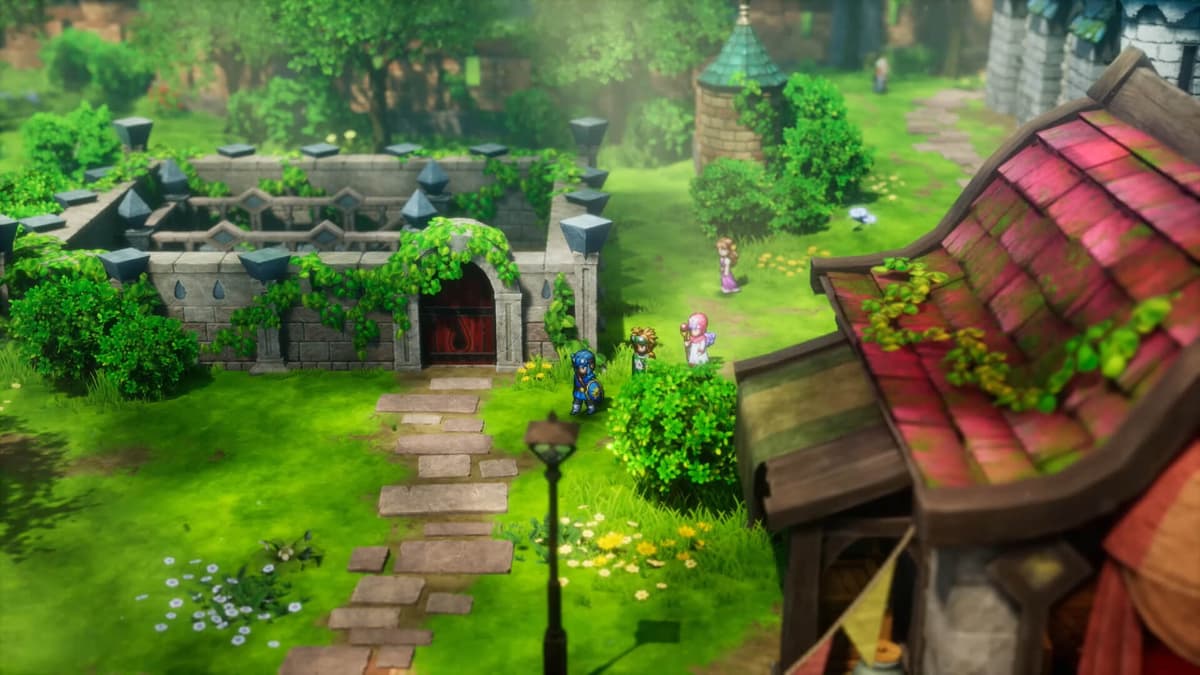
I’ve played plenty of HD-2D games, and they don’t always feel inviting. Dragon Quest I & II flips that script. The color palette leans warm and exuberant, pulling from Dragon Quest’s playful iconography rather than the desaturated look some pixel-diorama titles fall into. Towns sparkle with little life-signs—chimneys puffing, banners flicking, that familiar Dragon Quest roundness to architecture that makes you want to poke into every home even when you know it’s a pot with herbs.
The undersea areas in II are the visual highlight. Light shafts ripple, and the background layers exaggerate depth in a way that feels like peering into a glass tank full of secrets. It’s still the HD-2D we’ve come to know—tilted perspective, depth-of-field tricks—but the art direction is defiantly optimistic and cozy rather than moody. It matches the games’ hearts.
On the audio side, the orchestral takes on Koichi Sugiyama’s score give familiar melodies a sweep that feels earned without being bombastic. The classic village theme had me zoning into that Dragon Quest rhythm of “talk, shop, save, gossip” all over again. The only misstep: some loops are too short. When you’re circling a multi-floor dungeon, that snappy repetition can grate. I caught myself muting for a few minutes, then bringing it back for the big rooms and boss chambers so the impact could land fresh.
Modern comforts that respect the grind (and let you dial it up or down)
The remakes stack a bunch of small, practical upgrades that change how you play, without changing what you’re playing. It’s the difference between “I’m fighting the UI” and “I’m fighting monsters.” Shortcuts reduce menu fishing. Enemy weaknesses you’ve discovered appear in a handy, readable way mid-combat. The quality-of-life suite from III’s remake returns and expands here so you spend less time toggling and more time choosing.
The difficulty options are the quiet MVP. There’s actual flexibility here: you can aim for a classic-leaning run or switch on certain assists without torching the challenge outright. The approach to easy mode feels smarter this time—the notorious “invulnerability” toggle from III isn’t the default vibe-killer anymore. You can keep the training wheels in the closet or pull them out for a particularly gnarly stretch, and the game doesn’t shame you for it. That matters in II, where bumps still exist even after the careful rebalancing.
All of this means that your in-battle decisions matter more. With scrolls and seals in play, you actually get build expression across both games. In I, I leaned into sustain and status mitigation to make solo runs viable. In II, my fourth party member became a keystone for damage smoothing so my mage could focus on targeted nukes instead of triaging constantly. You feel the modern systems without losing the series’ simplicity.
Let’s talk pacing: repetition, dungeon sprawl, and when the old bones creak
Even with the clever remixes, you can’t fully hide the structure of 80s RPG design. If you marathon all three Roto remakes in order, you’ll absolutely notice déjà vu—shared towns, familiar items, and echoing quest beats. In the big picture, that repetition reinforces the multigenerational theme. In the moment, especially in the back half of II, it can feel like you’re retracing steps more than you’d like.
Certain dungeons also overstay their welcome. One tower in II has a couple of floors that feel like historical exhibits: “This is how we designed mazes in 1987.” I enjoyed them as a throwback, right up until I didn’t. Trimming a layer or two would have kept the momentum taut without losing identity. The rebalancing helps, but you still get those sequences where the encounter rate, the looped music, and the floor layout conspire to wear you down.
Finally, while the new scenes and voice touches are genuinely charming, they won’t flip any skeptics who find Dragon Quest’s tone too earnest. I happen to love that sincerity—it’s like stepping into a folk tale—but it’s worth saying: this is still Dragon Quest, not a wink-heavy modern RPG. The humor lands because it’s straightforward, not meta.
Three moments that sold me
First, in Dragon Quest I, I stumbled into a late-game miniboss thinking my newfound seal combo made me invincible. Two wipes later, I finally respected its pattern: stack a defense-down early, interrupt a telegraphed heavy hit with my one emergency option, then play the MP economy like a violin. That razor-thin win is the most fun I’ve had soloing anything in a turn-based game this year.
Second, in Dragon Quest II, the moment I got the boat I did the classic RPG sin: sailed straight into unknown waters, found an undersea passage, and got obliterated by a smiling sea monster after surviving for a tantalizingly long time. That failed expedition mapped out a plan for my next two hours and reminded me why I love open-world JRPG exploration—failure as breadcrumb.
Third, an added character beat with the fairies tied I and II back to III in a way that felt less like a cameo and more like a thesis: these are stories about a family line, not just a hero. It clicked then why the remakes shipped in this order. The trilogy wants to be read as one long, warm, slightly repetitive but deeply affectionate ballad.
Who should play this
- Series newcomers who bounced off older versions: The remakes keep the heart but remove the sand in the gears. DQI, especially, is now a stellar entry point rather than a historical curiosity.
- JRPG fans craving tactical spice without a systems spreadsheet: Scrolls, seals, and a fourth party slot in II add just enough build expression to chew on.
- Veterans of the Roto trilogy: The new scenes, voice flourishes, and connective fairy thread are meaningful. The rebalancing of II in particular makes revisiting it feel like vindication instead of penance.
- Purists who want pure-original difficulty and pacing: You can nudge settings to get close, but the spirit here is modernization. If you want the exact old spikes and labyrinths unchanged, these lean warmer and more accessible.
Performance, polish, and small quibbles
Across my time, the HD-2D presentation held steady: clean battle transitions, snappy UI response, and no immersion-breaking hitches in the busier towns or elaborate undersea scenes. The camera flourishes are restrained enough that they never obscure important information in combat. Load times were fast enough that hopping across the map or diving into retries never felt like a chore.
My quibbles are the kinds you feel after the honeymoon. A couple of dungeons are a floor or two too long. Some track loops could use a touch more length. A handful of optional encounters lean heavily on status ailments in a way that feels more “gotcha” than “learnable.” And, inevitably, marathoning I and II back-to-back will surface structural repetition that softens the impact of later story beats. None of these dents the core experience, but they’re there.
The bottom line: classic heart, modern rhythm, and a family saga worth your time
Dragon Quest I & II HD-2D Remake feels like a gentle but confident rewrite of history. It doesn’t overwrite what made these games beloved; it reframes them. The scrolls and seals give fights texture. The fourth party member re-centers II as a challenge you want to solve, not endure. The voice work, the added scenes, and the fairy throughline turn a trio of loosely linked quests into a cohesive, multigenerational story about courage handed down like a family heirloom.
I expected to respect the effort and then bounce. Instead, I found myself planning routes during lunch and jotting down which seal I wanted to try next like a kid scribbling in a strategy guide margin. The best praise I can give is simple: these remakes made me fall in love with the oldest Dragon Quests for what they are—not just what they were.
TL;DR
- Dragon Quest I is the surprise standout: solo play revived by multi-enemy battles, scroll abilities, and smart seals.
- Dragon Quest II’s early boat and expanded undersea zones make exploration intoxicating; a fourth party member stabilizes the infamous difficulty.
- HD-2D art is vibrant and cozy; orchestrated music soars, though a few loops are short.
- QoL shines: shortcuts reduce menu churn, enemy weaknesses surface cleanly, and difficulty options respect both newcomers and veterans.
- Some dungeons run too long, and marathoning the trilogy reveals structural repetition—but the family-saga cohesion makes it sing.
- If you love classic JRPG heart with modern pacing, this is an easy recommendation.
FinalBoss // Gear
Level up your setup
01Retro consoleson Amazon→028BitDo controllerson Amazon→03Capture cards (Elgato & more)on Amazon→04Discounted game keyson Kinguin→Affiliate links · As an Amazon Associate, FinalBoss earns from qualifying purchases.
Want to Level Up Your Gaming?
Get access to exclusive strategies, hidden tips, and pro-level insights that we don't share publicly.
Ultimate Reviews Strategy Guide + Weekly Pro Tips