
Table of Contents (13)
Dragon Quest VII: Reimagined Review – Brilliant Jobs, Bloated Journey
Dragon Quest VII was always the “why that one?” entry for me. I’d played and loved Dragon Quest XI, messed around with some of the older games, and watched Square Enix roll out beautiful HD-2D treatments for Dragon Quest III and the I-II combo. Then out of nowhere, they circle all the way forward to one of the series’ most infamous entries – the slow, bloated PlayStation-era monster – and give that game a modern makeover.
After more than 40 hours with Dragon Quest VII: Reimagined, I understand the appeal a lot better. This remake finally lets the heart of VII breathe: the melancholy time-hopping premise, the gloriously silly job system, and a world that oozes Akira Toriyama charm from every pore. At the same time, the team has been very selective about what it’s willing to change, and you absolutely feel that. The conveniences are modern, the pacing is not.
Key Takeaways
- Sprawling time-hopping story plays out as dozens of short, mostly standalone island arcs; it often feels like an anthology rather than a single epic.
- Excellent quality-of-life tools (battle speed, auto-battle, overworld strikes, generous fast travel) and granular difficulty/XP toggles greatly cut down grinding.
- The new Moonlighting system, which lets characters progress in two vocations at once, is a smart fix that makes the job system the clear highlight.
- Classic, straightforward turn-based combat stays grounded and readable, but it also barely evolves across 40+ hours of play.
- Gorgeous Toriyama-style 3D character models and one of the best localizations in a JRPG give the journey real warmth, even when the structure drags.
A World Where the Villain Already Won
My first surprise with Dragon Quest VII: Reimagined came right at the start. You begin as Auster, a fisherman’s kid, and Kiefer, the prince of your tiny island kingdom. They’re convinced there has to be more out there. The punchline: there isn’t. The entire “world” is literally one island in a very empty ocean.
That emptiness is not a mystery to be solved so much as a consequence. This is a world where the villain has already won. The other continents have been wiped off the map, and no one even remembers they existed. When Auster and friends discover ancient stone tablets, they’re pulled back in time to doomed islands. They fix some historical disaster, and in doing so, those islands reappear in the present, restored as if they’d always been there.
Moment-to-moment, that loop is great. You drop into a new land, poke around in its politics and petty squabbles, deal with some monstrous manifestation of its flaws, and then pop back to the present to see what survived and what twisted over the centuries. Some episodes go surprisingly dark; others lean into Dragon Quest’s trademark warmth and goofiness. There’s a quietly grim undertone to the idea that every place you help is, canonically, a civilization that wiped itself out once already.
On paper, that sounds like a cousin to Chrono Trigger, another Toriyama-styled time travel RPG. In practice, it’s structured very differently. Chrono Trigger braids its timelines tightly together; VII breaks them down into bite-sized arcs.
An RPG That Feels Like a Short-Story Collection
By hour ten, the shape of Dragon Quest VII really clicked for me. This is essentially a fantasy short-story anthology disguised as a JRPG. Each island is its own self-contained tale: meet the locals, investigate the problem, clear a dungeon or two, resolve the drama, watch the credits roll on that “episode,” then move on to the next.
There is an overarching plot involving a religious order called the Roamers and a ritual to restore the Almighty, the series’ benevolent god. Threads do eventually pull together and the last several hours finally feel like a single, focused crescendo. But most of the runtime is spent hopping between isolated moral fables and local tragedies that barely reference each other.
That structure has upsides. I enjoyed seeing the world map slowly fill with restored islands — it scratches that completionist itch in a very tangible way. A few arcs genuinely stuck with me, like one about the unreliability of oral history that forces Auster’s party to go back and correct centuries of misunderstanding. It’s clever, a bit introspective, and uses the time-travel premise for something more interesting than “go back and punch the demon.”
The flip side: in any anthology, not every story sings. There are islands where I realized within 30 minutes that I was not invested in these people’s problems, but I still had another two hours of dungeons and backtracking ahead of me. The restore-an-island loop is repeated so many times that even the better scenarios occasionally feel like variations on a template.
Reimagined speeds up the process of going through those arcs, but it does not meaningfully reduce how many there are. So even in 2026, Dragon Quest VII remains a uniquely “long-winded” game. That stubbornness is part of its identity, though it will absolutely test your patience if you crave a tight, forward-driving narrative.
Modern Conveniences on an Old Skeleton
Square Enix was unusually open about what this remake is trying to fix: the original Dragon Quest VII simply did not respect your time. You could spend hours before even seeing your first combat encounter. That is gone. In Reimagined, I was fighting monsters very early, and the game keeps layering in time-saving tools.
The combat flow is the biggest win. You can set battle speed to multiple faster settings; I settled on the middle option, which kept things snappy without turning fights into an unreadable blur. There’s a one-button auto-battle that’s smart enough to handle everyday trash mobs. For regular leveling sessions, I mostly let AI handle it and only stepped in for bosses or new enemy types.
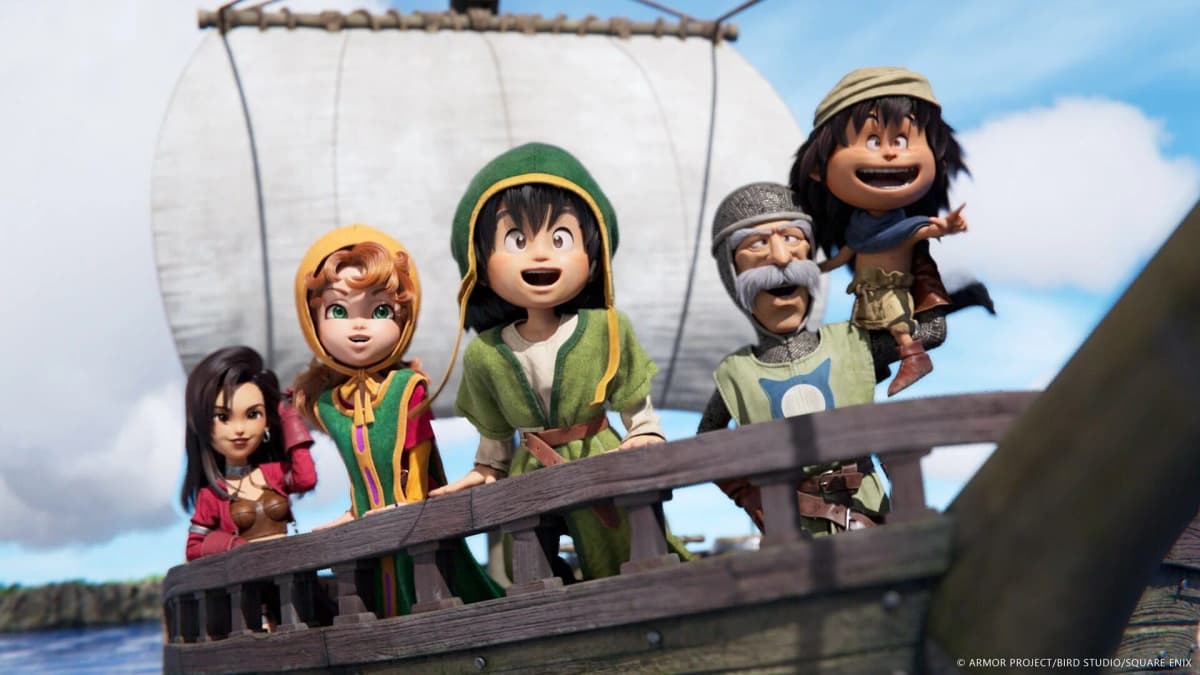
The best small touch is the overworld slash: if your party is strong enough, swinging your weapon at a visible enemy just deletes it on the field. You get reduced rewards, but it saves you from another loading transition and another handful of inputs. It sounds minor; across hours of exploration and backtracking, it feels huge.
Fast travel is similarly generous. As the map fills out with islands, you’re given multiple ways to hop around quickly, so revisiting older locations rarely turns into a slog. It helps that there’s usually a clear marker for where to go next, even if specific quest steps can still get a bit cryptic in that old-school Dragon Quest way.
Difficulty & Tuning: Have It Your Way
What genuinely impressed me is the level of control the remake gives you over difficulty and progression. There are three broad presets — Easy Going, Happy Medium, and Tough Going — but that’s just the surface. Under the hood, you can tweak individual sliders:
- How much damage you deal and take
- Monster strength and aggression
- Whether HP restores after battle
- Experience gain, gold gain, and job proficiency gain
- Whether monsters even initiate combat with you at all
For my run, I left monster behavior and damage at default but gave myself a bump to experience. That way I could still engage with battles as designed, without needing quite as much raw grinding between story beats. With those settings, finishing the main story took me a bit over 40 hours. Anyone sticking to the default curve or cranking up the challenge can expect a longer haul.
The key point: if you find yourself loving the characters but dreading another loop around the grindwheel, the game lets you quietly nudge it into something more manageable. That alone makes this the only sane way to play Dragon Quest VII in 2026.
Combat: Classic, Grounded, and a Little Static
Moment-to-moment battles in Dragon Quest VII: Reimagined are pure, traditional JRPG. Turn-based, front-facing enemies, characters choosing between attacking, spells, skills, and items. No timeline gimmicks, no fancy positional systems. Coming from years of increasingly baroque combat systems in modern RPGs, there’s something relaxing about that simplicity.
One thing I liked immediately: skills and spells do not feel like rare, hoarded resources. MP costs are modest, so I was free to use proper abilities throughout dungeons instead of defaulting to basic attacks for 95% of the runtime. The numbers also stay pleasingly restrained. Even near the end, my party’s HP sat in the low hundreds and their big signature attacks did similar amounts of damage, not the 9,999+ fireworks show that a lot of JRPGs lean on.
That grounded approach has a downside. Bosses become more elaborate, but your core tools don’t change as radically as you might expect across dozens of hours. I relied on some of the same elemental spells and buffs at the end of the game that I did in the middle. If you play a lot of turn-based RPGs, you can fall into a comfortable autopilot pretty quickly.
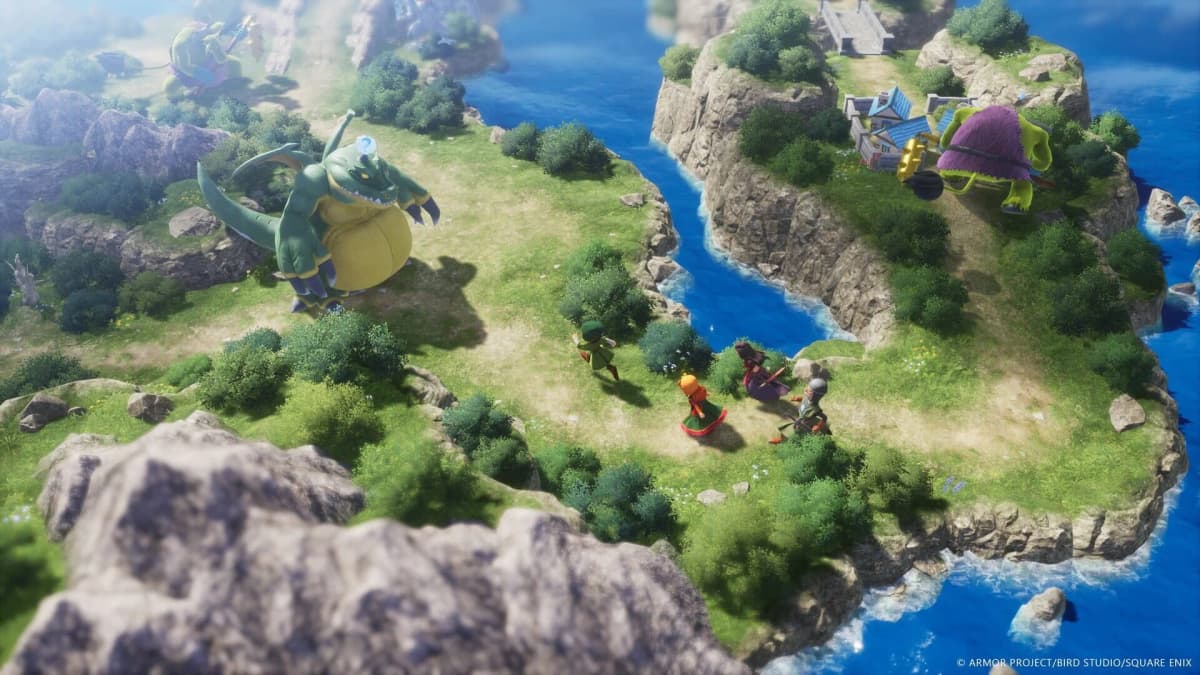
Vocations & Moonlighting: The Real Star of the Show
The job system is where Dragon Quest VII grabbed me and refused to let go. It does take its time getting there; vocations do not unlock until roughly 12 hours in. Once they do, the game’s whole texture changes.
Each main character has a signature base vocation, and then there are 20+ jobs spread across multiple tiers. Tier-1 jobs are your foundation — Mage, Priest, Martial Artist, and more creative spins like Shepherd, which literally summons sheep to help in battle. As you master combinations of Tier-1 jobs, you unlock Tier-2 vocations, and after enough investment there’s a single, ultra-powerful Tier-3 vocation waiting at the top.
Where Reimagined really changes the feel is through the new Moonlighting system. In the original, vocation progression was notoriously slow; job proficiency did not ramp efficiently with stronger enemies, so no amount of grinding could completely bypass the pacing. Here, Moonlighting lets a character essentially “equip” two vocations at once. You gain proficiency in both simultaneously, and you can use abilities from each.
That means you can, for example, run a Paladin/Monster Masher who can both tank hits for the team and summon iconic Dragon Quest monsters like Slimes to slam into enemies. Or a Shepherd/Armamentalist hybrid who both buffs the party and slings elemental magic with high resistance. On top of that, each vocation comes with a special “Let Loose” ability — a powerful technique that charges as your character takes damage. With Moonlighting active, you can choose which of your two jobs’ Let Loose skills to bring into battle, adding another layer of personality to each build.
For a good chunk of the midgame, tinkering with job combinations was the main thing pulling me back in each night. I’d wrap up a story arc, immediately head to the vocation menu, and start theorycrafting the next evolution for my team.
There are still some rough edges. Changing vocations is weirdly clumsy: you have to summon a special priestess with a shortcut, sit through the same spiel every time, confirm your new jobs, then watch another repeated dialogue snippet. It’s not long, but when you’re experimenting frequently, those seconds add up and start to feel like friction. Selling old equipment is similarly awkward and quickly became something I avoided unless I was truly desperate for gold.
And that single Tier-3 vocation, while satisfying to unlock, is less flexible than the multi-branch “ultimate jobs” you see in some other RPGs. It feels like a cool capstone to the system rather than a whole new decision space to explore.
Charm, Art, and One of the Best Localizations Around
What carried me through the weaker islands was not the macro plot — it was the game’s personality. Dragon Quest VII: Reimagined is overflowing with charm in a way that very few modern RPGs manage.
The visual style takes Akira Toriyama’s art and turns it into detailed 3D maquettes. The main cast look fantastic up close: expressive faces, layered clothing, little touches in animations that make them feel alive rather than static models. That philosophy extends to townsfolk and monsters too. Meeting a new enemy type was always a small delight, just to see how the artists had interpreted another weird Toriyama creature in 3D.
The localization is even better. Dialogue between the party members snaps with personality, helped along by voice acting that actually leans into their individual quirks. As you travel, different islands have distinct accents that loosely map to real-world dialects — hints of France here, Russia there — which sells the idea that you’re stepping into different cultures that were once carved off the world.

On top of that, this might be the most consistently funny Dragon Quest translation I’ve played. Spell names like Coral Grief and Gritty Ditty, monsters called Tongue Fu Fighter, Grinade, and Slaughtomaton — it’s a barrage of puns, but it lands more often than not. There’s a specific kind of goofy sincerity to Dragon Quest humor, and Reimagined nails that tone while still delivering emotionally heavier arcs when it needs to.
What Still Feels Stubbornly Old-School
For all the thought put into modernizing the grind, this is still very much a product of its era in how it structures and communicates content.
The biggest lingering issue is the sheer number of islands and how few of them meaningfully feed back into the main story. Reimagined has not rewritten Dragon Quest VII into a tight 30-hour epic, and it does not pretend to. If the idea of spending several sessions essentially watching disconnected fantasy shorts does not sound appealing, no amount of battle speed settings will change that.
There are also plenty of small, paper-cut annoyances: repeated dialogue for routine systems like vocation changes, slightly clunky shop interfaces, and the occasional quest objective that is much less clear than it feels like it should be in 2026. The fast travel and overworld tools make them tolerable, but they never fully disappear.
Who Dragon Quest VII: Reimagined Is For
After finishing the game, I have a much clearer sense of the audience that will click with this remake.
- Dragon Quest fans who skipped VII will finally get a version that respects their time without mangling the original’s eccentric structure. If you love the series’ mix of sincerity and weirdness, this is worth the commitment.
- JRPG players who adore job systems will find a lot to tinker with. Vocations plus Moonlighting are easily the highlight and justify the ticket price on their own.
- Story enjoyers who like episodic, self-contained arcs rather than one huge sweeping narrative will probably vibe with the “traveling hero anthology” feel.
- Players who crave a tight, urgent main plot or who get restless with repetition will likely bounce off the pacing long before the credits roll.
- Anyone allergic to grinding, even with assists may still find it too long, though the difficulty and XP sliders help enormously.
Bottom Line
Dragon Quest VII: Reimagined is a fascinating compromise between eras. It takes one of the series’ most intimidating entries and sands down a lot of the sharp edges: faster early progression, smart auto-battle, quick navigation, granular difficulty controls, and the Moonlighting system, which does heavy lifting to make vocation progression feel fair.
What it does not do is fundamentally reshape the game’s identity. The anthology-style island hopping is still there, for better and for worse. Some arcs are memorable and even moving; others feel like padding. The combat is charmingly straightforward but a little static across such a long runtime. And a few stubbornly old menus and repetition-heavy systems remind you that you’re dealing with a remake of a very specific kind of late-90s RPG.
Despite all that, the game’s heart wins out. The art direction, the localization, the lovable weirdos you travel with, and the sheer delight of turning your party into a bespoke team of monster mashers, paladins, shepherds, and spell-slingers kept me coming back.
TL;DR
- What it is: A modern remake of one of Dragon Quest’s longest, strangest entries, focused on quality-of-life improvements rather than structural surgery.
- What I loved: Excellent job system and Moonlighting dual-vocations, slick combat speed and auto-battle options, generous difficulty/XP tuning, beautiful Toriyama-style 3D art, and a consistently delightful localization.
- What frustrated me: Endless-feeling string of episodic island stories, some forgettable arcs, combat that evolves only modestly across 40+ hours, and a few clunky, repetitive menus for vocations and shops.
- Play it if: You’re a Dragon Quest fan or JRPG enthusiast who loves job systems and can enjoy an anthology-like structure with strong character and worldbuilding.
- Skip it if: You need a tightly plotted main story, hate repetition, or want a short JRPG you can finish in a couple of weekends.
FinalBoss // Gear
Level up your setup
01Top-rated gaming headsetson Amazon→02High-refresh gaming monitorson Amazon→03Gaming chairson Amazon→04Discounted game keyson Kinguin→Affiliate links · As an Amazon Associate, FinalBoss earns from qualifying purchases.
Want to Level Up Your Gaming?
Get access to exclusive strategies, hidden tips, and pro-level insights that we don't share publicly.
Ultimate Reviews Strategy Guide + Weekly Pro Tips