
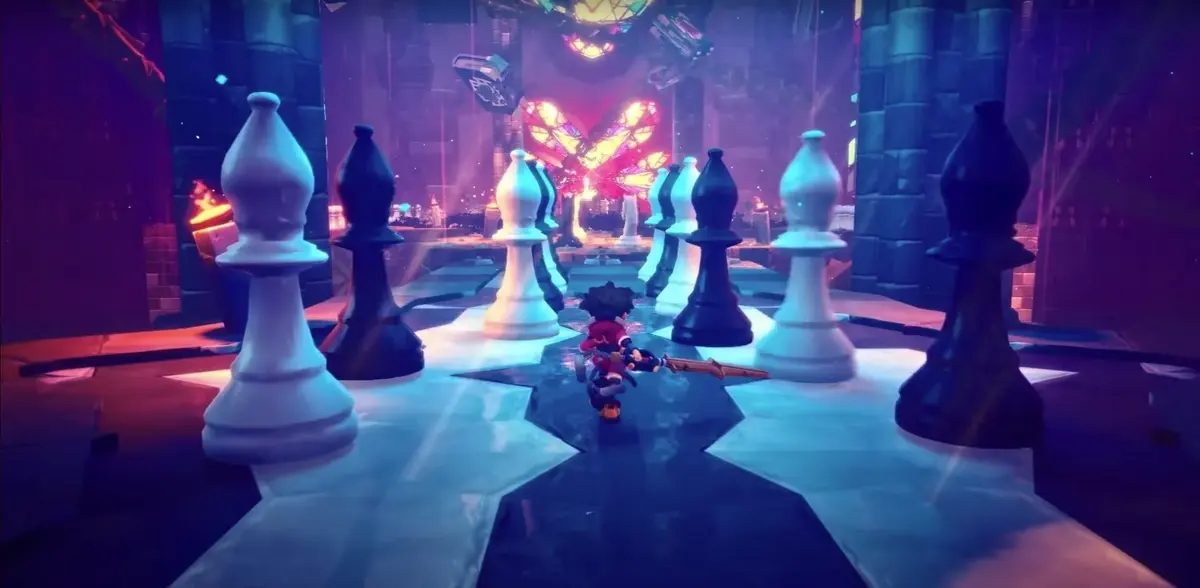
Here’s the thing about Weird Beluga. Five Spanish students founded the studio in 2019, won PlayStation Talents that same year with a twin-stick shooter called Clid the Snail, shipped it in 2021, and then decided their second game would be a full 3D action-platformer in the Jak and Daxter mould, the genre the whole industry quietly walked away from. Duskfade started as a two-person project. The team topped out around thirteen people. Fireshine Games, the publisher that also put out the Dreamcast love letter Denshattack, picked it up. I’m telling you this up front because it changes how you should read everything below: this is a thirteen-person studio’s second game, and the fact that it looks like it does is already the story.
You play Zirian, a young apprentice clockmaker in Tick Town who has just lost his grandfather. Before he and his sister Allira can even start grieving, a tower appears over the world, the sky goes dark for good, and Allira is taken. Zirian goes after her with Minutero, a clock hand that belonged to his grandfather and works as a sword, and Cuco, the clockwork bird every platformer hero needs. The route is the genre’s route: four biomes hanging off the Tick Town hub, four chains to sever on the tower, and a mythology about the old Clockmaker Masters to piece together through Echoes, little tears in time you find in each level.
The bit I didn’t expect is how openly the game is about grief. The bosses are named Despair, Rage and Sadness. The obvious comparison is Gris, another Spanish indie built on the stages of mourning, except Gris asked you to solve puzzles and contemplate, and Duskfade asks you to hit things. It’s the Kingdom Hearts friendship-speech thing, only about death, and the ambition outruns the writing. The dialogue is thin. On a Mario game that doesn’t matter. On a game that names its final boss Despair, it shows.
Table of Contents (4)
The Platforming Is the Reason to Buy It
Zirian has a double jump, a long jump, a wall jump, a ledge grab and an air dodge, and the air dodge is the trick: chained after the double jump it effectively gives you a third jump, so you can read a gap from a distance, count the jumps you’ll need, and still adjust mid-air because there’s a little inertia to play with. He feels floaty for the first hour. Then it clicks, and you’re landing long, precise jumps you’d have called impossible on the first attempt. It feels like a game from another era wearing modern clothes, and that is the highest compliment this genre can get.
The structural decision that makes it work is one I’d normally list as a flaw: there is no map. No markers, no compass, no objective arrow. You will get lost. You will backtrack down a route you were sure was right. And it’s the correct call, because the levels are simple enough to read and the absence of a map forces you to actually look at them. It’s the kind of decision a bigger publisher would have focus-tested out of the game.
Each biome is a chain of levels along one path rather than a set of doors in a hub, so the sea biome runs forest, beach village, islands, underwater academy, with the visual identity changing every level. And there’s a proper collect-a-thon buried in there: upgrade gears for the shop, antique coins you trade to Nico for cards, music boxes that each hide a rhythm mini-game, kittens to catch for skins, dye flasks, rainbow ingots to recolour Minutero, clockwork hearts for health, temporal cores for ability energy. Some of it needs a tool you don’t have yet, so you teleport back later with the grapple or the sundial that lets you grind rails. None of it changes how the game plays. All of it gives you a reason to poke at a suspicious ledge.
Combat: Great Bosses, Bad Crowds
On paper the kit is fine. Light and heavy attacks, a dodge, a perfect dodge, a counter you can buy from the merchant that fires automatically after a perfect dodge and is genuinely strong, a special per biome fuelled by a spirit-energy gauge, a lock-on, and a new tool from each biome’s temporal chamber that you swap on the D-pad. There’s a light Souls-like idea underneath it: enemies telegraph attacks, the roster is varied, and almost every boss mixes a combat phase with a platforming phase and works a recently unlocked tool into its pattern. The bosses are the good version of Duskfade combat, and they’re genuinely good.
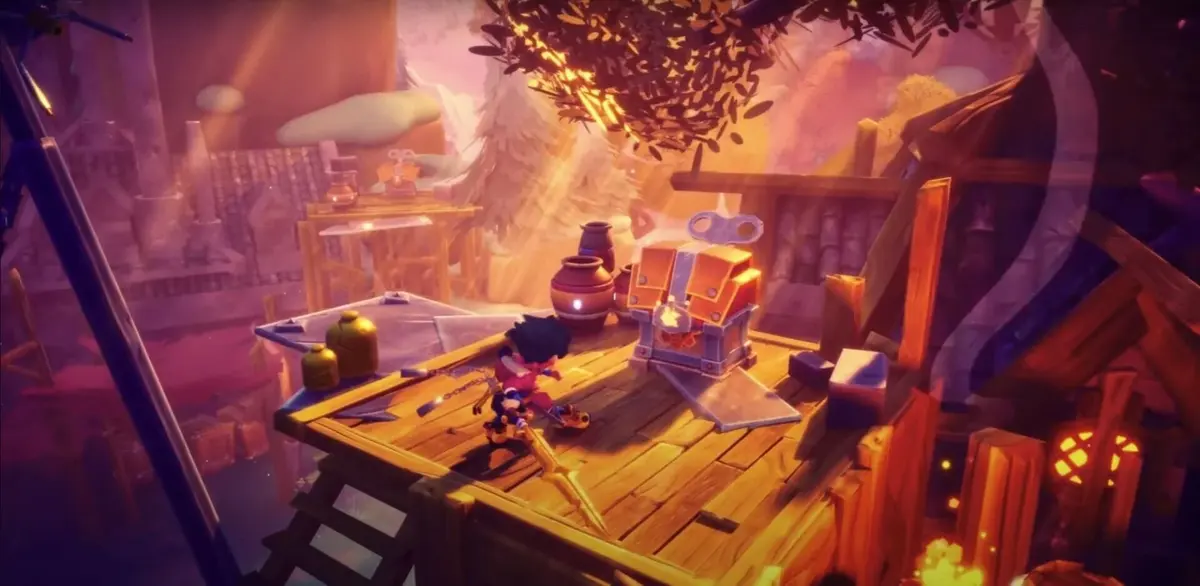
The problem is what happens when the numbers go up. Where most action-platformers throw three or four melee enemies at you, Duskfade will drop fifteen, a good chunk of them ranged, attacking from angles the camera can’t show you. The lock-on is imprecise, the camera doesn’t pull back far enough, and the invincibility window when you’re hit is short enough that you’ll eat two or three hits in a row without a chance to react. Then the second half raises the difficulty, and instead of making fights more interesting it makes those problems louder. You end up fighting the camera rather than the enemies, and the whole thing feels soft: the same lightness that makes the jumping feel great makes the hits land like nothing.
So it’s one system with two faces. The bosses are the good version, the mob fights are the bad version, and the game leans on mob fights far more often. If you can treat fights as the thing between platforming sections, you’ll be fine. If you came for the combat, you’ll be swearing at the camera by the third biome.
It Runs Out of New Ideas Before It Runs Out of Levels
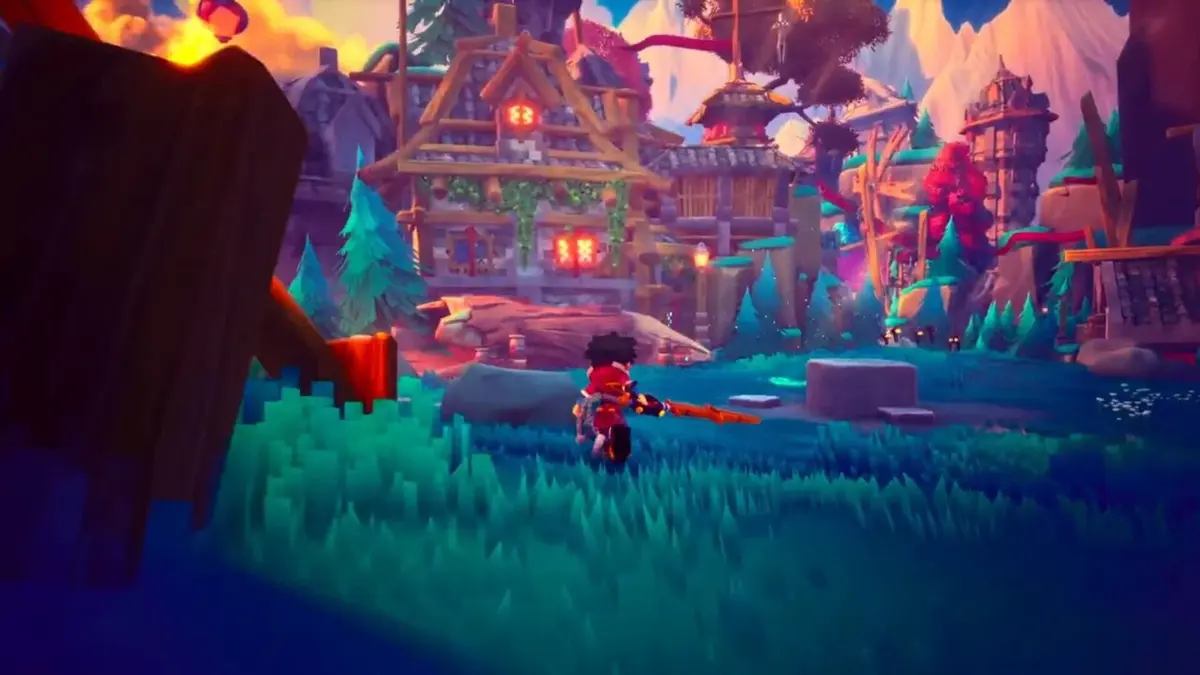
This is a gorgeous game. Unreal Engine 5, enormous depth of field, lighting that puts it among the best-looking games out there full stop, and it joins Expedition 33 and Denshattack in the list of small teams that have made that argument this year. But it is also soft. The music stays in the background even during fights, the art direction dazzles early and then stops surprising you, and it’s hard to play more than an hour at a stretch before the pace starts to sag. That’s the shape of the campaign: a first impression that’s genuinely special, then a middle that doesn’t add wrinkles as fast as it should. It’s around fifteen hours to the credits and a lot more for the secrets, and it plays best in exactly those one-hour sittings.
Platforms and Performance
Duskfade launched on August 13, 2026 for PC, PlayStation 5, Xbox Series X|S and Switch 2 at $29.99. On PS5 the 60fps drops in a handful of moments, nothing that ruins anything, but enough to make you nervous about the Switch 2 build, which targets 60 docked and 40 in handheld and was the only version without a pre-launch demo. If handheld is the point for you, watch Switch 2 footage before you buy, and know that the game looks the way it does partly because it’s asking a lot of the hardware.
Duskfade
With a good combat system this would have been an excellent game. Without one it drops a notch, and that’s the 7. The movement is as good as this genre gets, the no-map exploration is a brave call that pays off, and the world is beautiful and built on something real. But you’ll spend too much of the second half in fights the camera can’t keep up with, and the campaign never quite builds on its opening.
- Precise, momentum-rich platforming once it clicks
- No map, no markers, and it works
- One of the best-looking games of the year, from thirteen people
- Bosses that mix combat and platforming phases
- A grief story with real intent behind the colour
- Mob fights: fifteen enemies, blind angles, short i-frames
- Imprecise lock-on and a camera that won’t pull back
- Hits land soft; music stays in the background
- Thin dialogue under heavy themes
- Pace sags after the first biome; PS5 frame dips
Buy it for the jumping and the world. Don’t buy it for the sword. And keep an eye on Weird Beluga, because if this is game two, game three is going to be a problem for the big studios.
FinalBoss // Gear
Level up your setup
01Top-rated gaming headsetson Amazon→02High-refresh gaming monitorson Amazon→03Gaming chairson Amazon→04Discounted game keyson Kinguin→Affiliate links · As an Amazon Associate, FinalBoss earns from qualifying purchases.
Want to Level Up Your Gaming?
Get access to exclusive strategies, hidden tips, and pro-level insights that we don't share publicly.
Ultimate Reviews Strategy Guide + Weekly Pro Tips