
This caught my attention because Epic’s numbers finally pair real growth with a roadmap that addresses the one complaint that has dogged the Epic Games Store for years: the product experience. Big money and big hours are impressive, but usability decides whether players stick around.
Table of Contents (7)
Epic Games Store’s 2025: strong metrics, a rebuilt launcher, and a push for discoverability
Key takeaways
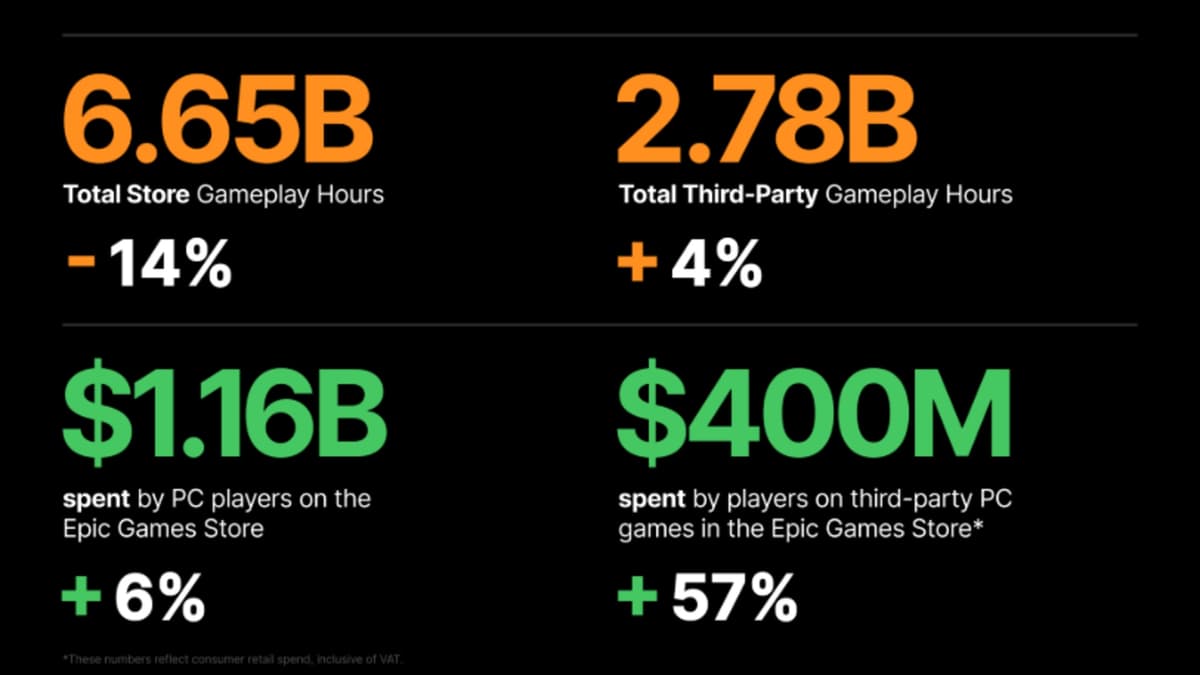
- Epic reported record third‑party spending ($400M, +57%) and 2.78B hours in third‑party games, but total store hours fell vs. 2024 to 6.65B.
- Epic plans a launcher rearchitecture to make the client faster, more stable and responsive – a direct answer to Steam’s UX advantage.
- New initiatives: expanded social features, regional storefronts, a PC↔mobile cross‑platform library, and larger pre‑order incentives.
- Free weekly games remain a traffic driver (662M claimed titles) and even lift Steam CCU by ~40% while the offer runs.
{{INFO_TABLE_START}}
Publisher|Epic Games
Release Date|2025 Year in Review
Category|Storefront / Platform
Platform|PC, Mobile
{{INFO_TABLE_END}}
Why the numbers matter – and why the roadmap matters more
Epic’s topline metrics are meaningful. Player spending on third‑party PC games jumped 57% to a record $400 million, and players logged 2.78 billion hours in third‑party titles. Monthly active users hit 78 million, and across the whole store players spent 6.65 billion hours in 2025. That growth in third‑party time (+4%) is the clearest sign Epic’s storefront is increasingly relevant for devs.
But raw figures only go so far. Epic’s strategy since 2018 has mixed developer‑friendly economics (devs keep their first $1M, then a 12% cut above that; developers who process in‑app payments keep 100%) with aggressive promotions like weekly free games and timed exclusives. Those tactics get people to try things – the question Epic has historically failed to answer is whether players then make the store their daily launcher.

The rearchitecture: small promise, big potential
Epic says it’s “rebuilding the underlying architecture of the Epic Games Store Launcher” and plans to ship improvements this summer to make the launcher responsive, fast to load, and more stable. That phrasing matters. Performance, polish and speed are exactly where Steam has the edge: richer discovery curation, faster storefront navigation, mature community features, and a UI that people trust.
Technically, rearchitecture can mean a lighter client, better caching, async content loads, or switching to a different UI framework — all aimed at shaving seconds off interactions and avoiding the “clunky launcher” tag that keeps power users on Steam. Delivered well, this reduces friction for discovery and increases the value of Epic’s promotions and storefront curation.

Other moves: discovery, regional stores, cross‑platform libraries and preorder carrots
Expanded social features and regional storefronts with localized discovery are smart, practical changes. Localized storefronts improve relevance (language, pricing, payment options) and can help smaller regional studios get found. A cross‑platform library across PC and mobile is potentially the most strategic play: if Epic can make purchases and progress feel seamless across devices, that’s a real retention lever.
Pre‑order incentives — like the Crimson Desert Fortnite skin example — are being expanded with partner studios including S‑Game, Capcom and MiHoYo. Those tie‑ins are effective at driving short‑term sales and platform choice, but they’re also the type of exclusivity that sparks community backlash if overused.
What this means for players and developers
- Players: Expect a smoother launcher and more local storefront experiences. If Epic nails the speed/stability work, everyday use becomes less of a reason to default to Steam.
- Developers: The revenue terms and the free game halo (Epic claims 662M free claims and many free weeks set CCU records) are valuable for acquisition. Expanded regional discovery helps indie visibility.
- Store competition: Epic won’t unseat Valve overnight — Steam’s ecosystem (mods, community hubs, long‑tail features) is deep — but these UX and discovery investments are the right moves to close the gap.
There’s still risk. Rebuilding architecture is nontrivial and can introduce regressions if rushed. And exclusive pre‑order perks can feel like cosmetic coaxing rather than structural reasons to switch. But pairing meaningful developer economics with tangible improvements to the player experience is the only path Epic hasn’t fully realized — until now.
TL;DR
Epic had a good 2025: record third‑party spending and time, and huge reach via free games. The more interesting story is the product roadmap — a launcher rearchitecture, regional stores, social features and cross‑platform libraries are practical, user‑centered fixes that could move the needle on retention. If Epic executes, the store becomes a more credible daily alternative to Steam; if it stumbles, the growth numbers will look promising but ephemeral.
FinalBoss // Gear
Level up your setup
01Top-rated gaming headsetson Amazon→02High-refresh gaming monitorson Amazon→03Gaming chairson Amazon→04Discounted game keyson Kinguin→Affiliate links · As an Amazon Associate, FinalBoss earns from qualifying purchases.