
Table of Contents (11)
Esoteric Ebb: The RPG That Warns You It’s “Mostly Talking” – And Means It
The first thing Esoteric Ebb did was insult me.
Not with an enemy or a fail state, but with a tooltip. After the opening scene – waking up as a resurrected cleric in an arcanepunk city that looks like Planescape: Torment wandered into a D&D sourcebook – a little box slid across the bottom of the screen:
“This is a game mostly about talking, reading, and making choices. If that sounds boring, you should probably refund it.”
I laughed, and then I realized the game was dead serious. Esoteric Ebb is a solo-developed, isometric fantasy RPG that takes the idea of “dialogue-driven roleplaying” and pushes it further than anything I’ve touched since Disco Elysium. If that sentence excites you, keep reading. If it makes your eyes glaze over, the tooltip was right – this probably isn’t your game.
My First Night in Norvik: Tea, Ash, and Too Many Stat Checks
I played Esoteric Ebb on PC (1440p, mouse and keyboard, with a little bit of Steam Deck time on the couch). Within the first hour, three things hit me very hard:
- The game expects you to read. A lot.
- Attributes are not just numbers, they’re voices in your head.
- Nearly everything is a dice check… and the dice don’t care about your feelings.
The premise is sharp and immediately weird. You’re a cleric dragged back from the brink by a mysterious ritual, dumped into the city of Norvik right as a heated election looms. A teashop has exploded, bodies are on the floor, and you’re the unfortunate soul tasked with figuring out what happened before the city tears itself apart.
In my first conversation with the shell-shocked teashop owner, I had four attributes chattering in the dialogue box like unruly party members:
- Insight prodding me to notice inconsistencies.
- Devotion nagging me to offer comfort and ritual instead of questions.
- Guile suggesting I push hard and lie about what I already knew.
- Resolve quietly tracking how much of this horror my resurrected brain could stomach.
On one line, Insight lit up: a blue-highlighted option to call out a timeline inconsistency. DC 13, it said, with a little 1d20 icon and my modifier hovering beside it. I hovered, hesitated, clicked. The die rolled across the bottom of the screen in a tiny animation.
Natural 2.
My character blurted out a half-formed accusation, stumbled over the details, and the owner shut down. New options grayed out. A little pop-up informed me I had “burned a bridge – or at least singed it badly.” And that was the moment I realized Esoteric Ebb wasn’t kidding about consequences.
Talk-First Design: When Dialogue Trees Become Dungeons
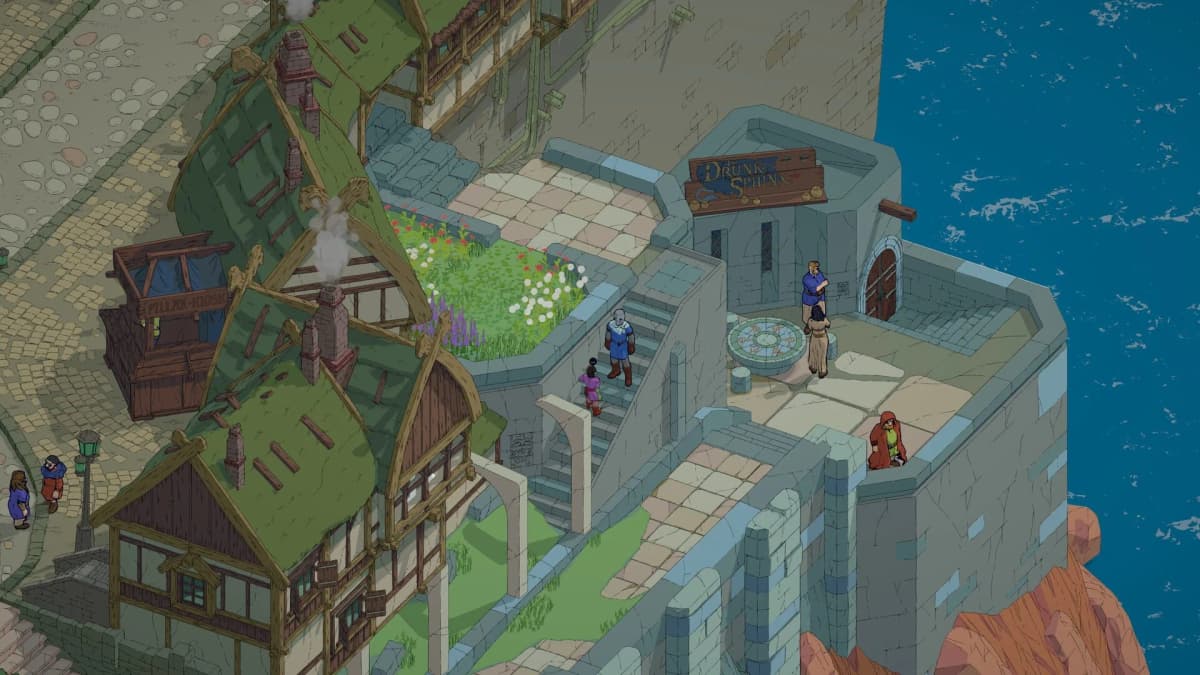
If you’ve played Disco Elysium, the broad structure will feel familiar, but Esoteric Ebb has its own rhythm. Instead of wandering huge open districts, you move through tightly authored scenes – the teashop, a clergy hall, political headquarters, back alleys – with each location basically a dense knot of conversations and skill checks.
I’d describe most “quests” less like “kill 10 rats” and more like “untangle this ideological argument and three people’s lies over the course of an in-game day.”
The attribute system is the star. It’s built on a D&D 5e backbone – attributes, modifiers, DCs, advantage/disadvantage, even pseudo-feats – but everything is contextualized as your inner council. When a check appears, that attribute often gets its own little voice line in the text, arguing for or against action:
Insight: “He’s hiding something. Push him. Gently, if you can still manage that.”
Devotion: “Grief before evidence, cleric. Let him breathe.”
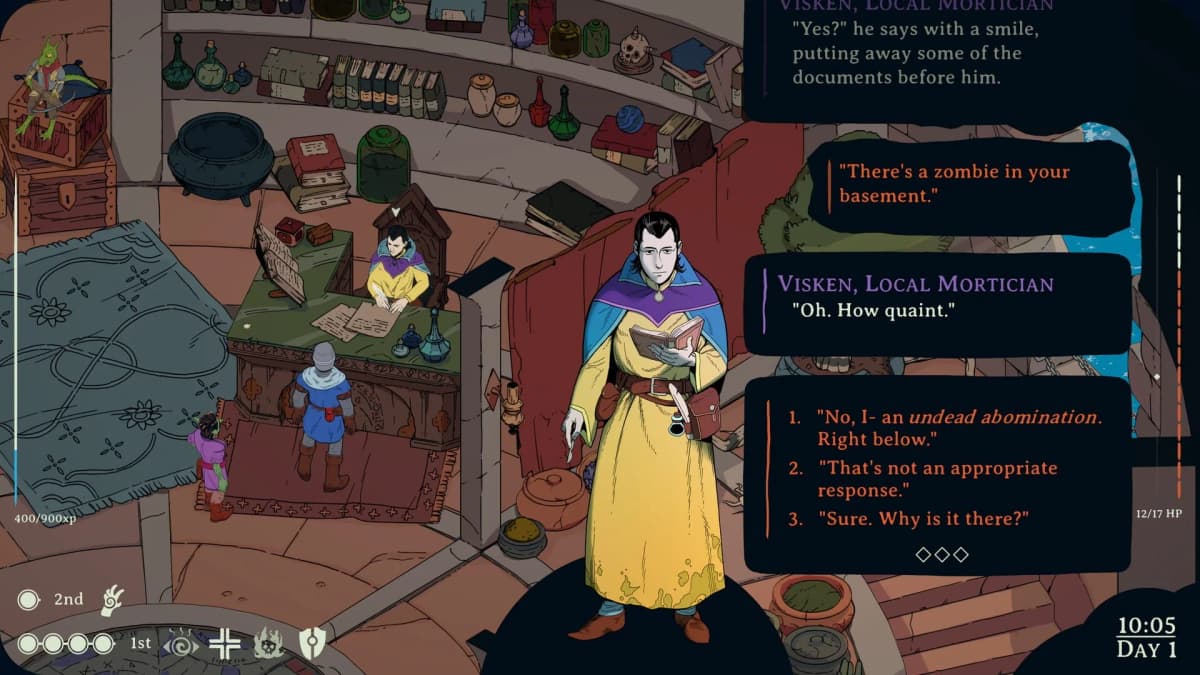
Mechanically, this does something clever: it makes the math feel like part of the narrative. I wasn’t just gaming the DC numbers; I felt like I was choosing which part of myself to trust in that moment. And because the game leans into partial failures and weird side consequences, I rarely reloaded a save. Even my disastrous early rolls opened new paths, or at least made later encounters spikier and more interesting.
The flip side: this design means Esoteric Ebb is dense. A single conversation can easily stretch to 20–30 minutes if you’re chasing every thread. There were evenings when I realized I’d technically only visited two screens in an hour of play, but my notebook (yes, physical) had a whole page of scribbled faction names, dates, and suspicious characters.
Five Days to Solve a City: Time Pressure Without a “Fail State” Screen
The whole investigation plays out over five in-game days. Each day is split into time blocks, and certain places or people are only available in specific windows. It’s less strict than something like Pathologic – you’re not racing a visible countdown – but you do feel the squeeze.
On my second day, I wasted a whole afternoon getting politically stonewalled by a smug campaign manager instead of going to the docks like my gut urged me to. That single choice meant one union organizer I’d heard about was already “unavailable” by the time I got there. The game didn’t pop a big “YOU MISSED THIS QUEST” alert; their name just quietly became a ghost in later conversations. People mentioned them in the past tense. My investigation notes had an awkward blank where I knew another perspective should be.
This is where the structure really clicked for me. Esoteric Ebb isn’t trying to let you see every scrap of content in one run. It’s building a specific version of the truth pieced together from whoever you had time – and social skill – to reach. My final conclusion about the teashop explosion felt earned, but I could feel the shape of alternate stories tugging at the edges.
Character Building: Cleric, But Make It Messy
Character creation looks simple at first: pick a race, pick a deity, distribute attribute points. Classic fantasy stuff – elves, dwarves, humans – flavored through the game’s slightly grimy, arcane-industrial lens. I went with a dwarf cleric devoted to a god of memory and oaths, partly because the flavor text was too good to ignore.
What I didn’t expect was how drastically this would tilt not just stats but perspective. My god occasionally chimed in during key moral decisions, giving me divine pressure on top of my attributes’ incessant commentary. Racial background colored how people judged my presence in certain districts. It never devolved into a simple [+2 social here] buff; it felt like carrying a reputation into every conversation.
Leveling is tied heavily to how you approach scenes. You get XP for uncovering truths, resolving disputes without bloodshed, pushing your own ideals, or completely leaning into being a manipulative nightmare. When you ding, you’re choosing new passives, reroll mechanics, and even ways to interact with your own trauma – things that change how you respond to stress, fear, or guilt in later scenes.
Leveling is tied heavily to how you approach scenes. You get XP for uncovering truths, resolving disputes without bloodshed, pushing your own ideals, or completely leaning into being a manipulative nightmare. When you ding, you’re choosing new passives, reroll mechanics, and even ways to interact with your own trauma – things that change how you respond to stress, fear, or guilt in later scenes.
🎮 Get This Game at the Best Price
Compare prices instantly and save up to 80% on Steam keys with Kinguin — trusted by 15+ million gamers worldwide.
*Affiliate link — supports our independent coverage at no extra cost to you
By day three, my Insight was monstrous, my physical stats were a joke, and I’d built around accepting “soft failures” as part of my playstyle. I had talents that turned failed rolls into new leads or self-reflection scenes, and it honestly felt like one of the truest “talk-based builds” I’ve played since Torment & Disco.
Is There Combat? Kind Of – But It’s Still Mostly About Talking
Yes, there is “combat,” but if you’re here for deep turn-based tactics, you’re in the wrong tavern.
Every once in a while, a scene breaks into a structured, turn-based encounter. Think of it like a stripped-down tabletop fight abstracted into text and a top-down layout. You pick positioning, use a handful of abilities, and the same dice that frustrated you in dialogue can make or break a clutch spell.
Two things stood out to me here:
- The fights are rare but meaningful – I could count them on one hand after a full playthrough.
- They’re written to support the story, not as XP farms. My favorite one could be defused entirely through a string of risky persuasion checks before the first initiative roll.
Mechanically, they’re fine – functional, sometimes tense, sometimes swingy. Narratively, they work because they feel like a natural escalation of the social powder keg you’ve been slowly kicking for hours. I never got the sense combat was tacked on, but I did feel like it was consciously minimized so the game’s real obsession – conversation – stayed center stage.
Worldbuilding and Lore: When the In-Game Encyclopedia Becomes a Second Monitor
Esoteric Ebb is the first game in a while that made me actually use an in-game encyclopedia instead of ignoring it. Norvik’s factions, faiths, and magical institutions are layered and jargony in that very specific CRPG way. When I hit day two, I realized my brain couldn’t keep all the cult splinters, trade unions, and electoral procedures straight without help.
Thankfully, the codex is well-structured. When text drops a term you’ve half-forgotten, it’s usually highlighted; click it, and you get a concise entry in a side panel rather than being yanked into a separate menu. It felt a lot like flipping open a rulebook at a tabletop session: a small pause, a quick fix, then back into character.
The writing itself is consistently strong. It’s not as relentlessly quotable or surreal as Disco Elysium – there’s less drunken philosophy, more theocratic and electoral knife-fighting – but it has a clear voice. The tone leans thoughtful and melancholic, with flashes of very dry humor. A bureaucrat describing divine audit procedures made me laugh harder than any holy paperwork should.
The weak spot is that the game can absolutely drown you in exposition if you’re not careful. A couple of scenes early on frontload a lot of setting history in monologues that went on long enough for me to catch myself skimming. Once I pushed past the tutorial-adjacent stretch and let myself ignore a few optional lore dumps, the pacing improved.
Presentation and Performance: Solo-Dev, But It Doesn’t Feel Cheap
Visually, Esoteric Ebb hits an interesting middle ground. The hand-drawn 3D backgrounds and cell-shaded characters feel almost like moving concept art, with Unity’s real-time lighting giving Norvik a smoky, industrial mood. It’s not a technical showpiece, but it has personality – the kind where a crooked gas lamp or a stained glass window tells you more about a district’s politics than a paragraph of lore.
Performance on my mid-range PC was rock solid. Load times were short, I didn’t see any stuttering, and ultra-wide support worked well, though the UI clearly feels “designed for 16:9” and just stretches politely beyond that. On Steam Deck, it’s fully playable – verified, in fact – but I strongly recommend bumping the text size and playing in short bursts. A reading-heavy game on a small screen can be rough on the eyes.
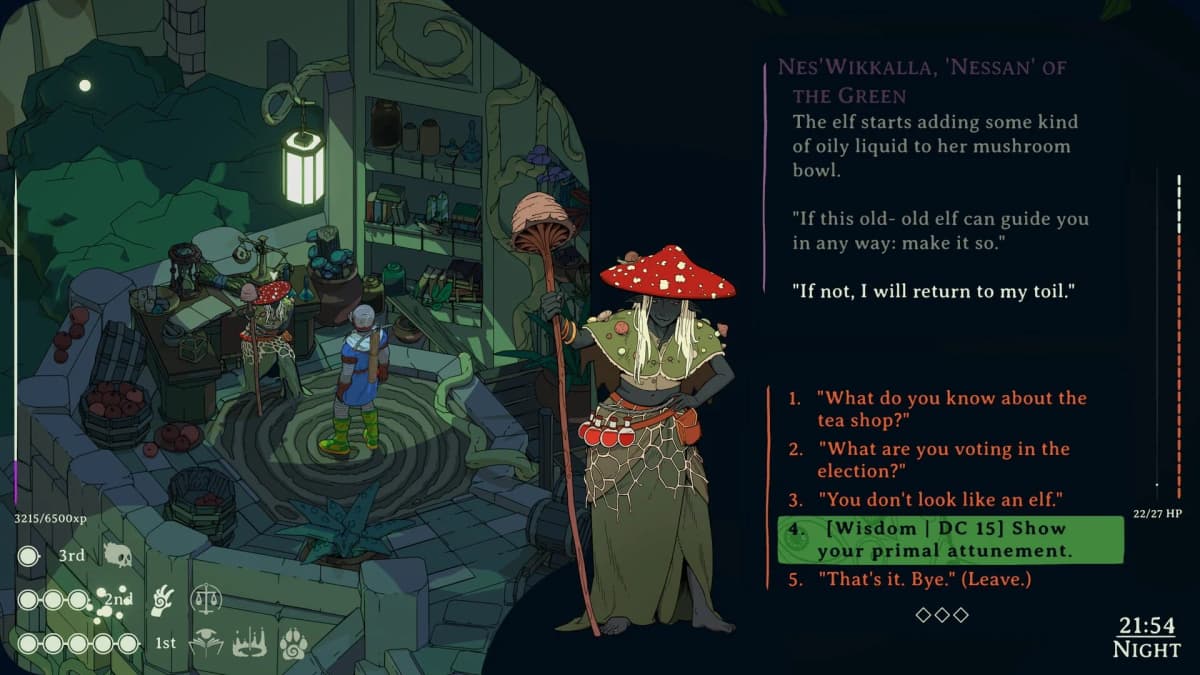
The biggest production compromise is obvious: there’s no voice acting. Zero. You’re reading everything. For me, that became a feature rather than a flaw – my inner voices for Insight, Devotion, and Guile were more vivid because the game never pinned them down – but if you prefer fully voiced RPGs, this will feel barebones.
In about 30 hours of play, I hit one mildly bugged conversation that looped a line twice before moving on, and that was it. For a solo-developed Unity RPG in 2026, that’s almost suspiciously clean. I’ve had more crashes in big-budget AAA titles this year than in my entire time with Esoteric Ebb.
Where Esoteric Ebb Lost Me (Briefly)
Even as someone who happily reads page-long item descriptions in Baldur’s Gate, Esoteric Ebb pushed my limits a few times.
- Early information overload. The first in-game day dumps you into the deep end: theology, city politics, criminal factions, arcane law. A better drip-feed would’ve helped, and I suspect some players will bounce off before the structure starts to make sense.
- Dice frustration is real. Saying “failure leads to interesting outcomes” is comforting until you miss three key rolls in a row on something your build should be good at. The game mostly compensates, but there were moments I felt punished for committing to a concept.
- Reading fatigue. After a long workday, I simply couldn’t face another 90 minutes of dense conversation trees. This isn’t “I’ll do one quick dungeon” material; it demands focus, and if you can’t give it that, the magic fades.
None of these killed the experience for me, but they did change how I played. I started treating Esoteric Ebb like a visual novel or a tabletop session: two to three concentrated hours, then stop. On that schedule, the game absolutely sang.
Who This Game Is (and Definitely Isn’t) For
If your favorite part of RPGs is min-maxing builds, hoovering up loot, and solving problems with a well-placed fireball, Esoteric Ebb is going to feel like someone ripped the combat system out and left you with the rulebook and a stack of character sheets.
If, instead, you:
- Still think about conversations you had in Disco Elysium or Planescape: Torment years later
- Like rolling actual dice at the table and accepting whatever chaos comes up
- Enjoy fantasy worlds that care more about institutions, belief systems, and power structures than prophecies and chosen ones
- Don’t mind reading walls of text without voice acting to carry you
…then Esoteric Ebb is one of the most exciting RPGs you can play in 2026. It feels like the first game since Disco that truly understands what made that style of design special and dares to apply it to a completely different setting and rule skeleton.
FinalBoss // Gear
Level up your setup
01Mobile gaming controllerson Amazon→02Top-rated gaming headsetson Amazon→038BitDo controllerson Amazon→Affiliate links · As an Amazon Associate, FinalBoss earns from qualifying purchases.
Want to Level Up Your Gaming?
Get access to exclusive strategies, hidden tips, and pro-level insights that we don't share publicly.
Ultimate Reviews Strategy Guide + Weekly Pro Tips