
Table of Contents (9)
Crash-landing into Everwind’s sky sandbox
The first thing Everwind did was make me feel pathetic.
You start the game staring up at a broken airship, scattered across a floating island like someone rage-quit a Lego set. A little magical compass tells you where each missing piece is, and as you scan the cockpit, the power core, the balloon frame, you slowly unlock the blueprints to rebuild it. It’s a simple intro, but after about 30 minutes of trudging around grabbing wood, ore, and ship parts, I had this ugly, half-finished zeppelin wobbling in place – and I was already more attached to it than to any Minecraft dirt hut I’ve ever made.
That’s Everwind’s hook: your base is a flying island-ship, and the entire survival loop orbits around making it better, faster, higher. You’re not just decorating a house; you’re turning a janky sky-barge into a fortress that can climb through cloud layers to reach nastier islands and better loot.
I spent around 20 hours in the Early Access build on Steam, mostly solo with a bit of 2-player co-op, and I bounced hard between “this is exactly the kind of survival game I’ve wanted” and “wow, this really feels like an Early Access prototype sitting in Hytale’s shadow.”
Everwind in a sentence: Raft meets Minecraft, but in the clouds
If you’ve played Raft, the overall structure of Everwind will feel familiar. Your floating base is both lifeline and progress bar. You chop trees and mine ore on random islands, bring it back to the ship, and spend it on better engines, stronger balloons, and upgraded cores that let you fly higher and (eventually) faster.
Layer in classic voxel survival crafting (think Minecraft, Hytale, Core Keeper), first-person RPG combat with swords, shields, bows, and magic staves, plus semi-random dungeons sprinkled across floating biomes, and you get the basic picture. Discover crashed ship bits, scan them with your compass, unlock new parts, slap them onto your airship, and use that to push towards more dangerous sky layers.
On paper, that’s a killer mix. In practice, there’s a clear split between the parts that already feel special (the airship, vertical base-building, the general vibe of drifting between islands) and the parts that feel like they’re barely above prototype (world density, combat polish, pacing).
The airship is the star of the show
My favorite Everwind moment didn’t happen in a dungeon or a boss fight. It was when I realized my ship had quietly turned into a home.
In the first few hours, my “airship” was a wooden slab with a balloon on top and a chest nailed to the side. I had to stand at the helm, stare at a basic compass, and creep across the sky at what felt like walking speed. I actually alt-tabbed to check if I’d placed the engine wrong because the movement was that glacial.
But slowly, the ship changed. I added a second deck under the main platform for storage. I built little side walkways so I could jump onto islands without awkwardly clambering off the nose. When I unlocked a bigger balloon and a stronger power core, I had to rearrange the entire layout to keep the weight and shape somewhat sensible. It almost felt like moving house.
Vertical base-building on a flying platform makes your design choices feel consequential. In a normal survival game, adding a third floor is mostly for vibes. In Everwind, stacking more decks and structures on top of your gondola subtly changes your relationship with the ship – you think in layers, you worry about where to put the engines, you carve little stairwells into the hull so you can sprint from helm to crafting stations when something goes wrong.
I love that. It’s the one thing that actually doesn’t feel like a Minecraft/Hytale retread. It’s a genuinely different rhythm – more about route planning and altitude management than just “run in a direction and see what you find.”
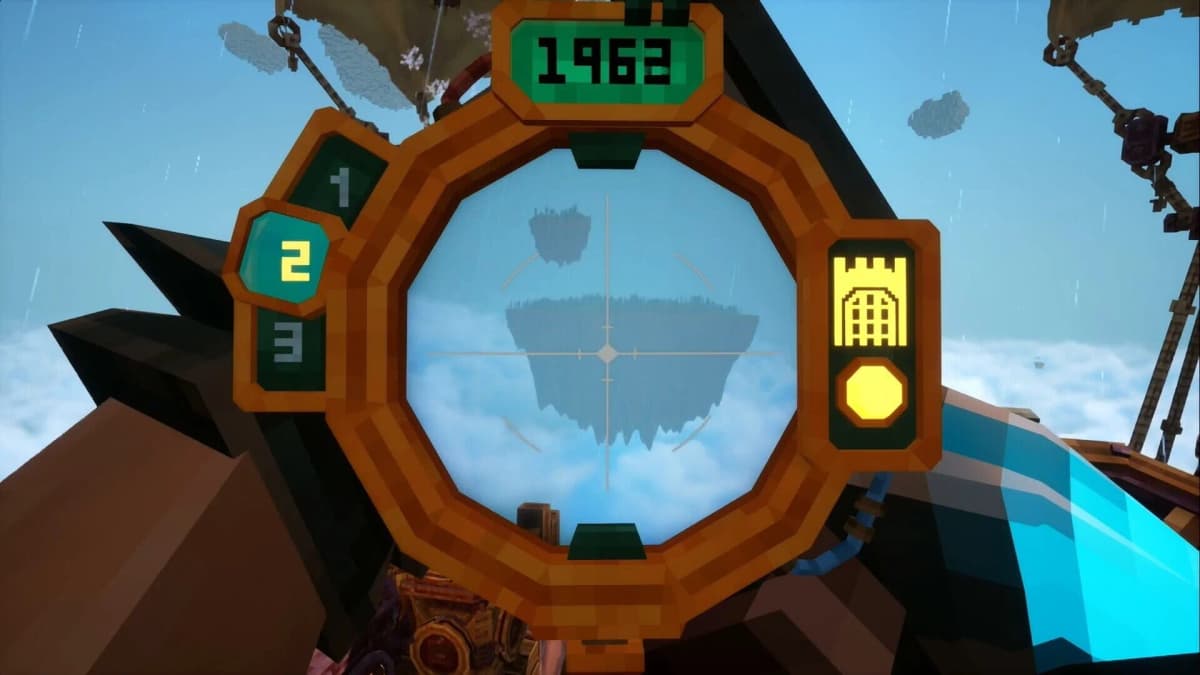
The downside is that Everwind makes you pay for that fantasy in boredom up front. Early flight is painfully slow, and upgrading the ship’s core to noticeably increase speed and max altitude takes a lot of grinding. I had a session where I spent 15 minutes flying toward a promising island on the horizon, only to realize halfway there that my altitude cap was too low to actually land. Turn around. Crawl back. Feel your enthusiasm deflate with the balloon.
Islands worth flying to? Kind of.
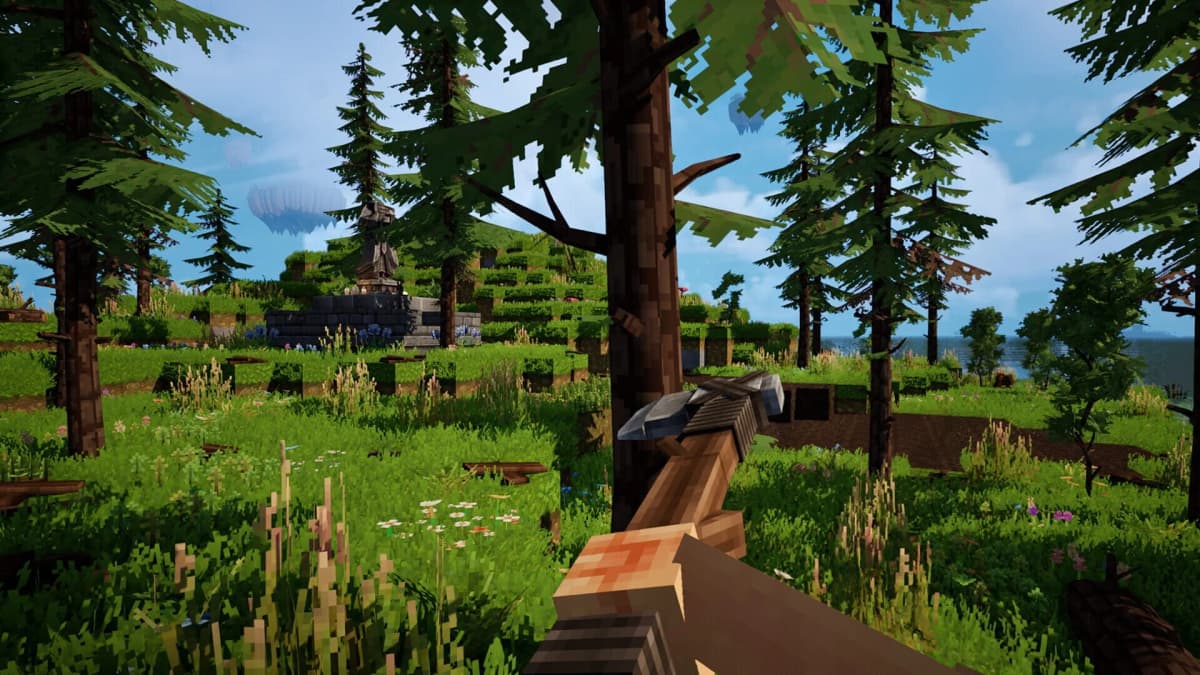
From a distance, Everwind’s world is gorgeous in that chunky voxel way. Biomes pop out of the fog as jagged chunks: a desert plateau here, a lush forest island there, some otherworldly crystal formation floating off to the side. When you’re steering the ship and scanning for your next pit stop, there’s a real sense of skybound exploration.
The problem is what happens when you actually land.
Up close, a lot of islands feel sparse. You’ll get some trees, a few ore nodes, maybe an animal or two and, if you’re lucky, the entrance to a dungeon or a crash site with ship components. But there are long stretches where new islands are basically just slightly different-shaped resource nodes. After a while, the excitement of “new land!” started turning into “okay, another three iron, some berries, and nothing else.”
In something like Minecraft, you can usually compensate for this with creativity — build some absurd structure just for the hell of it, or strip-mine the earth and turn it into a mega-base. Everwind absolutely lets you terraform and reshape islands (everything is destructible), but because your real home is your ship, I felt less inclined to sink hours into sculpting individual islands that I’d probably never come back to.
This is where the pacing stings. Long, slow flights across mostly-empty sky, leading to islands that are often just step one in another resource checklist… it can get repetitive fast. When I hit a dungeon, my motivation snapped back, but the peaks and valleys are extreme right now.
Dungeons and combat: ambitious, clunky, but interesting
Dungeons shift the camera into a more focused, first-person crawl, and this is where Everwind reminds you it wants to be an RPG, not just a chill builder. You’ve got a stamina bar, dodge rolls, blocks, parries, melee weapons, bows, and different flavors of magical staves. Some enemies telegraph heavy swings you need to dodge, others bombard you from range, and you can chug potions or use alchemy and enchantments to give yourself an edge.
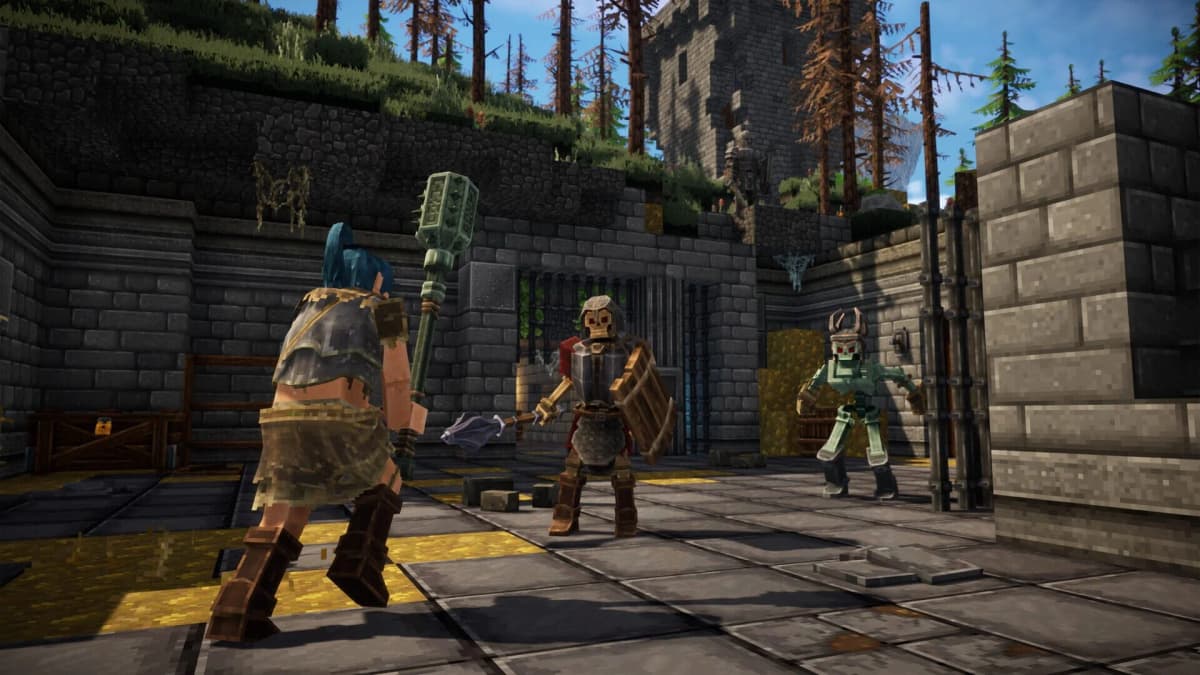
On my first serious dungeon run, I waltzed in with a half-upgraded sword and a cozy sense of overconfidence. Three skeleton warriors and a floating mage later, I was guzzling potions, whiffing dodge timings, and desperately trying to figure out if the parry window was actually as strict as it felt or if I was just bad. (It’s probably both.)
Everwind clearly wants combat to be more than spam-clicking, and I respect that. When a dodge into a counterattack works, it feels great. But the animations and hit feedback aren’t quite there yet. Sometimes enemies slide strangely across the floor mid-attack, sometimes hits seem to connect without clear visual response, and reading tells can be weird in tight, voxel corridors.
There’s a foundation here that could become something genuinely fun — especially if boss variety expands and the AI gets more interesting behaviors. Right now, it’s “serviceable with flashes of promise,” but nowhere near the level of polish you’d expect from a finished RPG. As an Early Access starting point, though, I’d rather have this slightly messy system than another pure click-to-win affair.
Survival and crafting: comfort food with a sky twist
The bread-and-butter survival systems are exactly what you’d expect: chopping, mining, cooking food, managing health and resources, crafting better tools, assembling armor sets, dabbling in alchemy. There are NPCs scattered around with basic trades and hints, and there’s enough item progression that you do feel stronger as you climb the tech tree.
What saves this from feeling completely generic is how tightly it feeds back into your ship. Crafting a tougher hull piece or a more efficient engine doesn’t just tick a box — you physically bolt those pieces onto your mobile base and immediately live with the consequences. Need more storage? Build another row of chests along the side and accept your ship now looks like a flying shed. Want better view and mobility? Raise the helm onto a tower and carve a staircase through your deck to reach it.
Playing in co-op made this loop shine a lot more. I had one friend dedicated to ship design and navigation while I ran islands and dungeons. I’d sprint up the gangplank, dump resources into our chests, and while I was off picking fights with island mobs, I’d come back to see an extra deck added or a new engine room cobbled together underneath everything. You can already see the potential for 4-player crews with defined roles once the systems deepen.
Performance, polish, and Early Access caveats
I played on a mid-range PC (RTX 3060, Ryzen 5, 16GB RAM) at 1440p, and Everwind was mostly stable but not spotless. Flying into new clusters of islands occasionally caused short hitches as chunks streamed in. Combat-heavy dungeon rooms sometimes dipped noticeably when particle effects stacked up. Nothing game-breaking, but it reminded me that this really is a work in progress.
Co-op, to the game’s credit, was functional from the start. We had some classic Early Access jank — minor desync on enemy positions, the occasional weird rubber-banding when boarding the ship at the same time — but no catastrophic crashes or save corruption during my sessions. For a fresh Early Access survival game, that’s better than I frankly expected.
The developers (Enjoy Studio, with Bohemia Interactive involved on the publishing side) are open about planning at least a year of Early Access, with things like farming, expanded enemy varieties, air combat, and dedicated servers on the roadmap. It genuinely feels like a base layer rather than a content-complete game, so whether you jump in now should depend on your tolerance for rough edges and repetition.
The Hytale and Minecraft shadow
Let’s talk about the giant voxel elephant in the room.
Everwind has been framed everywhere as “Minecraft meets Wind Waker” or “Hytale but with airships,” and it’s honestly both accurate and a little unfair. The blocky art style and survival formula invite those comparisons immediately, and the recent buzz around Hytale makes the timing particularly rough. You can feel the discourse already baked in: is this “just another” Minecraft-like chasing the trend?
From actually playing it, I’d say: mechanically, Everwind does enough with its airship-centric loop to stand out. Emotionally, though, it hasn’t carved out a strong identity yet. The sky exploration is cool, but the islands themselves rarely tell stories the way the best sandbox worlds do. The combat has ambition, but not yet the personality or flavor to make you talk about specific encounters days later. The voxel visuals are clean and readable, but they don’t carry a distinctive style that grabs you at a glance.
The irony is that Everwind’s biggest advantage over Hytale right now is painfully mundane: it’s actually on Steam. You can buy it, download it, play it with friends today, and that alone will pull in a ton of curious survival fans who just want a new sandbox to chew on. If the team uses this window well — listening to feedback, filling in the empty spaces, sharpening what’s already there — it absolutely has a shot at being more than “the airship one.”
Who should play Everwind right now?
After living with it for a couple of weeks, this is how I’d break it down.
- Play it now if you love survival crafting and base-building, and the idea of a fully customizable flying base makes your brain light up. If you enjoyed Raft, or you’ve ever spent too long building airships in Minecraft creative mode, Everwind already has enough systems to justify a ticket.
- Play it now if you’re happy to be part of an Early Access journey, offering feedback, tolerating repetition, and revisiting the game as major updates land.
- Wait a year if you’re more interested in dense worlds, strong narrative hooks, or honed combat. The skeletons of those things exist, but they’re nowhere near their full potential yet.
- Skip it (for now) if slow progression annoys you. The early ship upgrades are grindy, and the slow travel speed plus sparse islands can feel like dead time.
FinalBoss // Gear
Level up your setup
01Top-rated gaming headsetson Amazon→02High-refresh gaming monitorson Amazon→03Gaming chairson Amazon→04Discounted game keyson Kinguin→Affiliate links · As an Amazon Associate, FinalBoss earns from qualifying purchases.
Want to Level Up Your Gaming?
Get access to exclusive strategies, hidden tips, and pro-level insights that we don't share publicly.
Ultimate Reviews Strategy Guide + Weekly Pro Tips