
Table of Contents (9)
The Night Assassin’s Creed Unity Broke My Trust (and Why I Came Back)
I remember the exact moment Assassin’s Creed Unity became a punchline for me. I was on PS4, creeping across a Paris rooftop, when the frame rate cratered into what felt like a PowerPoint slideshow just as three guards spotted me. The game froze, stuttered, and then hard-crashed to the dashboard. This was after I’d already seen the infamous missing faces and NPC rubber-banding that turned 18th-century Paris into a haunted wax museum.
I bounced off Unity hard. I joined in on the memes. “Ubisoft shipped a tech demo instead of a game” became a running joke in my group chat. And honestly? At launch, that wasn’t entirely wrong. The bugs, the crashes, the 15 FPS dips during big crowd scenes, the shameless microtransactions – Unity earned its bad reputation.
But here’s where I have to eat crow: underneath that broken launch was one of the best-designed Assassin’s Creed games the series has ever had. I only realised that years later when I replayed it on a stronger machine at high frame rates. And now, in 2026, with Ubisoft dropping a free 60fps patch for PS5 and Xbox Series X|S on March 5th – plus discounts and bundled DLC – the rest of the console crowd can finally see what some of us have been shouting for years:
Unity was never the real problem. The way it was shipped was.
Unity’s Real Crime Was Launching Half-Baked
Let’s be clear: I’m not rewriting history to pretend Unity didn’t deserve the backlash. It absolutely did. Ubisoft tried to launch a bleeding-edge, next-gen-only Assassin’s Creed on PS4 and Xbox One and clearly overshot what those machines could handle. Dense crowds of up to 5,000 NPCs, heavy global illumination, interior and exterior streaming, co-op – they stuffed the game until it burst.
We got texture pop-in so bad it felt like watching the game assemble itself in real time. We got faces missing geometry. We got NPCs T-posing on elegant Parisian balconies. And all of that was on top of a microtransaction system that was aggressively in your face: Helix Credits to speed up progression, chests tied to a companion app or browser minigame, the works. It felt like Ubisoft wanted us to pay to skip the mess they’d just sold us.
The tragedy is that the technical disaster and monetisation garbage fire completely overshadowed what Unity was actually trying to do as a game. For a lot of players, “Unity” just means “buggy, broken, avoid.” That’s the baggage it’s carried for over a decade. And that’s why this 60fps patch in 2026 isn’t just a performance tweak – it’s a chance to reassess whether we threw away something special because of how badly it was delivered.
Paris Proves: Smaller, Denser Worlds Age Better Than Endless Maps
Here’s my most “I’ll die on this hill” take: Unity’s Paris wipes the floor with most open worlds we’ve had since, even in the same franchise.
Odyssey and Valhalla gave us jaw-dropping scale – entire countries to roam, oceans to sail, content for hundreds of hours. But after a while, one Greek island blends into the next, one English village bleeds into another. Huge chunks of those maps exist to be checklist fodder: clear the camp, loot the chest, repeat until you forget what the main story was.
Unity went the opposite way. Paris isn’t small by any normal measure, but compared to Ubisoft’s modern “bigger is better” design, it’s intimate. The city is dense, vertically layered, and actually memorable. The slums feel choked and chaotic, the rich districts are open and airy, the palaces and gardens have their own architectural rhythm. After a dozen hours, I could navigate by landmarks – spot Notre Dame, the Bastille, or the Palais-Royal and know exactly where I was without even opening the map.
Because the world is focused, the detail hits harder. Laundry flapping on lines close enough to brush your head. Trash and mud piled in alleys. Cobblestone streets jammed with revolutionaries, nobles, beggars, and guards all jostling in the same space. That precomputed global illumination still holds up in 2026 – interiors bathed in candlelight, streets shifting from grey drizzle to warm evening glow as the sun sets. It’s one of the few open worlds where “just walking around” is still worth it years later.
And unlike the later countryside epics, that density has gameplay teeth. Crowds aren’t just flavour – they’re stealth tools. You duck into a cluster of citizens to break line of sight or use a mob as moving cover. They’re also obstacles: try sprinting away at street level from a patrol and watch your momentum die as you slam into panicking NPCs. It’s messy in a way that makes sense for a city in the middle of a revolution.
Parkour at Its Peak (and Why 60fps Finally Does It Justice)
Unity is the game where Assassin’s Creed parkour finally became what the early trailers promised – and then the series immediately turned away from it.
The city is built like a jungle gym. The buildings are so tightly packed that you can literally cross huge sections of Paris without touching the ground. Ubisoft finally added separate “parkour up” and “parkour down” inputs, which sounds trivial on paper but is massive in practice. Want to descend from a rooftop to street level quickly? Hold the down command and watch Arno flow across ledges, windowsills, and balconies in this gorgeous, controlled cascade.
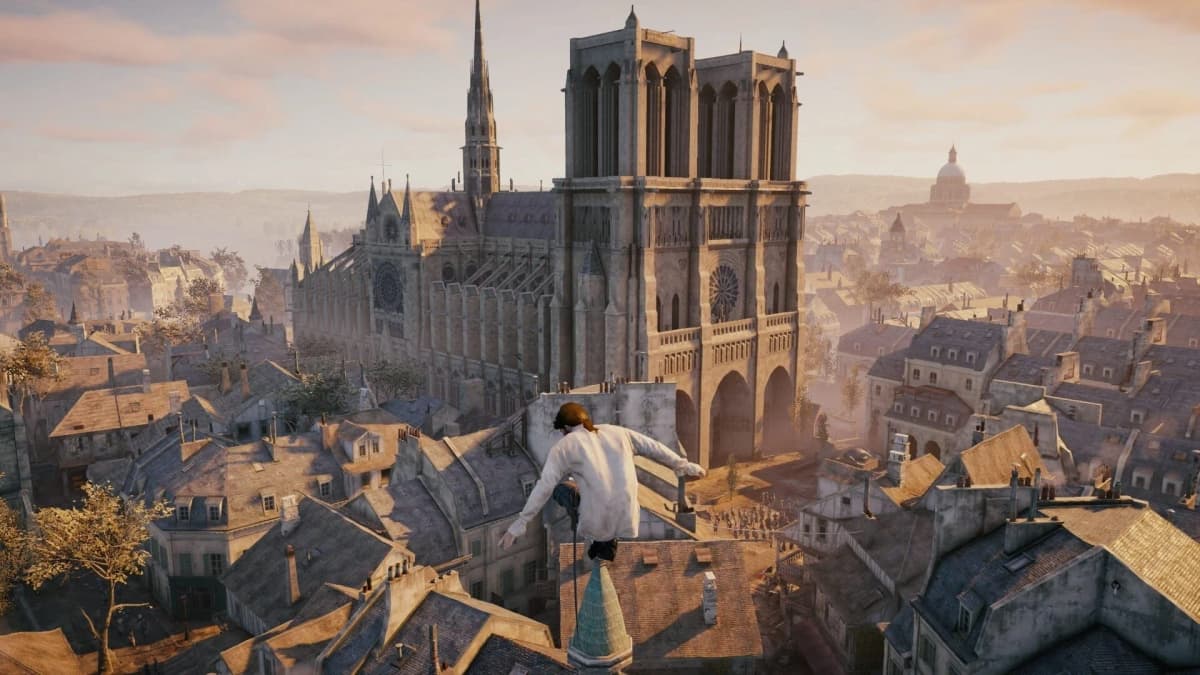
You can enter a lot of buildings seamlessly, running through apartments, weaving past tables and staircases, and bursting out of another window across the street. It turns chases into puzzles: do I stay on the roofs, cut through that café, or drop to the street and disappear into a crowd? Modern AC, post-Origins, mostly shrugs and says “just get a horse, man.”
This is exactly where the 60fps patch changes the perception of the game. At 30fps with drops, Unity’s parkour felt slightly floaty and imprecise, because your inputs weren’t being reflected as quickly as your brain expected. The animations were always impressive – Arno vaulting over railings, twisting through narrow gaps, grabbing onto a jutting brick with his fingertips – but they played out more like cutscenes than actions you fully owned.
On PS5 and Xbox Series X|S at 60fps, everything snaps into place. The timing of jumps feels tighter. The little half-second delay between input and movement shrinks just enough that you can thread Arno through much riskier routes. Running along the edge of a slanted roof and pivoting off a chimney onto a hanging sign doesn’t just look cool anymore; it feels like something you executed, not something the animation system gifted to you.
People love to say “frame rate matters most in shooters and fighting games.” Unity is the rebuttal. When your entire fantasy is “I am a deadly parkour assassin,” having the movement actually respond at a modern standard suddenly makes the pitch believable again.
Fight Like an Assassin, Not a One-Man Army
Unity’s combat is where you can really see the fork in the road that the series never fully committed to. Before Unity, Assassin’s Creed fights were basically counter-kill ballets. After Unity, they morphed into RPG-lite brawls where you chop away at health bars for days. Unity sits in this brutal middle ground that I still think is the most honest version of what an “assassin fantasy” should look like.
Enemies hit hard and die fast. You do too. Take on four or five armed soldiers in a straight fight and you will very often get wrecked, especially early on. You’re not Ezio mowing down half a garrison with one hidden blade and a smug smirk. You’re fragile. Outnumbered. Fights feel like “damn it, I screwed up the stealth” more than “time to clean up this room because the game expects me to.”
Because health pools are low, the whole thing becomes about timing: dodge, parry, counter, quick strike, step back. It’s closer to a light action game than a stat-check RPG. There’s gear and progression, sure, but they’re not the main event the way they are in Odyssey and Valhalla. Here, your skill actually matters.
Again, this is where 60fps matters more than the marketing bullet point suggests. Unity’s parry and dodge windows feel noticeably better at higher frame rates. When a guard swings, you’re reading the animation and reacting within a fraction of a second. At 30fps – especially when the frame rate nosedived in big fights back on PS4 and Xbox One – that precision went out the window. It just felt unfair.
Now? It lands much closer to how it always should have been: punishing, but not cheap. If you die, it’s because you got cocky or mistimed things, not because the game turned into a slideshow mid-swing.
Stealth That Actually Means Something
The other thing Unity nails – and which the series almost buried afterwards – is stealth that isn’t just a suggestion. Those “black box” assassination missions are still some of the best content Assassin’s Creed has ever produced. Sneaking into Notre Dame or infiltrating a palace doesn’t feel like walking down a scripted corridor; it feels like casing a location with multiple, genuine angles.
You can blend with crowds, slip through side alleys, climb up to rafters, use open windows, or drop from chandeliers. You can eavesdrop to discover infiltration opportunities or side objectives that make the kill easier or cleaner. It’s like Hitman on training wheels – not as complex, but chasing the same idea: “Here’s a space. Here’s a target. Figure it out.”
What makes it work is that stealth is encouraged not just by design, but by necessity. Because combat is so dangerous, sneaking isn’t a style choice; it’s basic survival. And for once, the control scheme actually respects that, with a dedicated crouch button so you can hug cover and stay low instead of relying on those magical Assassin’s Creed bushes that apparently bend light.
Even the co-op missions – which were a technical nightmare at launch – are shockingly fun today with stable performance. Coordinated infiltrations through different entrances, timing simultaneous assassinations, cleaning up after each other’s mistakes; it’s the closest the series has come to feeling like a little assassin crew actually operating in a living city.
The 60fps Patch: Redemption Arc or Just Good PR?
So what did Ubisoft actually do in 2026? They pushed out a free update that enables 60fps when you play Unity via backwards compatibility on PS5 and Xbox Series X|S. No extra charge, no “remaster” branding, just a patch. On top of that, they slashed the price hard – down to around ten bucks on the PlayStation Store in some regions – and threw in the Dead Kings DLC and Underground Armory pack for free during the promo window. Over in Europe, you can pick it up for the price of a coffee if you catch it on sale. Xbox players are even getting a Free Play Days window in early April.
Let’s not pretend Ubisoft is doing this out of pure love. This is smart catalogue management and a chance to turn a meme into a minor redemption story. The 60fps update dropped alongside marketing beats about the future of the franchise; it’s clearly part of a broader strategy to soften people up on Assassin’s Creed as a “prestige heritage” brand again.
But here’s the thing: it works because Unity’s foundation was always solid. The patch doesn’t change the mission design. It doesn’t suddenly fix every AI quirk or remove every clunky icon from the map. It doesn’t erase the scars of those early microtransaction decisions. What it does is finally remove the single biggest barrier between the game’s design and the player: a miserable, unstable frame rate on the hardware most people played it on.
From early impressions across the community, it’s not a perfect, locked 60 in every single scenario – heavy crowd scenes and chaotic fights can still wobble. We’ll need the usual Digital Foundry-style breakdown to see exactly how clean it is. But subjectively? It’s “good enough” in the way Unity never was on PS4 and Xbox One. And for a game built so heavily on animation, timing, and precise movement, that’s a night-and-day difference.
What We Lost When We Threw Unity Away
I keep coming back to one uncomfortable question: what if Unity hadn’t launched in the state it did?
After Unity and the also-underperforming Syndicate, Ubisoft took a break and came back with Origins, then Odyssey and Valhalla – the “light RPG” era of Assassin’s Creed. Skill trees, colour-coded loot, giant zones with level-gated content; the whole formula shifted. Parkour and dense cities became less important than massive regions, naval travel, and 80-hour story arcs.
I enjoy those games, but I don’t love them in the same way. They’re RPGs that happen to be wearing an Assassin’s Creed skin, not stealth-assassination sandboxes at their core. Mirage tried to throw a bone to old-school fans with a more focused city and a return of classic assassination missions, but it still felt like a side project rather than the main creative direction.
If Unity hadn’t been buried under its own launch disaster, would Ubisoft have doubled down on tighter, parkour-driven, stealth-focused entries? Would we have seen more black box missions instead of another hundred fortresses to clear? Would dense, handcrafted urban sandboxes have become the norm, instead of feeling like a weird evolutionary dead end in the franchise’s history?
We’ll never know. But replaying Unity now, at 60fps, makes that alternate timeline sting a little more. Because suddenly it’s obvious how much of the series’ original identity was still alive in 2014 – and how quickly it was abandoned when the sales graphs and Metacritic averages didn’t hit the targets.
So, Should You Play Unity in 2026? Here’s Where I Land
If you’re expecting a miracle, you’ll be disappointed. Unity in 2026 is still Unity. The map is cluttered with pointless collectibles. Some mission scripting is janky. NPC AI can flip between brilliant and braindead in the span of a single street. The story is serviceable rather than unforgettable, and Arno is no Ezio in the charisma department.
But if you can look past all that – and crucially, if you’re playing it now on PS5 or Xbox Series X|S with that new 60fps patch – you’ll find a version of Assassin’s Creed that we’ve basically lost: a game where being an assassin actually means planning, infiltrating, and escaping, not just speccing into the right build and tanking three platoons of soldiers on an open field.
My honest recommendation? Grab it while it’s cheap, ignore 80% of the icons on the map, and focus on:
- The main story assassinations and black box missions
- Free-roaming parkour tours of Paris – rooftops and interiors, not just streets
- Co-op heists with friends now that the netcode and frame rate aren’t on fire
- Dead Kings, which quietly delivers some of the best gloomy, atmospheric level design in the series
Is Unity a flawless masterpiece? No. But it is a deeply ambitious, wildly interesting entry that was absolutely kneecapped by its own launch. The 60fps patch doesn’t rewrite that history, but it finally lets the good parts breathe instead of suffocating under technical rubble.
I started as one of Unity’s loudest critics. Now, after revisiting Paris at 60fps, I’ve flipped completely: if Ubisoft announced a new mainline Assassin’s Creed that took Unity as its template – dense city, lethal combat, real stealth, meaningful crowds – I’d be there day one. That’s how much this “broken” game has grown in my estimation once the hardware finally caught up with the vision.
Unity didn’t suddenly become brilliant in 2026. It always was – we just couldn’t see it clearly through the mess. Now that the frame rate isn’t fighting you every step of the way, you’ve finally got a fair shot at judging the game for what it actually is. And if you ask me? It deserves a hell of a lot better than being forever remembered as just “that buggy Assassin’s Creed with the missing faces.”
FinalBoss // Gear
Level up your setup
01Top-rated gaming headsetson Amazon→02High-refresh gaming monitorson Amazon→03Gaming chairson Amazon→04Discounted game keyson Kinguin→Affiliate links · As an Amazon Associate, FinalBoss earns from qualifying purchases.
Want to Level Up Your Gaming?
Get access to exclusive strategies, hidden tips, and pro-level insights that we don't share publicly.
Ultimate Gaming Strategy Guide + Weekly Pro Tips