
Table of Contents (11)
The Week Invisible War Got Disowned… Right As I Was Replaying It
The timing genuinely could not have been worse. I’d just reinstalled Deus Ex: Invisible War, loaded it up with the Visible Upgrade mod, and started drafting notes for a “hey, this game was actually pretty good” piece-when interviews started circulating of the original devs dunking on it.
They called out the infamous loading screens. They admitted the universal ammo system was a mistake. They basically said what angry PC players have been yelling on forums for twenty years: it was compromised by being built for the Xbox, and it never lived up to the original Deus Ex.
So yeah, on paper this is the worst possible moment to say, “Actually, I still like Invisible War.” But after sinking back into it in 2026, with modern hardware and a community upgrade mod smoothing out its roughest edges, I’m going to say it anyway:
Invisible War is a flawed, compromised, but seriously underrated immersive sim that deserves a real second look-especially now.
Not as some secret masterpiece that secretly beats the original. It doesn’t. But as an ambitious, weird, choice-obsessed cyberpunk RPG that takes risks modern blockbusters are terrified of? On that level, it absolutely holds up, and honestly puts a lot of “choice-driven” games to shame.
How a PC Snob Learned to Stop Hating and Love the Sequel
I’m not coming at this as some contrarian who missed the original wave. I was one of the obnoxious “PC master race” teenagers who clung to the first Deus Ex like scripture. Multiple playthroughs, stealth-only runs, non-lethal runs, modded runs-the whole thing. When Invisible War launched on PC and Xbox, I was exactly the kind of person it pissed off.
Those tiny hub maps? The constant loading doors? The chunky, gamepad-first UI that felt like it was built for a couch ten feet away, not a CRT on your desk? I bounced hard. I finished it once, grumbled about the universal ammo, and then joined the chorus of “yeah, just replay the first game instead.”
Coming back two decades later with my older, more jaded immersive sim brain, a fast SSD, and the Visible Upgrade mod installed, I had a totally different experience. The loading screens are still there, but they’re not the agonizing momentum-killers they were in 2003. The higher resolutions and performance fixes make the whole thing less claustrophobic. Once the tech stopped screaming at me, the design underneath finally had room to speak.
And that’s when it hit me: Invisible War didn’t deserve to be dropped in the “failed sequel” bin and left there. Not when it’s doing things with faction choice, systemic betrayal, and cyberpunk worldbuilding that most modern RPGs, with ten times the budget, still refuse to attempt.
Yes, the Complaints Are Real—But They’re Not the Whole Story
Let’s not sugarcoat this. The reasons people hated Invisible War aren’t imaginary.
The level design is cramped. Those small hub spaces, sliced into chunks by loading doors, feel like someone took the original game’s open maps and fed them through a paper shredder. On original hardware, the long loads made it painful. Now, with the Visible Upgrade and a modern PC, the wait is tolerable—annoying, but not lethal.
The interface screams “console first.” Big chunky menus, simplified inventory, and the loss of little PC luxuries like lean-walking around corners. You can feel the Xbox’s RAM ceiling in almost every design decision.
Universal ammo absolutely flattened one of the original’s joys. In Deus Ex 1, ammo types were a quiet way of nudging you into playstyle variety and logistical planning. In Invisible War, one bar rules them all. Every bullet, every bolt, every rocket—you’re pulling from the same pool. Even the devs now say it was a terrible idea. And they’re not wrong.
So no, I’m not here to pretend those issues magically disappear if you squint hard enough. They don’t. But the way the discourse around Invisible War froze at “ugh, loading screens and universal ammo” absolutely does it a disservice. It became a meme, not a game anyone actually engaged with on its own terms.
Underneath the compromises, there’s a fiercely systemic immersive sim still trying very hard to let you play a double-dealing, augmentation-enhanced chameleon in a messy post-collapse future. And that’s where it quietly shines.
Invisible War’s Faction System Is Still Wilder Than Most Modern RPGs
Invisible War is obsessed with factions. Not just “pick red or blue ending” factions. Actual competing power blocs that want the same objective achieved in mutually exclusive ways—and are perfectly happy to let you lie to their faces as long as you deliver something useful.
On paper, you’ve got your big ideological players: the WTO’s surveillance-heavy corporate order; the pseudo-religious Order church; the violently anti-aug Templars; the Omar, drifting post-human merchants. But what makes it work is how that factional tension drips down into the moment-to-moment missions.

Invisible War rarely forces you to swear loyalty before you’ve even stepped out the door. Instead of “accept Order mission / accept WTO mission,” you often just… get both. NPCs hand you their agenda, you walk away with multiple overlapping objectives in your log, and the game quietly waits to see who you’ll actually show up for.
Will you go blow up the WTO facility like the Order wants, then sell the access codes to a third party? Will you stage a fake assassination to please the Templars while secretly warning the target? The game doesn’t stop you mid-dialogue with, “Are you SURE? This choice will have lasting consequences!” It trusts you to understand that betraying someone might matter later.
Under the hood, the scripting and AI are doing a lot of quiet work. NPCs track whether you delivered, lied, or ghosted them. Different hubs load in slightly altered states depending on whose agenda you’ve pushed. Guard hostility, dialogue, and even whose propaganda is plastered around a space can shift in subtle ways. It’s not as elaborate as what we imagine with today’s marketing buzzwords about “living worlds,” but it’s way more reactive than its reputation suggests.
Compared to a lot of recent “immersive sim-adjacent” games where the AI mostly exists to patrol routes and shout barks, Invisible War’s faction web makes you treat every quest-giver as a potential future enemy—or future asset. That sense of political improvisation is something I miss desperately in modern design.
The Coffee War, or How a Dumb Side Quest Says Everything
If you want a perfect snapshot of how Invisible War thinks about its world, look at the dumb coffee feud.
Pequod’s Coffee and Queequeg’s Coffee are two chains locked in absurd corporate warfare. Both are named after Moby-Dick characters (just like a certain real-world coffee company), and both are convinced their brand of brown water defines their entire identity. One leans workers-first and salt-of-the-earth; the other sells exclusivity and aspirational middle-class vibes.
What starts as petty sabotage—leaflets, underhanded deals—can escalate into full-on firebombings if you keep feeding the rivalry. You can choose a favorite, play both off against each other, or try to shut the whole thing down. It’s funny, but it’s also on the nose: these managers are every bit as consumed by their “vision” as the people trying to remake the world order.
From a systems perspective, it’s classic Invisible War. The AI isn’t doing anything flashy. It’s scripting, state changes, and condition checks. But because the game ties those states to your choices, you end up with a tiny, localized version of the same faction tug-of-war that defines the macro story.
It’s a reminder that power struggles aren’t just governments and conspiracies. They’re also brands, tribal identity, and the stupid hill people choose to die on. Tell me that isn’t still painfully relevant.
NG Resonance: A 2003 Vision of Our Data-Harvesting Future
The most prescient thing Invisible War ever did is hide one of its sharpest cyberpunk ideas behind a holographic pop idol.
NG Resonance is introduced as a kind of AI-powered virtual celebrity. Clubs and bars install her as a talking decoration. Fans queue up to gush over their lives, ask for advice, and send “personal messages” they’re convinced will reach the real singer behind the likeness. It’s parasocial as hell.
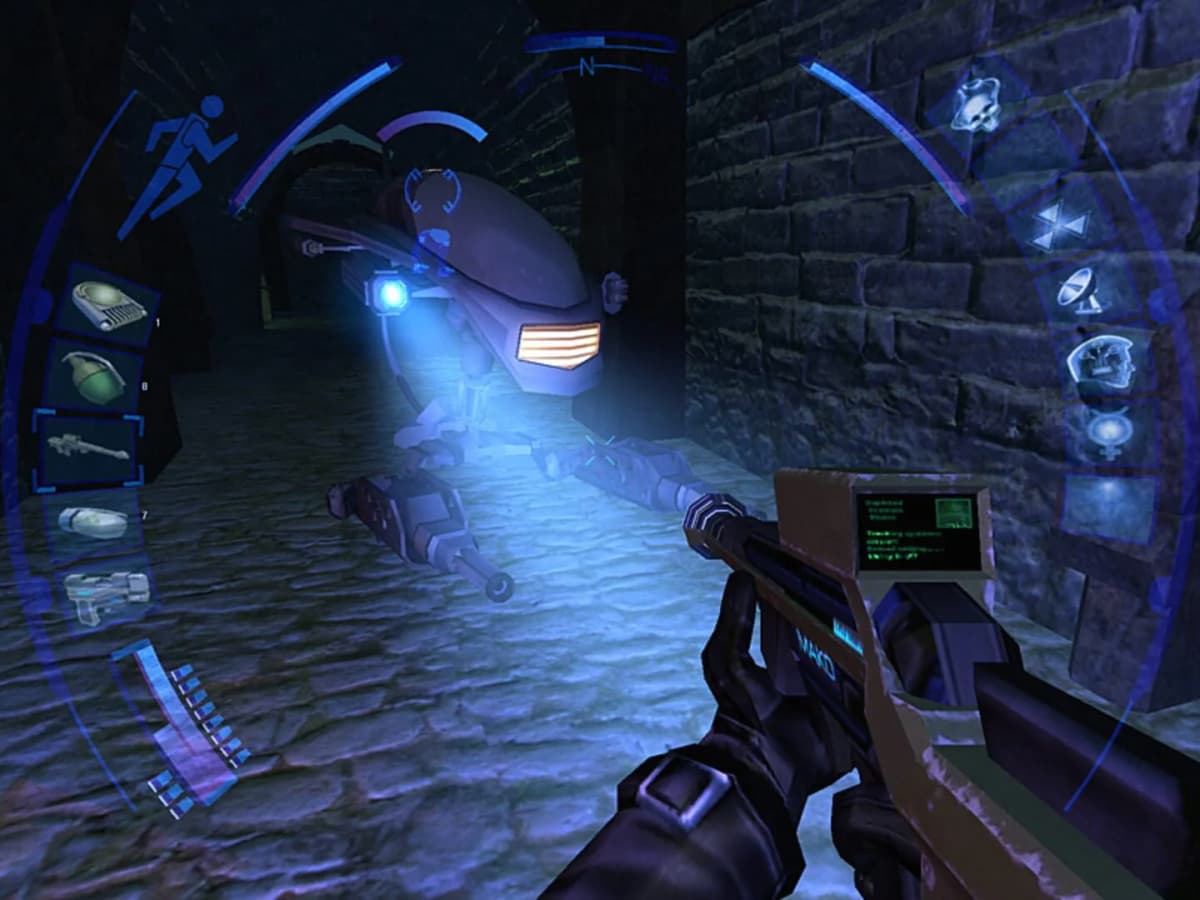
But when you walk up as Alex Denton, she realizes you’re not just another simping fan. The mask drops. Suddenly you’re dealing not with a ditzy hologram, but with the underlying surveillance system: an intelligence-gathering AI using its popstar façade to harvest data from an entire population that happily opens up to her. Names, relationships, habits, business secrets—it all goes in the database.
From a design angle, NG Resonance is brilliant because she’s not just exposition. She’s a quest hub. You can choose to help her collect juicy intel, manipulate what data she holds, or push back against the businesses that treat her like a flashy jukebox. You’re effectively deciding how much power to feed this corporate panopticon disguised as a friend.
Replay this in 2026, in a world of algorithmic influencers, VTubers, chatbot companions and platforms that monetize every scrap of user data, and it feels uncomfortably on the nose. Invisible War might not have cutting-edge NPC pathfinding by today’s standards, but the way it weaponizes a seemingly friendly AI against its own fanbase is more biting and clear-eyed about surveillance capitalism than half the “neon and katana” cyberpunk we get now.
And this is where I start thinking about what a modern Invisible War could do with today’s AI tech. Imagine NG Resonance actually building a long-term profile of you across hubs; reacting to your prior answers, blackmailing NPCs based on info you fed her; having guards and corporations adjust their suspicion because you’ve “over-shared” with a virtual idol. The skeleton of that idea is already here in 2003—it just needed another decade of tech and courage.
AI, Guards, and Why Predictable Enemies Can Be a Feature
One of the usual sticks used to beat Invisible War is that its combat and AI feel simpler than the original. And yeah, if you’re coming in expecting tactical SWAT-level behavior from guards, you’re going to be disappointed. They patrol. They investigate noises. They lose you more easily than they should.
But here’s the thing: in immersive sims, perfect AI isn’t the goal. Predictable AI is.
Invisible War’s enemy behavior is basic, but it’s readable. You know how far you can push your cloaking biomods before someone spots you. You can bait a security bot into chasing you past a hacked turret and let them shred each other. You can use physics objects and EMP grenades to turn a heavily guarded corridor into a chain reaction of chaos.
The universal ammo system absolutely narrowed some of your tools, but it didn’t delete the core immersive sim philosophy: give the player overlapping systems and dumb-but-reliable AI, then let them abuse it. In my recent playthrough, most of my favorite moments had nothing to do with gunplay and everything to do with manipulating patterns—setting mines around corners, hacking doors just long enough for a guard to wander through, or timing a sprint through a lobby while two factions shot each other to pieces.
Would smarter, more reactive AI make the game better? In some ways, sure. But I’ve also played enough “modern” stealth games where the AI is so twitchy and omniscient that experimentation becomes a chore. Invisible War still understands that you’re here to play with systems, not audition for a tactical shooter tournament.
Universal Ammo: The Bad Idea That Didn’t Kill the Game
Let’s tackle the sacred cow directly. Universal ammo was a bad call. It blurs weapon identity, erases some of the satisfaction of scrounging for that one rare ammo type, and encourages you to think in terms of a single resource bar instead of a varied toolkit.
But here’s what replaying Invisible War reminded me: even with that system, you still have more interesting options than the average shooter-RPG hybrid today.
Stealth biomods, hacking, bots, turrets, environmental hazards, non-lethal takedowns, multi-purpose grenades—it’s all still there. Universal ammo squeezes the combat sandbox, but it doesn’t erase the rest of the toys. In my run, I leaned so heavily on incapacitating tools, security subversion, and faction manipulation that my ammo bar felt more like a “panic button” meter than my main way of interacting with the world.
Could the game have been better without universal ammo? Absolutely. Does its presence alone make Invisible War worthless? Not even close. It’s one flawed variable in a still-functioning web of systems. I’d rather have that messy web with one dumb resource rule than a slick, focus-tested corridor shooter with thirty guns that all do the same thing.
Mods, Modern Hardware, and Why 2026 Is the Right Time to Revisit
There’s a reason my opinion flipped now and not ten years ago: the tech finally stopped getting in the way.
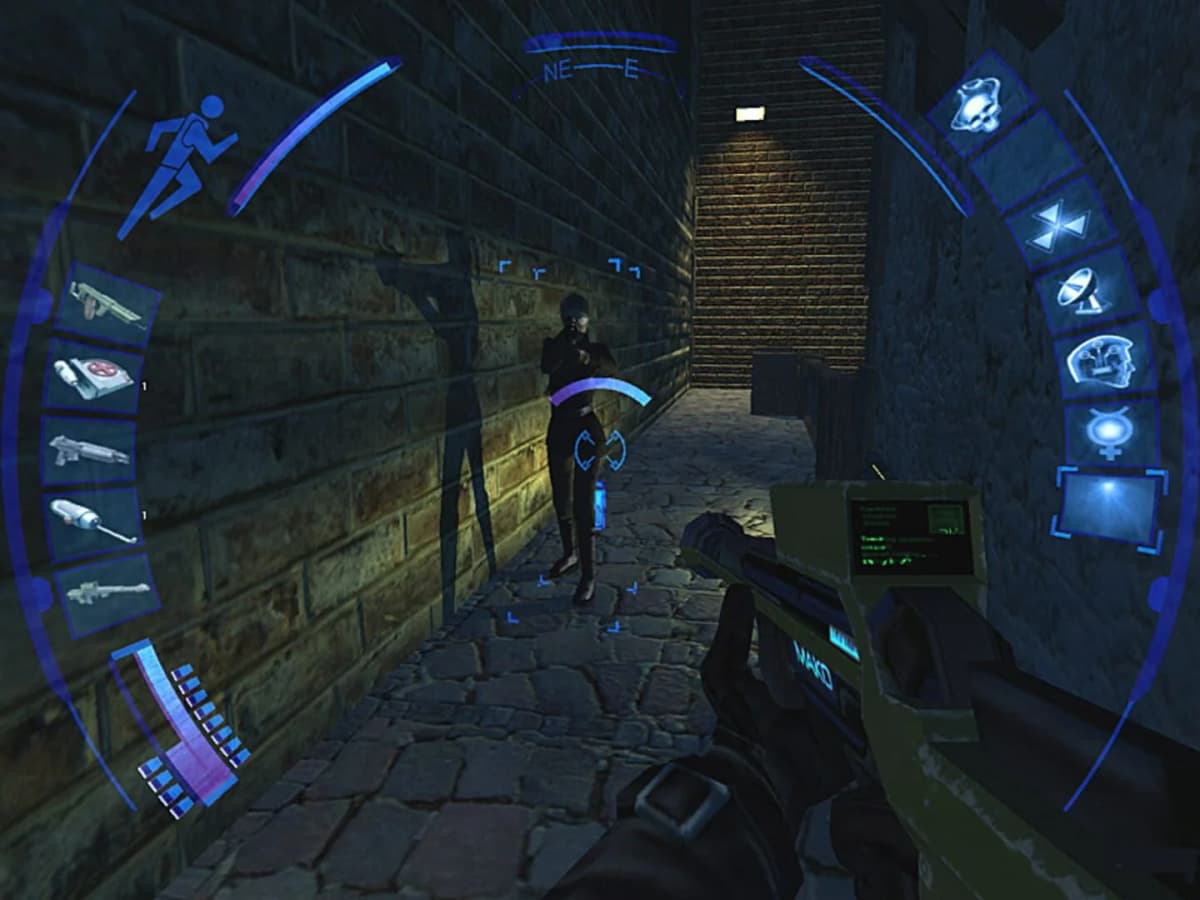
Back in 2003, those loading screens and performance issues were brutal. The engine choice—originally more suited for a tight, sneaky game like Thief—strained under the weight of Invisible War’s hub ambitions. On a clunky old PC, every door was a gamble: do I really want to sit through another 20-30 second pause just to poke around another cramped back alley?
Today, slap the game onto an SSD, install the Visible Upgrade mod, and suddenly a huge chunk of that friction is gone. Load times shrink. Resolutions scale to modern monitors. Visual glitches calm down. You’re still playing a 2003-ass game, but you’re not fighting the hardware every step of the way.
We’ve seen this story before. Assassin’s Creed Unity was a meme at launch—bugs, performance, the works. Years later, after patches and running it at a solid 60 fps on new consoles, people finally started noticing, “Oh, wait, this Paris is actually incredible.” Invisible War is in that same category: a victim of its launch context.
Now that the technical pain points are dialed back, the choice-heavy design, faction intrigue, and weird little side stories finally have room to breathe. Instead of judging it as “the game that wasn’t Deus Ex 1,” you can appreciate it as a strange, ambitious middle child in the immersive sim family tree.
When Even the Devs Disown It, Who Gets to Decide a Game’s Worth?
I get why the developers are so hard on Invisible War. They lived through the engine switch, the console constraints, the compromises. For them, “universal ammo” isn’t just a design quirk—it’s a scar from months of stress and second-guessing. Of course they look back and wince.
But creators aren’t the final word on how a work lands. Sometimes the audience finds value in the parts the devs feel most conflicted about. Sometimes the “failure” of a game becomes the exact reason it’s interesting twenty years later.
Invisible War is one of those games for me. It’s messy, compromised, and absolutely not above criticism. But it’s also braver in its systemic storytelling than a lot of slick, safe sequels that followed it. It lets you be a true opportunist, flipping allegiances for better offers, playing cults and corporations off each other, and selling out the world one side quest at a time.
That counts for something. In an industry that increasingly sandblasts all the rough edges off its big releases, a flawed but ambitious immersive sim like this is worth preserving and revisiting—even if its own creators would rather forget it.
So Where Does That Leave Invisible War in 2026?
Here’s where I land after my replay: Deus Ex: Invisible War is not a misunderstood masterpiece, but it is a seriously over-hated game.
If you go in expecting the purest form of Deus Ex 1 on modern tech, you’ll be disappointed. If you go in ready to meet it halfway—to accept small hubs, occasionally dumb AI, and a boneheaded ammo system in exchange for wild factional roleplay, sharp cyberpunk ideas, and real systemic freedom—you might walk away surprised at how much it still offers.
For me, it changed how I look at “failed” sequels in general. Not every follow-up that stumbles deserves to be memory-holed. Sometimes, buried under bad launch decisions and outdated hardware, there’s a strange, ambitious heart still beating. Invisible War has that heart.
So yeah, even if the devs are out there calling it a mistake, I’m going to keep defending it. Load it up on PC, throw Visible Upgrade on top, and let yourself get lost in its web of betrayals, cults, coffee wars, and data-harvesting pop idols. It won’t erase its flaws—but you might finally see why some of us never stopped believing it deserved better.
FinalBoss // Gear
Level up your setup
01Top-rated gaming headsetson Amazon→02High-refresh gaming monitorson Amazon→03Gaming chairson Amazon→04Discounted game keyson Kinguin→Affiliate links · As an Amazon Associate, FinalBoss earns from qualifying purchases.
Want to Level Up Your Gaming?
Get access to exclusive strategies, hidden tips, and pro-level insights that we don't share publicly.
Ultimate Gaming Strategy Guide + Weekly Pro Tips