
Table of Contents (8)
The night I realised the “bad” Deus Ex understood 2026 better than I do
I bounced off Deus Ex: Invisible War hard when it came out. I was that boring, insufferable PC snob in 2003: worshipping the original Deus Ex, foaming at the mouth over “consolization”, ranting about tiny levels and universal ammo on message boards like I was defending some sacred text.
Invisible War became a punchline. The wrong sequel. The one you were allowed to hate because, hey, even Warren Spector wasn’t thrilled with how it turned out. I finished it once, filed it away under “compromised Xbox experiment”, and spent the next decade parroting the same complaints everyone else did.
Then, recently, after a wave of retrospectives and a stray magazine feature knocked it back into my brain, I reinstalled it. No mods, no nostalgia glasses. Just me, an old save folder long gone, and a world that had lived through 9/11, the 2008 crash, the rise of platform oligarchs, COVID, and a decade of weaponised conspiracy culture.
Halfway through that replay-standing in a gleaming WTO enclave while a zealot from the Order ranted about spiritual purity and bio-augmented elites-I had a horrible realisation: this “failed” sequel understood the 21st century way better than I did when I first played it. It understood the way collapse actually feels: not Mad Max chaos, but gated comfort for a few and managed decay for everyone else.
Invisible War isn’t just a decent game trapped inside an awkward design. It’s a political fable that accidentally predicted the next twenty years of techno-politics, culture wars, and backlash to augmentation-biological, digital, and social. And I’m tired of pretending it’s just “the one with universal ammo”.
Invisible War’s Great Collapse is basically our 2008 hangover in sci-fi drag
Invisible War is set in 2072, twenty years after the original Deus Ex’s 2052 techno-conspiracy blowout. JC Denton’s endgame choices are effectively mashed into one catastrophic event: the Great Collapse. Communications shattered, infrastructure crumbled, old power structures fell apart, and out of that rubble a new order slithered in.
That’s the backdrop: a world that already broke. Not a looming apocalypse, but a society quietly reassembled from fragments by whoever had the cash, guns, and backup servers to survive. You’ve got WTO-guarded “enclaves” with climate control and decent healthcare, surrounded by sprawling slums where the best you can hope for is a trickle of aid and a hologram sermon.
Playing it now, post-2008, it hits very differently. When I first played as a teenager, “The Great Collapse” was flavour text. Generic dystopia noise. Today, after watching my generation spend its entire adult life limping away from the financial crisis, climate disasters, and austerity politics, it feels uncomfortably on the nose.
Invisible War doesn’t depict some dramatic, cinematic end-times. It depicts the slow normalisation of collapse. The way “temporary emergency measures” harden into permanent structures. The way that, after a big enough shock, the people who rebuild things are exactly the kinds of people you don’t want in charge—but they’re the only ones with the capital and the server farms.
The WTO enclaves are basically corporate city-states. They’re glittering bubbles of stability, where the trains run on time and biomod clinics keep the rich healthy and beautiful. Outside? You get black market surgery, cults, and imported propaganda. The Gap between those two worlds is less a metaphor now and more like a blurred screenshot of our own: Silicon Valley compounds, private islands, and walled-off “smart city” projects versus underfunded public everything for everyone else.
The original Deus Ex absolutely had its finger on the pulse of turn-of-the-millennium paranoia—surveillance, bioterror, globalist conspiracies. But Invisible War moves the camera forward to the era of austerity and techno-feudalism. It’s about what happens after the cyberpunk revolution never arrives and we just get used to being managed.
WTO, Order, Templars, ApostleCorp: four bad answers to a real question
What makes Invisible War so sharp isn’t just “the world went to hell”. It’s the way every faction is a plausible, awful response to that collapse. The game’s politics aren’t subtle, but they’re messier and more honest than I gave them credit for.
On one side you’ve got the WTO and the resurgent Illuminati—high-tech technocrats hiding behind the language of trade, stability, and “rational leadership”. Chad Dumier, the WTO poster boy, is exactly the sort of centrist we’ve all been conditioned to tolerate: blandly well-spoken, obsessed with macro indicators, and more scared of volatility than of injustice.

He doesn’t want to solve the inequality that fuels extremism; he wants to keep it to a “manageable” level. A bit of slum here, a bit of rationing there, but keep the enclaves humming and the growth graph pointing slightly upward. Playing in 2026, it’s hard not to see shades of the real-world “adults in the room” who keep telling us that fundamental change is impossible but maybe we can fiddle with interest rates and ESG scores.
Opposite that, there’s the Order: a syncretic, pseudo-religious movement built out of scraps of Buddhism, Sufism, New Age babble, and good old-fashioned authoritarianism. Its leader beams into the slums like a YouTube guru with a private army, telling the dispossessed that spiritual enlightenment is more important than the fact they live in a corrugated metal coffin.
On my replay, it felt like a mash-up of wellness grifters, Q-adjacent “researchers”, and the kind of spiritual influencers who pivot smoothly from meditation tips to reactionary talking points. When the material reality of people’s lives gets unbearable and the political options on the table all suck, charismatic mystics step up to fill the void. Invisible War saw that coming and, more importantly, showed how quickly that soft-power woo slides into hard-power violence.
From that same Order soil the Templars grow—a militant, anti-augmentation sect that blends medieval cosplay with biotech terror. They’re the ones bombing biomod facilities, kidnapping augmented kids, and ranting about the need to “purify” humanity. Their recruits are almost all from the crushed margins of society: refugees, ex-workers, former believers who realised praying wasn’t fixing anything.
Looking at them now, after a decade of far-right movements fuelled by economic precarity and culture-war brainworms, they stop feeling like cartoon villains. They’re pathetic and terrifying in the exact way real extremists are: part LARP, part serious death cult. Their hatred of augmentation—of bodies hacked by technology, of people who took the deal they weren’t offered—rhymes sickeningly well with modern anxieties around vaccines, trans bodies, gene therapy, and any tech that makes the human form feel negotiable.
Then there’s ApostleCorp, the wildcard: a biotech collective built by the surviving Denton brothers and their old allies. They’re the utopian pitch deck: augmentation for everyone, a new global commons of empowered citizens, biomods as universal public infrastructure rather than luxury accessories for the rich.
On paper, it’s the “good” faction: egalitarian, anti-elitist, openly hostile to both Templar purism and Illuminati shadow-rule. But Invisible War never lets you forget the cost. ApostleCorp’s vision is still engineered from above, by hyper-augmented semi-gods hiding in a frozen ruin on Liberty Island. The final choice you’re offered—upload global routing protocols to them, to the Illuminati, to the Templars, or to an AI super-intelligence—boils down to picking your poison.
As someone watching our current AI and biotech discourse from the sidelines, that hit hard. We’re having almost exactly the same argument: should we trust a self-alleged “benevolent” elite to manage technology for us? Should we democratise it completely, knowing full well that puts nukes in everyone’s pocket? Or should we slam the brakes so hard that the resulting backlash fuels something even worse?
As someone watching our current AI and biotech discourse from the sidelines, that hit hard. We’re having almost exactly the same argument: should we trust a self-alleged “benevolent” elite to manage technology for us? Should we democratise it completely, knowing full well that puts nukes in everyone’s pocket? Or should we slam the brakes so hard that the resulting backlash fuels something even worse?
🎮 Get This Game at the Best Price
Compare prices instantly and save up to 80% on Steam keys with Kinguin — trusted by 15+ million gamers worldwide.
*Affiliate link — supports our independent coverage at no extra cost to you
Alex D, cloned bodies, and the politics of being “enhanced”
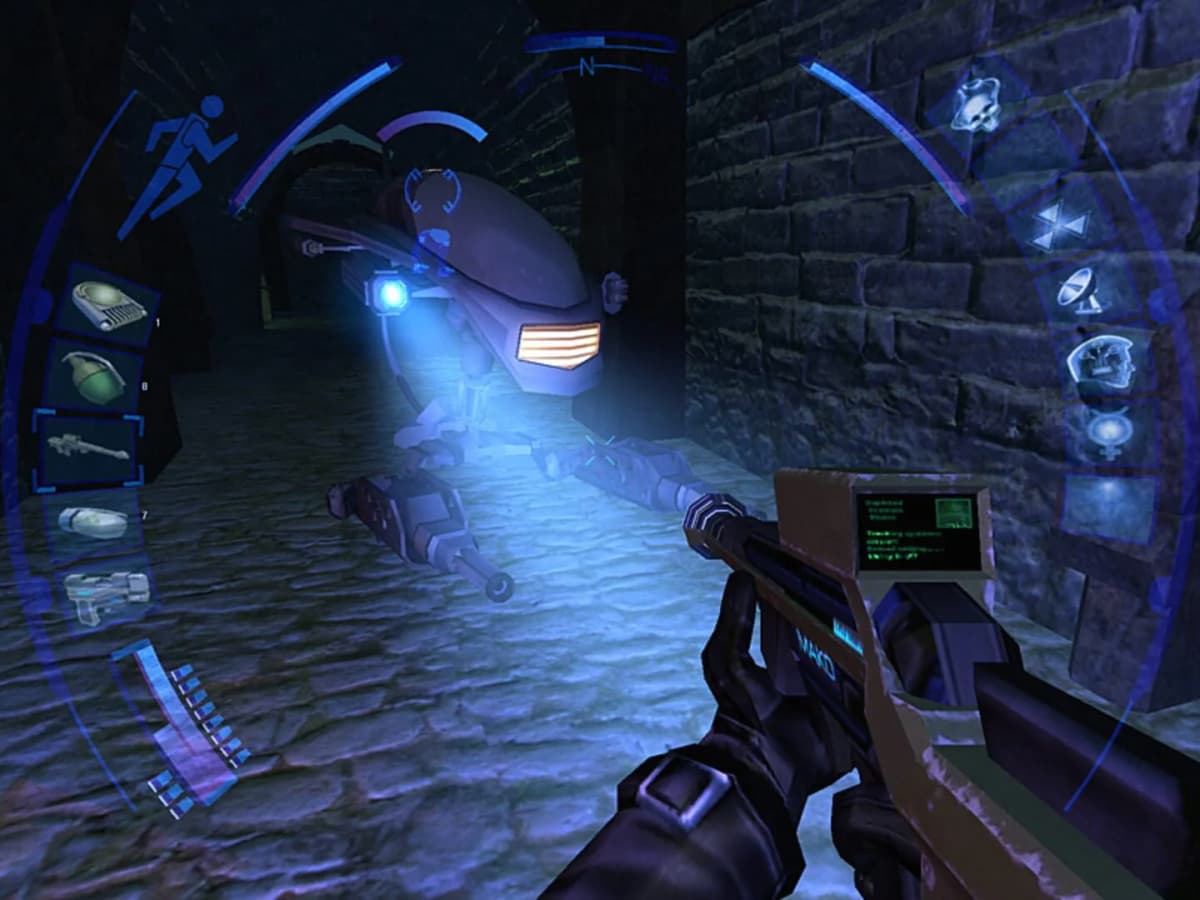
The other thing Invisible War absolutely nails—and which I completely whiffed on as a kid—is how personal it makes all this. You’re not some cleanly defined hero. You’re Alex D, a literal clone from a corporate training facility. Depending on your choices, you drift between factions that all want to use your body, your biomods, and your plausible deniability as tools.
When the game reveals that Alex is one of several cloned prototypes, it’s not just a sci-fi twist. It’s a nasty little gut punch about disposability. You’re valuable, but only as an instrument. The specifics change—one run, my Alex leaned into mercenary pragmatism; another, I tried to be the wide-eyed idealist—but the power relationship never really does.
That hits different when you’ve watched entire generations treated as upgradeable components in the real world. Gig workers algorithmically managed like NPCs. “Userbases” being farmed and abandoned. Whole swathes of people nudged, tracked, and sorted by systems they never consented to. Invisible War’s training facility prologue, with its chirpy corporate tutorial tone wrapped around deeply sinister experimentation, might as well be a recruitment video for the modern attention economy.
Even the way biomods work reflects this tension. In the original Deus Ex, augmentations felt like a permanent, identity-defining choice. In Invisible War, they’re removable, swappable, a little more like apps than organs. At the time, I hated that. It felt less “roleplaying” and more loadout tinkering.
Now it feels uncomfortably apt. Bodies as platforms. Selfhood as a series of reversible tweaks optimised for whatever system you’re embedded in. You’re encouraged to think of your own biology like a min-max spreadsheet—and the world around you treats it that way too.
Yes, the design is compromised. No, that doesn’t kill what it gets right.
None of this erases Invisible War’s problems. I’m not here to gaslight anyone who bounced off those corridor-sized “hubs” and loading screens every ten metres. The universal ammo system is still a clumsy attempt at simplification. The AI, even with my nostalgia, remains hilariously thick in places.
It was absolutely a victim of its context: a PC-and-Xbox simultaneous release in 2003 when level memory budgets, controller layouts, and marketing pressure were pushing every immersive sim toward something bite-sized and “streamlined”. And unlike some revisionist history types, I’m not going to pretend those compromises magically became virtues.
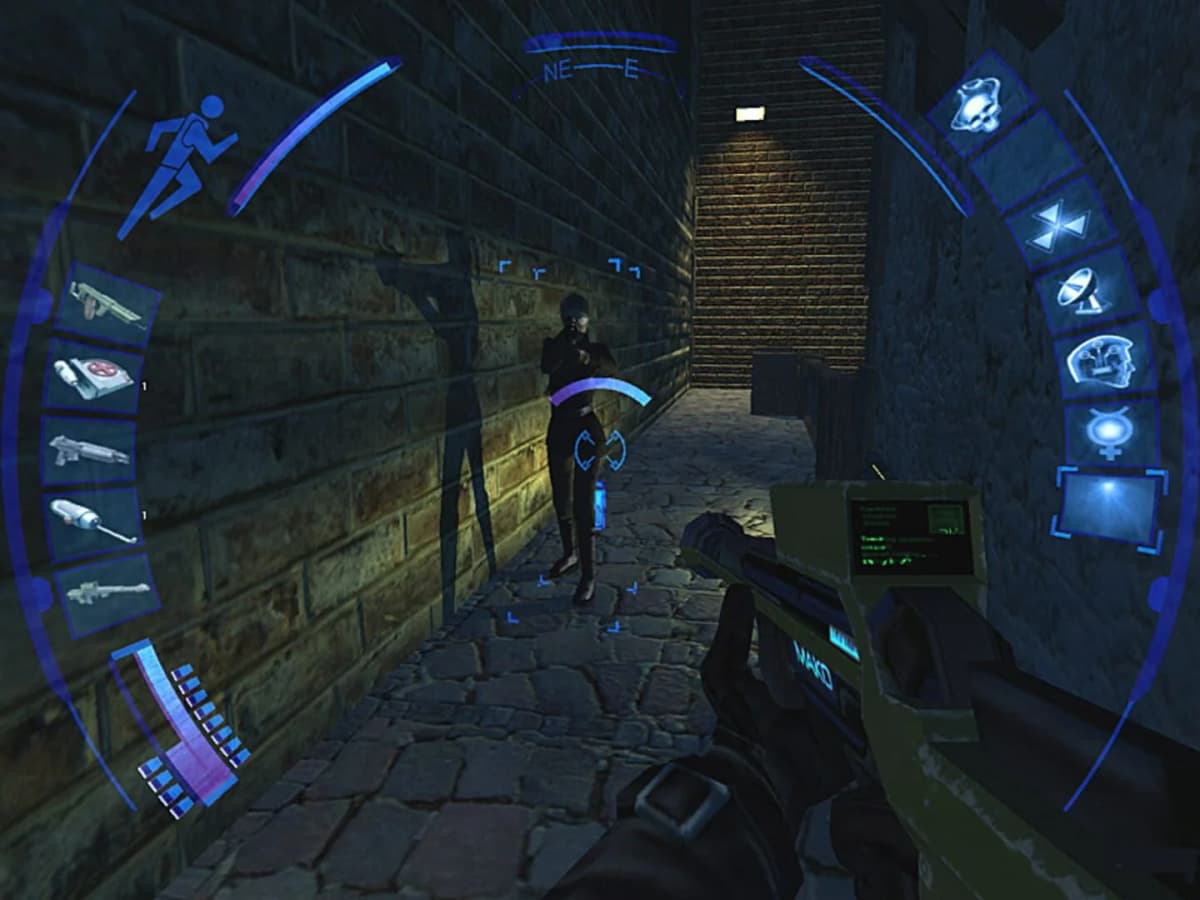
But here’s where I’ve changed my tune: the roughness doesn’t blunt its political teeth. If anything, the cramped spaces sometimes make the factional tension feel more claustrophobic. When you can walk ten seconds from a WTO security office to a slum bar full of Order preachers, the fiction of separation collapses. You see how tiny the distance is between comfort and desperation.
And unlike most modern AAA games that pretend to be about politics but refuse to commit to an angle (“we’re not making a statement, we just put the fascists in cool uniforms for fun!”), Invisible War is happy to be openly, gloriously messy. Every faction is wrong in a different way, but the game doesn’t flatten them into the same shade of grey. It forces you to decide what kind of wrong you can live with.
That’s something a lot of games still don’t have the backbone to do. They’re terrified of someone yelling about “agenda”, so they sand everything down until the only real choice is which colour of ending explosion you prefer. Invisible War, for all its jank and its Xbox-era constraints, lets you burn the world, hand it to technocrats, surrender it to zealots, or entrust it to a machine god. That’s not neutral. That’s the point.
This isn’t just “like Metal Gear Solid 2, but with biomods”
Whenever people talk about prophetic games, they wheel out the usual suspects. Metal Gear Solid 2 gets its (well-deserved) flowers for anticipating algorithmic information control. The original Deus Ex gets applause for its pre-9/11 paranoia and talk of engineered pandemics.
Invisible War almost never makes those lists, and that’s a mistake. Where MGS2 laser-focuses on memetic warfare and the construction of reality, Invisible War is chewing on something different: what happens when breakthrough technology gets captured by elites, sold as salvation, and then triggers a backlash that’s somehow even worse.
It’s interested in governance more than surveillance, in biotech more than media. AposteCorp isn’t just a plot device; it’s a stand-in for every modern lab, startup, and think tank that insists they’ll “align” powerful technologies with human values. The Illuminati are the permanent conference circuit: the Davos crowd in fancier robes. The Templars are the reactionary snapback you get when huge swathes of the population conclude, not entirely wrongly, that none of this was ever for them.
I’m not arguing Invisible War predicted specific headlines. That’s always the dumbest way people talk about “prophecy” in media. What it did do is sketch the fault lines: techno-utopianism versus techno-feudalism versus techno-puritanism. It understood that the fight wouldn’t simply be “for or against technology”, but over who gets to merge with it and on what terms.
Where I draw the line with the Invisible War hate
After replaying Invisible War in 2026, I’m done treating it as a punchline. I get why people were upset in 2003. Hell, I was
But we’re not in 2003 anymore. We’ve spent two decades living through our own slow-motion Great Collapse, watching technocratic enclaves harden, conspiracy cults metastasise, and biotech miracles roll out alongside nightmarish inequities. In that context, Invisible War looks less like a failed follow-up and more like a rough-cut transmission from the future we landed in.
The universal ammo sucks. The level streaming is annoying. Those are still true. But if that’s all you see when you look at Invisible War now, I honestly think you’re missing something important. You’re ignoring one of the very few games that dared to grapple with what a post-collapse, post-ideological, post-trust society might feel like—and did it with more honesty than half the “serious” sci-fi sitting on prestige TV platforms.
For me, this replay changed how I think about the whole Deus Ex series. The original is still the better game, mechanically and structurally. But Invisible War might be the more relevant warning. It’s the one that saw we weren’t heading toward a cleanly defined cyberpunk dystopia, but toward a muddier, more insidious reality of managed decline and overlapping cults of salvation—technocratic, spiritual, or both.
So I’m planting my flag. Invisble War is messy, compromised, often clumsy—and essential. It deserves better than its black-sheep status, not because we should politely “reconsider” it, but because its ugly little mirror is pointed squarely at us now. And whether we like what it shows or not, we don’t get to pretend it isn’t accurate.
FinalBoss // Gear
Level up your setup
01Top-rated gaming headsetson Amazon→02High-refresh gaming monitorson Amazon→03Gaming chairson Amazon→04Discounted game keyson Kinguin→Affiliate links · As an Amazon Associate, FinalBoss earns from qualifying purchases.
Want to Level Up Your Gaming?
Get access to exclusive strategies, hidden tips, and pro-level insights that we don't share publicly.
Ultimate Gaming Strategy Guide + Weekly Pro Tips