
Table of Contents (9)
The moment DLSS 5 stopped looking like “magic” and started looking like a band-aid
I was watching the Kinda Funny Games segment on DLSS 5 with one eye while grinding dailies, and I actually stopped mid-match when they brought up that “extremely old-looking character” example. You know the one: an elderly woman that was supposed to look haggard, rough, lived-in – and DLSS 5 basically turned her into something between a wax statue and an AI-beautified Instagram filter. More “glamour grandma” than “this woman has seen some shit.”
That’s when it clicked for me: DLSS 5 isn’t bridging the gap between art and hardware. It’s papering over that gap and hoping we don’t look too closely.
I’ve been obsessed with game visuals since the PS2 era, when you could feel every polygon straining against the hardware. Shenmue, early Silent Hill, even janky stuff like early 3D fighters – they all lived or died on strong art direction because they couldn’t brute-force realism. When a character looked old, it was because an artist sweated those wrinkles, those sagging lines, those expressions, within brutal technical limits.
Now NVIDIA is standing on a GTC stage calling DLSS 5 a “GPT moment for graphics,” promising real-time neural rendering that can slap photoreal lighting, materials, and even facial tweaks on top of whatever the game is doing. And I’m supposed to cheer because my GPU is less of a bottleneck while an AI guesses what the game “should” look like?
Yeah, no. I’m not buying the magic trick. Not yet.
What DLSS 5 actually is: not just upscaling, but AI taste layered on top of your game
DLSS used to be simple, at least conceptually. Lower internal resolution, some smart reconstruction, get more performance. DLSS 4 pushed further with frame generation. Cool, controversial at times, but you could still squint and say: this is accelerating what the game is already trying to render.
DLSS 5 is different. It’s not just guessing missing pixels. According to NVIDIA and coverage from places like The Verge and PC Gamer, it’s a 3D-guided neural rendering model that can:
- Change lighting and reflections in real time
- Swap out or “enhance” materials
- Subtly alter faces and surfaces to look more photoreal
- Apply a sort of AI-driven “cinematic” pass over the whole frame
In demos, that means Starfield suddenly looks like a high-end sci-fi movie, Assassin’s Creed has richer, denser materials, Hogwarts Legacy glows a bit more like a film set. NVIDIA’s pitch is clear: your GPU can’t handle full-fat Hollywood VFX in real time? No problem. Let AI hallucinate the missing detail, informed by the 3D scene.
On paper, that sounds like a dream. In motion, you start noticing something else: everything starts to look like it was shot through the same lens, with the same idea of what “good” looks like. Critics and devs have been calling this the “waxy” or “slop” effect. Character faces nudge toward a particular flavor of fake realism. Lighting leans into a certain AI-approved vibe. It’s not just sharpening what’s there; it’s nudging art direction toward a default.
And that’s where my alarm bells go off. Because that default isn’t coming from the game’s artists. It’s coming from the training data and biases of NVIDIA’s model.
Art vs hardware has always been a war – but at least we knew who was fighting it
I grew up watching devs squeeze impossible things out of garbage hardware. Think about what Resident Evil 4 pulled off on GameCube. Think about how much mood Silent Hill 2 squeezed out of fog because the console couldn’t render far distances anyway. They embraced constraints as part of the aesthetic.
The deal was always this: artists and tech teams push up against hardware walls, and what slips through that pressure is the final look of the game. Sometimes you get ugly compromises — muddy textures on last-gen consoles, weird LOD popping, cut corners in crowds. Sometimes you get brilliance, where the style isn’t in spite of the limits; it’s born from them.
DLSS 5 changes that equation. It inserts a third, invisible “artist” into that relationship: a neural net that’s been trained on what “nice” graphics look like. Now it’s not just human art vs hardware. It’s human art vs hardware vs AI taste.
NVIDIA insists developers remain in control. They say artists can dial intensity, tweak color grading, mask areas, even exclude objects from DLSS 5’s treatment. Bethesda’s already on record saying DLSS 5 will stay “under our artists’ control” and optional for players. Technically, that’s reassuring.
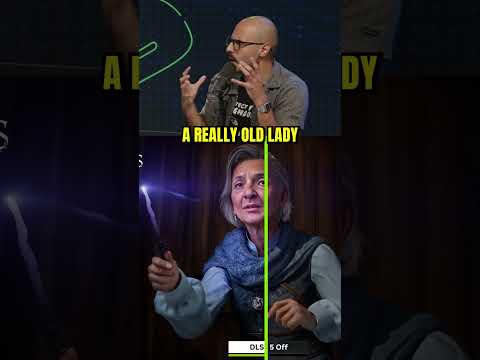
But the Kinda Funny discussion nailed the core problem better than any marketing slide: even if you give me all those sliders, you still haven’t fixed the actual constraints. You’ve built a machine that hides them better — as long as I accept your default aesthetic.
The “old woman” example is exactly why this tech scares me
That extremely old-looking character example isn’t just meme fodder. It’s a perfect microcosm of what’s going wrong here.
Artists design an elderly woman to look truly aged. Harsh skin, uneven tone, deep lines, maybe even unsettling in a deliberate way. Hardware limits might mean they have to simplify some details, cut poly count, tone down shaders. That sucks, but it’s an honest compromise: their intent hits a wall, and we see the cost.
Now drop DLSS 5 on top. Suddenly, the AI decides what those wrinkles, pores, and shadows “should” look like. And what it tends to do — based on the early footage and breakdowns floating around — is clean her up. Smooth some surfaces, even out the tone, add that slightly glossy, oversharpened layer that screams “AI beautify pass.”
The artists didn’t intend that. The hardware didn’t demand that. The AI just did it because its training brain thinks: “Ah, a human face. Let me make that look like the fancy faces in my dataset.”
This isn’t fixing a technical constraint. This is masking it with someone else’s aesthetic. When the Kinda Funny hosts say DLSS 5 doesn’t really “bridge the gap” between art and hardware, that’s what they’re getting at. The pain point doesn’t go away — it just gets hidden under a generative filter that can actively fight the original intent.
And honestly, once I saw that, I couldn’t unsee it in the other DLSS 5 clips. The Starfield demo that people praised? Yeah, it looks richer, but it also looks subtly less like Starfield and more like “generic prestige sci-fi show on a streaming service.” The Resident Evil stuff? Some of it leans more into movie horror, but some of it slides into uncanny, overprocessed territory.
“It’s just a tool” is the laziest defense of this tech
Every time there’s pushback on DLSS 5, someone drops the same line: “Relax, it’s just a tool. Artists don’t have to use it.”
And in a vacuum, sure. On paper, it’s optional. NVIDIA says devs can mask, exclude, tune, or even disable DLSS 5. Bethesda says it’ll be under artist control. That’s all great.
But games don’t get made in a vacuum. They get made under deadlines, under publisher pressure, under marketing bullshit about feature parity and graphical “wow” moments for trailers. If DLSS 5 becomes a checkbox on a slide deck — “Supports DLSS 5!” — there will be enormous pressure to just flip it on and dial it toward “cinematic” whether or not it matches the original art direction.
And let’s be blunt: not every studio has the time or budget to deeply customize this for every scene, every character, every material. You think smaller AA teams are going to meticulously paint exclusion masks for stylized faces, test every cutscene, and iterate settings for months? Or are they going to crank the slider until QA stops complaining and marketing likes the screenshots?
The “just a tool” argument ignores power dynamics. The default becomes the standard. The slider position that NVIDIA demos becomes the baseline expectation. If you want to not use it, now you’re the one “leaving performance and visual quality on the table.” Good luck winning that argument with a producer who only sees side-by-side GIFs at 1080p on Slack.
So no, I don’t buy “it’s just a tool.” In practice, it’s a taste engine that will quietly push games toward a narrow idea of what “high-end” graphics look like — unless artists fight it every step of the way.
DLSS 5 doesn’t fix constraints — it risks making them invisible
Here’s the thing that really bothers me: DLSS 5 might actually slow down progress where it matters most.
If you’re a studio struggling with performance, you now have a tempting shortcut: slap DLSS 5 on, let the AI polish the output, ship it. Why spend more time optimizing geometry, streaming, materials, or animation fidelity if a neural net can patch over the rough edges well enough for a launch trailer?
Animations still stiff? Eh, the AI lighting and material work makes it all look smoother in motion. Character shaders undercooked? DLSS 5 adds that fake pore-level detail and filmic contrast. World feels a bit flat? Crank the “cinematic” pass and call it a day.
That’s what I mean by masking constraints. The underlying problems don’t get solved; they just get dressed up with AI sauce. And because the AI is guessing based on patterns, you get that homogenized look critics have been ripping into since the reveal: different games, somehow all smelling like the same tech demo.
The worst part? Players get gaslit. NVIDIA’s already leaning on the “don’t believe your eyes, trust the tech” angle through evangelists and marketing. If something looks off — a face too smooth, a weird shimmer in the lighting, a stylized character suddenly half-realistic — the response is basically: “Well, the model is operating at the geometry level, it’s technically more accurate.”
I don’t care if it’s more “accurate” to some abstract notion of photorealism. If it betrays what the art team was going for, it’s wrong.
Where DLSS 5 could actually be useful — if we stop pretending it’s magic
Here’s the twist: I’m not anti-tech. I like my frame rates high and my fans quiet. DLSS 2 and 3 have saved my PC more than once. I’m not out here demanding we go back to software rendering for the sake of purity.
DLSS 5 could be genuinely valuable if we stop treating it like a universal glow-up machine and start treating it like a niche, carefully controlled option:
- For heavy, realistic titles where the goal already is “look like a movie,” I get it. If your art direction is pure photoreal — sports games, simulation racers, gritty shooters — having an AI that sweetens reflections and materials while freeing up GPU time could be a win, if artists are actually steering it.
- For accessibility and lower-end hardware, if DLSS 5 legitimately lets a midrange card handle complex scenes smoothly without downgrading too much, that’s huge. More people playing at decent quality is always a good thing.
- As an opt-in, per-scene enhancement — imagine it used sparingly for specific cinematic setpieces, instead of just blanketing the entire game. That’s a tool. That’s intentional.
The key is intentionality. The moment DLSS 5 becomes the “on by default, don’t think about it” setting, we’ve lost. Because then it’s not amplifying the artist’s choices; it’s replacing them with a neural average of “what looks expensive.”
What I want from devs and NVIDIA before I trust this thing
If NVIDIA actually cares about art as much as they claim, here’s what I want to see before I even consider leaving DLSS 5 on in my own games:
- Ship it off by default. Let players explicitly opt into DLSS 5, not quietly have it enabled under “Recommended” or bundled with some vague “Cinematic” preset. If it’s that good, people will turn it on.
- Per-object and per-character hard excludes that are obvious and easy. Stylized faces, heavily designed materials, UI, VFX — give artists hard “do not touch this, ever” flags that the model respects.
- Style locks. If my game is cel-shaded, painterly, low-poly, or intentionally ugly, there should be a way to tell the AI: “You are not allowed to chase realism here. Enhance within this style, or do nothing.”
- Transparent controls for players. Don’t bury DLSS 5 behind a single toggle. Let me see intensity, material enhancement, facial treatment, all of it. If my old woman NPC suddenly looks like she’s had work done, I want to be able to dial that back myself.
- Artists on record, not just executives. I want GDC talks, postmortems, and dev diaries where actual character artists and technical artists walk through where DLSS 5 helped and where it fought them. Real workflows, not PR lines.
And on the studio side, I want someone — anyone — to be brave enough to say, “We tested DLSS 5 and chose not to use it because it clashed with our art.” The fact that some devs were reportedly surprised to see their studios listed as partners at all doesn’t exactly inspire confidence.
Where I’m drawing my own line with DLSS 5
After watching the Kinda Funny segment, digesting the backlash, and replaying those demo clips frame by frame, my line is pretty simple:
I’m treating DLSS 5 as guilty until proven innocent — and I’m turning it off in every game by default.
If a developer I trust comes out and says, “We used DLSS 5 here, in these scenes, with these constraints, and our artists loved it,” I’ll give it a shot. If a stylized game proudly brags, “No DLSS 5, 100% in-engine art,” I’ll respect that even more.
But I refuse to let an AI model — trained on god-knows-what, tuned by people who don’t ship games — decide how characters should look, how old they should seem, how gritty a world is allowed to be. That’s not a technical choice. That’s a creative one. And that belongs to the people actually making the games, not the people selling the GPUs.
DLSS 5 could still become a powerful ally for artists. Right now, though? In its launch pitch, with its beauty-filter demos, its waxy faces, and its “don’t believe your eyes” counter-messaging? It looks less like a bridge over hardware limits and more like a very expensive rug to sweep those limits under.
And as someone who’s spent decades falling in love with games precisely because of their <emimperfections< em> — the jagged edges where tech and art wrestle — I’m not ready to watch that wrestling match get covered up by neural gloss.
Let the artists speak. Then maybe I’ll listen.
FinalBoss // Gear
Level up your setup
01Top-rated gaming headsetson Amazon→02High-refresh gaming monitorson Amazon→03Gaming chairson Amazon→04Discounted game keyson Kinguin→Affiliate links · As an Amazon Associate, FinalBoss earns from qualifying purchases.
Want to Level Up Your Gaming?
Get access to exclusive strategies, hidden tips, and pro-level insights that we don't share publicly.
Ultimate Gaming Strategy Guide + Weekly Pro Tips