
Table of Contents (11)
That DLSS 5 Trailer Hit Me Like a Bad Instagram Filter
I was doing the usual late-night doomscroll when DLSS 5 slammed into my feed. Nvidia headline, dramatic music, RTX branding, the works. Cool, I thought, another incremental bump in resolution and frame gen. I’ve been using DLSS since the early, smeary days of 1.0; I know the drill. But then the footage actually started, and my brain did that instant recoil it hasn’t done since the worst era of uncanny PS3 faces.
Grace from Resident Evil Requiem pops up, and suddenly she doesn’t look like a character rendered in the RE Engine anymore. She looks like an influencer cosplaying Grace with lip fillers and an AI beauty pass. The Hogwarts Legacy kid? He stops looking sixteen and turns into some weird mid-20s model with pores and contouring. Even Virgil van Dijk in EA Sports FC goes from “elite footballer” to “Instagram brand partnership waiting to happen.”
I’ve spent decades watching graphics tech evolve. I’ve seen the jumps that actually mattered: going from PS1 fog to Dreamcast’s Shenmue streets, the first time I saw real-time shadows in Halo 2, the absurd detail of Red Dead Redemption 2’s world. DLSS 5 is the first time in years I’ve looked at “better graphics” and thought: this is actively worse for games.
DLSS 5 Isn’t Just Upscaling Anymore, It’s Repainting Your Game
To be fair, what Nvidia is doing is technically wild. DLSS 5 isn’t just reconstructing resolution or faking extra frames like DLSS 3 did. It’s a full-blown neural rendering pass: a model analyzing color, motion vectors and scene data every frame, then injecting “photorealistic” lighting, materials, skin and hair detail, even atmosphere. Depending on whose description you trust, it’s not just a dumb filter slapped on the final image; it’s anchored to actual geometry and textures the game engine outputs.
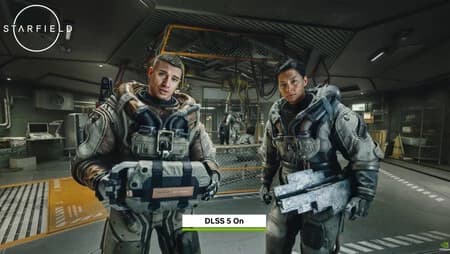
They showed it off in big-name titles because of course they did: Resident Evil Requiem, Starfield, Assassin’s Creed Shadows, Hogwarts Legacy. Dual RTX 5090 setup, maxed-out DLSS 5 settings, “cinematic” framing. Jensen Huang calls it a “GPT moment for graphics,” the kind of line that tells you exactly who they’re trying to impress: investors who think “AI” is a synonym for “value,” not players who actually have to look at this stuff for 80 hours.
And yeah, on a purely superficial level, it’s convincing. Skin reflects light more like skin. Metal feels more like metal. Eyes, hair, fabric – it’s all dripping in specular highlights and subsurface scattering. Digital Foundry, from their hands-on at GTC, basically called it a huge leap toward path-traced levels of lighting without full path tracing. Technically, I get the hype.
But “technically impressive” and “actually good for games” are not the same thing. When I watched those side-by-sides, my main reaction wasn’t “wow, that’s immersive.” It was “why does every game suddenly look like the same over-processed promo render?”
When Every Game Gets the Same AI Makeover, Art Direction Dies
I’ve been complaining for years that too many Unreal Engine games look like distant cousins of each other. Same lighting vibe, same kind of materials, same “cinematic third-person” visual language. It’s not that UE doesn’t allow variety; it’s that pipelines and defaults and market pressure slowly nudge everything toward one safe, proven look.
DLSS 5 takes that quiet convergence and slams the accelerator.
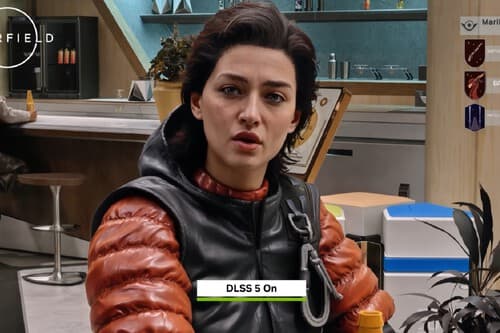
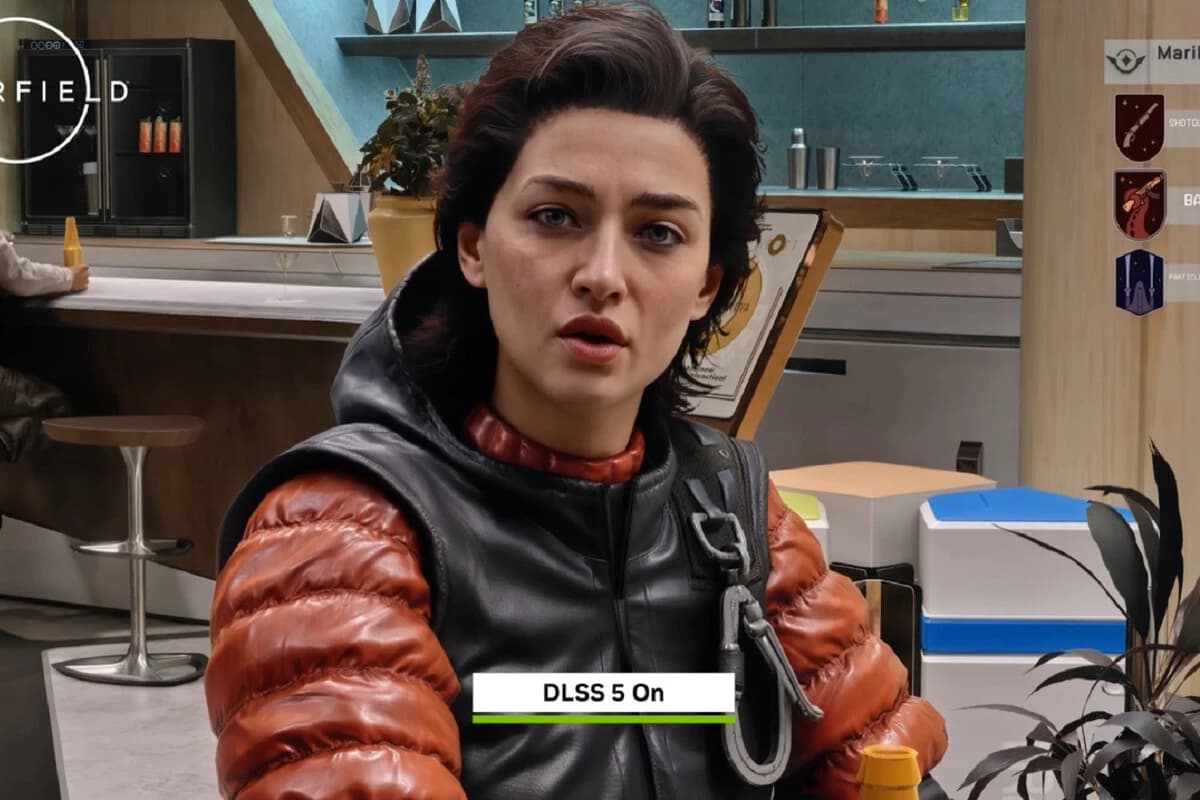
Look at the demos again. A Capcom horror game, a Bethesda RPG, a Ubisoft stealth epic, a wizard school adventure – all fundamentally different art directions… until DLSS 5 blasts them with the same neural understanding of “this is what reality should look like.” Shadows deepen. Contrast spikes. Faces get smoother, shinier, more symmetrical. Backgrounds stay fully in focus instead of leaning into depth of field, so scenes become this hyper-detailed but weirdly flat diorama.
The backlash online nailed it. People called it a “trash AI filter,” an “Instagram beauty filter for games,” said it looked like “exaggerated contrast, sharpness and airbrush.” They’re not wrong. You can tell there’s an AI model underneath trying to “fix” the image according to its training data, not the artists’ intent. It’s like running every game through the same photo-editing preset because the algorithm thinks that’s what’s most “engaging.”
Respawn’s Steve Karolewics and other rendering folks have already voiced what a lot of us felt: this looks over-processed and unnatural, like a filter that doesn’t care about the art decisions that were already made. When rendering engineers start sounding nervous about tech this close to their own turf, that’s a red flag.
I Remember the Uncanny Valley. We Worked Hard to Escape It.
The thing that really pisses me off is how familiar this all feels. DLSS 5 dragged me right back into the uncanny valley I thought we’d left behind years ago.
There was a time when “more realistic” was the only dial anyone cared about. Early 360/PS3 games with hyper-detailed but dead eyes. Human faces that were technically impressive but felt like corpses on puppeteering rigs. We all remember those cutscenes where your brain knew it was fake before you even clocked why.
We climbed out of that not just by throwing more compute at the problem, but by getting smarter about art. Naughty Dog didn’t beat the uncanny valley with polygon counts alone in The Last of Us; they did it with subtle animations and stylization. Kojima leans into strangeness in Death Stranding instead of chasing pure realism. Even the recent Resident Evil games have a very deliberate, heightened horror look. They’re not pretending to be reality; they’re owning the fact that they’re art.
DLSS 5 is Nvidia looking at all that progress and saying, “Cool, but what if we made everyone’s skin look like high-end skincare marketing?” It’s chasing a version of realism that impresses in a tech demo but starts to fray the second you remember games are interactive stories, not benchmark reels.
Photorealism Is Not Automatically “Better” – and Nvidia Acts Like It Is
This is where I think dlss nvidia equivoca – Nvidia is straight-up wrong about what “better graphics” means in games. They’re equating “closer to a live-action movie” with “objectively improved,” and that’s just nonsense if you’ve actually played anything outside the AAA grey-brown comfort zone.
Look at games that age well. The Wind Waker – mocked to death at reveal – still looks gorgeous because its stylization was confident. Guilty Gear Strive looks better than half the “realistic” fighters precisely because it leans into a bold anime aesthetic. Hi-Fi Rush will look good in 10 years because it knows exactly what it wants to be visually and sticks to it.
Even in more grounded worlds, style beats fetishistic realism. Red Dead Redemption 2 isn’t legendary because it chases photoreal pores. It’s legendary because it uses detail to serve interactions: muddy boots, smoke hanging in the air, horses reacting to gunfire. That’s visual design built around what the player does, not just what a still frame looks like on a 4K thumbnail.
Rockstar clearly gets this; even GTA VI has that slight cartoon edge inherited from the PS2 era, and it absolutely works. I’d take that over some DLSS 5 “fix” that irons it into generically attractive faces any day.
Rockstar clearly gets this; even GTA VI has that slight cartoon edge inherited from the PS2 era, and it absolutely works. I’d take that over some DLSS 5 “fix” that irons it into generically attractive faces any day.
🎮 Get This Game at the Best Price
Compare prices instantly and save up to 80% on Steam keys with Kinguin — trusted by 15+ million gamers worldwide.
*Affiliate link — supports our independent coverage at no extra cost to you
DLSS 5, as shown, doesn’t seem interested in that nuance. It’s chasing a singular idea of realism that comes straight out of AI training sets and Hollywood grading, and if you let that run wild across the industry, you flatten a huge range of visual identities into one boring “premium” look.
“It’s Optional” Sounds Great… Until It Isn’t
Nvidia and their publisher buddies know the backlash is real. Bethesda has already tried to calm people by saying the DLSS 5 Starfield footage was an “early look,” that their art teams will tune the lighting and effects, and, crucially, that it will be fully under their control and optional for players.
Jensen Huang insists this isn’t some runaway AI filter. According to him, developers can tweak intensity, color grading, even mask out areas that shouldn’t be touched. On paper, that sounds fine. In engineering terms, it’s reasonable. But I’ve been around long enough to know how this story usually plays out.
First, it’s “optional.” Then it’s “on by default, but you can turn it off in advanced settings.” Then, in the next game, it’s just baked into the render path, and turning it off is “not supported because it breaks our QA matrix.” Meanwhile, Nvidia has sunk millions into building this tech; you really think they’re going to be cool if most players just toggle it off?
We’ve seen this pattern with live service models, with aggressive motion blur, with intrusive sharpening, with every fad the suits decide is the future. The money comes first, the spin comes second, the “oh, I guess players didn’t want this after all” comes last-after a bunch of projects have already contorted themselves around the trend.
Right now, publishers like Bethesda, Capcom, Ubisoft, Warner Bros. are smiling and nodding in Nvidia’s demos, talking about “cinematic quality” and “next-gen immersion.” They love the marketing bullet point. But there’s no shipped game using this thing yet. No real benchmarks across dozens of scenes, no public beta feedback, no proof that studios will actually keep that optional promise once the SDK gets baked into their pipelines.
AI Graphics Should Serve Players, Not Humiliate Artists
What frustrates me most is how little respect this shows for art direction and the people behind it. You’ve got concept artists, lighting artists, material artists, all working for years to nail a coherent look. They push engines in weird directions, fight with tech constraints, cheat reality to make something that feels right for their world.
Then DLSS 5 comes along as this giant, learned model that says, “Nice job, but my dataset thinks your skin shading is wrong, so I’m going to fix it. Also your lighting, and your hair, and your atmosphere.” Even if developers technically can tune and mask it, the whole pitch is built around overriding their work “for the better.” That’s humiliating if you actually care about your craft.
I’m not anti-AI in graphics by default. Smart upscaling that lets mid-range GPUs punch above their weight? Love it. AI denoising in path tracing so we can get decent performance? Totally fine. Tools that help artists iterate faster on their own vision, not overwrite it? That’s genuinely exciting.
But DLSS 5, as marketed, isn’t a quiet helper. It’s the headliner. The entire narrative is “you thought this game looked good before; watch how our AI makes it look like a Pixar-adjacent Netflix sci-fi drama.” It’s ego tech. It’s about Nvidia proving it can step into the role of co-director of your game’s visuals. And that’s where I draw the line.
The Industry Keeps Chasing Trends Nobody Asked For
This DLSS 5 mess is the same sickness that gave us the doomed gold rush on live-service everything. Boardrooms decide “this is the future,” sink ridiculous money into it, then twist games around the tech instead of starting from what makes them fun or memorable.
Recently, a lot of people have been pointing out how live-service bloat crashed into reality: players didn’t want every game to be a forever grind. Now we’re watching the same mindset latch onto AI graphics. Instead of asking “what visuals best serve this game,” the question becomes “how can we showcase our AI stack in this game?”
That’s backwards. The best-looking games I’ve played didn’t start from a technology bullet point; they started from a mood, a place, a fantasy. Shenmue’s Yokosuka streets. Yharnam in Bloodborne. The neon filth of Night City when it’s finally running properly. If any of those had to clear some AI filter standard of “photoreal,” they’d be less themselves.
What I’d Actually Accept From DLSS 5
Here’s the thing: I don’t think DLSS 5 is inherently evil. The raw tech could be used in ways that aren’t obnoxious. I could see it doing subtle work on reflections, or helping simulate tricky materials under weird lighting conditions, as long as it’s doing so invisibly and under tight artistic control.
But that means a few non-negotiables:
- It must never be forced on as the only way to get decent performance.
- It needs a big, obvious toggle in settings, not buried three menus deep.
- Default presets should respect each game’s established art, not nuke it for drama.
- Developers should feel empowered to say “no thanks” without taking a marketing hit.
Used subtly, with restraint, DLSS 5 could be just another tool in the box. But Nvidia clearly doesn’t want subtle. Their whole GTC show was about shock value: “look how different this looks!” That’s not how you talk about a gentle enhancement; that’s how you talk about a takeover.
Where I’m Drawing the Line as a Player
I’ve spent my whole life watching this medium grow up. From blocky PS1 faces to the eerie calm of Shadow of the Colossus, from the grounded mess of The Last of Us Part II to the stylish chaos of Devil May Cry 5. The stuff that sticks with me is never “this texture looked like a real photograph.” It’s the games that knew exactly who they wanted to be on screen.
DLSS 5, the way Nvidia is selling it right now, feels like an attack on that identity. It treats games as incomplete drafts waiting for the AI grown-up to come in and make them “properly realistic.” And sorry, but no. I don’t want my horror monsters, my space weirdos, my stylized cowboys run through the same neural taste filter.
When this thing ships in autumn 2026 on RTX 50-series cards, I’m not touching it unless a dev I really trust tells me, “Look, we tuned this specifically for our game, it enhances our style, and you can turn it off if you hate it.” Until then, that slider is staying off, and my money’s going to games whose visual identity comes from artists, not a generic AI model trained to impress slide decks.
Nvidia can keep chasing their “GPT moment for graphics.” I’ll be over here chasing something they can’t train a neural network on: games that actually look like themselves.
FinalBoss // Gear
Level up your setup
01Graphics cardson Amazon→02Gaming laptopson Amazon→03High-refresh gaming monitorson Amazon→04Discounted game keyson Kinguin→Affiliate links · As an Amazon Associate, FinalBoss earns from qualifying purchases.
Want to Level Up Your Gaming?
Get access to exclusive strategies, hidden tips, and pro-level insights that we don't share publicly.
Ultimate Gaming Strategy Guide + Weekly Pro Tips