

Chroma in Clair Obscur: Expedition 33 is two systems wearing one name. Chroma Catalysts are the tiered materials you feed to the Curator to raise a weapon’s level, and they gate your damage far harder than most players realise — every weapon has passive breakpoints at rank 4, 10 and 20, and the top two tiers of catalyst are effectively finite. Luminas are the equippable effects you spend Lumina points on, and by mid-2026 the endgame meta around them is fully solved rather than speculative. This guide covers both: the exact catalyst tier ranges and what a 0→33 weapon actually costs, the best farms for each tier, every source of the one-time Perfect Chroma Catalyst, and the Lumina cores that carry current top-end builds.
Table of Contents (17)
Chroma Catalyst tiers and level ranges
You upgrade weapons through the Curator — in the cave to the right of the campfire at main Camp, or from any Rest Point, via Upgrade Weapon. Each catalyst grade only works inside a fixed level band. You cannot burn Resplendent stock on a level 2 weapon, and base Catalysts do nothing for a level 10 one.
| Catalyst | Weapon levels | Approx. total for one weapon 0→33 |
|---|---|---|
| Chroma Catalyst (base) | 1 → 3 | ~6 |
| Polished Chroma Catalyst | 4 → 9 | ~12 |
| Resplendent Chroma Catalyst | 10 → 19 | ~27 |
| Grandiose Chroma Catalyst | 20 → 32 | ~35 |
| Perfect Chroma Catalyst | 32 → 33 only | 1 |
Inside a tier the per-level cost climbs — 4→5 is cheaper than 7→8 — but it resets when you cross into the next tier, and no single upgrade ever costs more than 5 catalysts. That ceiling is what makes routing predictable: you are never one bad roll away from a wall, you are just short a known number of a known material.
The three passive breakpoints at rank 4, 10 and 20 are where a weapon stops being a stat stick and starts defining a build. If you are deciding between spreading upgrades or committing, commit — a weapon parked at rank 9 has one passive; the same investment concentrated to rank 20 has three.
Where to farm each tier
Base Catalysts (levels 1–3)
Purple-glow ground loot across Spring Meadows and Flying Waters, plus early enemy and boss drops. The story boss Goblu in Flying Waters hands over 3 base Catalysts and 1 Polished in a single clear. Two merchants carry stock: the one in the Gestral Village Bazaar and the one near the Old Farm Flag in Stone Wave Cliffs, through a small tunnel.
Polished Catalysts (levels 4–9)
The efficient answer is Petank mini-bosses. Each one yields 5 Polished Chroma Catalysts, and there are four accessible ones: Ancient Sanctuary, Stone Wave Cliffs, Esquie’s Nest and Forgotten Battlefield. Clearing all four covers a full weapon’s Polished band and then some. Polished also appears as floor loot across those same zones.
Resplendent Catalysts (levels 10–19)
This is the tier with no standout farm. Resplendent comes from natural progression — mid-to-late floor loot, story bosses and optional bosses once you are past the early zones. Late-game merchants in Sirene (Crumbling Path Flag, via the handholds near Glissando) and the Monolith (Tainted Meadows Flag, and Tainted Hearts Flag after beating Gargant) are where you top up when you are a few short. Budget accordingly: 27 is the single biggest tier requirement outside Grandiose.
Grandiose Catalysts (levels 20–32)
Two reliable sources once you are in Act 3. The Endless Tower throws Grandiose at you as you climb, which is convenient because you want to be there anyway. The tighter loop is Dark Shores in the south-west of the map: the area contains only three fights, every enemy in them drops 1 Grandiose, and the enemy counts are 2 / 2 / 3 — 7 Grandiose per full run, in a small area you can reset quickly. That is the best Grandiose-per-minute route currently documented.
Perfect Catalysts (level 32 → 33)
Perfect Catalysts are one-time rewards. There is no repeatable farm, so the number you can obtain per save file is finite and you must choose which weapons to cap. Known sources:
- Flying Manor (optional dungeon near the Axon Islands): Lampmaster (1), each of the Eveque trio — Flame, Frost, Thunder (1 each), Dualliste (1), and Clea (1).
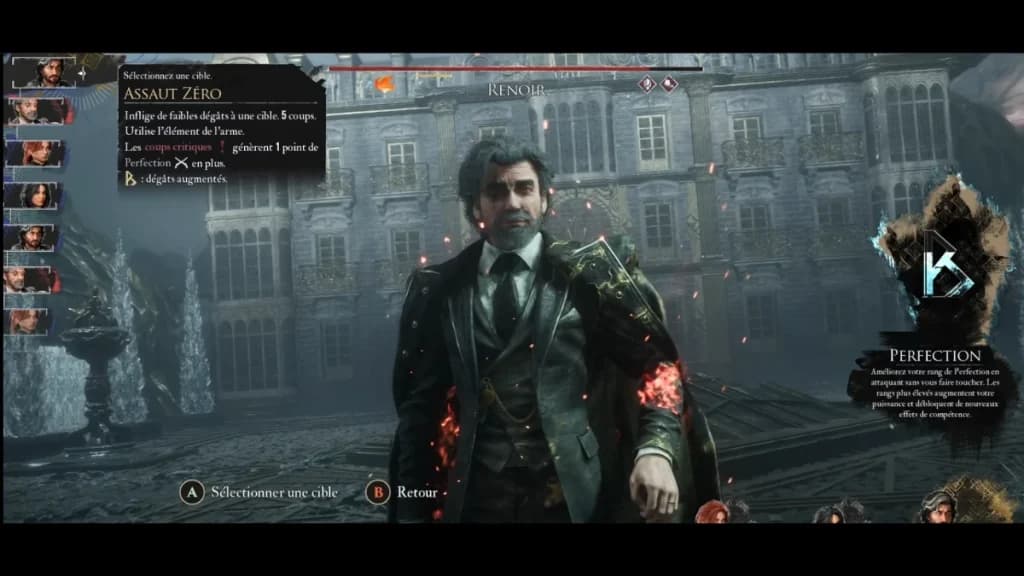
- Renoir’s Drafts: Chromatic Creation (1), and Simon, the superboss, drops 2.
- Serpenphare, the overworld superboss you reach with Esquie’s flight (1).
- Painting Workshop: beat Lampmaster, then talk to the Faceless Boy by the exit (1).
- Endless Tower: Stage 11, Trial 3 — the final challenge (1).
- Trash-Can Man: if you interacted with him in the prologue, revisit his spot in Act 3 (1).
The efficient order is Flying Manor first, then Renoir’s Drafts — those two dungeons cluster the most Perfects into the fewest trips. Our Esquisses de Renoir prep and loot guide walks the whole zone, including the Chromatic Creation fight that drops one.
New Game Plus note: NG+ replaces your catalyst upgrade paths with the higher-tier variants earlier in the run. Grandiose (to level 32) becomes accessible sooner, and Perfect — the level 33 cap — is NG+ territory. Weapons and their upgrade levels carry over, so nothing you invest is lost.
Weapon upgrade strategy: commit, don’t spread
The single most expensive mistake with Chroma Catalysts is generosity. Pushing five weapons to rank 8 costs roughly what pushing one weapon to rank 20 costs, and only one of those outcomes unlocks a build-defining passive. The routing that works:
- Pick one weapon per character that matches the build you actually intend to run.
- Push it straight through the base and Polished bands — these are cheap and the rank 4 passive comes fast.
- Bank Resplendent until you are sure, then take it to rank 20 in one push for the second and third passives.
- Save Grandiose for the two or three weapons that will still be in your party at the end of Act 3.
- Spend Perfect Catalysts last, and only on weapons you have already tested at rank 32.
If you want the wider farming picture — Chroma currency, Pictos and materials, not just catalysts — our Expedition 33 farming guide covers the best repeatable loops.

The Lumina side: what the endgame meta actually runs
Earlier versions of this guide argued that specific Lumina synergies were undocumented and told you to test your own. That is no longer true. By 2026 the late-game consensus is settled, and it is built on a small shared core plus one dominant damage pattern.
The shared Lumina core
These show up on almost every top-end build regardless of character:
- Cheater — damage on status and weakness exploitation. Near-universal.
- Critical Burn — the multiplier that makes Burn scaling absurd.
- Energising Start I–III / Energy Master — full AP on entry, so your opening turn is a real turn.
- First Strike / Augmented First Strike — front-loads damage, which matters when the goal is a turn-one kill.
- At Death’s Door — a huge low-HP damage steroid, the backbone of the risky builds.
- Shortcut, Painted Power, Combo Attack — turn-cycle and charge acceleration on the support half of the party.
The stat target underneath all of it is ~100% crit rate on your damage characters. Farm Luminas and Pictos toward that first; damage multipliers stacked on an unreliable crit rate produce a build that feels great in half your fights and terrible in the other half.
The four synergies that define the meta
- Maelle — Stendhal Virtuose nuke. Enter Virtuose (Mezzo Forte / Swift Stride), stack Burn hard with Burning Canvas or Pyrolyse, then fire Stendhal or Phantom Strike + Last Chance. With Critical Burn and At Death’s Door online this is a one-turn boss delete. Medalum or Chantenum are the late-game weapon picks; prioritise Luck and Agility.
- Lune — Dark Stain / Elemental Genesis. Wildfire and Thunderfall stack Dark Stains and Burn; at max Stains you cash out with Elemental Genesis. Scaverim is the weapon of choice specifically to exploit the four-Dark-Stain bonus. She also doubles as your Burn applicator so Maelle’s nuke scales.
- Sciel — Fortune’s Fury turn engine. Fortune’s Fury hands extra turns to Lune or Maelle, Delaying Slash pushes boss turns back, and Intervention is the panic button. Sciel is not the damage; Sciel is the reason the damage happens twice.
- Verso / Monoco — Break and Mark. Verso ends his turn with Marking Shot or Defiant Strike, with Double Mark to extend it, so the next hit from Maelle or Lune lands into a multiplier. Monoco applies Break and Mark through Clair Enfeeble and Chapelier Slash, and is worth benching until a Break-heavy fight.
Put together, the standard endgame party is Maelle (nuke) + Lune (Burn / Dark Stain) + Sciel (Fortune’s Fury) + Verso or Monoco (Break/Mark). For rotation-level detail on how those turns actually sequence, see our Expedition 33 best teams and rotations guide, and the skills tier list for where individual abilities land.
Patch changes you should know about
- Patch 1.5.0 (12 December 2025) added Lumina Sets — up to 50 saved loadouts. If you have been manually re-speccing between fights, stop; save a nuke set, a sustain set and a Break set and swap in two clicks.
- Patch 1.5.6 (30 June 2026) fixed two things that directly affect these builds. Burn applied to an already-stunned enemy no longer lets that enemy act the moment the stun ends, which makes Burn-centric plans meaningfully more reliable. And several Lumina effects on top-tier weapons — Cleim, Martenon and Sireso — were not triggering consistently on AoE skills or at battle start; they now fire correctly.
- Patch 1.4.0 removed the Second Chance + Healing Boon + Protecting Death immortality combo and fixed a Thermal Transfer extra-turn bug. If an old guide recommends either, it is out of date.
Nothing in any published patch note has changed Chroma Catalyst tier ranges, per-upgrade costs or drop rates. The tables above have held since launch.
FAQ
What is the maximum weapon level?
33. Levels 20–32 use Grandiose Chroma Catalysts; the final step from 32 to 33 requires one Perfect Chroma Catalyst, which is a one-time reward from a fixed set of bosses and dungeons.
Can I farm Perfect Chroma Catalysts?
No. Every known source is a single, non-repeatable reward. Plan which weapons you cap before you spend one.
What is the fastest Grandiose farm?
Dark Shores in the south-west. Three fights, seven Grandiose per clear, small enough to reset quickly.
Do I need to test my own Lumina combos?
Not any more. The core — Cheater, Critical Burn, Energy Master, First Strike, At Death’s Door — plus the Maelle Stendhal / Lune Dark Stain / Sciel Fortune’s Fury structure is the current community consensus. Use Lumina Sets to keep a couple of variants saved rather than rebuilding from scratch each time. More Expedition 33 coverage lives on our Clair Obscur: Expedition 33 hub.
FinalBoss // Gear
Level up your setup
01Top-rated gaming headsetson Amazon→02High-refresh gaming monitorson Amazon→03Gaming chairson Amazon→04Discounted game keyson Kinguin→
Affiliate links · As an Amazon Associate, FinalBoss earns from qualifying purchases.
Want to Level Up Your Gaming?
Get access to exclusive strategies, hidden tips, and pro-level insights that we don't share publicly.
Ultimate Guide Strategy Guide + Weekly Pro Tips