

Table of Contents (29)
Why Expedition 33’s Combat Feels So Demanding
After spending dozens of hours grinding out perfect parries and Break loops in Clair Obscur: Expedition 33, the pattern finally clicked: this isn’t a normal turn-based RPG. The combat is Reactive Turn-Based – your choices still happen on turns, but your execution is judged in real time with strict timing windows.
When I first started, I treated QTEs as flashy animations and button-mashed through defenses. The result was predictable: missed parries, wasted AP, and bosses that felt like brick walls. The breakthrough came when I started treating every attack and defense as a rhythm game with clear inputs, time windows, and punish/reward loops.
This guide breaks down the combat system the way I wish I’d learned it:
- Exact timing windows for attacks, parries, and dodges (in milliseconds)
- How AP, QTEs, and the Break meter actually interact under the hood
- Character-specific tech that turns clumsy turns into lethal combo rotations
- Platform and patch notes that matter for input lag and practice
- Step-by-step drills that can take you from “whiffing QTEs” to “95% perfects”
Expect around 1-2 hours to internalize the basics and 10-15 hours of real practice to reach high-level consistency (85–95% perfect QTE rate, near zero chip damage on most encounters).
Step 1 – Get Your Setup Right (Prerequisites)
Most people who “can’t hit parries” aren’t actually bad at timing – their setup is fighting them. I made the same mistake and lost hours before fixing it.
Controller & Display Setup
- Use a wired controller (Xbox Series, DualSense, etc.) whenever possible.
Step → Action → Result: Plug in via USB → Disable wireless → Cut ~10–20ms of input delay, which is a huge chunk of the 100–150ms parry window.
- Lock to 60Hz / enable Game Mode on your display.
Step → Action → Result:Options → Video→ Set refresh to 60Hz & enable low-latency/Game Mode → Smoother QTE circles and more predictable timing.
- On PC, make sure V-Sync is correctly configured.
- As of Patch 1.2, PC received V-Sync fixes for cleaner QTEs – use in-game V-Sync first, then experiment with driver-level settings if you still feel stutter.
Unlocking the Full Combat Kit
- The system really opens up after the prologue (~30–45 minutes) once you have Gustave, Maelle, Lune, and eventually the full 6-character party by Chapter 3 (~2–3 hours).
- At that point you’ll have:
- Enough skills with different AP costs to practice real rotations
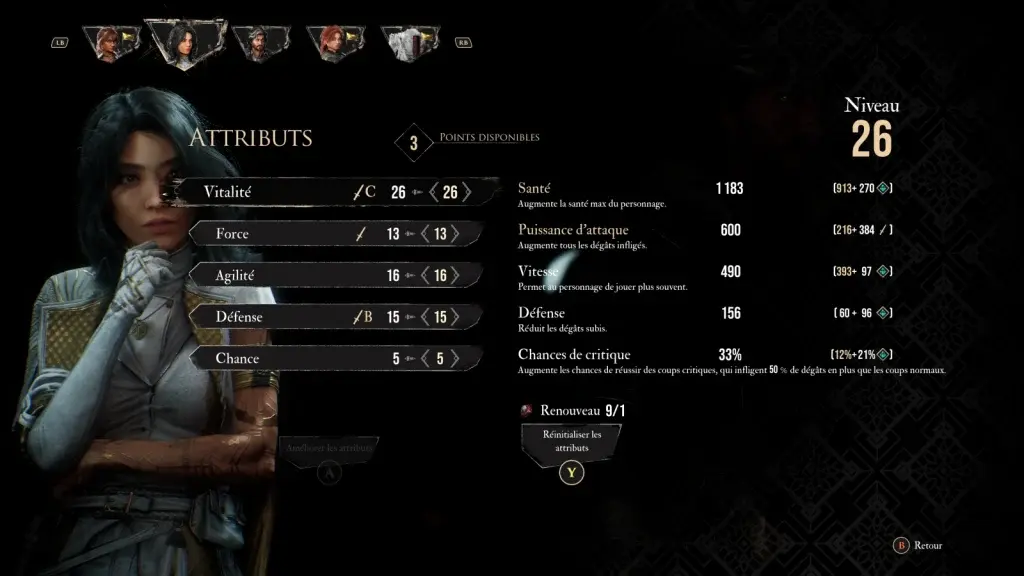
- Access to Pictos (passives) and Lumina (stat allocation)
- Better opportunities to build and exploit the Break meter
Core Build Foundations (Pictos & Lumina)
- Pictos – passive modifiers (e.g. +Break damage, extended parry window, status synergies).
- Priority early: anything that buffs Break gain, timing windows, or AP regen via parry.
- Farm early enemies in Nevrons for a steady trickle – expect roughly 5–10 Pictos per hour.
- Lumina (stat points) – a simple but very abusable system:
- Agility: First priority. Faster turns, tighter control of initiative, and better feel for reactive defense.
- Might: Second. Straight damage – amplifies the payoff from perfect QTEs and Break windows.
- Luck: Third. Crits and Break-related bonuses. Great once the basics are stable.
- Defense: Low priority if you consistently parry/dodge; the system heavily rewards skillful avoidance over face-tanking.
If your damage feels anemic, it’s often because Pictos/Lumina are ignored. That can easily be a 30–50% effective DPS loss versus a tuned build.
Step 2 – Understand the Reactive Turn-Based Flow
Think of Expedition 33 as a hybrid between classic ATB systems and a rhythm game. Turns are ordered, but every meaningful action has a timing check.
- Turn Order Bar: The bar at the top shows upcoming actions based on Agility.
- High-Agility characters can “double-turn” slower enemies, especially with speed buffs.
- Action Points (AP):
- You start each of your turns with around 3–5 AP (scales with level & builds).
- Skills consume AP; basic attacks are cheap or free.
- Parries restore AP (typically +1 per successful parry), and some skills like Gustave’s Overcharge add bonus AP (+2).
- Battle Wheel:
Step → Action → Result: Your portrait glows → Open Battle Wheel → Choose Attack / Skill / Item / Free Aim → Commit to an action with a timing window.- Use shortcuts (e.g.
L1/R1) to cycle quickly; hesitating in the menu is the fastest way to miss QTEs.
A full “think → choose → execute” turn usually runs 5–10 seconds. Once you know your rotations, your brain load drops a lot, and you can reserve your focus for the actual timing windows.
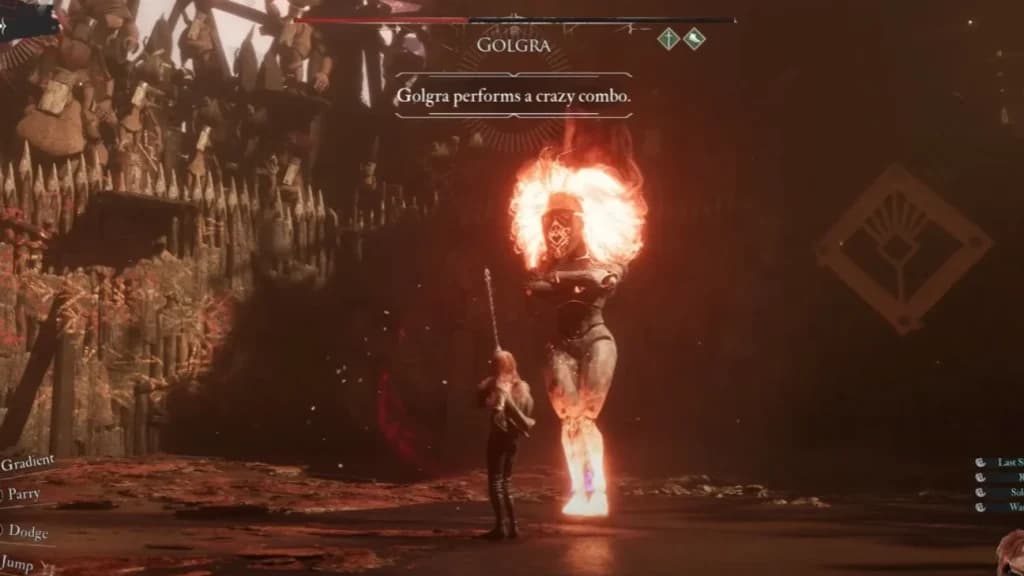
Step 3 – Offensive Mechanics: AP, QTEs, Breaks & Combos
Offense in Expedition 33 is about precision, not spam. The game pays you hard for perfect timings – and punishes sloppy ones just as hard.
Timing Windows – The Numbers That Matter
- Skill QTE circle:
- Perfect inner ring: ~100ms window – gives ~2x damage plus enhanced effects (extra Break buildup, extra hits, etc.).
- Green success zone: ~200–300ms – standard success, ~1.5x damage.
- Outer failure zone: Miss or late press – usually drops you to ~0.5x damage with no bonus.
- Patch 1.2 note (consoles): Timing windows were expanded by ~5%, making perfects slightly more forgiving if your setup is clean.
Step-by-Step Skill Execution
Step → Action → Result: Choose skill (e.g. Lune’s Stains, 2 AP) → Watch the shrinking circle → TapA / Xas the ring hits the inner green zone → Big damage + strong DoT + extra Break build.- Stringing together 3+ perfect skill QTEs begins to fill the Gradient / Break-related gauge under enemy HP.
- Each perfect hit generally adds around 20% Break, so expect 4–6 perfects for a full Break, depending on skills and Pictos.
The Break System – From Build to Exploit
- The Break Meter (yellow bar under enemy HP) builds as you land attacks, with perfect QTEs giving the biggest chunks.
- At 100%, you must deliberately use a Break-marked skill (e.g. Gustave’s Detonate) to trigger Break.
Step → Action → Result: Fill Break meter → Select a Break-capable skill → Enemy is stunned, loses their next action, and takes ~+50% damage from all sources for about one turn.
- Some Pictos can increase Break gain or extend the stun to effectively two turns, enabling “no-turn” loops on certain bosses.
Your goal in most fights becomes: Build Break fast → Explode damage during stun → Repeat before they can stabilize.
Practical Offensive Rotations
- Gustave – Weak Point Alpha Strike:
Step → Action → Result: Ambush (First Strike) → Use Free Aim shots on glowing weak points → Each hit deals ~2x damage and high Break gain → Chain into a Break skill for AoE detonation.- On PC, mouse-based Free Aim can feel ~20% snappier; on consoles, use the auto-assist toggle added around Patch 1.2 to help snap to weak points.
- Maelle – Stance Combo Chain:
- Open with a stance-accelerating move like Swift Stride, nail its relatively tight (~150ms) QTE window, then transition into Virtuous Stance for boosted speed and crit.
Step → Action → Result: Apply Burn → Swift Stride (perfect) → Virtuous Stance → Follow with multi-hit skills → Rapid Break and huge single-target damage.
- Lune – DoT Break Builder:
- Perfect QTEs on Stains upgrade them (e.g. Stain II has ~25% max HP DoT over time) and can stack up to 3 times on a target.
- During Break, refreshing high-level Stains lets you carry massive damage past the stun window.
Once you have one or two reliable rotations like these, you can start thinking in terms of “AP budget per turn” instead of random button presses.
Step 4 – Defensive Mechanics: Dodge, Parry, Jump & Counters
Defense is where most players either unlock the combat’s brilliance or hit a wall. There is no passive block – you must react to every major enemy attack.
Timing Windows for Defense
- Dodge (usually
Circle / B):- Window: ~400ms (blue ring) – the most forgiving defensive option.
- Effect: Negates damage, great for fast multi-hits and when you’re learning patterns.
- Parry (usually
Square / XorYdepending on layout):- Window: ~100–150ms (gold ring) – narrow but powerful.
- Effect: Nullifies or heavily reduces damage and typically restores +1 AP. Multi-hit strings can be parried one hit at a time.
- Jump (Triangle / Y):
- Window: ~200ms (red upward arrow prompt).
- Effect: Avoids ground-based AoE only. Using jump when the attack needed a dodge/parry will usually get you hit.
Parry Chains & Counters
- Many enemy combos come as multi-hit strings. If you parry every hit in the string, the game often rewards you with an automatic counter for ~1.5x return damage.
Step → Action → Result: Recognize telegraph → Time parry on hit 1 → Stay ready for subsequent hits → Land full parry chain → Free counter + multiple AP restored.- A long 10-hit parry streak can build a temporary Resolve effect (depending on build/Pictos): bonus shielding and +1 AP per turn for several turns. With specific gear, Gustave can even reflect ~20% of incoming damage while shielded.
This is where the system really rewards mastery: a good player will defend every turn and come out with more AP than they started.
Common Defensive Pitfalls & Fixes
- Problem: Constantly missing parries by a hair.
- Likely cause: Mild input lag or misreading the telegraph.
- Fix:
- Re-check 60Hz/Game Mode and wired input.
- Spend 10–15 minutes in a low-risk encounter focusing only on parries, not on winning fast.
- Target: Hit at least 20 perfect parries in a row before moving on.
- Problem: Overusing dodge and never parrying.
- Result: You survive, but you starve yourself of AP and counters.
- Fix: Start by forcing yourself to parry the first hit of every combo, then dodge the rest until you’re comfortable extending the chain.
- Problem: Getting hit by ground AoE despite “dodging”.
- Cause: Those patterns often demand a jump, not a dodge.
- Fix: Train yourself to notice the specific red arrow icon and higher-pitched audio cue that signal a jump requirement.
Step 5 – Character-Specific Mechanics & Synergies
Each of the six main characters layers an extra mechanic on top of the core system. Once you understand the basics, these are where big optimization gains come from.
- Gustave (Leader / Gun)
- Core: Free Aim weak-point shots and AP manipulation (e.g. Overcharge).
- Playstyle: Use him to start encounters with First Strike ambushes and to quickly Break high-priority targets via precision shots.
- Maelle (Melee / Stances)
- Core: Swaps between Virtuous and more aggressive stances via well-timed QTEs (e.g. jumps and mobility skills).
- Playstyle: Treat her like a stance-dancing combo machine – perfect QTEs speed her up and push your Break uptime sky-high.
- Lune (Mage / Stains)
- Core: Applies stacking Stains (DoTs and debuffs); perfect QTEs enhance them (Stain II, III, etc.).
- Playstyle: Long fights become dramatically easier if you maintain high-level Stains and refresh them during Break windows.
- Sciel (Support / Shields)
- Core: Barriers and buffs, often triggered or amplified by successful parries.
- Playstyle: Pair Sciel with a parry-focused frontline – full parry chains can grant team-wide barriers (e.g. ~50% damage reduction for a couple of turns).
- Verso (Tank / Gradient Charge)
- Core: Builds a rage/gradient meter through blocking and surviving hits, then unloads massive AoE.
- Playstyle: In fights where you can’t cleanly avoid everything, Verso converts “necessary damage taken” into burst AoE.
- Monoco (DPS / Picto Synergy)
- Core: Scales heavily with the number and level of equipped Pictos, enabling mid-combo stance or mode changes.
- Playstyle: Think of Monoco as your late-game stat monster – shines when you have lots of Pictos leveled and want to push pure DPS.
For most of the main story, a strong trio like Gustave / Maelle / Lune can handle almost everything: Gustave for control and Break, Maelle for single-target burst, Lune for attrition and boss melting.
Step 6 – Building Your Party: Pictos, Lumina & Stats
Raw timing skill is only half the story. A poorly tuned build turns great execution into mediocre results.
Pictos – Passive Powerhouses
- Break-focused Pictos: Increase Break buildup or extend Break duration.
- Best when paired with high-Agi attackers (Maelle, Gustave) so they can reach Break faster and benefit more turns in a row.
- Parry-focused Pictos: Widen parry windows (e.g. +50ms), add chip damage on parry, or grant Resolve-like buffs.
- Highly recommended while learning; turning a 100ms parry window into ~150ms can be the difference between frustration and flow.
- Damage-over-time & Elemental Pictos: Synergize especially well with Lune’s Stains and Burn/other status setups.
Lumina Stat Targets
- By around Level 20, a strong general-purpose distribution might look roughly like:
- Agility: Your highest stat – enough to consistently act ahead of most enemies.
- Might: Close second – this is your Break and burst amplifier.
- Luck: A flexible third stat to spike crit rates and certain Break interactions.
Step → Action → Result: Prioritize Agility and Might in Lumina menus → Your turns come faster and hit harder → Break windows arrive sooner and hurt more, shortening fights.
For New Game+ and higher difficulty, investing in parry-boosting Pictos plus Agility stats opens up near-infinite AP loops through constant parry refunds.
Step 7 – Practice Routines & Troubleshooting
Once I stopped randomly “playing the game” and started deliberately training specific skills, my performance jumped fast.
- Use Training Grounds / QTE Practice Mode (added around Patch 1.3):
- Spend 15–20 minutes just practicing offensive QTEs with a favorite skill until you can hit 10 perfects in a row.
- Then do the same for defensive prompts (parry vs dodge vs jump).
- One-Thing Sessions:
- Run 2–3 normal encounters where your personal rule is: “I must parry the first hit of every enemy combo.”
- On the next set, change the rule: “I must land a Break within 3 turns on at least one target.”
- Track Your Metrics:
- Use in-game stats to monitor perfect QTE rate. Aim for:
- ~70% while learning
- ~85%+ for comfortable story clears
- 90–95%+ for NG+ and boss speed-kill runs
- Use in-game stats to monitor perfect QTE rate. Aim for:
If you feel stuck, the usual Culprit List is: input lag, ignoring Pictos/Lumina, and not respecting enemy telegraphs. Fix those first, then refine your timing.
Step 8 – Advanced Tech: Break Loops & Zero-Damage Runs
Once you’re comfortable, Expedition 33’s combat quietly turns into a combo-puzzle game. The following ideas are what make late-game and NG+ feel broken in the best way.
- AP-Positive Defense Loop:
Step → Action → Result: Stack parry-boosting Pictos + Agility → Perfect-parry most incoming attacks → Gain more AP than you spend each cycle → Convert that surplus AP into constant offensive skills and Break triggers.
- Break Locking:
- Use First Strike to open with a fast Break on one target.
- During Break, stack DoTs (Lune) and stance buffs (Maelle), then push the next enemy’s Break meter before the first one recovers.
- With “Stun extension” Pictos, it’s possible to chain back-to-back Breaks and deny bosses most of their turns.
- Weak-Point Clear Speedruns:
- Gustave targets weak points with Free Aim while the rest of the team runs high-AoE skills.
- Enemy packs can vanish within ~15 seconds if you combine weak-point detonations with party-wide AoE under Break.
- Zero-Damage Runs:
- Build around:
- High Agility
- Parry-window Pictos
- Sciel’s barriers and support
- Goal: Fully parry or dodge every single attack. Once you can do this for a full boss fight, you’ve essentially “solved” that pattern.
- Build around:
With practice, you stop thinking of combat as “press attack until it dies” and start thinking in rotations, resource cycles, and timing windows. That’s where Expedition 33 really shines.
TL;DR – Key Steps to Master Expedition 33 Combat
- Clean your setup: 60Hz, Game Mode, wired controller, stable framerate.
- Prioritize Agility & Might with Lumina; equip Pictos that buff Break, parry windows, and AP gain.
- Learn the timing numbers:
- Perfect QTE: ~100ms
- Standard QTE: ~200–300ms
- Parry: ~100–150ms
- Dodge: ~400ms
- Use parries to generate AP, not just to avoid damage.
- Play around Break: 4–6 perfect hits → Break skill → full-team burst inside the stun.
- Build a core trio like Gustave / Maelle / Lune and master one or two reliable rotations.
- Deliberately practice in Training Grounds / QTE mode until you can maintain 85–95% perfect QTEs.
- Push advanced loops: AP-positive parry chains, extended Breaks, weak-point nukes, and eventually zero-damage boss clears.
If you treat every fight as a chance to refine your timing instead of just “win the battle”, Expedition 33’s reactive combat system rewards you with faster clears, cleaner fights, and that deeply satisfying feeling of having actually mastered its mechanics instead of brute-forcing them.
FinalBoss // Gear
Level up your setup
01Top-rated gaming headsetson Amazon→02High-refresh gaming monitorson Amazon→03Gaming chairson Amazon→04Discounted game keyson Kinguin→
Affiliate links · As an Amazon Associate, FinalBoss earns from qualifying purchases.
Want to Level Up Your Gaming?
Get access to exclusive strategies, hidden tips, and pro-level insights that we don't share publicly.
Ultimate Guide Strategy Guide + Weekly Pro Tips