
Table of Contents (10)
The Expedition 33 moment that made me lose patience
Watching the Indie Game Awards publicly strip Clair Obscur: Expedition 33 of its Debut Game and Game of the Year titles felt like watching the industry trip over its own performative ethics in real time.
This is a game that had just pulled off the impossible: an original IP from Sandfall Interactive, a new studio, grabbing 2025 Game of the Year at a major show and snagging Best RPG on top of it. An ambitious, weird, turn-based RPG that actually landed – and, frankly, made a lot of bloated AAA games look lazy by comparison. I was genuinely thrilled it existed. It felt like one of those rare moments where the system rewards artistry and risk instead of just brand recognition.
Then, days later, the same industry that happily platformed it suddenly decided it was too dirty for the “indie” trophy shelf because of one thing: Sandfall confirmed they’d used a tiny sliver of generative AI during development – a “0.1%” placeholder asset from 2022 that was supposedly never meant to ship. The Indie Game Awards yanked its titles and handed them to Blue Prince, whose publisher Raw Fury made a point of stressing their game was “built and crafted with full human instinct” over eight years and contained no AI.
The message was obvious: the line isn’t “don’t use AI.” The line is “don’t admit you used AI, and definitely don’t get caught with even a trace of it left lying around.” That’s what actually pissed me off.
The facts: what Sandfall actually did (and didn’t) do
Let’s ground this before anyone accuses me of hand-waving. Sandfall Interactive admitted they experimented with generative AI early in development. One placeholder asset – from those experiments — lingered where it shouldn’t have. Their line is that no AI assets exist in the final game itself; this was legacy cruft from 2022 that slipped through the cracks in peripheral material.
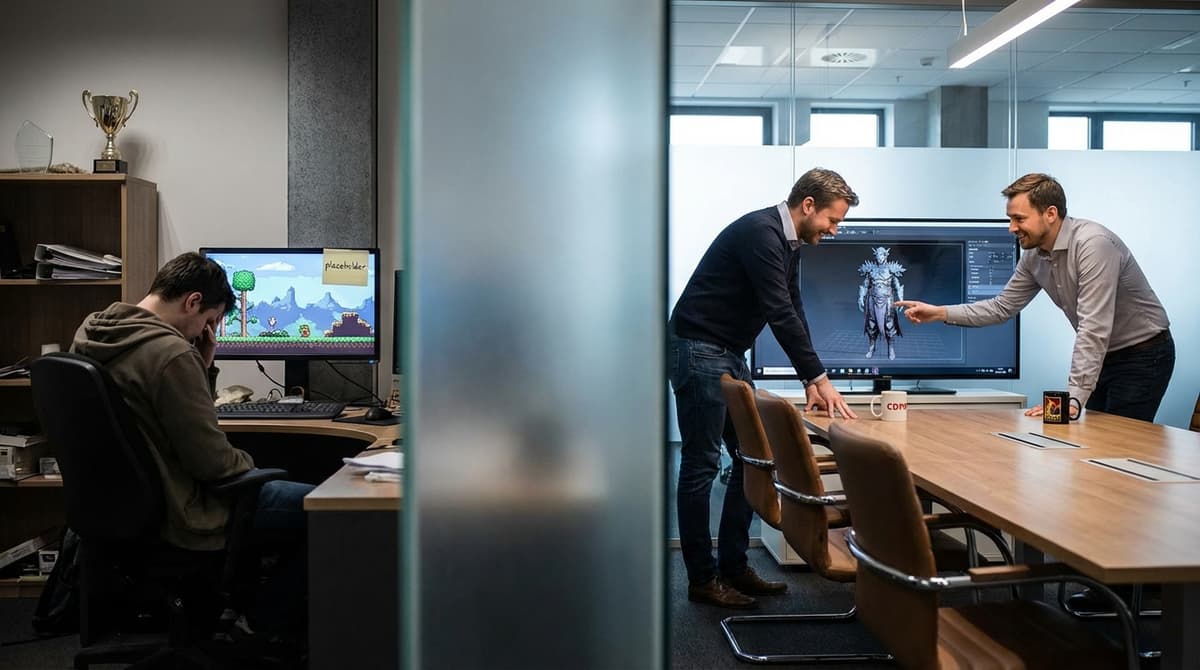
Now, “placeholder” has become the magic word every studio throws out whenever AI art gets spotted. It’s already a cliché defense. Recent coverage has pointed out how often so-called placeholders mysteriously survive ship and show up in marketing materials or in-game menus. Pearl Abyss said the same thing when AI art was found in Crimson Desert. Owlcat has talked about using AI for “vision coordination” and prototyping on its Expanse RPG while promising everything in the actual game will be “100 percent human-made.” The pattern is familiar: lean on AI for speed, tell people it’s just internal, then apologize if any of it leaks into public view.
So yeah, I don’t think Sandfall is blameless here. If you claim your final product is AI-free, you have to be absolutely ruthless about hunting this stuff down and deleting it. But I also don’t buy that one ancient placeholder is enough to retroactively erase the reality of what Expedition 33 achieved as a piece of art and design. That’s where the Indie Game Awards completely lost the plot.
Meanwhile, Larian and others quietly normalize AI behind the scenes
Here’s where the hypocrisy really kicks in.
Earlier that same month, Larian Studios — the darlings of the industry after Baldur’s Gate 3 — confirmed they’ve been using generative AI in planning for the next Divinity game. They were explicit that AI wouldn’t touch actual game assets: no AI-written dialogue, no AI voices, no AI art in the release build. The tools are being used for ideation and pre-production, and they’ve promised a detailed FAQ to outline the boundaries.
I actually respect the honesty there. This is what a grown-up conversation about AI should look like: say what you’re using, where, why, and what you refuse to automate. But compare how that was received versus how Sandfall was treated. Larian’s transparency sparked debate, sure, but nobody’s stripping them of awards or declaring their future games ineligible. The implicit consensus is: as long as the magic word “final” is respected, we’re cool.
And it’s not just Larian. Owlcat, again, has openly talked about using generative AI for internal mood boards and placeholders. Capcom is literally building an entire “AI level” aesthetic into Pragmata — not with real AI, ironically, but by imitating its glitches and uncanny-feeling errors. AI has become part of the visual and conceptual grammar of how games are made and even how they comment on modern life.
CD Projekt Red has also been talking about AI tools in a more general productivity sense — and while details are fuzzy and not as pinned down as Larian’s public statements, it’s clear they’re at least exploring the space like every other big studio that wants to ship sprawling open worlds without crunching their people into dust. None of this is shocking. Of course giant RPG factories are looking at tech that promises faster iteration, quicker test content, and faster localization passes.
So we have a situation where multiple beloved studios are either already using or openly exploring AI for planning, coordination, or “vision,” and the community isn’t torching their entire legacy. But a small French studio that left one ancient AI placeholder in its wake gets its breakout indie awards revoked. Same technology. Different PR outcomes. Completely inconsistent application of “ethics.”
The line isn’t moral, it’s cosmetic
The ugly truth is that the industry’s line on AI isn’t about ethics, labor, or artistic integrity. It’s about optics. It’s about whether the AI use is visible, scandalous, and meme-able.
If generative AI helps you write ten variations of a quest description that a human then rewrites, nobody cares. If it generates level blockouts that a designer later rips apart and rebuilds, nobody cares. If it does early mood art and you hire an illustrator to paint over it and own the final piece, most people will shrug. Awards bodies don’t have the tools — or frankly the will — to audit any of that. They rely entirely on what studios choose to admit.
On the other hand, if some AI-looking monstrosity ends up on a load screen or a marketing banner? Suddenly it’s a crisis of artistic purity, and everyone scrambles to show they’re “taking a hard stance.” Not because they’ve changed their values overnight, but because they’ve been publicly embarrassed.
That’s exactly what the Indie Game Awards disqualification of Expedition 33 looks like to me: damage control masquerading as principle. If they genuinely believed that any contact with generative AI disqualifies a game from being a valid indie effort, they’d need to start interrogating every nominee about their tools and pipelines in detail. They didn’t. They punished the one studio that put its hands up and explained what happened.
Blue Prince and the rise of “AI-free” as a marketing label
Then there’s Blue Prince, the game that inherited Expedition 33’s trophies. None of this is Raw Fury’s fault; they just found themselves in the right place at the right time. But the way they framed the game in their statement says everything about where we’re heading.
They emphasized that Blue Prince was crafted over eight years, powered by “full human instinct,” and made a clear point: no generative AI was involved. It was positioned almost like an organic, hand-made food label in a supermarket full of processed junk. That’s smart marketing, and honestly, I’m glad a traditionally-built indie can capitalize on being purely human.
But let’s not pretend this doesn’t create a weird hierarchy of perceived purity that has very little to do with the actual quality of the games. Blue Prince might absolutely deserve those awards on its own merits; that’s not the issue. The problem is tying legitimacy to a binary “AI-free” label in a world where more and more studios, including some of the most celebrated, are openly weaving AI into some part of their workflow.
If we keep going down this road, awards will become less about “what did you make?” and more about “what tools are you willing to publicly admit you used?” That’s not a serious critical framework; that’s vibes-based policing.
My stance on AI in games: pro-human, not blind to reality
I should be clear here: I don’t want a future where half the Steam front page is AI slurry and the other half is “content” spat out by execs who think Midjourney can replace a concept artist with 15 years of craft. I care about human creativity, about labor, about people being paid to do honest work instead of being turned into glorified prompt janitors.
But I’m also not going to pretend we’re putting the AI genie back in the bottle. Of course studios are experimenting. Of course someone in design is smashing prompts into a model to generate quick variations. Of course producers are asking whether AI can automate test dialog, localization passes, or camera setups. It’s already happening, from the biggest publishers down to small teams trying to survive in a brutal market.
My line is different from what the Indie Game Awards just broadcast. I care much more about:
- Is AI being used to directly replace paid creative roles?
- Is it being trained on unlicensed work without consent?
- Is the studio lying or obfuscating when they’re caught?
- Are they transparent about where the human craft actually sits?
If a team uses AI to rough out some early ideas and then throws it all away once real people start building the game, I still have questions, but it’s not even in the same moral league as auto-generating thousands of environment textures and firing half your art team. Lumping every kind of AI interaction into one radioactive bucket doesn’t protect artists; it just obscures where the real harm is happening.
Placeholder excuses vs. award-show theatrics
That said, the “placeholder” defense is wearing thin, and Sandfall isn’t magically exempt from criticism. A lot of developers and critics have pointed out something pretty basic: placeholders, historically, are supposed to be obviously temporary. They’re big red cubes, rough sketches, backed-in stock photos with watermarks — things you can’t accidentally ship without a dozen people noticing.
When studios say, “oh, that AI art was just a placeholder we somehow forgot to remove,” that’s not a neutral statement. It points at sloppy production, weak QA, or a culture that’s comfortable letting unlicensed or ethically dubious material sit in the build for months at a time. So yes, I think Sandfall should wear some of that. If they’re going to experiment with AI, they need internal guardrails stronger than “maybe someone will remember to delete this later.”
But punishment has to match intent and impact. Stripping Expedition 33 of its indie awards over a small, historical mistake in the margins — while the actual 40-60 hour RPG experience is the result of human writing, human art, human sound, human design — feels disproportionate to the point of being performative. Especially when other studios are already laying the groundwork to bake AI deeper into their pipelines in ways that will be much harder to see, let alone challenge.
The policy vacuum at the heart of all this
The core problem is that almost nobody in power has real rules yet. Awards shows, platform holders, even a lot of publishers are winging it. They’re reacting case by case based on community outrage and social media temperature, not on any coherent standard.
Imagine if, instead of panicking once a year when another AI controversy blows up, the Indie Game Awards and others laid out something like this:
- No generative AI is allowed in final in-game assets for art, writing, VO, or music if you want to qualify for “indie” categories.
- Any use of AI in pre-production, concepting, or toolchains must be disclosed privately to the jury, with examples.
- If generative AI does slip into shipping materials, awards are only reconsidered if the studio refuses to remove or correct it.
- Repeat offenders or studios caught lying get banned for a set period; honest mistakes get documented and monitored, not punished retroactively by tearing down everything they made.
Is that perfect? No. Is it enforceable down to every line of code and every brushstroke? Obviously not. But it’s at least a framework that acknowledges nuance instead of pretending that one forgotten placeholder is equivalent to building your entire game on the backs of non-consenting artists.
Right now, the message from the industry is basically: “Use AI all you want, just don’t let us see it — unless you’re a prestige studio, in which case we’ll applaud your transparency as long as you reassure us that the ‘final’ game is human.” It’s incoherent. And it’s making players more cynical, not less.
What this changes for me as a player
Before all this, Clair Obscur: Expedition 33 was one of those rare games that cut through my launch fatigue. I’d been burned by big-budget releases enough times that I’d mostly retreated into weird indies and old comfort food. Expedition 33 pulled me back into the excitement of watching a new RPG world unfold, turn by turn, with systems that actually respected my time and imagination.
That hasn’t changed. The game is still the game. Whatever Sandfall did or didn’t do with AI in 2022 doesn’t retroactively erase the hours of human work that clearly went into the final product. I’m not uninstalling it because a jury suddenly decided it no longer qualifies for a certain label.
What has changed is how seriously I take awards bodies when they start lecturing about integrity. The Indie Game Awards’ handling of this mess made me trust them less, not more. It signaled that if a controversy flares up around some other tool or hot-button topic, they’re just as likely to throw a game under the bus to protect their image instead of doing the hard work of building real criteria.
On the flip side, I’m paying much closer attention to how studios talk about AI. When Larian says “we’re using it here, not here, and here’s the line we won’t cross,” that actually buys goodwill with me, even if I’m wary. When a publisher tries to sell “no AI” like a Health Check label but says nothing about working conditions, crunch, or pay — I side-eye that too. Purity branding without substance isn’t any more comforting than tech boosterism.
Where this leaves us
We’re in an awkward, messy transition period where generative AI is both a dirty word and a quietly normalized tool, depending on where you look and who’s talking. Sandfall Interactive got publicly hammered for tripping over that contradiction at the worst possible time. Larian, Owlcat, and probably half the studios you can name are trying to navigate it more carefully, hoping transparency buys them space to experiment without a mob forming.
I don’t think the answer is to declare any contact with AI forever disqualifying, nor do I think we should shrug as big companies automate more and more of the craft that makes games meaningful. We need sharper questions, better rules, and less lazy moral theater.
For now, I’m stuck in a weird place. I love that Clair Obscur: Expedition 33 exists. I’m glad Blue Prince is getting its moment as a proudly human-built indie. I’m cautiously curious about what Larian’s next Divinity looks like after their AI-assisted planning. And I’m watching CDPR and every other big studio like a hawk as they chase “productivity” with whatever tools Silicon Valley throws at them.
What I don’t have yet — and what the industry clearly doesn’t either — is a stable, honest way to tell which uses of AI are acceptable compromises and which are crossing a line we’ll regret. Until that gap closes, we’re going to keep getting episodes like Expedition 33: great games caught in the crossfire of rules that only seem to matter once someone gets caught.
FinalBoss // Gear
Level up your setup
01Top-rated gaming headsetson Amazon→02High-refresh gaming monitorson Amazon→03Gaming chairson Amazon→04Discounted game keyson Kinguin→Affiliate links · As an Amazon Associate, FinalBoss earns from qualifying purchases.
Want to Level Up Your Gaming?
Get access to exclusive strategies, hidden tips, and pro-level insights that we don't share publicly.
Ultimate Gaming Strategy Guide + Weekly Pro Tips