
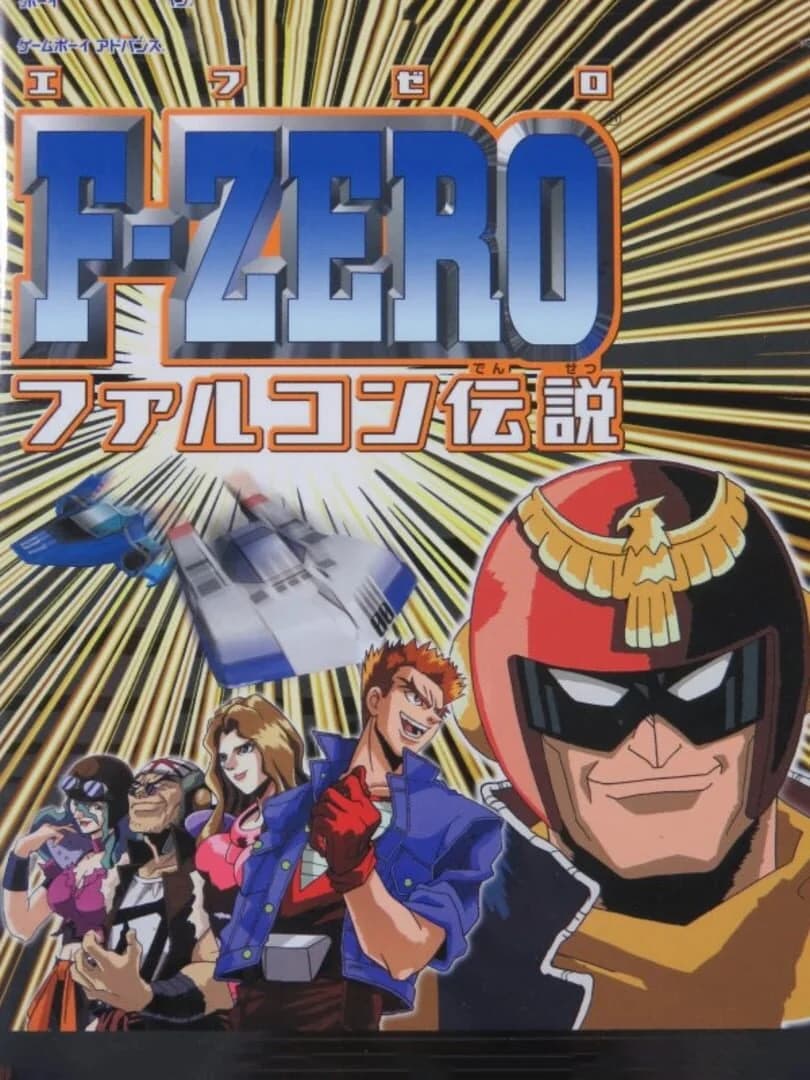
Before F-Zero had a sprawling legacy, it had a flat image performing a magic trick. In 1990, the Super NES used Mode 7 to scale and rotate a background plane beneath a hovering machine, and suddenly a console racing game looked like it had ripped open the future. The road bent toward the horizon. The track seemed to rush under the vehicle. Every sharp turn carried the ugly, thrilling possibility that the player had pushed too hard and was about to pay for it.
That feeling matters because it explains the entire strange history of F-Zero, including F-Zero: Falcon Densetsu. Nintendo did not build this series as a comfortable racer where every player could feel capable after a lap or two. It built a machine for people willing to fight the track, learn the edges of control, and accept that speed comes with a cost. The franchise’s tragedy is that Nintendo spent decades treating that intensity as a liability when it was always the whole point.
F-Zero became a ghost because Nintendo had another racing series that was easier to explain, easier to pick up, and far better suited to a broad party-game audience. That does not make Mario Kart inferior. It makes it a completely different answer to a completely different player need. The mistake was allowing that distinction to become an excuse for leaving F-Zero behind.
Table of Contents (5)
F-Zero Was Built Around Losing Control
The defining feature of F-Zero has never been futuristic paint jobs or the vague idea of going fast. Plenty of games have neon tracks and high speedometers. F-Zero stands apart because it makes speed feel hostile. Its anti-gravity machines hover inches above the surface, and that lack of contact creates a fundamental tension between player input and vehicle behavior. The faster the machine moves, the less it feels like a friendly extension of the player’s hands.
That is a design choice, not a flaw to be ironed out. A conventional racing game often gives players a dependable relationship with the road: turn the stick, understand the drift, correct the slide, recover. F-Zero asks for something harsher. You commit to a line before the danger arrives. You manage momentum before it becomes a crisis. You feel the machine start to escape you, then force it back into shape with a mix of timing, memory, nerve, and outright stubbornness.
I value that resistance because so much modern racing design mistakes immediate comfort for depth. Smooth handling has its place, especially in a game built to support a room full of people with wildly different skill levels. But F-Zero should never chase that kind of approval. The franchise works because its vehicles feel dangerous enough to demand respect. You do not casually steer an F-Zero machine through a turn. You negotiate with it at catastrophic speed.
That is why calling F-Zero “Nintendo’s other racer” has always been lazy. It makes the series sound like a less successful version of something designed for a completely separate purpose. Mario Kart is built around readable handling, playful interference, and the rapid reversals that make a group race memorable. F-Zero is built around precision under pressure. It is an anti-grab racer. It refuses to hold the player’s hand, stabilize every mistake, or turn danger into a joke.
Mode 7 Was More Than a Technical Flex
The original game’s Mode 7 presentation was revolutionary because the technology served the fantasy. Mode 7 let the Super NES scale and rotate backgrounds to create a convincing faux-3D view, and F-Zero used that trick to sell impossible velocity. The tracks were technically flat, yet they communicated distance, momentum, and looming disaster with shocking clarity.
That illusion also shaped how the game felt to play. A flat plane racing toward the screen creates a particular kind of tunnel vision. The track is not a welcoming environment. It is a strip of survival space surrounded by consequences. The road seems to move beneath the machine rather than sitting patiently under it, which gives the player the sensation of skimming across a surface that barely wants to support them.
That old visual trick is why the current retro-technology conversation around F-Zero feels more meaningful than another empty nostalgia lap. Super ZSNES, a return built by original ZSNES authors zsKnight and _Demo_, includes a Super Enhancement Engine aimed at giving selected Super NES games modernized presentation options. It supports high-resolution assets, texture mapping, overclocking, widescreen presentation, improved audio, and GPU-driven 3D conversions for Mode 7 backgrounds.
The important word there is conversion. The goal is not to slap a blurry filter over old pixels and call it preservation. The engine can take a Mode 7 background and render it with a proper 3D perspective camera and height maps. In F-Zero, that changes details such as track pylons, allowing them to look like they actually rise from the ground rather than merely sitting on a rotating flat layer.
Super ZSNES currently supports seven games, includes save states and rewinding, and depends on community mods for wider feature expansion. I do not see that as a replacement for a new F-Zero. It is more useful as a reminder of what made the original worth revisiting. The old game still has mechanical identity strong enough that people want to interrogate its visual language, rebuild its perspective, and see how its tracks behave when the illusion gains new depth.
Nintendo Let the Wrong Lesson Win
After 1992, audience attention moved hard toward Mario Kart. Nintendo had a racing series with accessible handling, instantly readable chaos, and a social loop that could turn a race into an event even when nobody in the room understood racing games. Meanwhile, F-Zero demanded concentration. It punished clumsy inputs. It offered exhilaration through mastery rather than reassurance through constant recovery.
That split helps explain why F-Zero spent so much of its life fighting for oxygen. The series reached real peaks with F-Zero X and F-Zero GX, each proving that the central idea could survive new hardware and new dimensions. Then came a gap that stretched for roughly two decades. The franchise returned in fragments: nostalgia-driven Switch Online availability, cameos, and eventually F-Zero 99.
What irritates me is the implied lesson behind that absence. Nintendo treated F-Zero as though an uncompromising racer had to justify its existence by becoming broader, friendlier, or more recognizably like its bigger sibling. That thinking is backwards. A catalogue full of polished, inviting games has more need for one sharp-edged outlier, not less. The company already knows how to make people laugh through a race. It has spent far too long refusing to make them sweat through one.
F-Zero: Falcon Densetsu belongs in that wider argument because the series has always been more expansive than the narrow public memory Nintendo allowed it to have. There is a world around these machines: personalities, rivalries, technology, spectacle, and a sense that the sport itself is too fast, too loud, and too dangerous to be civilized. A future entry should treat that material as fuel for a stronger racing identity, not as a decorative skin wrapped around safer handling.
F-Zero 99 Made the Argument Nintendo Needed to Hear
F-Zero 99 matters because it did not revive the franchise by sanding it down into a generic online racer. Its core appeal comes from making the old pressure more immediate. The crowded track, the constant threat of contact, and the demand to preserve momentum all reinforce the original series philosophy: survival is part of the race.
That is the proof Nintendo needed. Players did not need F-Zero to become a forgiving kart game with faster scenery. They responded to the exact thing the franchise had been denied the chance to emphasize for years: fierce competition shaped by speed, risk, and technical decision-making. The formula still works because it was never dependent on old hardware. It was dependent on a willingness to let the player feel overwhelmed before they become capable.
There is a temptation to frame F-Zero 99 as a pleasant side project, a clever way to keep an old name circulating while Nintendo decides whether it wants to do anything bigger. I reject that framing. It has already demonstrated that the series’ central tension can still pull players in. The question is whether Nintendo has the nerve to build a full-scale game around that tension rather than using it as a limited novelty.
A New F-Zero Needs to Protect the Fear
A real return cannot be a museum piece, and it cannot be a disguised attempt to make F-Zero behave like something it is not. Modern hardware should give Nintendo more room to push the franchise’s original fantasy: enormous futuristic circuits, visual depth that makes speed feel physically intimidating, and vehicles whose handling rewards discipline rather than button-mashing.
The Super ZSNES work provides a useful visual clue. Giving Mode 7 tracks a proper 3D perspective and height-mapped detail does not erase the original identity; it exposes the ideas that old hardware had to imply. A modern F-Zero should follow that same philosophy. It should expand the illusion without sterilizing it. More detail, more scale, more verticality, more machine personality-but always in service of the same terrifying relationship between velocity and control.
- Keep the handling demanding enough that every clean lap feels earned.
- Build tracks around risk, momentum management, and lines that require commitment.
- Use modern visuals to make anti-gravity racing feel unstable, massive, and physically threatening.
- Let the world of F-Zero: Falcon Densetsu inform the sport’s identity instead of reducing it to background flavor.
- Give competitive play the same priority that F-Zero 99 proved players will embrace.
Nintendo does not need to rescue F-Zero from its identity. It needs to stop apologizing for that identity. The franchise began as a technical showcase because the Super NES needed a game that could make players believe a flat screen had become a racing world. Its next full return should chase the same ambition: create a speed machine so intense that players feel slightly out of control, then give them the tools to earn control back.
That is the practical lesson from F-Zero: Falcon Densetsu, from Mode 7, from the long silence, from Super ZSNES’s attempt to give the old tracks new perspective, and from F-Zero 99. Preserve the fear. Preserve the friction. Preserve the feeling that finishing cleanly required more than showing up. A new F-Zero should make players work for the future again.
FinalBoss // Gear
Level up your setup
01Top-rated gaming headsetson Amazon→02High-refresh gaming monitorson Amazon→03Gaming chairson Amazon→04Discounted game keyson Kinguin→Affiliate links · As an Amazon Associate, FinalBoss earns from qualifying purchases.
Want to Level Up Your Gaming?
Get access to exclusive strategies, hidden tips, and pro-level insights that we don't share publicly.
Ultimate Gaming Strategy Guide + Weekly Pro Tips