

Fields of Mistria Review: 1.0 Makes Its Village the Real Progression System
The museum ledger stopped feeling like a checklist the afternoon I arrived in Mistria with a bag full of fish, bugs, crops, and an artifact I had been saving for the right donation set. I handed everything over, collected the rewards, and then did what Fields of Mistria quietly trains me to do: I walked through town before heading home. People had fresh things to say. The donation had changed the texture of the day. By Friday night, I was back at the inn with the town gathered around me, and the farm work I had done that morning had become part of a larger place with its own gossip, rituals, and history.
That is Fields of Mistria at its best. I planted crops, raised animals, fished, mined, foraged, cooked, and crafted, but none of those tasks stayed isolated for long. Every useful item had another destination: a museum collection, a town repair requirement, a request, an upgrade, a recipe, a relationship, or a story milestone. Version 1.0 finishes the shape of that idea with the complete storyline, new unlocks, expanded social content, marriage, 10-heart events, and children. The result is one of the most absorbing cozy farming games I have played because the town itself gives my daily work momentum.
Table of Contents (9)
Key Takeaways
- I found the villagers and their changing dialogue to be the game’s strongest feature, especially after museum donations, town progress, and major story beats.
- I treated museum completion and Town Repair as the real progression spine, since they gave fishing, farming, bug catching, mining, and artifact hunting a clear purpose.
- I enjoyed crafting and cooking because materials constantly fed into useful goals, though the frequent menu visits, inventory sorting, and repeated inputs regularly broke my rhythm.
- I found the 1.0 additions meaningful rather than decorative: the full storyline, marriage, 10-heart events, children, and higher Town Renown give a long-running save a proper finish line.
- I recommend Fields of Mistria strongly to players who want a social, story-led farm life rather than a private optimization sandbox.
The Villagers Turn Routine Into a Reason to Leave the Farm
I rarely stayed on my farm all day because Mistria made that choice feel wasteful. A field of crops can wait an hour; a new conversation after a major donation or a story step cannot. I kept routing my errands through town, partly because I wanted to check requests and partly because the cast gave me a reason to care about what my labor had changed.
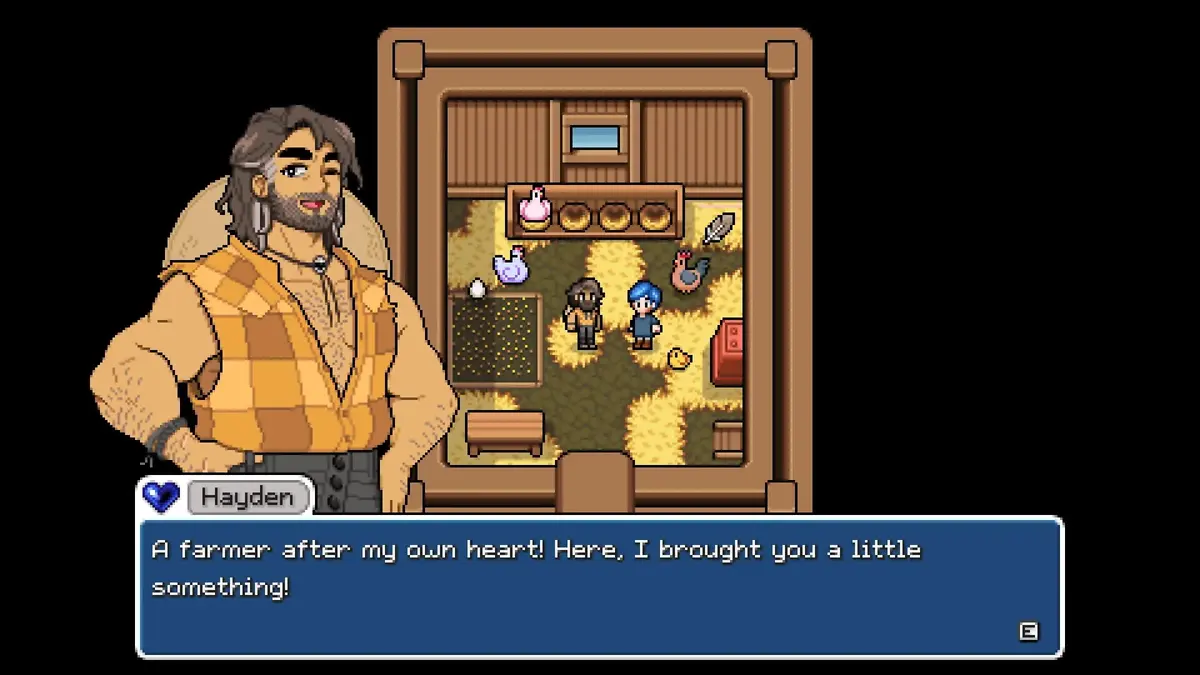
March, Olric, Holt, Nora, Ryis, Hayden, and the rest of Mistria’s residents never blended into the usual background crowd for me. Their personalities land quickly, but the important part is that they continue to matter after the first good introduction. I found fresh dialogue at the inn, around town events, and following progress that would have gone unacknowledged in a thinner farming game. The regular Friday-night gatherings became a small but vital ritual in my save. I was not visiting the inn to tick off a friendship task; I was visiting because I wanted to see how the town was spending its evening.
The same applies to Caldarus, the dragon statue at the center of Mistria’s magical undercurrent. Talking to a dragon statue and assigning chores to a pink dog should be a ridiculous pair of sentences, yet both fit the town’s warm, earnest fantasy tone. Fields of Mistria has a playful surface, but I felt a real sense of lore beneath it. The village’s problems, its repairs, and its supernatural history all gave my ordinary agricultural routine more weight.
I came away convinced that the villagers are not an accessory to the farming loop. They are its emotional interface. Crops pay the bills, mining produces materials, and cooking turns ingredients into useful items, but the people of Mistria make those actions feel connected to a home I was actively helping rebuild.
The Museum and Town Repair Give Every Activity a Job
The museum is where Fields of Mistria separates itself from a farm sim built around harvest schedules alone. I donated fish, bugs, crops, artifacts, and other finds because each category did more than fill an empty display. Donations unlocked rewards, encouraged me to explore areas I might otherwise have ignored, and pushed my broader town progress forward. A good museum system turns collecting into a loop. Fields of Mistria turns it into infrastructure.
I always had a practical answer when I wondered what to do with the next in-game day. If my fields were watered, I could fish for a missing donation. If I had enough energy, I could mine for materials. If I needed a break from both, I could forage, catch bugs, check a request, talk to villagers, or work toward a recipe. The game kept feeding those activities back into Town Renown, repair goals, and story progression. My choices never felt like filler between harvests.
The early town-rank structure already gave Mistria a substantial 70-level progression foundation, and the 1.0 release builds on that work with the completed Town Repair questline, higher Town Renown, and the finished main storyline. I appreciated having a town-scale goal that remained visible even when I was deep in a smaller personal project. My farm could become tidy and profitable, but Mistria still needed something from me.
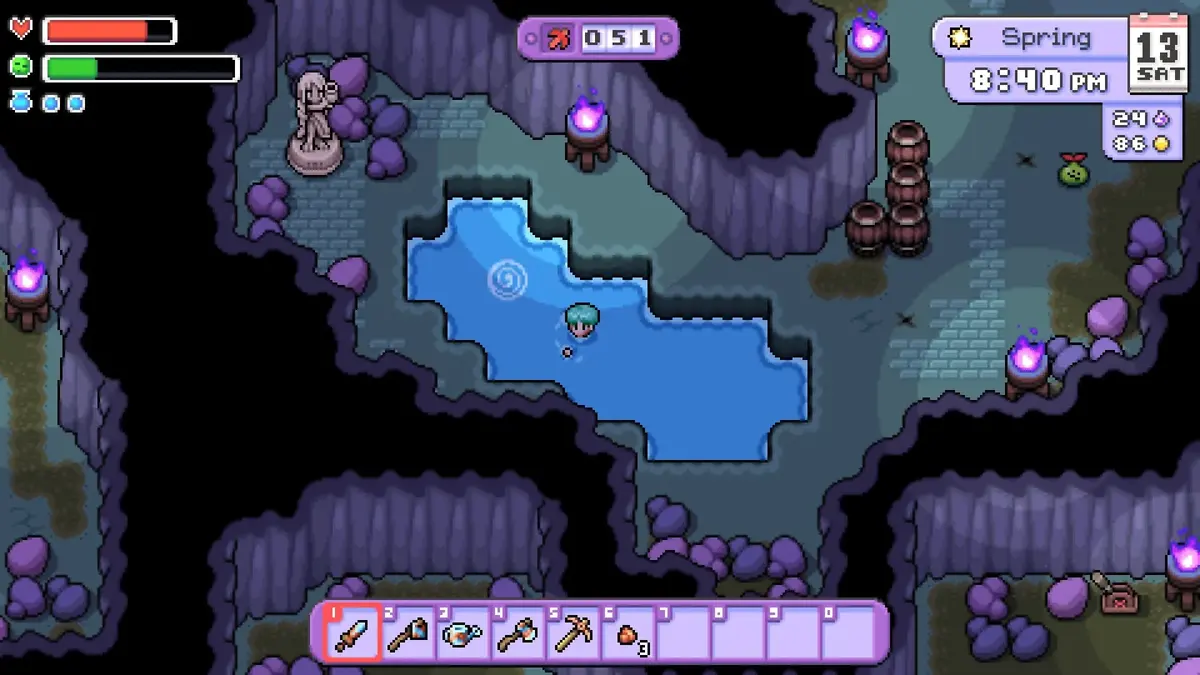
I also loved how the museum created social consequences. A collection screen is usually a silent wall of missing entries. Here, donations sent a ripple through town. The people around me recognized progress, and that recognition made each completed set feel more satisfying than a reward popup ever could.
Crafting and Cooking Are Useful, Busy, and Sometimes Too Menu-Heavy
I enjoyed the crafting and cooking loop because the game rarely let materials become meaningless clutter. My haul from farming, foraging, fishing, and mining could become a recipe, a useful upgrade, a town contribution, or a component for another project. That integration kept me gathering with intention. I was not hoarding resources because the genre expects hoarding; I had active places to spend them.
The problem is that Fields of Mistria often makes me work through too many interfaces to follow that intention. I moved repeatedly between my inventory, relationship information, crafting recipes, cooking screens, requests, museum needs, and town systems. A normal day could easily stretch past 20 minutes because I was talking to everyone and opening one more menu before deciding where to go next. The density is compelling, but it comes with a real pace cost.
I felt the friction most sharply when I was trying to keep a quick routine. Repeated inputs and inventory management could turn an otherwise soothing session into a small administrative chore. The tool-and-haul side of farm work never stopped me from enjoying the game, but I noticed every extra bit of sorting when I wanted to move fast. Fields of Mistria asks me to stay mentally engaged with its systems, and I did not always want that level of attention during a cozy evening.
Version 1.0’s quality-of-life work softens some of that irritation, and I appreciated the practical options around romance-related notifications in particular. Still, I would not call the interface invisible. I tolerated its roughness because the underlying loop was excellent, not because the friction disappeared. Players who want a farming game built around pure low-effort relaxation should know that Mistria is busier and more menu-conscious than its pastel appearance suggests.
Version 1.0 Gives Relationships and Story a Proper Ending
The early version of Fields of Mistria already gave me plenty of reasons to build friendships, but romance had stopped short of the payoff I wanted from a long-term life sim. Version 1.0 closes that gap. Raising a relationship to its maximum can now lead into romance and marriage, while 10-heart events give the major relationships more room to breathe. Children add another long-tail layer to a save that previously risked feeling emotionally unfinished once I had seen the available relationship scenes.
I value those additions because Mistria’s cast earned them. I did not pursue relationships merely to collect a spouse or clear a social objective. The writing made the choice feel personal, which also made selecting a partner harder than I expected. The game gives its residents enough charm and enough individual presence that commitment carries actual weight.
The full storyline matters for the same reason. I had already invested in the town’s mysteries through Caldarus, the repair work, and the steady drip of lore, so I wanted the central thread to reach a real conclusion. Version 1.0 gives that journey an ending without stripping away the everyday life that makes the game work. I still had crops to tend and collections to finish, but I was no longer building toward an unfinished promise.
The Retro Anime Look Carries the Whole Mood
I fell for Mistria’s visual identity immediately. The pastel overworld, expressive portraits, retro anime character designs, and small environmental touches such as cloud shadows give the game a warm, distinctly hand-made atmosphere. The style does not merely decorate the farm; it supports the sense that Mistria is a place suspended between a comforting memory and a magical adventure.
That visual personality also helps the game survive its busiest moments. I spent plenty of time managing lists, checking donations, comparing needs, and moving through menus, yet returning to town still felt inviting. The inn, the homes, the fields, and the wider wilderness all carried enough color and character that I wanted to make one more trip before bed.
Who I Recommend Fields of Mistria To
I recommend Fields of Mistria to players who want their farm work tied to people, lore, and visible civic progress. I found it especially rewarding when I treated the farm as a launchpad for the rest of the town rather than as the entire game. The strongest sessions were the ones where I planted crops in the morning, gathered materials in the afternoon, donated something meaningful, spoke with a few villagers, and ended the day with a new repair or relationship goal in mind.
I would steer players away only if they want a completely frictionless routine or have little patience for menu checking, inventory management, and repeated interactions. Mistria gives me many meaningful tasks, but it also asks me to keep track of them. Its comfort comes from participation and momentum, not from switching my brain off.
Bottom Line: Fields of Mistria Earns Its Long-Term Place
Fields of Mistria made me care about a museum donation, a town repair, a cooking ingredient, and a casual conversation at the inn because all of them pointed toward the same larger life. That cohesion is its great achievement. Farming, crafting, collecting, romance, lore, and restoration do not compete for my attention; they pull me through Mistria together.
The interface still has enough menu weight and repeated-input friction to interrupt the game’s otherwise graceful rhythm. I felt that drag regularly, and I would welcome further streamlining. It never outweighed the pleasure of returning to a town full of people I wanted to see, goals I wanted to finish, and mysteries I wanted to resolve.
FinalBoss rating: 9/10. Fields of Mistria 1.0 is a rich, charming, and deeply purposeful farming life sim. I recommend it without reservation to anyone who wants a cozy game with real forward motion, memorable villagers, and a town worth rebuilding one day at a time.
Quick Take
I found Fields of Mistria strongest when I stopped treating it as a private farm project and started living in Mistria itself. The museum, Town Repair, lively villagers, relationship events, marriage, children, and complete storyline give every daily task a destination. Its menus can be cumbersome, but its village has the rare power to make routine feel like a story in motion.
FinalBoss // Gear
Level up your setup
01Top-rated gaming headsetson Amazon→02High-refresh gaming monitorson Amazon→03Gaming chairson Amazon→04Discounted game keyson Kinguin→
Affiliate links · As an Amazon Associate, FinalBoss earns from qualifying purchases.
Want to Level Up Your Gaming?
Get access to exclusive strategies, hidden tips, and pro-level insights that we don't share publicly.
Ultimate Reviews Strategy Guide + Weekly Pro Tips