
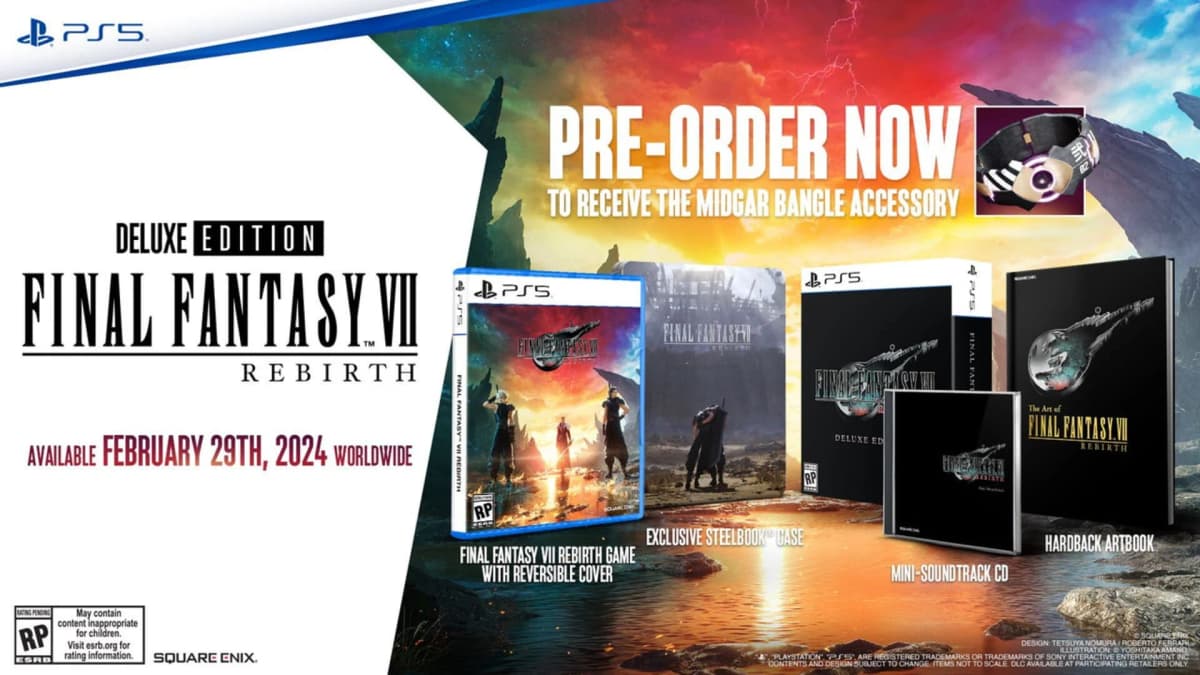
A trilogy whose American player base is 77% aged 30 or older has a succession problem. That is the hard truth sitting underneath the celebration around Final Fantasy VII Rebirth. Circana analyst Mat Piscatella’s figures, shared in March, put 62% of the game’s US players at 35 or older. Those players matter. They are the people who carried decades of affection for this story into Square Enix’s giant, expensive remake project. They also cannot be the whole plan.
I love that Rebirth takes its world seriously enough to be huge, strange, emotional, and occasionally gloriously indulgent. A proper Final Fantasy should have room to breathe. It should let a character moment linger instead of sprinting to the next explosion. But Square Enix has confused “respecting longtime fans” with “making the door look heavy.” Younger players are being asked to enter a story with decades of cultural baggage, a previous chapter hanging over it, complicated systems, a 16+ rating in some markets, and a looming final installment that risks feeling reserved for people who already know the rules.
That is a terrible way to grow a generation of Final Fantasy fans.
Table of Contents (7)
The Legacy Audience Is a Foundation, Not a Future
The 77% figure should make Square Enix nervous, even if it also flatters the company’s ability to hold onto its established audience. A remake trilogy built mainly around players over 30 can generate enormous enthusiasm and still leave the brand exposed. The audience that remembers the earlier version of this story is finite. Every year that passes makes the emotional shorthand of this project less automatic for the people Square Enix needs next.
Long development cycles make that problem worse. A younger player who saw Final Fantasy VII Rebirth as an intimidating “Part Two” in 2024 may see the final chapter as an even more intimidating conclusion in 2027. By then, the conversation has accumulated more lore, more assumed knowledge, more fan arguments, and more pressure to experience the trilogy in the correct order. That pressure kills curiosity before a newcomer even reaches the first menu.
I do not buy the lazy argument that younger players lack the patience for a big role-playing game. They have patience for games that make their investment feel worthwhile. They will learn dense combat systems when the game teaches those systems with confidence. They will follow a long narrative when the story gives them a reason to care right now. What they will reject is homework disguised as an invitation.
Rebirth has to stop feeling like the middle chapter that young players need permission to touch. Square Enix needs to sell it as a complete, exciting place to begin.
“Standalone” Means Nothing If the Game Still Feels Like a Sequel Exam
Square Enix has made a real effort to position Final Fantasy VII Rebirth as playable without prior knowledge of Final Fantasy VII Remake. That matters. It should matter more than it currently does. The problem is perception: players see a giant, prestigious remake trilogy and naturally assume they are arriving late.
The word “Rebirth” carries dramatic weight for longtime fans, but it carries no practical promise for someone who has never entered this version of the world. A new player does not need a lecture about why the trilogy structure is clever. They need to know that the game will orient them, teach them, and give them an emotional stake without punishing them for missing a previous release.
That means Square Enix has to make onboarding visible everywhere the game is sold. Platform pages need to state plainly that newcomers can start here. The opening hours need to establish character relationships with clarity rather than treating every returning face as a reward for veterans. Story recaps need to be easy to find, easy to understand, and free of the smug “you had to be there” energy that franchises love to cultivate.
A trilogy can reward history without making history a toll booth. Square Enix has the tools. It needs the nerve to use them aggressively.
Head Start Mode Is a Shortcut for Veterans, Not a Welcome Mat
The new Streamlined Progression and Head Start options show that Square Enix understands the friction problem. That is the good news. The bad news is that a Level 65 starting point in a game with a Level 70 cap, backed by effectively unlimited resources, is the wrong answer for a genuinely new player.
Head Start mode is fantastic for a returning player who wants to focus on the final stretch, replay key scenes, or skip a familiar grind. I have zero issue with that. Veteran-friendly options are healthy, and forcing every returning player through the same progression wall would be petty design. But handing a newcomer an almost endgame-ready character risks turning accessibility into pure confusion.
A new player entering at Level 65 has more numbers, more choices, more resources, and more reasons to feel lost. They have skipped the gradual process that teaches why progression exists in the first place. They have been given a pile of power without the vocabulary to understand it. That is not empowerment. That is being dropped into the middle of a technical manual with the last page already open.
Streamlined Progression has the better instinct. Reduce busywork. Cut the dead air. Let players reach the emotional and mechanical fun faster. But the mode should guide newcomers through the game’s systems in clean stages rather than bulldozing those systems out of the way. Young players do not need to be protected from complexity. They need complexity presented with readable goals, a sensible pace, and room to experiment without feeling punished.
Square Enix should label Head Start for what it is: a returning-player convenience. Then it should build the newcomer route with equal care.
The USK 16 Rating Creates a Real Ceiling
There is also a limit that marketing cannot wish away. In markets where Final Fantasy VII Rebirth carries a USK 16 rating, under-16 players face a clear barrier. No amount of cheerful social media copy transforms a 16+ game into a product aimed directly at 12-year-olds. Pretending otherwise would be cynical.
That does not mean Square Enix should abandon younger audiences. It means the company needs to think more clearly about what “younger” means. Older teens and players in their twenties are the immediate audience the trilogy must win before they become another missing generation for Final Fantasy. At the same time, the franchise needs to create a healthy path for younger fans to become curious about its world, its characters, and its storytelling without being pushed past an age rating.
Clear content information, accessible story introductions, and platform-specific onboarding are useful because they reduce uncertainty for families and new players. They do not erase the rating. They make the experience easier to understand for the people who are eligible to play it and the people deciding whether it belongs in their household.
That distinction matters. A 16+ rating is a boundary. A confusing, legacy-heavy first impression is a design failure. Square Enix can solve the second problem immediately.
More Platforms Help, but Access Has to Mean More Than Availability
Final Fantasy VII Revelation is set for spring 2027 on PC, PlayStation 5, Xbox Series X/S, and Nintendo Switch 2. That platform spread is exactly the kind of move the trilogy needs. Keeping the conclusion confined to one corner of the hardware market would have been self-defeating. A wider release puts Final Fantasy in front of people who never bought into the earlier platform strategy.
But a new storefront does not create a new audience by itself. A player can finally see the final chapter on their preferred system and still conclude that they missed the train years ago. The trilogy’s last act has to communicate the opposite: this is a major event with a clear route in, clear story support, and systems that respect someone learning the language for the first time.
Square Enix should treat every new platform as a fresh introduction, not as another shelf for an old fanbase. That means different onboarding, direct explanations of where new players can start, and a deliberate effort to lower the anxiety surrounding trilogy continuity.
Square Enix Needs to Make the Next Chapter Feel Comfortable to Enter
There is a design lesson here that reaches beyond menus and difficulty settings. Big-budget games often mistake friction for depth. They bury the player under icons, alerts, quest markers, dense terminology, and an endless stream of systems demanding attention. Then they act surprised when someone younger decides the whole thing looks exhausting.
I value games that can make a player feel oriented without treating the screen like an airport departure board. I value relaxed comfort in a huge world: enough direction to prevent frustration, enough space to explore, and enough restraint that every moment does not feel like an assignment. That feeling of ease is not shallow design. It is the difference between a player settling into a world and bouncing off it after an hour.
For the final chapter, Square Enix should commit to a few blunt principles:
- Market the final game as an entry point with context, rather than as a reward reserved for players who completed every prior step.
- Use Streamlined Progression to teach cleanly, with readable systems and a progression pace that lets newcomers understand their own growth.
- Keep Head Start mode focused on returning players, where its extreme boost makes practical sense.
- Communicate age ratings honestly, while giving eligible younger players and families straightforward information about the experience.
- Build platform onboarding around first-time players, especially as the trilogy expands across PC, PlayStation 5, Xbox Series X/S, and Nintendo Switch 2.
Part 3 Cannot Be a Reunion That Accidentally Locks Everyone Else Out
The Final Fantasy VII remake trilogy deserves its longtime audience. Those players kept the emotional charge of this world alive for decades, and Square Enix would be foolish to flatten the story into a generic product for the sake of chasing a demographic chart. But loyalty becomes a trap when every major decision assumes the player already understands why this journey matters.
The 77% over-30 statistic is not proof that Rebirth failed. It is proof that Square Enix has a narrowing window. The company has already done the difficult creative work of rebuilding a beloved world for a modern audience. It cannot let continuity anxiety, messy onboarding, and a misplaced reliance on Level 65 shortcuts turn the trilogy’s climax into a private celebration for people who were there at the beginning.
Final Fantasy needs younger players who feel invited into the story now. If Square Enix treats them as late arrivals, the trilogy will finish as a beautifully expensive closed loop around its oldest fans.
FinalBoss // Gear
Level up your setup
01Top-rated gaming headsetson Amazon→02High-refresh gaming monitorson Amazon→03Gaming chairson Amazon→04Discounted game keyson Kinguin→Affiliate links · As an Amazon Associate, FinalBoss earns from qualifying purchases.
Want to Level Up Your Gaming?
Get access to exclusive strategies, hidden tips, and pro-level insights that we don't share publicly.
Ultimate Gaming Strategy Guide + Weekly Pro Tips